
Agentic AI vs. Traditional Chatbots: Why Customer Service Is Shifting Beyond Chatbot
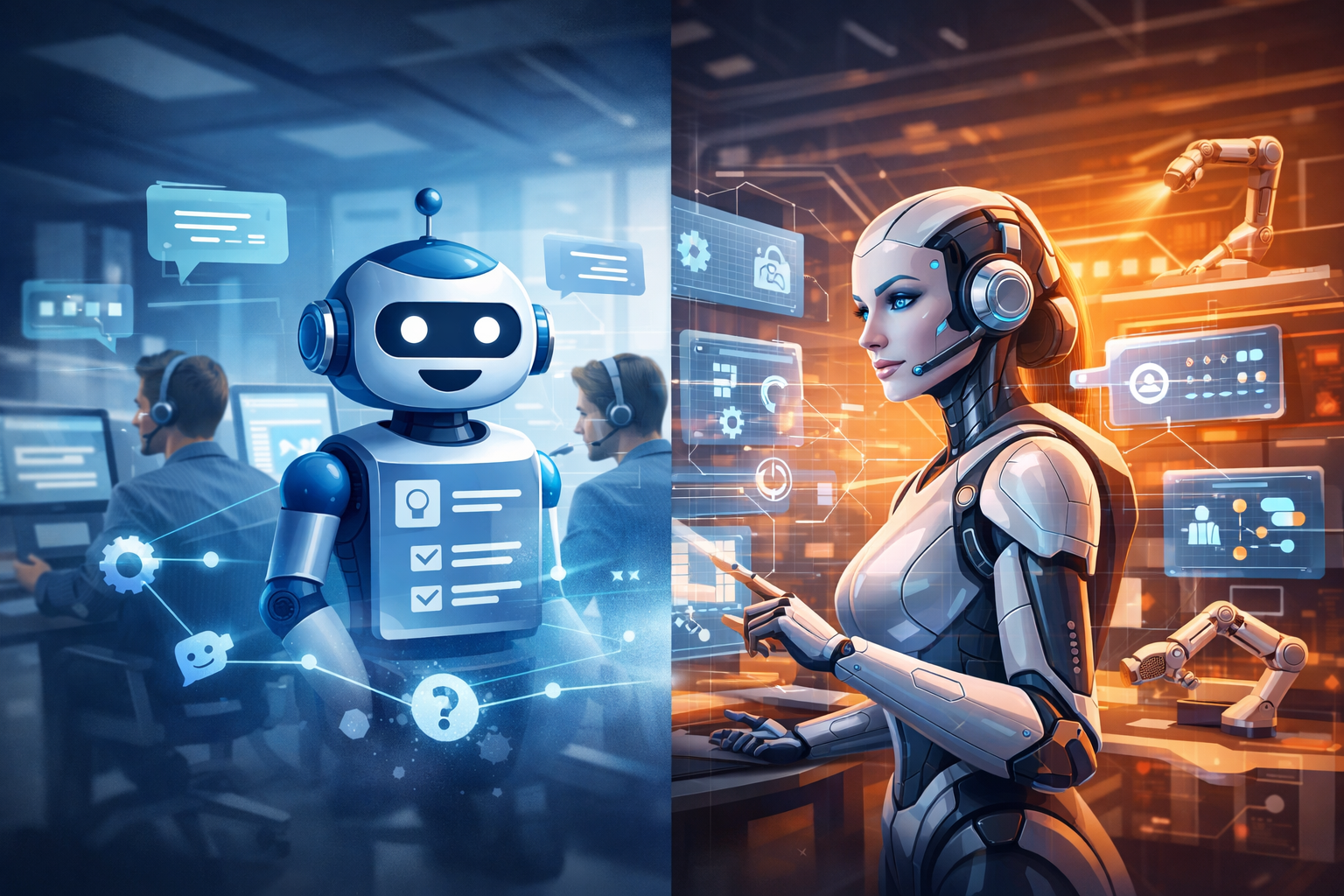
Customer service has evolved fundamentally over the past 10 years. It used to depend on phone calls and emails. Today, it is increasingly driven by automation, AI-powered tools, and always-on digital experiences. Platforms like Zendesk AI have been playing a major role in this transformation for countless teams, enabling agents to respond more quickly as well as manage the rising number of tickets they must deal with.
But as expectations continue to rise, faster responses alone are no longer enough. Customers need their problems to be solved, not just acknowledged. At the same time, support leaders are under pressure to lower costs while maintaining quality. This tension has driven teams to look beyond traditional chatbots and AI-assisted tools toward a newer model: Aissist.io.
This is where the comparison between traditional chatbots, AI-assisted support, and agentic AI becomes critical. Understanding that difference explains why customer service organizations are beginning to move beyond assistance-based automation toward systems capable of owning outcomes end to end.
How Traditional Chatbots Changed Customer Service
Short answer: Traditional chatbots facilitate scalable responses, but they were never designed to own full resolutions.
Early chatbots were a big deal. They could answer frequently asked questions, prevent duplicate tickets, and deliver instant responses 24/7. Support teams with products that utilize chatbots, including Zendesk AI, alleviate pressure from agents by automating simple conversations such as checking order status or helping with password resets.
Typical chatbot strengths include:
- Answering commonly asked questions
- Educating users through simple and predefined flows
- Collecting information before handing off data to staff
- Reducing first-response time
However, these systems depend heavily on predefined rules, decision trees, or scripted logic. When a customer inquiry falls outside those parameters, the chatbot needs to escalate the request to a human. As a result, chatbots enhance efficiency at the surface level, but they rarely complete end-to-end support tasks.
Why Traditional AI Still Depends on Human Agents
Short answer: Most AI in support is designed to assist humans, not replace manual workflows.
Zendesk AI and other tools layer intelligence onto agent workflows. They assist in categorizing tickets, recommending replies, producing conversation summaries, and routing issues better. There is no denying that these features greatly increase productivity, particularly for agent-led teams.
But even with AI assistance, human agents are still responsible for:
- Cross-checking customer identity
- Triggering backend actions
- Updating internal systems
- Coordinating across tools
- Closing issues completely
In practice, this means automation tends to plateau. Once a workflow requires system access, judgment, or multiple steps across tools, traditional AI steps aside and waits for a human. This limitation is exactly where agentic AI enters the picture.
Image Alt Text
Human support agents working alongside AI systems in a modern customer service environment.
Image Description
Image showing customer service agents collaborating with AI tools inside a modern support center, showing how human decision-making and AI assistance work together in complex workflows.
What Makes Agentic AI Different From Traditional AI?
Short answer: Agentic AI is intended to think, act, and get things done on its own.
Agentic AI is not an enhancement layer for agents. It is a fundamentally different approach to automation. Instead of responding within predefined boundaries, agentic systems are built to understand goals, plan steps, and execute procedures across multiple systems.
Aissist.io is one example. It is an Agentic AI platform that deploys Digital Employees to automate sales and customer service with higher performance and lower cost. These Digital Employees operate more like teammates than tools.
Platforms like Aissist.io maintain 83% average automation, and can reach up to 98% in mature deployments.
Key differences include:
- Reasoning around goals, not just classifying intent
- Executing multi-step procedures
- Operating across systems and tools
- Completing tasks end-to-end without constant human intervention
This shift changes what automation means in customer service.

Why the Focus Has Shifted From AI Agents to Agentic Workflows
Short answer: Individual AI actions do not scale, but autonomous workflows do.
Previous AI agents were designed to handle a narrow task: answering a question, suggesting a reply, or summarizing a ticket. Despite being helpful, these measures left much of the job undone.
Agentic workflows take a broader view. They focus on outcomes, not interactions. Instead of assisting at individual steps, agentic systems are responsible for completing entire procedures from the resolution request. This new model enables automation to scale further even when workflows are complex, in a way that traditional assistance-based automation fails to do.
Traditional Chatbots vs Agentic AI: A Practical Comparison
Traditional chatbot-based systems:
- Rely on rules or predefined flows
- Handle simple interactions well
- Escalate complex cases to humans
- Improve speed, not ownership
- Require ongoing agent involvement
Agentic AI platforms:
- Reason dynamically based on goals
- Execute tasks across multiple systems
- Own full procedures from start to finish
- Increase automation as complexity grows
- Reduce dependency on human agents
This difference explains why customer service teams looking for deeper automation are shifting away from conversation-layer AI.
How Pricing Models Reinforce the Shift
Short answer: Pricing built for assistance does not fit autonomous execution.
Traditional support platforms, including Zendesk AI, typically price around:
- Per-agent seats
- Conversation or usage volume
- Paid AI add-ons
As automation increases, costs often rise alongside engagement. Zendesk AI pricing starts at $55 per agent per month (Suite Team) and goes up to $169 (Suite Enterprise), with optional AI add-ons around $50 per agent per month. The platform mainly assists humans, requiring agents to complete most tasks.
Pricing is different for agentic AI platforms. Being a tool that allows businesses to automate work, AI correlates more closely with usage and results than staff numbers. According to Aissist.io, a free tier that includes up to 3,000 interactions per month is available and paid plans charge based on usage (starting at around $0.09 per interaction, with lower rates at higher volumes). There are no mandatory agent licenses, and costs do not automatically rise as customer engagement increases.
This model supports higher automation without penalizing growth.

Why Conversation-Based Automation Breaks at Scale
Short answer: Conversations are not the same as completed work.
When AI only assists humans, measuring value by interactions makes sense. But when AI can verify users, update records, trigger workflows, and resolve issues independently, the meaningful measure becomes the completed resolution.
Agentic AI platforms are built around this idea. By focusing on ownership rather than assistance, they can achieve significantly higher automation rates. In mature deployments, platforms like Aissist.io report average automation levels around 83%, with some environments reaching up to 98%. At that level, cost efficiency improves as automation increases instead of flattening out.
What Is the Best AI Tool for Customer Service?
Short answer: It depends on whether your goal is assistance or autonomy.
For teams centered on human-led support, platforms like Zendesk AI remain a strong choice. They help agents work faster and manage higher volumes more effectively.
For companies looking to decrease the manual burden, automate entire processes, and manage costs as they grow, agentic AI platforms represent a different value system. Leveraging Digital Employees who can think, act, and complete tasks is what platforms such as Aissist.io use to move beyond chatbots to fully operational automation in customer service.
Image Alt Text
Professional evaluating AI tools for customer service on futuristic digital screens.
Image Description
Image showing a business professional studying holographic panels displaying different AI tools in a modern office, comparing features of chatbots, Zendesk AI, and autonomous automation.
Frequently Asked Questions
-
What makes agentic AI different from traditional AI? Agentic AI is intended not just to help with tasks, but to do them for you. Where traditional AI enables agents to respond faster or route tickets better, agentic AI can reason through goals, take multi-step action, and address problems end-to-end without human intervention at every step.
-
Why has the focus shifted from AI agents to agentic workflows? Single AI actions do not scale effectively when workflows become complex. Agentic workflows focus on completing the entire process rather than handling isolated steps, which allows automation to grow alongside business complexity instead of stalling.
-
What is the difference between agentic AI and chatbots? Most chatbots are based on rules or flows and process predefined interactions. Agentic AI functions more as a digital teammate that is capable of reasoning, learning, accessing systems, and completing entire tasks across tools, rather than relying on inflexible scripts.
-
How are chatbots changing customer service? Chatbots have increased the speed and availability of response, especially when dealing with basic questions. But most still rely on human agents to complete difficult tasks, which limits how much operational effort they can truly replace.
-
What is the best AI tool for customer service? There is not one best tool for every team. For productivity, agent-led support models do well on platforms like Zendesk AI. If your team is looking to automate an entire workflow, eliminate manual work, and scale without exponentially increasing costs, agentic AI platforms will serve you best.
Traditional Chatbots vs Agentic AI: Summary Comparison
| Aspect | Traditional Chatbots / AI Assistants | Agentic AI Platforms |
|---|---|---|
| Primary role | Assist human agents | Own and complete tasks |
| Automation scope | Partial, interaction-level | End-to-end procedures |
| Decision-making | Rule-based or limited AI | Goal-driven reasoning |
| Human dependency | High | Significantly reduced |
| Workflow execution | Requires agent intervention | Executes autonomously |
| Scalability | Plateaus as complexity grows | Improves with maturity |
| Pricing alignment | Seats, conversations, add-ons | Usage and completed work |
| Best suited for | Agent-centric support teams | Automation-first organizations |
Final Thoughts: Why Customer Service Is Moving Beyond Chatbots
Customer service is no longer just about replying to questions fast. It is more about resolving issues fully, consistently, and at scale. Traditional chatbots and AI-assisted tools laid the foundation. But as expectations rise and complexity grows, their limitations become clearer.
Agentic AI represents the next step, not by improving replies, but by taking ownership of the work itself. For modern support teams evaluating life beyond Zendesk AI, this shift is not just technological. It is structural, operational, and economic. And that is why the future of customer service is moving beyond chatbots toward agentic workflows.