
Intercom Fin vs Aissist.io: Features, Automation Depth, and Pricing Models Compared
Meta description: Compare Intercom Fin vs Aissist.io on features, automation depth, and pricing. Learn which AI fits your needs and when agentic AI becomes necessary.
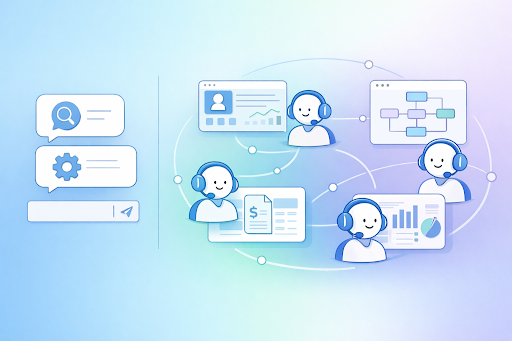
Intercom Fin and Aissist.io are often evaluated together because both use AI in customer service, but they solve fundamentally different problems. Fin is designed to resolve conversations inside Intercom, while Aissist.io is designed to execute complete business procedures across systems using Agentic AI Digital Agents.
As AI adoption accelerates across customer service teams, many organizations are discovering that not all "AI support tools" operate at the same layer of work. Some platforms focus on improving how conversations are handled, while others focus on automating what actually happens after a customer asks for help. Intercom Fin and Aissist.io both fall under the broad label of "AI for support," but they are built for different outcomes.
Intercom operates as an engagement layer for managing conversations and tickets at scale. Fin extends that layer by using AI to automate replies, deflect tickets, and reduce inbox workload. Aissist.io, by contrast, operates as an execution layer. It deploys Digital Agents that own end-to-end procedures, reason through multi-step workflows, interact with backend systems, and complete outcomes such as refunds, account changes, or service provisioning.
This difference matters because many teams now need to automate more than just replies. As ticket volumes grow and costs rise, the real problem is often not answering questions, but completing the work those questions trigger across billing systems, CRMs, and internal tools.
That is why buyers are moving from asking "Which AI gives better answers?" to "Which AI actually finishes the job?" In this blog, we compare Intercom Fin and Aissist.io to show where each one fits, when Fin is enough, and when a deeper automation layer becomes necessary.
What problems does Intercom Fin solve?
Intercom Fin is built to handle customer conversations inside Intercom using AI. Its main job is to answer questions, deflect tickets, and reduce how often a human agent needs to step in.
Fin works entirely within the Intercom helpdesk. It reads incoming messages, pulls information from approved knowledge sources, and generates replies that aim to solve the issue without escalating to a human. It learns from things like help center articles, internal docs, PDFs, and web pages, all managed in a central content library. This lets it answer common questions about billing, product usage, or account policies using the same material human agents rely on.
Intercom measures Fin's success at the conversation level. Metrics like resolution rate, involvement rate, and CX score are used to track how many conversations Fin can handle on its own and how well customers respond to those interactions. This makes Fin most useful in teams where the main goal is inbox efficiency rather than completing backend work.
Fin also includes controls for how it behaves. Teams can adjust tone, set escalation rules, and decide when Fin should hand off to a human, such as when it gets confused or when a customer asks for an agent. What's important is that Fin's automation stops at the conversation layer. Even with features like procedures and branching logic, it doesn't own full business processes. It won't issue refunds, update account records, or carry out multi-step actions across systems.
In practice, that means Fin can explain what to do or guide a customer through steps, but it can't actually complete the work itself. When real operational action is needed, the conversation has to be handed off to a human or another automation tool. That's both Fin's strength and its limit: it's great at handling conversations, but it isn't built to finish the underlying work.
What problems does Aissist.io solve?
Aissist.io deploys Agentic AI Digital Agents that execute complete business procedures across sales and service. It is designed to have multi-step workflows, interact with backend systems, and complete outcomes rather than just respond to messages.
Aissist.io positions itself as a "Full-Suite Digital Workforce" rather than a conversational AI layer. Its architecture is built around a Multi-Agent Platform designed to handle procedures and standard operating processes, not just individual messages. Each Digital Employee is intended to function like a human teammate, capable of reasoning through tasks, planning next steps, and coordinating actions across multiple systems.
Unlike tools that focus primarily on answering questions, Aissist is built to take responsibility for end-to-end task ownership. Its Digital Employees can interact with APIs, databases, CRMs, billing platforms, and internal tools to complete workflows such as account updates, service provisioning, ticket lifecycle management, and data reconciliation. When a process requires human review, Aissist can escalate at defined checkpoints rather than defaulting to immediate handoff.
This procedural orientation is what differentiates Aissist from conversation-first AI agents. Rather than optimizing for resolution inside a helpdesk inbox, Aissist is optimized for execution across operational systems. The result is an AI layer designed not just to assist human agents, but to complete work autonomously within defined governance boundaries.
Check out our case study about how Holafly use Aissist.io automated 100% sales and resolved 75% of service.
How deep is the automation in Fin vs Aissist.io?
At a high level, the difference between Intercom Fin and Aissist.io comes down to ownership. Fin automates responses within conversations and hands off when real work begins. Aissist.io automates entire procedures from start to completion. One reduces inbox workload; the other reduces total operational work. This distinction explains why Fin fits teams focused on conversational efficiency, while Aissist.io fits teams that need outcomes completed across backend systems at scale.
Table 1: Automation Depth Comparison
| Dimension | Intercom Fin | Aissist.io |
|---|---|---|
| Core function | Resolve conversations inside Intercom | Execute end-to-end business procedures |
| Level of reasoning | Conversational, retrieval-based | Procedural, multi-step planning |
| Task ownership | Partial (conversation-level) | Full (outcome-level) |
| Multi-step workflow support | Limited to inbox procedures | Native SOP-driven procedures |
| System interaction | Via connectors and guided flows | Direct API, CRM, billing, and database actions |
| Escalation dependency | High for backend tasks | Checkpoint-based, not default |
| Completion rate focus | Conversation resolution rate | End-to-end task completion |
Fin vs Aissist: Difference at a capability level
Fin and Aissist.io differ less in surface features and more in underlying capability layers. Fin is optimized for conversational resolution, while Aissist.io is optimized for procedural execution.
Rather than listing product features in isolation, the more useful comparison is to look at capability categories, meaning what each system can reason about, what it can execute, and how much ownership it has over real work.
Reasoning ability
Intercom Fin uses a retrieval-based reasoning model. When a customer message arrives, Fin refines the query, retrieves relevant content from approved sources, and generates a response grounded in that material. Its reasoning is optimized for interpreting intent and selecting the best conversational answer, not for planning multi-step operational workflows.
Aissist.io uses procedural reasoning designed for task execution. Its Digital Employees evaluate the current state of a workflow, plan next steps, and sequence actions across systems. Instead of stopping at "what should I say next," Aissist reasons about "what should happen next" in a multi-step process.
Task execution
Fin's execution capability is intentionally limited. It can guide users through processes, validate conditions using branching logic, and trigger predefined procedures inside the Intercom environment. However, it does not independently carry out backend actions from start to finish.
Aissist is designed to execute tasks directly. Its Digital Employees can interact with APIs, databases, CRMs, billing systems, and internal tools to complete workflows such as account updates, provisioning, and record changes. Execution is a core function, not an add-on.
Multi-agent coordination
Fin operates as a single conversational agent with governance rules controlling tone, escalation, and content priorities. While it can follow structured procedures, it does not coordinate multiple specialized agents behind the scenes.
Aissist operates as a coordinated system of sub-agents. Each sub-agent can be optimized for a specific role, such as data retrieval, validation, or system interaction. These agents collaborate to complete complex procedures that would otherwise require multiple human handoffs.
System interaction
Fin interacts with external systems through connectors and guided flows. These integrations support validation steps and limited automation but remain anchored to the conversational context of the inbox.
Aissist is built for direct system interaction. It connects to APIs, CRMs, ERPs, billing platforms, and internal tools to execute changes in real time. System connectivity is treated as a first-class capability rather than a supporting feature.
Learning and adaptation
Intercom emphasizes content management and performance monitoring. Teams tune Fin's behavior by updating knowledge sources, adjusting guidance rules, and tracking metrics such as resolution rate and CX score.
Aissist emphasizes workflow optimization and procedural reliability. While it publicly claims continuous improvement, the exact technical mechanisms for learning and adaptation are not fully detailed. What is clear is that optimization is framed around improving execution outcomes, not just response quality.
Governance and auditability
Fin includes escalation rules, simulations, and compliance controls designed to prevent incorrect responses and enforce safe handoff to human agents. Its governance model is oriented around conversation reliability and brand safety.
Aissist includes a governance layer focused on procedural execution. It emphasizes quality checks, hallucination prevention, smart escalation, and enterprise security controls. Governance is treated as a core requirement because Digital Employees execute real actions across systems.
Table 2: Feature-Level Capability Comparison
| Capability dimension | Intercom Fin | Aissist.io |
|---|---|---|
| Reasoning ability | Retrieval-based, conversational | Procedural, multi-step planning |
| Task execution | Guided, inbox-scoped | Direct execution across systems |
| Multi-agent coordination | Single-agent with escalation rules | Native multi-agent orchestration |
| System interaction | Via connectors and guided flows | Direct API, CRM, billing, and database actions |
| Learning and adaptation | Content tuning, guidance controls, performance KPIs | Workflow optimization (mechanism not publicly detailed) |
| Governance and auditability | Escalation rules, simulations, compliance controls | Governance layer, quality checks, escalation checkpoints |
| Deployment model | Embedded in Intercom helpdesk | Standalone execution layer + helpdesk integrations |
Intercom Fin pricing vs Aissist.io pricing models
Intercom Fin uses a per-resolution pricing model, while Aissist.io follows a digital employee and enterprise automation model. The difference affects cost predictability and long-term scaling economics.
Intercom Fin pricing
Intercom prices Fin based on how many customer conversations it resolves without human involvement. Each resolution represents a successfully handled interaction across chat or email. To use Fin, teams also need an active Intercom plan, and helpdesk seats are priced separately.
As Fin resolves more conversations, total spend increases proportionally. This makes costs easy to forecast when inquiry volume is stable and workflows are simple. The model works best when most issues can be solved through answers alone, because the cost of each automated resolution closely reflects the operational savings from reduced inbox load.
It becomes less predictable when ticket volume grows or fluctuates, or when many conversations still require human follow-up for backend work. In those cases, teams may pay once for the AI resolution and again for the human labor that finishes the task.
Aissist.io pricing
Aissist.io approaches pricing differently. Rather than billing per conversation resolution, it follows a digital employee and enterprise automation model built around usage interactions and tiered engine capabilities.
Its pricing reflects a focus on executing procedures rather than answering messages. In practical terms, Fin's pricing aligns with inbox efficiency, while Aissist's pricing aligns with operational automation capacity. One charges for conversations handled. The other charges for procedures executed. For buyers, the key question is not which model is cheaper, but which model matches the type of work they are trying to automate at scale.
Aissist.io can be 40% - 70% cheaper than Intercom Fin. You can explore the full pricing details on the Aissist.io pricing page.
How do both platforms handle reliability and control?
Both platforms provide governance controls, but agentic AI systems require stronger oversight because they execute real actions across systems.
Intercom Fin governance
Intercom Fin focuses on conversational safety and reliability. It provides guidance rules, escalation thresholds, simulation testing, and performance dashboards to control tone, accuracy, and handoff behavior. Intercom also publicly lists compliance with standards such as SOC 2, ISO 27001, ISO 42001, HIPAA, and GDPR alignment. These controls reflect Fin's role as a system that must protect brand voice and response quality.
Aissist.io governance
Aissist.io approaches governance from a procedural execution perspective. Its Digital Employees use quality checks, hallucination prevention, smart escalation, and enterprise security controls. Aissist publicly states compliance with ISO 27001 and GDPR, alignment with SOC 2, and encryption for data at rest and in transit. Because it executes real actions, governance is treated as a core requirement rather than an optional layer.
Which platform should you choose?
The right choice depends on whether your team mainly needs conversational automation or end-to-end task execution. Fin is best for inbox efficiency. Aissist.io is best for owning outcomes across systems.
When Intercom Fin makes sense
Intercom Fin is a strong fit when most of your support workload is made up of repetitive questions, policy explanations, and basic product guidance. In these environments, issues can usually be resolved through knowledge-based answers without requiring backend changes.
Fin also works well when inbox efficiency is the main bottleneck. If the primary problem is response volume rather than operational complexity, conversational automation can deliver meaningful value. This is especially true for smaller teams or early-stage companies that are just beginning their automation journey.
Because Fin is centered on knowledge sources and guidance rules, it can be deployed quickly without redesigning backend systems or defining complex standard operating procedures. In short, Fin makes sense when you want faster replies, fewer tickets, and lower agent workload, not full process automation.
When Aissist.io becomes the better choice
Aissist.io becomes the better choice when customer requests regularly trigger backend actions, multi-step workflows, or cross-system updates. Examples include account changes, refunds, service provisioning, entitlement updates, and compliance-driven workflows.
It is also a stronger fit in high-volume environments. As ticket volume grows, the cost of per-resolution pricing and human follow-up labor can become a material operating expense. In these cases, automating only the conversation layer reduces surface workload but does not reduce total work volume. Procedural execution becomes the more meaningful optimization target.
Aissist.io is particularly well-suited for teams that need automation to own outcomes rather than just deflect interactions. When success is defined by whether a task is completed, not just whether a conversation is resolved, an execution-layer platform becomes a functional requirement.
Quick decision table
| Your situation | Best choice | Why it fits |
|---|---|---|
| FAQ-heavy, simple support workflows | Intercom Fin | Optimized for conversational resolution |
| Early-stage team just starting with AI | Intercom Fin | Fast setup, low procedural complexity |
| High-volume support with backend-heavy work | Aissist.io | Reduces total operational work, not just replies |
| Multi-step workflows across CRM, billing, and ops | Aissist.io | Built for end-to-end procedure execution |
| Compliance, audits, or SOP-driven processes | Aissist.io | Stronger governance for real actions |
| Cost pressure from human follow-up work | Aissist.io | Automation replaces work, not just messages |
Final decision
This is not a choice between better AI and worse AI. It is a choice between two automation models built for different layers of work.
Intercom Fin is an engagement-layer AI designed to resolve conversations. Aissist.io is an execution-layer platform designed to complete procedures.
For many teams, Aissist.io is not a replacement for Intercom. It is the next layer that sits alongside it, allowing Fin to handle conversational resolution while Digital Employees take ownership of the operational work that begins after the conversation ends.
The idea of blending human teams with Digital Employees rather than replacing them is explored further in this guide to building a hybrid AI-human support team.
FAQs
Q. Is Intercom Fin enough for customer support automation?
Intercom Fin is enough if your main goal is automating replies and reducing inbox volume. It is not designed to execute backend tasks or own multi-step workflows.
Q. What is the main difference between Intercom Fin and Aissist.io?
Intercom Fin focuses on resolving conversations, while Aissist.io focuses on executing complete procedures. The difference is not response quality, but ownership of outcomes.
Q. Does Aissist.io replace Intercom?
No. Aissist.io is designed to work alongside tools like Intercom by handling backend execution that starts after the conversation ends, not replacing the helpdesk.
Q. Which platform is better for high-volume support teams?
Aissist.io is better for high-volume teams with backend-heavy workflows because it reduces total operational work. Intercom Fin is better for inbox efficiency and conversational automation.