
Rep AI Reviews: What Support Teams Are Saying in 2026
Rep AI is built for ecommerce teams that want an AI assistant to handle repetitive shopper questions while also nudging conversations toward conversion. For stores buried under requests about order status, returns, sizing, and product details, that promise is attractive: fewer repetitive tickets for the team and more guided purchase decisions for shoppers.
Rep AI has become a recognizable Shopify-native option for support and sales teams in 2026. Reviews highlight its strong fit for ecommerce workflows, quick setup, and measurable revenue impact, but they also point to the usual limits around training quality, pricing, and the need for ongoing tuning.
Why Rep AI Feels Like Part of the Team
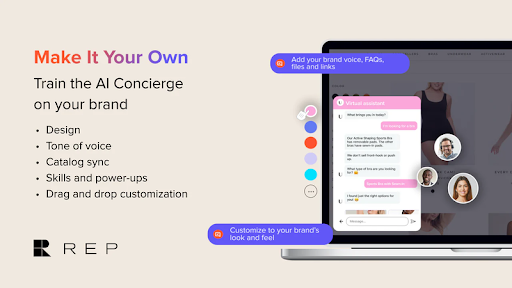
Rep AI is designed to fit directly into a Shopify workflow. It learns the product catalog, absorbs FAQ content, and responds in a way that aims to feel natural and brand-aligned instead of scripted.
Users often value it for three main reasons:
- It automates repetitive shopper conversations without forcing agents to step in on every ticket.
- It uses behavioral signals to identify hesitation and recommend products or fixes in the moment.
- It helps support teams spend more time on high-value conversations instead of answering the same questions repeatedly.
For ecommerce brands, that combination turns support from a cost center into something closer to guided selling.
Rep AI's Standout Features
Rep AI focuses on shopper-facing support and conversion workflows. Commonly cited capabilities include:
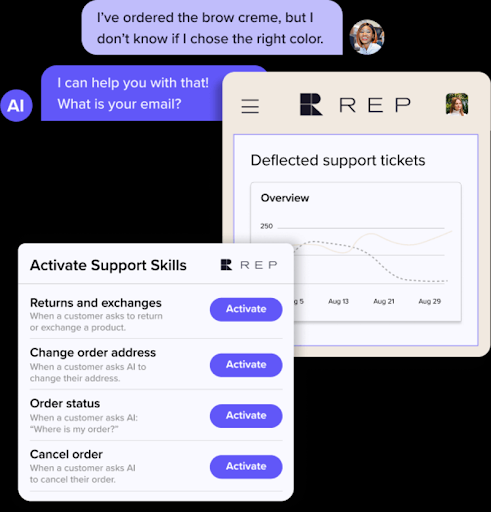
- Instant answers for order tracking, returns, and product questions
- Personalized recommendations that help reduce cart abandonment
- Human handoff when the conversation needs a live agent
- Analytics dashboards that surface top questions and revenue influence
- Fast Shopify setup without requiring engineering support
Pricing starts at a lower tier for smaller stores and scales with traffic, which makes it accessible for some teams but more debatable for others as usage grows.
Users also credit Rep AI with:
- Faster ROI through upsells and recovered sales
- Better support coverage during traffic spikes
- Integrations with tools such as Gorgias for broader support operations
- Multilingual shopper conversations

What Support Teams Like About Rep AI
Across review sites and user feedback, Rep AI is often described as strong at smoothing ecommerce customer journeys. Teams appreciate its mix of support automation and sales assistance, especially when they want one tool to answer product questions and guide shoppers toward purchase.
Recurring positives include:
- Quick time to value: Setup is typically described as straightforward for Shopify stores.
- Natural language experience: Users often say the conversations feel less robotic than older scripted bots.
- Revenue contribution: Teams value the combination of support deflection and upsell assistance.
- Useful analytics: Managers can review conversation trends and support-driven revenue signals.
- Strong ecommerce fit: Apparel, automotive, and other product-led brands report that it works well inside catalog-heavy storefronts.
Honest Rep AI Reviews: Common Drawbacks
Rep AI is not a perfect fit for every team. Most of the tradeoffs come from the quality of the underlying store data and the economics of scaling.
Common concerns include:
- Training quality matters: Weak FAQs or incomplete catalog data can lead to poor answers or hallucinations.
- Costs can rise: Smaller businesses may hesitate once traffic and usage move into higher tiers.
- Tone still needs tuning: Some users say responses can occasionally feel too bot-like before refinement.
- Performance depends on product data: The better the catalog and support content, the better the assistant performs.
Most of these issues are manageable, but they mean Rep AI is not a set-and-forget tool.
How Rep AI Stacks Up in Sales and Support
Rep AI stands out because it blends customer support and conversion support more directly than many generic chatbots. It is especially effective for inbound ecommerce conversations where shoppers need help choosing products, checking orders, or resolving common issues without waiting for a human.
Its strengths are clearest when the business priority is:
- Serving inbound shopper conversations
- Improving ecommerce conversion rates
- Deflecting repetitive support volume
- Keeping support available around the clock
Its limitations become clearer when a team needs broader outbound sales workflows, deeper multi-system automation, or support beyond an ecommerce-first environment.
Looking for Alternatives to Rep AI in 2026?
As support and sales teams expand beyond Shopify, some businesses start comparing Rep AI with alternatives that offer wider integrations, more flexible automation, or broader omnichannel support.
Rep AI remains a strong option for shopper chat, but other platforms may be a better fit if the goal is to automate across service and sales tools such as Zendesk or Intercom, or to support workflows that go beyond store conversations.
Aissist is one example of that broader category: an agentic AI platform aimed at teams that want workflow depth across multiple systems rather than a Shopify-first assistant alone.
| Pros | Cons |
|---|---|
| Strong Shopify-native setup | Performance depends heavily on FAQ and catalog quality |
| Helps with both support and conversion | Scaling costs may rise for growing stores |
| Fast setup for ecommerce teams | Some responses may still feel bot-like without tuning |
| Analytics connect chats to revenue outcomes | Best suited to inbound ecommerce use cases |
| Human handoff is available when needed | Less ideal for broader outbound or cross-system workflows |
FAQs
Is Rep AI mainly a support tool or a sales tool?
It is both, but with an ecommerce-first bias. It helps answer shopper questions while also guiding customers toward purchase decisions.
What kind of business benefits most from Rep AI?
Shopify stores and other ecommerce brands with large volumes of repetitive shopper conversations tend to get the most value from it.
Does Rep AI work well without strong FAQ content?
Not really. Like most AI assistants, it performs better when the underlying product data, FAQs, and support content are complete and accurate.
Why do some teams look for Rep AI alternatives?
Usually because they need broader integrations, more complex workflow automation, or support beyond inbound ecommerce chat.