

While chatbots reply, AgentMesh resolves.
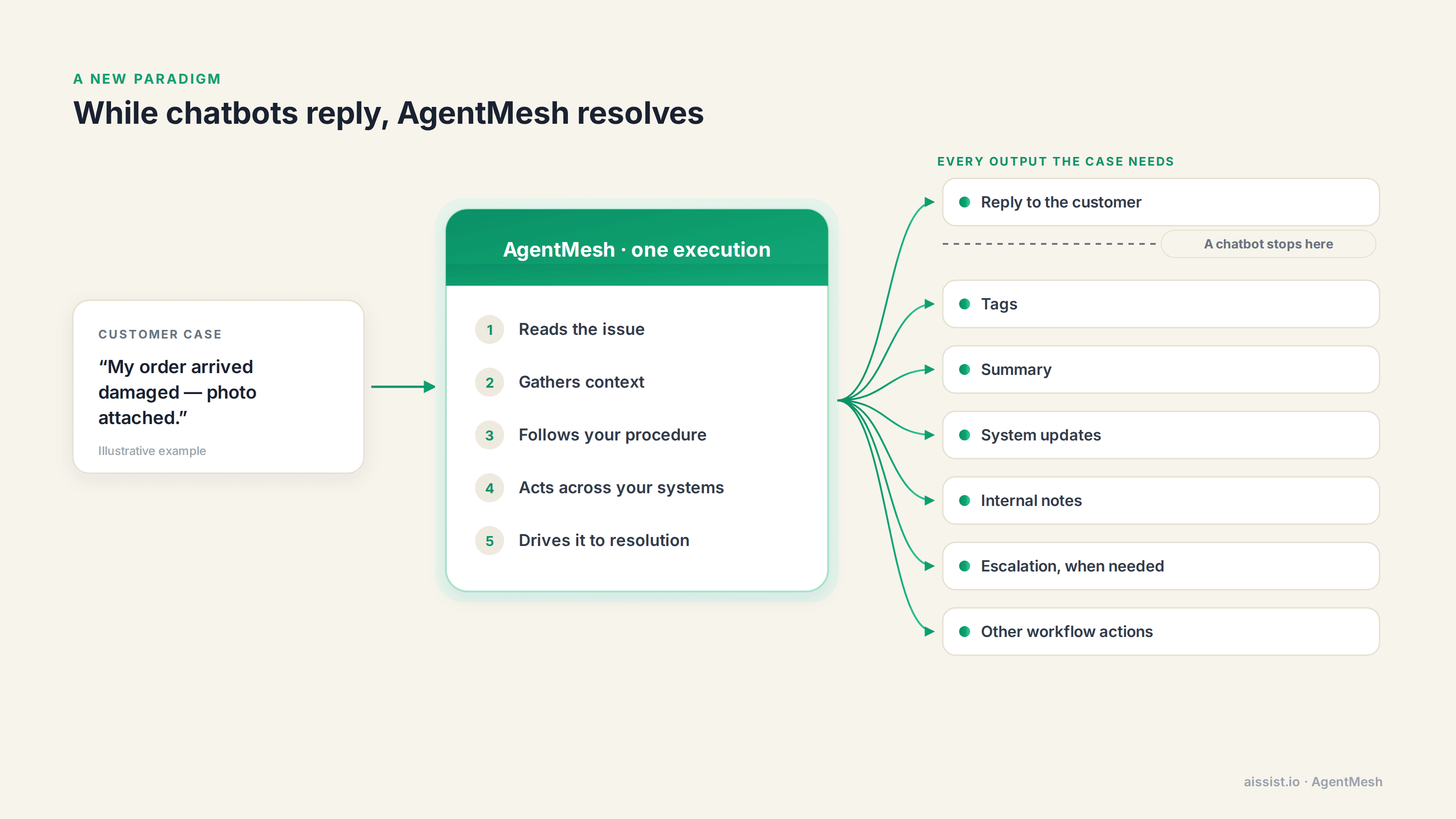
A chatbot stops at the reply. AgentMesh finishes the work: it reads the issue, gathers context, follows your procedure, acts across your systems, and drives the case to resolution.
It is deployed like a teammate, inside your workflow rather than beside it. AgentMesh monitors inboxes, picks up assignments, and acts on notes in the platforms your team already uses, so it is operational on day one.
It handles complex procedures and simple FAQs equally well — ambiguity, multi-step logic, policy-heavy operations, and cross-system tasks — without losing the plain, clear answer when that is all the customer needs.
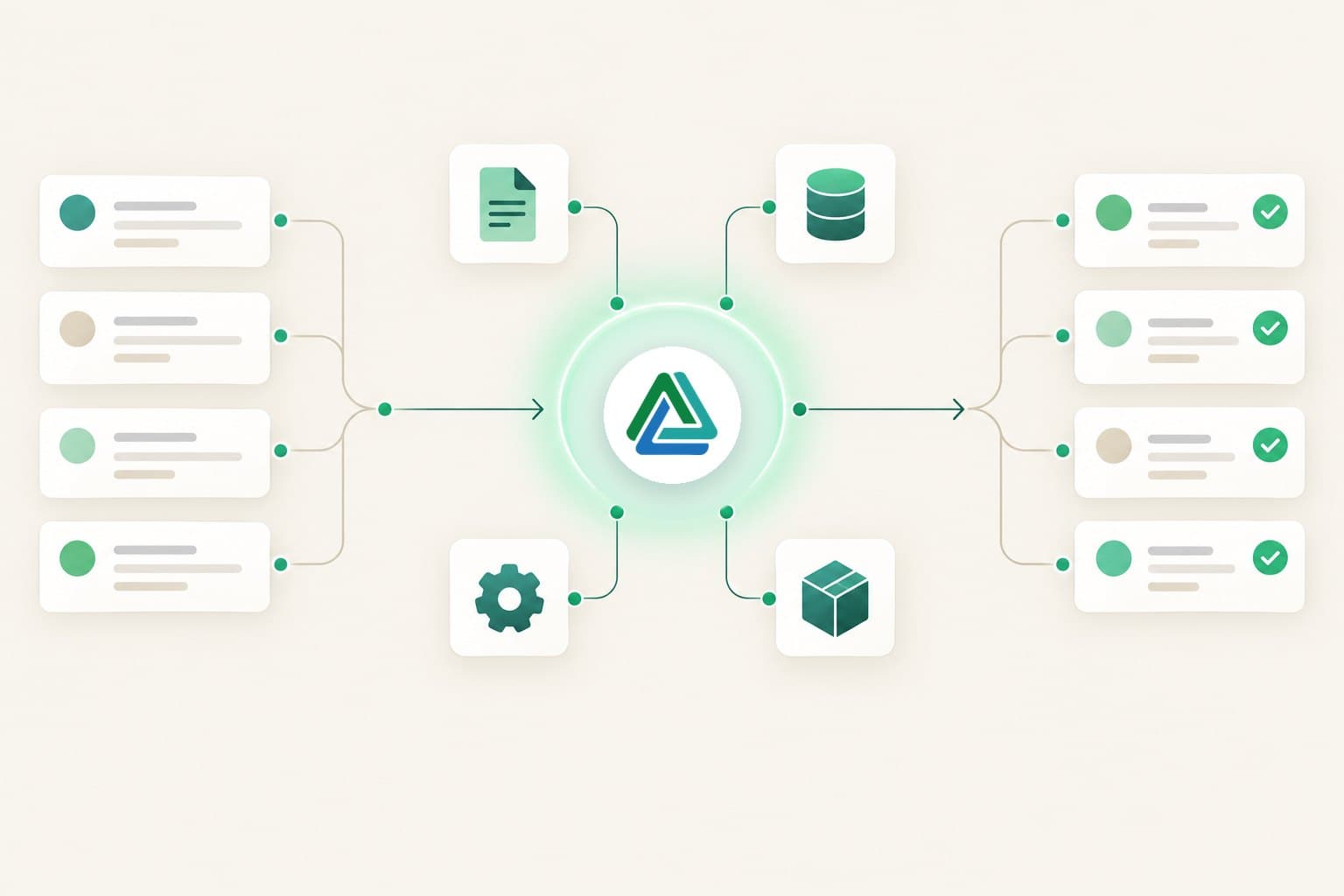
And one execution produces everything the business needs from a case: tags, the reply, summaries, system updates, notes, escalations, and other workflow actions.
| Category | AgentMesh | Chatbots |
|---|---|---|
| Outcome | Resolves end-to-end on questions, diagnosis and procedures | Responds to questions |
| Technology | Multi-Agent + Agentic AI | FAQ + RAG |
| Capability | Thrives on complexity and procedures | Breaks on complexity or procedures |
| Integration | Integrate from inside with your team and workflows | Integrate from outside |
| Output | Multi-tasks including tags, responses, analysis, summary, notes, updates, and more | Responses only |
How does AgentMesh work?
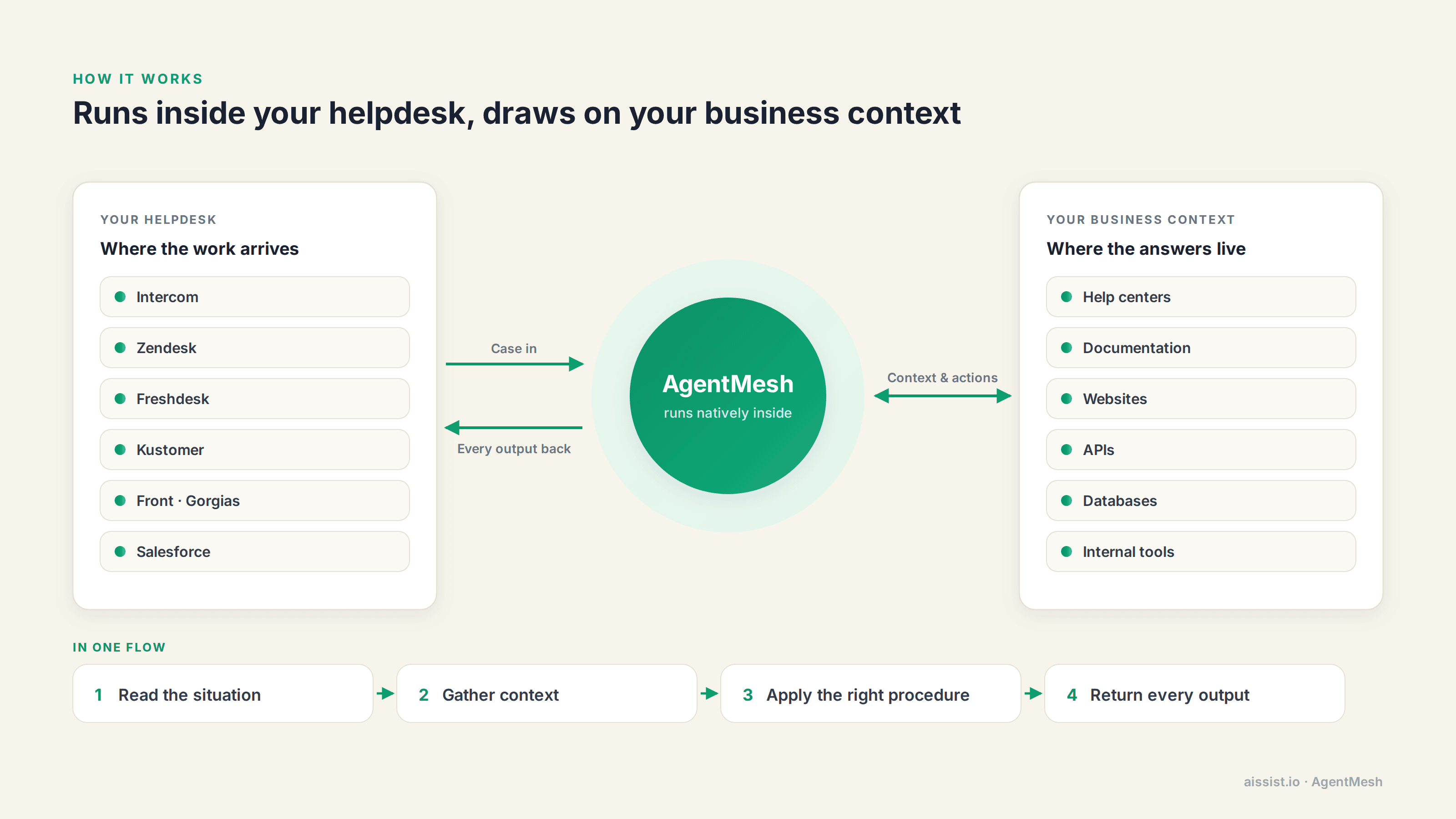
AgentMesh runs natively inside the stack you already have: Intercom, Zendesk, Freshdesk, Kustomer, Front, Gorgias, Salesforce, and the other platforms that run your customer operation.
It also connects to the systems that hold your business context — help centers, documentation, websites, APIs, databases, and internal tools. That is what lets it work like an operator rather than a detached assistant.
In one flow it reads the situation, gathers context, applies the right procedure, and returns every required output: the response, and the operational aftermath around it.
- Intercom
- Zendesk
- Freshdesk
- Kustomer
- Front
- Gorgias
- Salesforce
- Help centers
- Documentation
- Websites
- APIs
- Databases
How is the performance of AgentMesh measured?
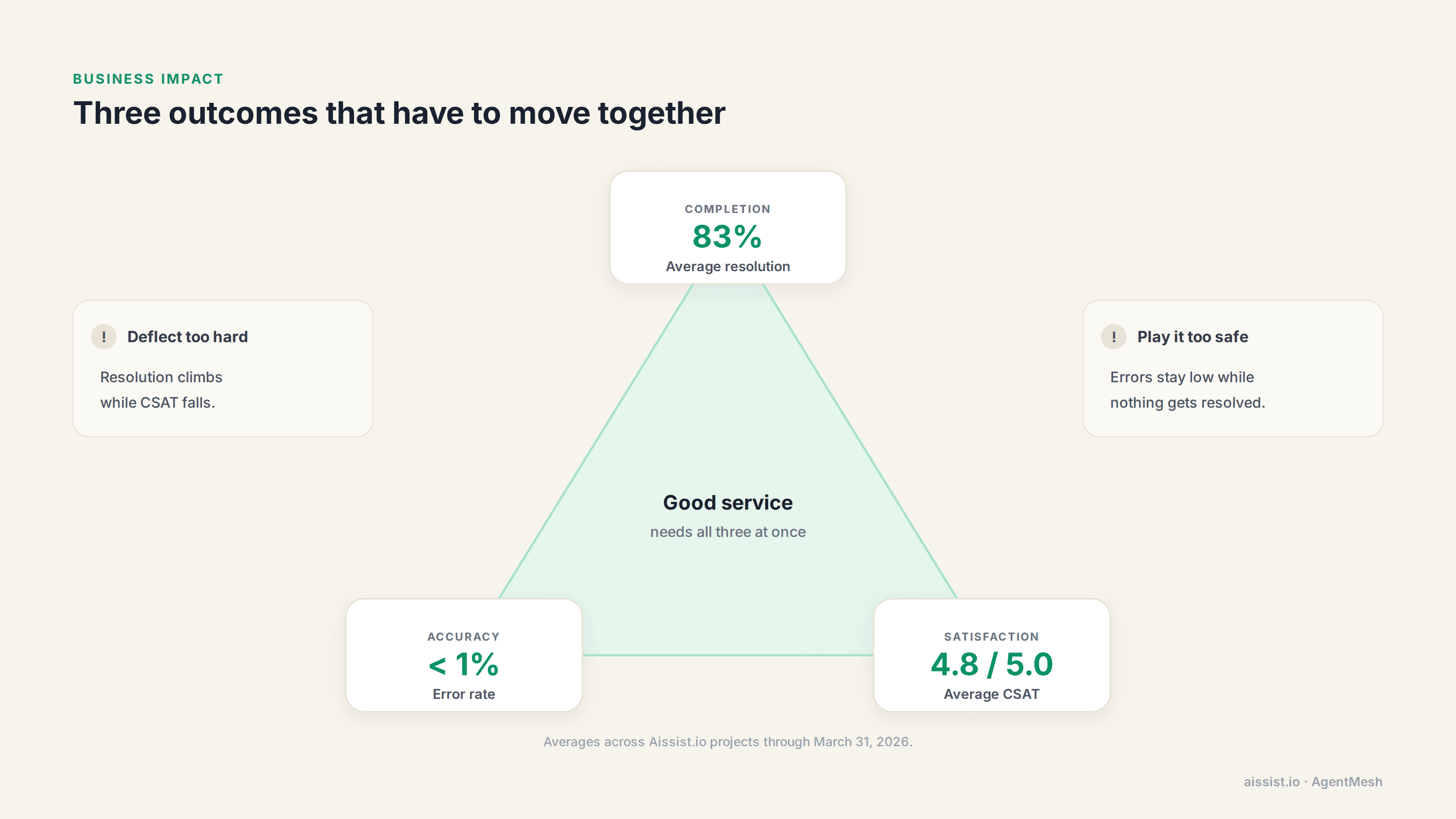
AgentMesh is measured on three outcomes that have to move together: resolution, error rate, and CSAT. Any one of them can be gamed on its own, which is why we publish all three.
Deflect too aggressively and resolution climbs while CSAT falls. Play it safe and errors stay low while nothing gets resolved. Good service needs completion, accuracy, and satisfaction at the same time.
Measured across all projects through March 31, 2026.
Measured across all projects through March 31, 2026.
Measured across all projects through March 31, 2026.
Across Aissist.io projects through March 31, 2026, average resolution reached 83%, error rate stayed under 1%, and average CSAT reached 4.8 / 5.0. All three have improved since.
Agent Insight measures the same work at a finer, customizable level — AI quality, workflow behavior, and business-specific metrics — for every agent, AI and human.
What can AgentMesh be used for?
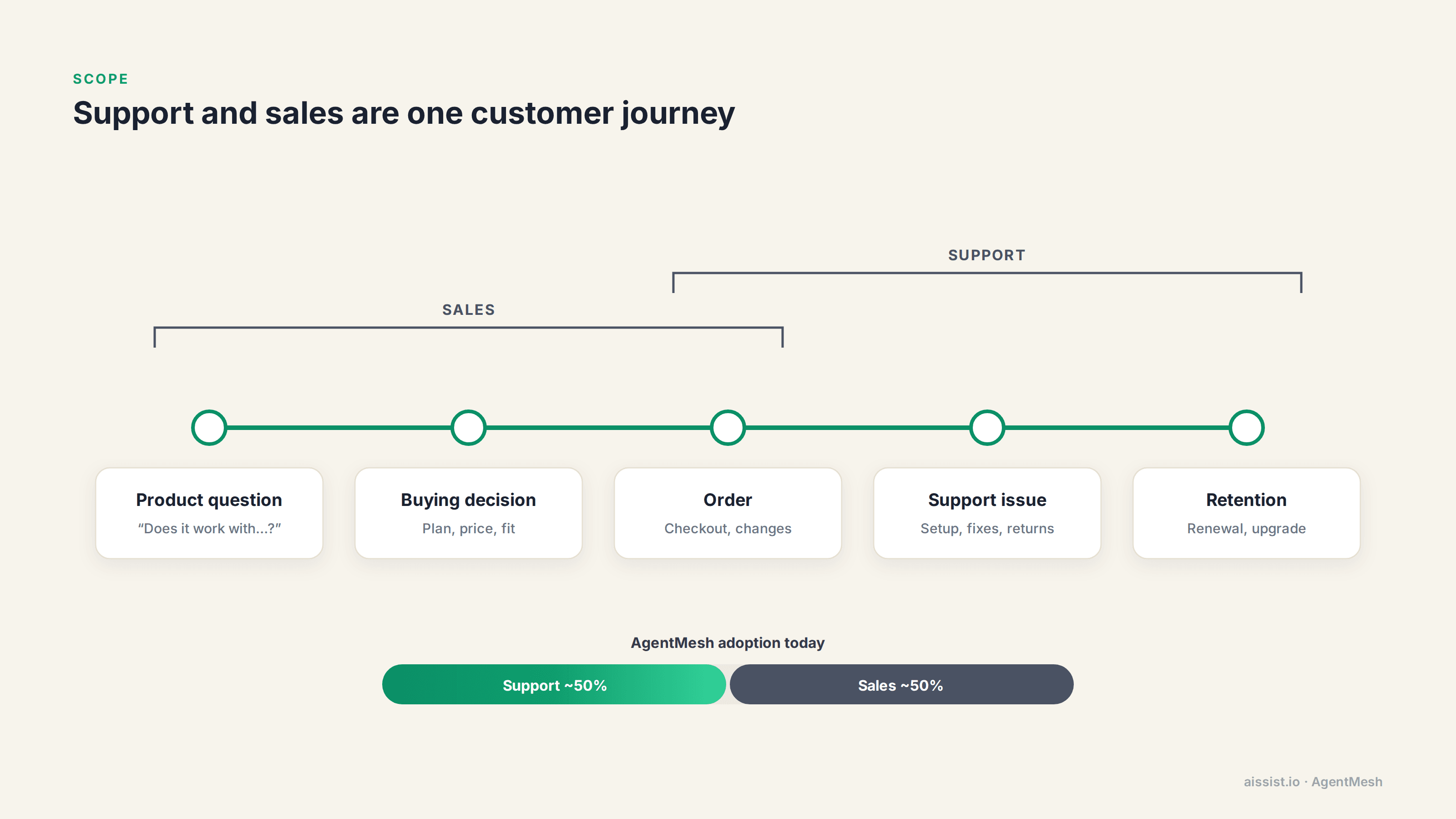
AgentMesh automates customer support and sales, with adoption split close to 50/50. Those functions used to sit in separate teams; in practice they are one journey.
Product questions turn into buying decisions, support issues affect retention, and escalations need commercial context. More companies are consolidating both into one operating layer instead of two disconnected systems.
AgentMesh fits that shift because it is built around execution, context, and workflow continuity rather than one narrow use case.
What makes AgentMesh different under the hood?
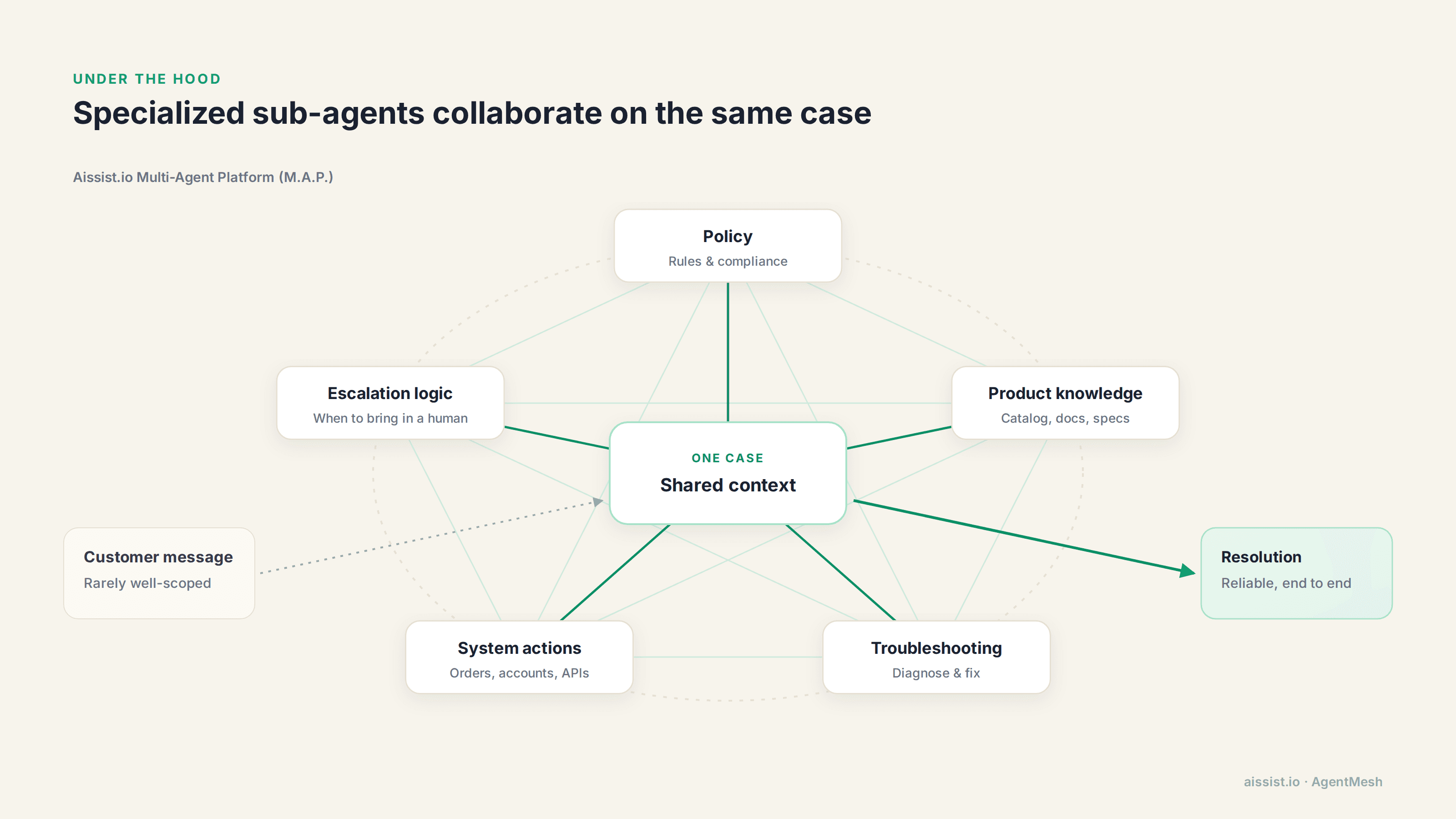
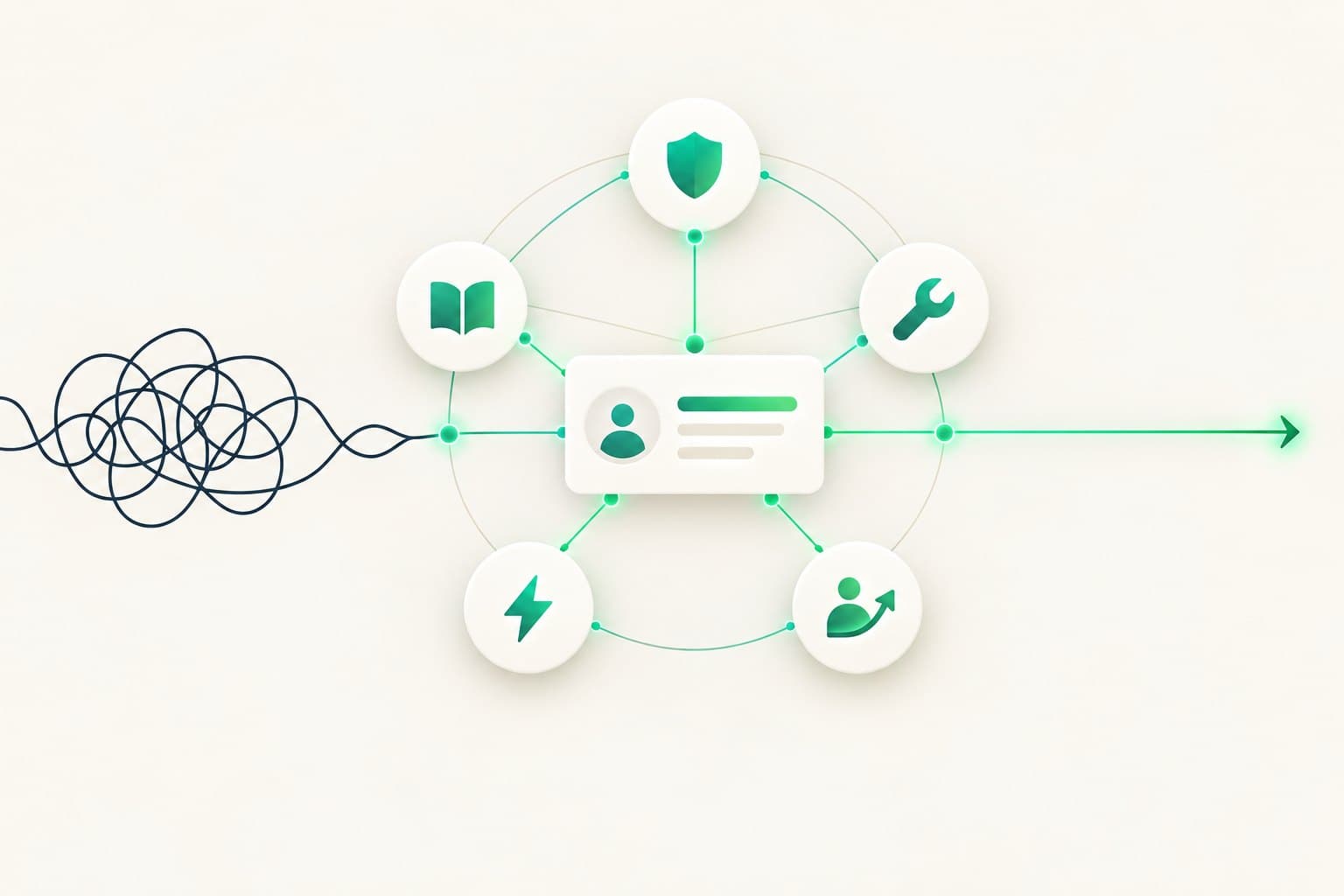
AgentMesh runs on Aissist.io's proprietary Multi-Agent Platform, or M.A.P. Specialized sub-agents each own a domain — policy, product knowledge, troubleshooting, system actions, escalation logic — and collaborate on the same case.
That matters because customers rarely state the issue cleanly, and the business behind it is complex: multiple products, policies, workflows, and systems are usually in play at once.
Multi-agent coordination is a more reliable way through that ambiguity. It does not assume the problem arrives well-scoped; it is designed for the mess of real operations.
What systems can AgentMesh connect to?
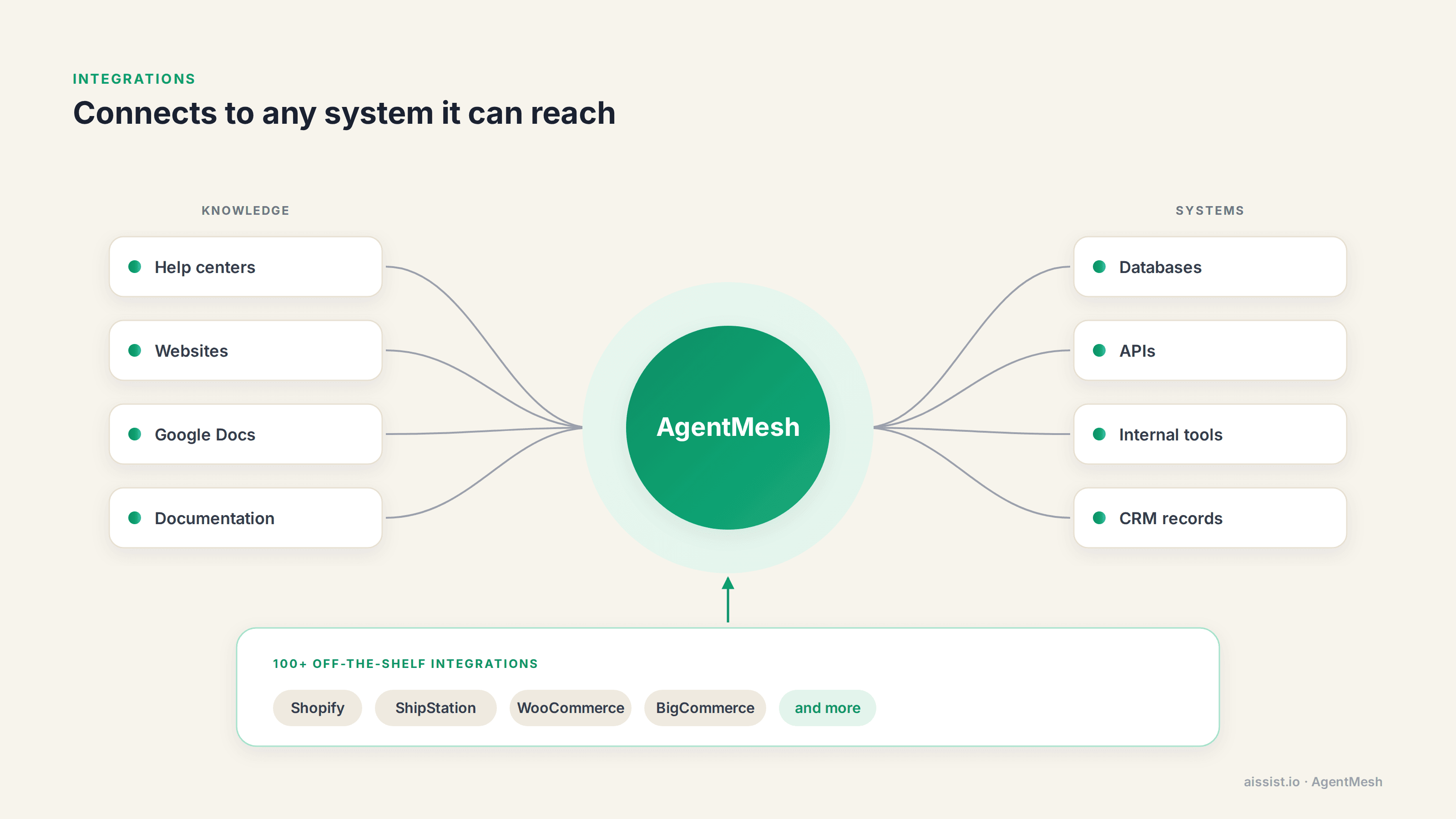
AgentMesh connects to any system it can reach: help centers, websites, databases, Google Docs, internal tools, APIs, and other business systems that expose usable access.
That matters because real support and sales work rarely lives in one place. A single resolution can need product documentation, order data, CRM records, shipping updates, policy references, internal notes, and live system actions across several tools.
On top of that flexibility, AgentMesh ships with 100+ off-the-shelf integrations for common operational and commerce platforms, including Shopify, ShipStation, WooCommerce, and BigCommerce.
The practical benefit is speed: connect the systems you already run and start automating real work, without waiting for every integration to be custom-built.
How does AgentMesh ensure reliability and quality?
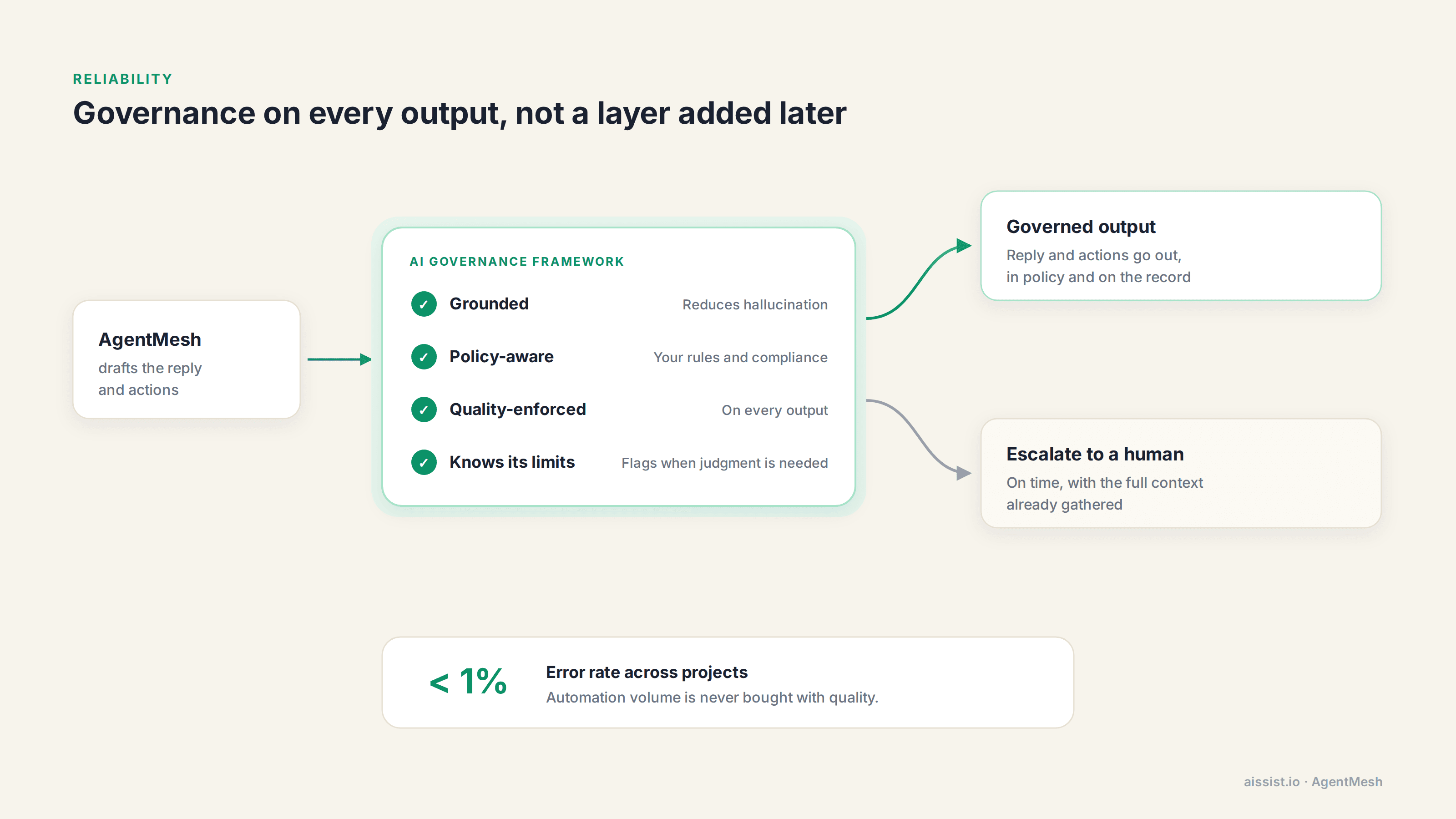
Reliability is the hardest part of putting AI into a business. Hallucination, compliance mistakes, and late escalation make AI unusable in serious operations.
From day one, Aissist.io built an AI governance framework that enforces quality on every output — not a layer added later. In business use, reliability is part of the product. More in Reliable AI.
Outputs are governed, policy-aware, and designed to escalate when the situation needs human judgment. Automation volume is never bought with quality.
How can AgentMesh be deployed?
AgentMesh is deployed like a person: embedded in your team and workflows, monitoring inboxes, reacting to assignments, and acting on notes in real time.
That model matters because the AI adapts to the operation you already run, instead of the operation being redesigned around a new tool.
- Monitor inboxes or group queues and start work when inquiries arrive.
- React to assignment from a human agent or a workflow rule.
- Trigger from a note so AgentMesh can complete a specific task in context.
What languages, media, and channels does AgentMesh support?
AgentMesh supports 65+ languages. Language is auto-detected, conversations run in the customer's language by default, and it can switch mid-conversation.
It reads multimedia too — text, image, video, and voice messages — so it reasons from the same evidence a human agent would.
And it is channel-agnostic: web chat, in-app chat, WhatsApp, SMS, email, online forms, and social media.
- Chat
- SMS
- Voice
- Image
- 65+ Languages
- Web
Questions teams usually ask before deploying AgentMesh.
What is AgentMesh?
AgentMesh is Aissist.io's agentic AI workforce for support and sales: specialized AI agents that complete work end-to-end inside the systems and workflows your team already uses. It runs on Aissist.io's proprietary Multi-Agent Platform, so several specialized agents collaborate on one case to resolve complex issues reliably.
How does AgentMesh measure success?
The primary metrics are resolution, error rate, and CSAT: 83% average resolution, an error rate under 1%, and 4.8 / 5.0 CSAT across projects through March 31, 2026. All three matter — good automation improves them together instead of trading one away for another.
What makes AgentMesh reliable for enterprise use?
Aissist.io built an AI governance framework from day one to reduce hallucination, enforce policy and compliance rules, and ensure timely escalation.
Can AgentMesh handle both support and sales?
Yes. AgentMesh is used across customer support and sales almost evenly, because those journeys are increasingly connected in practice.
Can AgentMesh handle multiple media types?
Yes. AgentMesh supports text, image, video, and voice messages, so it can work from the same kinds of inputs that human teams use during real operations.
What can AgentMesh automate?
AgentMesh can automate nearly any task a human operator would do in support or sales workflows. It is designed for end-to-end automation, so one execution can generate multiple outputs at once, including tags, replies, system updates, summaries, escalations, notes, API calls, and internet or knowledge searches when needed.
Can AgentMesh take live calls?
Not yet. AgentMesh supports voice messages, but it does not currently support real-time live voice communication.
How much does AgentMesh cost?
AgentMesh is priced per interaction, capped per resolution, with published rates on our pricing page and no upfront commitment — you pay per use. The cap is the part that matters: a conversation that takes ten interactions to resolve still bills as one resolution, so cost does not scale with how chatty a case is. Across our customer base this works out to roughly 50% lower AI spend than per-interaction pricing without a cap — our own figure, from our own billing data, not independently audited.