
Did Moore's law for AI actually happen?
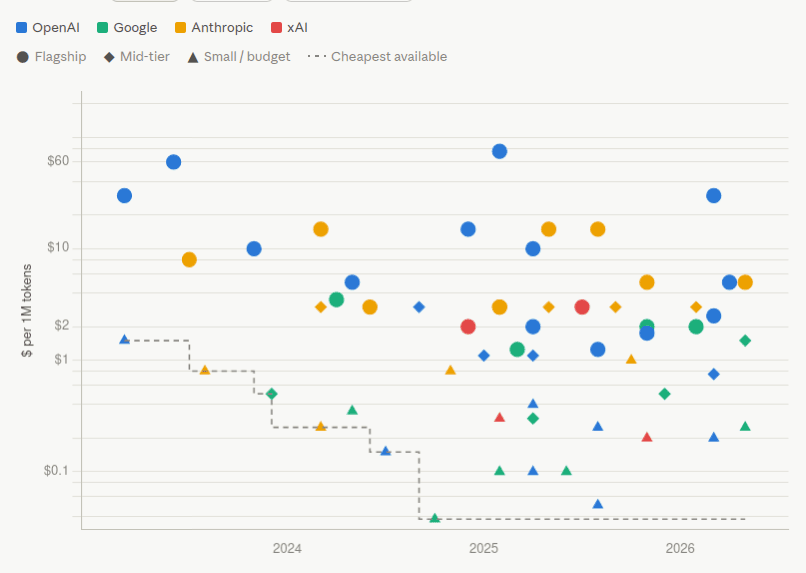
It depends on the unit you measure. Compute hardware is still getting stronger, but that does not automatically mean AI gets cheaper per useful business function.
Over the last few years, the cost per compute unit has improved, but the cost per token has not fallen in a straight line for stronger models, and the cost per completed workflow can rise sharply once reasoning and agentic execution are involved.
The pattern is simple. Chips improve, but the models also get larger and more capable. That means the user does not always see a Moore's-law style collapse in price.
The clearest way to see it is to look at official input-token pricing over time. Every figure below is OpenAI's own published rate, read from OpenAI's pricing page and its model release notes; prices are per million input tokens and were re-checked on 24 August 2026. GPT-3.5 Turbo's January 2024 refresh was priced at $0.50 per million input tokens. GPT-4o, released in May 2024, was $2.50. GPT-4o mini, released in July 2024, reached $0.15. GPT-4.1, released in April 2025, was $2.00. GPT-5, released in August 2025, was $1.25. GPT-5.4, released in March 2026, is $2.50. GPT-5.4 mini, also released in March 2026, is $0.75.
The main message is not that nothing ever gets cheaper. It is that $ per million input tokens has not declined in a simple, reliable line over time. Stronger frontier models remain expensive, and even the small-model line has not kept moving only downward.
Reasoning makes this more expensive still. Reasoning tokens are billed as output tokens, so deeper thinking can raise cost even when the visible answer stays short.
Agentic AI pushes the bill further because one user request can expand into planning, retrieval, verification, tool calls, and follow-up tasks. The model is doing more useful work, but it is also consuming more tokens to do it.
What will happen to AI price in the next two years?
Our view is that end-user AI pricing is more likely to stay flat or drift upward than collapse.
There are two reasons. First, stronger models tend to consume more expensive compute even when the raw hardware curve improves. Second, AI demand is now colliding with infrastructure constraints well beyond GPUs.
Power is becoming part of the AI cost stack. Industry forecasts now expect data centers to take a much larger share of electricity demand, and AI is a major driver of that growth. That makes it hard to assume that token prices will simply fall every year.
We therefore expect the next two years to look more like subtle repricing than dramatic price drops: stronger models, more token-heavy workflows, and only selective cost relief on smaller or narrower models.
What is efficient AI (token economy)?
Efficient AI means reducing cost while preserving the best useful performance.
In practice, there are three main levers: better system design, task optimization, and training or fine-tuning your own models when the economics justify it.
Cost efficiency is also one of the strong pillars of Aissist.io's offering. We do not treat model cost as a minor optimization to worry about later. We treat it as a core design constraint from the start, because AI that performs well but cannot scale economically will eventually fail the business case.
That is why Aissist.io focuses so heavily on operational architecture, specialization, and controlled execution. The goal is not only to make AI more capable. The goal is to make it capable in a way that businesses can sustain at real volume over time.
Which efficiency strategy works best?
| Approach | Effectiveness | Cost saving | Best use |
|---|---|---|---|
| System design | High | High | Repeatable workflows with clear operational boundaries |
| Task optimization | Moderate to high | Moderate | Narrow tasks where cheaper or simpler models are enough |
| Train your own models | Situational | High at scale | Large volume, stable tasks, and strong evaluation discipline |
System design is usually the strongest lever.
The single most effective way to improve token economy is to design a system that is tightly coupled to the problem you are trying to solve.
Generic AI burns tokens because it has to reason broadly. Specialized AI spends less because the system already knows the workflow, the boundaries, and the likely next steps.
That is why operational design matters so much. If the system already knows which sub-agent to activate, which system to query, and which outputs to generate, the model does not need to rediscover that structure every time.
The tradeoff is flexibility. A highly specialized design is usually cheaper to run, but less open-ended than a fully general agent. Good architecture is about finding the right balance between extensibility and cost discipline.
Task optimization reduces waste inside each run.
Task optimization is especially effective when the task is narrow or well defined.
Many tasks do not need expensive reasoning. Some only need classification, routing, extraction, or lightweight summarization. Others can tolerate some false positives or negatives if the downstream process already has review or filtering.
That creates room to shrink prompts, tighten instructions, choose cheaper models, reduce unnecessary retries, and avoid reasoning where it adds little value.
In many systems, this is where the first big savings appear: not from changing the frontier model, but from stopping the model from doing work it never needed to do in the first place.
Training your own models can shift cost from inference to training.
Fine-tuning or training your own model can be effective when the task is stable, the traffic is large, and the performance target is clear.
The economics work because you may spend more upfront on training, evaluation, and maintenance, but less on ongoing inference. In some cases, a tuned model also needs fewer input tokens because it already carries more task-specific behavior.
The tradeoff is flexibility. Fine-tuned systems are harder to change quickly, and every major change needs careful evaluation because the behavior can shift in unexpected ways.
In short, this approach is most useful when you want to convert a recurring inference bill into a more predictable model-development cost.