
AI Agent Pricing Benchmark · Revised 14 September 2026
AI Agent Pricing Benchmark 2026: September Repricing
AI agent pricing in 2026 runs from $0.10 per ticket to $600,000+ annual contracts — and the sticker price tells you almost nothing. The only number that makes vendors comparable is effective cost per resolved conversation: what you pay, divided by what actually gets resolved, with platform fees and seats added back in. This benchmark normalizes 18 major AI customer service agents to that single metric, tags every figure by provenance (vendor-published, third-party reported, or estimated), and shows the math at real ticket volumes.
Revised after the September 2026 repricing, which broke comparability outright. Salesforce moved Agentforce inside the seat on 3 September and Zendesk changed what its action credits meter; we re-checked all eighteen vendors and found those two moved and sixteen did not. The short version: published per-resolution rates still cluster between $0.50 and $2.00, per-conversation and per-session models cost more than they look because you pay for the AI's failures, and the enterprise quote-based tier starts around $50,000 a year before a single conversation is handled. The new question is no longer what a vendor charges — it is who gets to increase the count.
Why a table of dollar signs stopped working
This AI customer service pricing benchmark shows why a seat price with bundled credits and a per-resolution price are not the same product. They move risk in different ways. A per-resolution price puts volume risk on the vendor: no resolution, no invoice. A seat-plus-credits bundle puts it on you, because the credits are prepaid and the meter runs inside the vendor's software.
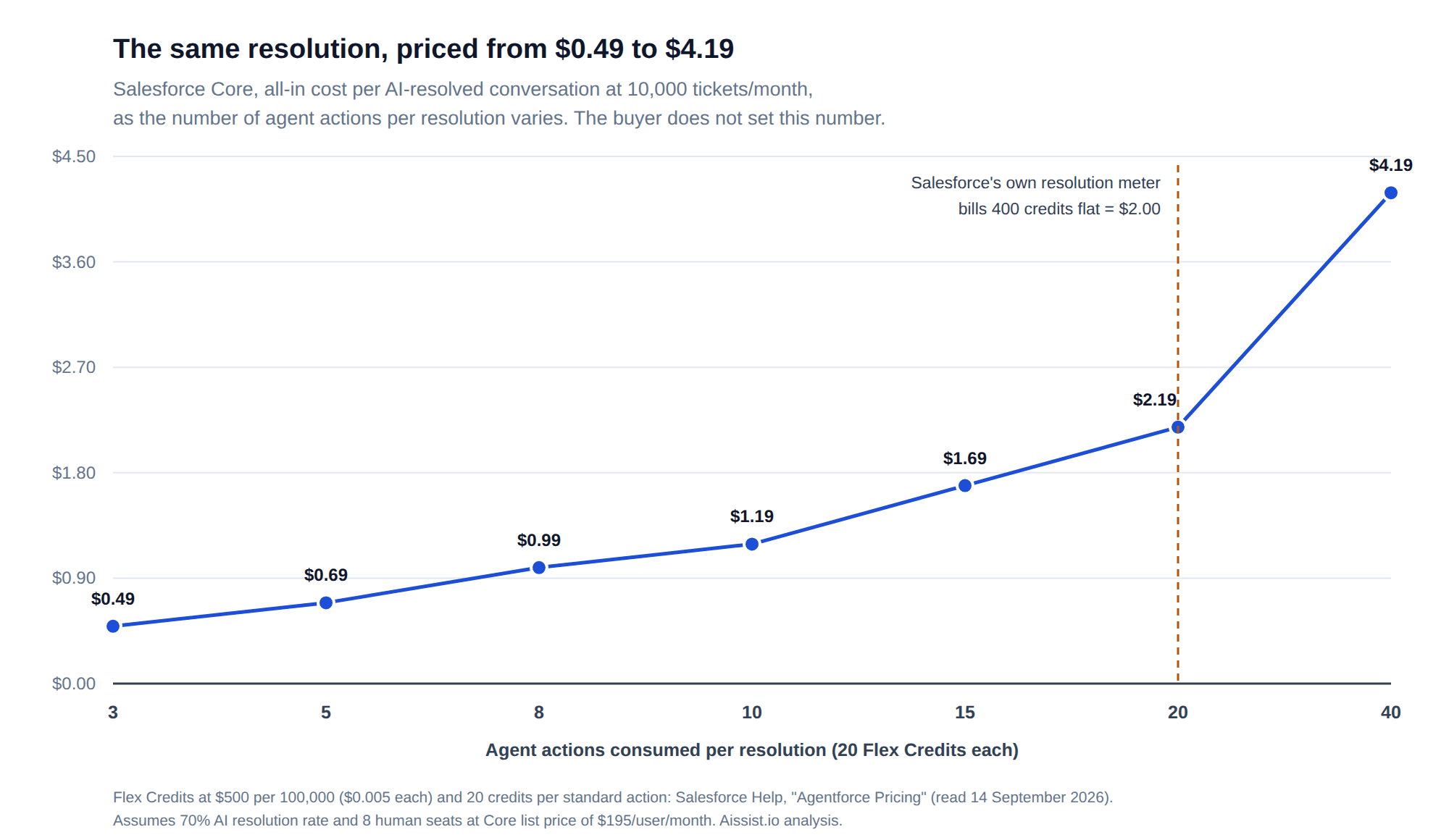
Salesforce prices Flex Credits at $500 per 100,000 — or $0.005 each — and says one Agentforce action uses 20 of them (read 14 September 2026). So Core's half-million credits have a face value of $2,500, or about 5,000 resolutions at five actions each. It is a large number attached to a small amount of work.
The one thing Salesforce has not published
Salesforce does not state publicly whether the new editions' credit allowances are per org or per seat, annual or monthly. Its Flex Credits rate card says only that the entitlement is listed in the Usage Details table on the Order Form. We model it as per org per year, because Salesforce's own pricing page described the earlier Agentforce 1 allowance that way. If yours is per seat, the economics improve sharply. Ask for the Usage Details table before you sign.
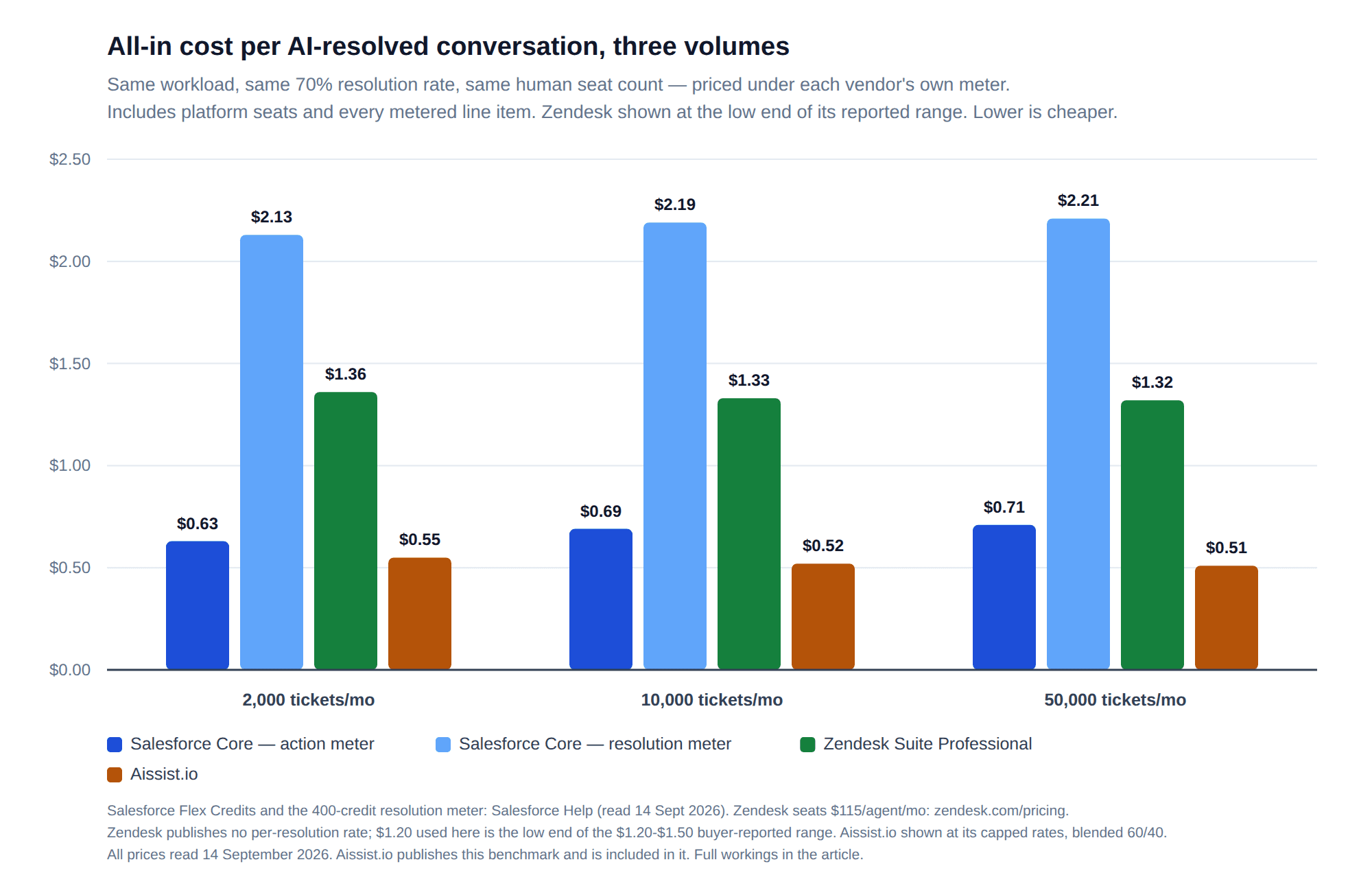
The honest concession is that a bundle can genuinely win. Below roughly 417 AI resolutions a month, or about 600 tickets at a 70% resolution rate, Core's included credits cover everything. In that range the marginal cost of an AI resolution is zero, and no per-resolution vendor beats zero. Above that line the allowance covers about 6% of a 10,000-ticket operation's annual credit need, and the rest bills at list. Negotiate the overage rate, not the included amount: the bundled number is fixed marketing, the rate above it is commercial.
What AI agents actually cost in 2026
What one AI-resolved conversation costs on Salesforce Core at 10,000 tickets a month, depending only on how many actions its agent takes — 3 at the low end, 40 at the high end. Nothing else changes. The buyer does not set that number.
Face value of the Flex Credit allowance bundled into Salesforce Core, at Salesforce's own $0.005 per credit. At five actions per resolution that is about 5,000 resolutions — roughly 417 a month before the meter starts.
Salesforce launched new editions on 3 September and Zendesk freed its native actions from action credits. We re-checked the other sixteen and found no change — which is itself worth publishing, since most coverage implies the whole market repriced.
The sticker price tells you almost nothing. The only comparable number is effective cost per resolved conversation: what you pay, divided by what actually gets resolved, with platform fees and seats added back in.
Per-conversation and per-session models look cheaper and cost more. You pay for the AI's failures. A $0.49 session fee at a 25% resolution rate is an effective ~$2.00 per real resolution — four times the sticker.
The cheapest headline rates are not resolution rates. My AskAI and eesel charge per ticket whether or not the issue is resolved, and both sit on top of a helpdesk you keep paying for.
Native helpdesk AI is the most expensive per resolution. Zendesk, Freshdesk and Salesforce carry the highest effective rates in this benchmark despite the perception that native means economical — you are paying for the platform twice.
Every enterprise custom vendor charges you before value is delivered, through platform fees, implementation fees, or minimums — precisely what outcome-based pricing was supposed to eliminate.
Effective cost per resolved conversation
Usage price divided by a realistic resolution rate. Bars show the midpoint of each vendor's effective range and colour marks agentic capability; platform fees, seats and helpdesk costs sit outside the bar and are modelled in full in the worked scenario further down.
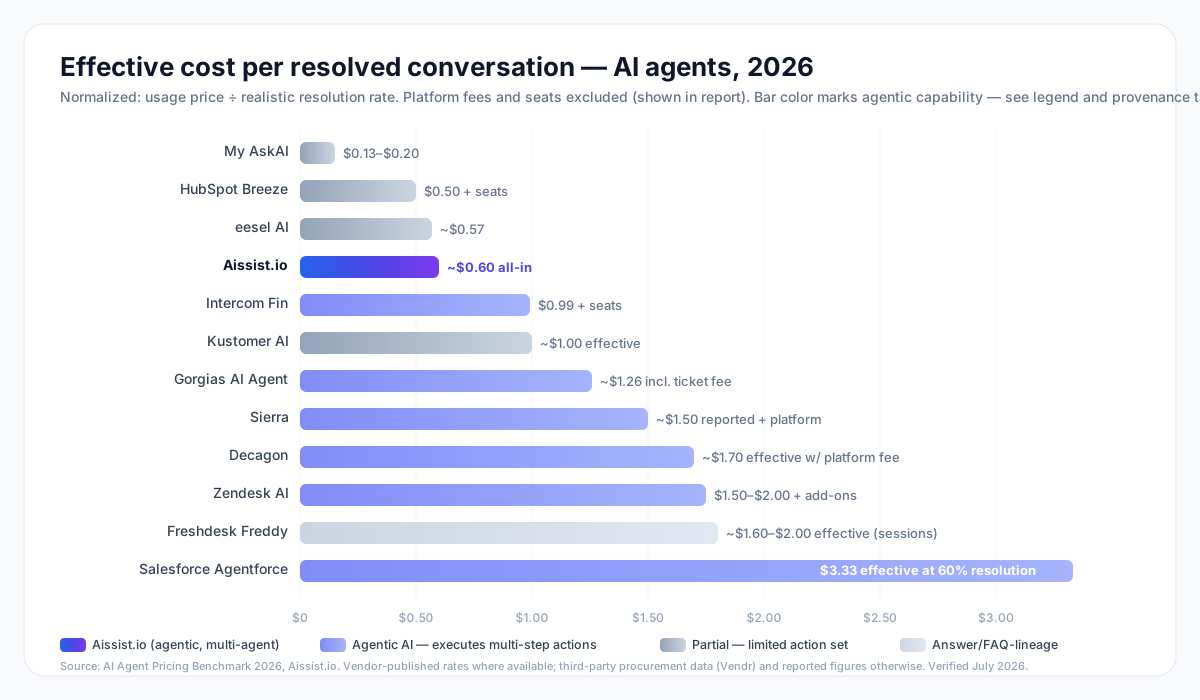
The chart plots 12 of the 18 vendors for legibility; the full set, with ranges and provenance tags, is in the benchmark table below. Midpoints are for scale only. My AskAI and eesel AI exclude the helpdesk they sit on; Decagon excludes its ~$50K annual platform fee; Maven AGI is not plotted, because no public or reported price for it exists and we no longer publish an estimate in its place.
Where does each number come from?
Pricing in this market is opaque. Roughly half the vendors publish no numbers at all. So every figure below carries one of three provenance tags, and none of them should be treated as a quote.
Listed on the vendor's own pricing page or documentation, verified as of July 2026.
Third-party procurement data (primarily Vendr marketplace records), buyer disclosures in public forums, or independent analyst estimates. Directionally reliable, not contractual.
Our informed estimate where no public or reported data exists, stated with reasoning. Treat as a planning placeholder, not a fact.
Verify any figure against the vendor before signing. Pricing in this category changed a lot at least four times in the first half of 2026 alone: HubSpot's April repricing, Zendesk's overage auto-billing, the Zendesk–Forethought acquisition, and the pending Salesforce–Fin deal.
Why the model matters more than the price
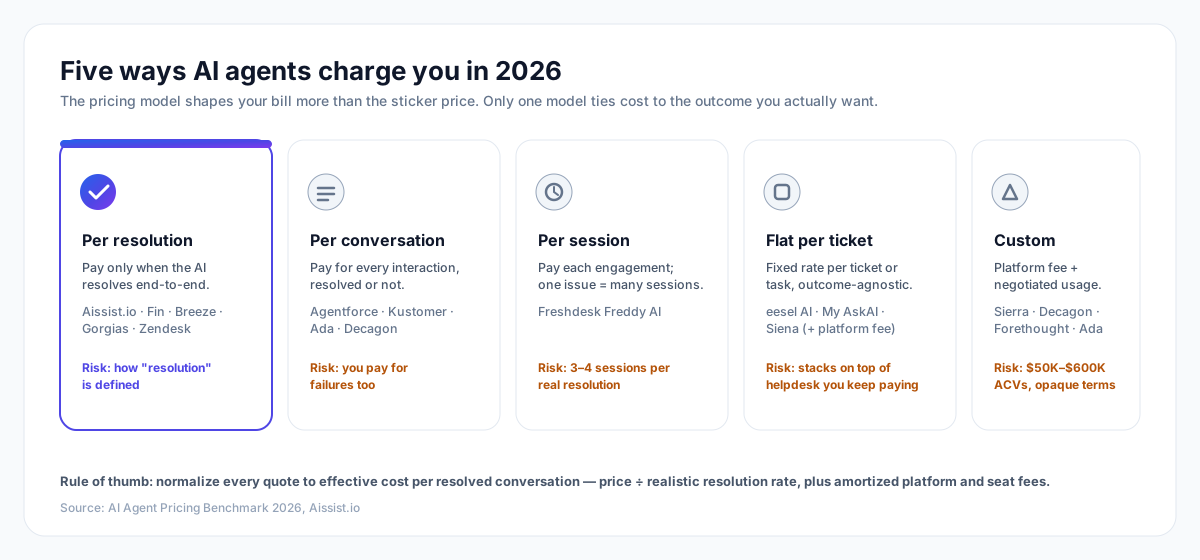
Every AI agent bills through one of five structures, and identical sticker prices can produce wildly different invoices depending on which one applies. The model matters more than the headline price.
Per resolution
Outcome-basedYou pay only when the AI resolves a conversation end-to-end. This is the model that aligns vendor incentives with yours — but the entire economics hinge on how “resolution” is defined. Intercom Fin, for example, bills “assumed resolutions” when a customer simply exits without replying, which can include customers who gave up. Watch the definition, not just the rate.
Aissist.io · Intercom Fin · Zendesk · Gorgias · HubSpot Breeze
Per conversation
Deflection economicsYou pay for every interaction the AI touches, resolved or not. A conversation that ends in frustration and human escalation costs the same as one that solves the problem. The vendor gets paid whether or not the customer got helped.
Salesforce Agentforce · Ada · Decagon · Kustomer
Per session
Multiple sessions per issueYou pay each time the AI engages, and one customer issue routinely spans multiple sessions. Freshworks' own case studies put Freddy AI's resolution rate at roughly 23–30%, which means teams consume three to four billable sessions per genuine resolution.
Freshworks Freddy AI
Flat per ticket / task
Add-on layerA fixed rate per ticket regardless of outcome. Predictable, and cheap at the low end — but these tools are add-on layers, so the helpdesk bill underneath doesn't go away.
My AskAI · eesel AI · Siena AI
Enterprise custom
Platform fee + usageA platform fee plus negotiated usage, no public rates, sales-led procurement. Annual contract values run from ~$50K to $600K+, with implementation fees and volume minimums layered on top.
Sierra · Decagon · Ada · Forethought · Maven AGI
Why price means nothing without a resolution rate
A pricing benchmark read in isolation will steer you wrong, because the cheapest rate attached to a low-performing agent is often the most expensive way to buy support automation. Cost and resolution rate are one number, not two.
The arithmetic is unforgiving. A $0.49 session fee at a 25% resolution rate is an effective ~$2.00 per real resolution, or four times the sticker. A $2.00 per-conversation fee at 60% resolution is $3.33. A $0.99 outcome fee at a genuine 70% resolution rate is exactly what it says. Vendor-claimed resolution rates of 65–86% routinely compress to 40–70% in production, and some vendors' own case studies sit at 23–30%, so the base you use matters as much as the price you're quoted.
Performance also compounds beyond the AI invoice. Every conversation the agent fails to resolve becomes a human ticket at roughly $6–$12 of labor. So a ten-point difference in resolution rate at 10,000 monthly conversations is 1,000 tickets, or $6,000–$12,000 a month, moving between the AI column and the payroll column. Two vendors with identical per-resolution rates can differ by six figures a year in total support cost purely on performance.
Never evaluate a quote without a resolution rate attached to it. Insist that the rate be measured on your ticket mix, not the vendor's best case, and compare vendors on effective cost per resolution plus escalation labor, the full equation, not the price sheet.
Our AI customer service benchmark tracks claimed-vs-verified resolution rates across these vendors for exactly this reason; use it as the denominator source alongside this report's prices.
18 AI agents, normalized to cost per resolution
Effective cost per resolution is calculated as usage price ÷ realistic resolution rate, using vendor-claimed rates where credible and production-reported rates where vendor claims diverge from field data. Platform fees are amortized in the worked scenario below, not in this column.
The Agentic column classifies each product by documented capability, not marketing language. This matters because agentic capability is what sustains the 60%+ resolution rates that make per-resolution pricing economical.
Reasons through multi-step problems and executes actions across external systems — refunds, order edits, record updates.
Primarily knowledge-grounded answers with a limited action set.
Retrieves and responds, escalating anything that requires an action.
| Vendor | Agentic | Pricing unit | Headline price | Provenance | Effective $/resolved conv. | Who controls the meter | Key fine print |
|---|---|---|---|---|---|---|---|
| My AskAI | Partial | Flat per ticket | $0.10/ticketsource | Published | ~$0.13–$0.20 | VendorBills tickets engaged, not resolutions | RAG-first with basic actions; add-on layer, helpdesk seats continue underneath |
| HubSpot Breeze | Partial | Per resolution | $0.50/resolvedsource | Published | $0.50 + seats | VendorResolution = no human handoff for 72h; agent-qualified leads also count | Knowledge-grounded answers with limited CRM actions; requires Service Hub Pro/Enterprise ($90+/seat/mo) + $1,500–$3,500 onboarding; repriced from $1.00/conversation on Apr 14, 2026 |
| eesel AI | Partial | Flat per ticket | $0.40/ticketsource | Published | ~$0.57 at 70% res. | BuyerPer task; user-settable monthly spend cap | Knowledge-grounded add-on with a limited action set; pay-as-you-go since July 2026; a “task” can be smaller than a resolution; heavy tasks $2–$4 |
| Aissist.io | Agentic AI | Per resolution | $0.09/interaction, capped per resolutionsource | Published | $0.25 email / $0.60 chat (cap) | SplitMetered per interaction, capped at the resolution price | Multi-agent (AgentMesh); no platform fee, no seat fees; runs on your existing helpdesk. Metered per AI interaction and capped at the resolution price for the channel — $0.25 email/form/social, $0.60 chat/WhatsApp/SMS — so you pay the lower of the two; escalated cases are not charged. 83% average resolution rate (vendor-claimed). This is our own product; we model it at the caps |
| CoSupport AI | Answer / FAQ-lineage | Per resolution or flat | $0.19–$0.59/res., or $99/mono source URL recorded | Reported | ~$0.19–$0.59 | BuyerCoSupport states tickets routed to a human are unbilled | Answer-focused; unlimited flat tier reported; verify resolution definition |
| Yuma AI | Agentic AI | Per resolution | ~$0.65/resolutionno source URL recorded | Reported | ~$0.65 | BuyerAny human touch voids the charge; one charge per ticket | 100+ ready-made ecommerce actions; no public pricing page; Shopify-centric |
| Gorgias AI Agent | Agentic AI | Per resolution | $0.90 (annual) / $1.00 (monthly)source | Published | ~$1.26 | Vendor72h no-handover window; ticket fee bills alongside the automation fee | Executes Shopify actions; AI-resolved tickets also bill as helpdesk tickets ($0.32–$0.40) per Gorgias' own docs; $1.50 overage rate beyond bundle |
| Fin (Salesforce) | Agentic AI | Per outcome | $0.99/outcomesource | Published | $0.99 + seats | Vendor24h customer silence bills as an assumed resolution | Fin Tasks/Procedures execute multi-step actions; an “outcome” includes assumed resolutions, counted when a customer exits without replying for 24 hours; 50-outcome minimum; seats $29–$139/agent. Salesforce closed the acquisition on 10 Sept 2026 (~$3.6B) with no announced change to pricing or packaging |
| Kustomer AI | Partial | Per conversation | ~$0.60/conversationsource | Reported | ~$1.00 at 60% res. | UndeterminableNo published definition of the billable event | Platform workflows, narrower autonomous action set; plus $89–$139/user/mo seats, 8-seat minimum, annual commitment |
| Freshdesk Freddy AI | Answer / FAQ-lineage | Per session | $49 per 100 sessions (~$0.49)source | Published | ~$1.60–$2.00 | VendorTime-boxed session; outcome is irrelevant to billing | Session-based Q&A; Freshworks case studies show 23–30% resolution, so ~3–4 sessions per resolution; Copilot separate at $29/agent/mo |
| Zendesk AI AgentsNative actions freed from action credits, Sept 2026 | Agentic AI | Per resolution | No published rate; $1.20–$1.50 reportedsource | Reported | $1.32–$1.63 loaded | BuyerOnly LLM-verified resolutions bill — but Zendesk's model is the judge | Since 18 May 2026 only LLM-verified resolutions bill; contained resolutions and assisted escalations do not count against the allowance — a genuine improvement, though Zendesk's own model adjudicates and publishes no appeal. Allowances are now dollar budgets, not counts: $2/$5/$10 per seat per month by plan, capped at $5,000 a year. From Sept 2026 action credits apply only to third-party connectors and custom actions; extra credits are $200 per 100,000. Suite seats $55–$115 published, Enterprise quote-only |
| Sierra | Agentic AI | Outcome-based custom | ~$1.50/resolutionsource | Reported | ~$1.50–$2.50 loaded | VendorUpsells and saves count as billable outcomes | No public pricing; ACVs ~$150K+, setup $50K–$200K, year-one $200K–$350K+; 3–7 month deployments; routing conversations billed per conversation |
| Decagon | Agentic AI | Platform + usage | ~$50K/yr + ~$0.99/conversationsource | Reported | ~$1.70 at 70% res. + platform | VendorDefault per-conversation plan bills every inbound conversation | Agent Operating Procedures execute workflows; Vendr median ACV $432,750 (range $105K–$923K), read 20 Aug 2026, sample size unpublished; per-resolution variant reported at $0.50; no helpdesk included |
| Ada | Agentic AI | Per conversation (custom) | ~$30K/yr entry; $1–$3.50/res. reportedsource | Reported | ~$1.50–$3.00 | VendorResolution count is sampled and extrapolated, not itemised | Vendr median ACV $72,000 across 113 recorded purchases; enterprise deals $300K+; designed for 300K+ conversations/year; shifted from outcome-based to per-conversation billing |
| Forethought (Zendesk) | Agentic AI | Platform + usage | ~$0.12/deflection + platformsource | Reported | ~$0.80–$1.50 loaded | UndeterminableNo published definition of the billable event | Multi-agent system (Solve/Triage/Assist); Vendr median ACV ~$59.5K; 20,000-ticket historical minimum; acquired by Zendesk March 2026 |
| Salesforce AgentforceNew Core / Advanced / Max editions, 3 Sept 2026 | Agentic AI | Per action, conversation, or seat bundle | $0.005/Flex Credit (20/action); $2.00/conversationsource | Published | $0.49–$4.19 by action count | VendorThe agent decides how many billable actions a resolution takes | Core $195 / Advanced $395 / Max $550 per user per month since 3 Sept 2026, bundling Agentforce, Slack and Tableau Next with 500,000 / 1,000,000 / 2,750,000 Flex Credits. Salesforce does not publish whether that allowance is per org or per seat — its rate card puts the entitlement on the Order Form — and the predecessor Agentforce 1 allowance was per org per year. Because credits burn per action at 20 credits each, the same resolution costs $0.49 at 3 actions and $4.19 at 40. A flat Help Agent Resolution meters at 400 credits ($2.00) |
| Maven AGI | Agentic AI | Enterprise custom | No public or reported data foundno source URL recorded | Estimated | Not estimated | UndeterminableNo published definition of the billable event | Agentic positioning, but no published or reported price exists. An earlier version of this table carried an estimated $1.00–$2.00 derived from where Maven sits between Decagon and mid-market tools; we have withdrawn it, because a number we invented does not belong in a table about what vendors actually charge. Ask Maven directly |
| Siena AI | Agentic AI | Platform + per ticket | $750/mo + $0.90/ticketno source URL recorded | Published/Reported | ~$1.20–$1.50 loaded | VendorPer automated ticket; escalation treatment undefined | Executes ecommerce actions (returns, order edits, subscriptions); DTC only; platform fee makes low volumes expensive (~$2.40 effective at 500 tickets/mo) |
Prices re-verified 14 September 2026 from vendor pricing pages, vendor documentation, and third-party procurement data. The Who controls the meter column records whether the vendor's own software can increase the billable count without you acting — after the September repricing it matters more than the headline rate. Enterprise contracts are quote-only and approximated. Verify before signing.
Four patterns stand out. First, the cheapest headline rates are not resolution rates: My AskAI and eesel charge per ticket whether or not the issue is resolved, and both sit on top of a helpdesk you keep paying for. Second, the native helpdesk AI agents (Zendesk, Freshdesk, Salesforce) are the most expensive per resolution, despite the perception that native means economical — you're paying for the platform twice. If that is pushing you to reconsider the helpdesk itself rather than the AI on top of it, see our Zendesk competitors comparison.
Third, every enterprise custom vendor charges you before value is delivered, through platform fees, implementation fees, or minimums, which is precisely what outcome-based pricing was supposed to eliminate. And fourth, visible in the Agentic column: the answer-only and partial products cluster at the extremes of effective cost — either cheap because they do less, or expensive because low resolution rates inflate the per-resolution math.
What does 10,000 conversations a month actually cost?
Assume a mid-market team handling 10,000 support conversations monthly, with the AI achieving a 70% resolution rate (7,000 resolutions) where the vendor's technology credibly supports it, and vendor-reported rates where it doesn't. Monthly costs include required platform and seat fees but exclude one-time implementation.
| Vendor | Monthly math | Est. monthly cost | Effective $/resolution |
|---|---|---|---|
| My AskAI | 10,000 tickets × $0.10 | ~$1,000 (+ helpdesk) | ~$0.14 (+ helpdesk) |
| Aissist.io | 7,000 res. × $0.39 blended cap | ~$2,730 (+ helpdesk) | ~$0.39 (+ helpdesk) |
| eesel AI | 10,000 tickets × $0.40 | ~$4,000 (+ helpdesk) | ~$0.57 (+ helpdesk) |
| HubSpot Breeze | 7,000 res. × $0.50 + 10 seats × $90 | ~$4,400 | ~$0.63 |
| Salesforce Core — 5 actions/res. | 8 seats × $195 + credit overage, less 500K allowance | ~$4,850 | ~$0.69 |
| Intercom Fin | 7,000 outcomes × $0.99 + 10 seats × $85 | ~$7,780 | ~$1.11 |
| Zendesk AI | 7,000 verified res. × $1.20 + 8 seats × $115, less allowance | ~$9,280 | ~$1.33 |
| Gorgias | 7,000 res. × $0.90 + ticket fees + plan | ~$10,000+ | ~$1.43 |
| Decagon | $50K/12 + 10,000 conv. × $0.99 | ~$14,070 | ~$2.01 |
| Sierra | 7,000 res. × $1.50 + amortized platform/impl. | ~$15,000–$20,000 | ~$2.14–$2.86 |
| Salesforce Core — 20 actions/res. | same seats, same workload, four times the actions | ~$15,350 | ~$2.19 |
Sorted by effective cost per resolution. My AskAI and eesel AI figures exclude the helpdesk subscription underneath them, which is not optional.
At this volume the spread between the cheapest and most expensive credible options exceeds $200,000 per year — for the same 7,000 resolved conversations. The pricing model, not the AI quality, drives most of that gap.
To run the same math on your own volumes and pricing model, use our AI pricing converter — it normalizes per-interaction, per-session and per-resolution quotes to one comparable number.
What does “resolution” actually mean on your invoice?
Outcome-based pricing only aligns incentives if the outcome definition is honest. Four definitional gaps recur across vendor documentation — and each one moves real money.
Assumed resolutions. Intercom Fin bills when a customer exits without asking for more help — an “assumed resolution” that can include a customer who gave up. Zendesk moved to a three-tier model in May 2026 where only “Verified Resolutions” are billed, a notable improvement.
Double billing. Gorgias' own billing documentation confirms an AI-resolved conversation is charged as both a helpdesk ticket and an AI resolution — unless the customer reaches a human within 72 hours, in which case only the ticket fee applies. The clean automations are the ones billed twice.
Session inflation. Per-session billing charges every engagement. At Freddy AI's reported 23–30% resolution rates, the effective cost per real resolution runs three to four times the per-session headline.
Automatic overages. From 1 January 2026 Zendesk bills usage above the resolution allowance automatically each month, for customers on non-standard contracts (Agent Months, Multi-Year and ELA). It is a default, not an unavoidable charge: setting “Don’t allow overage” pauses AI agent functionality at the limit instead, and Zendesk emails the account owner and billing admin at 80% and 100% of allowance. Gorgias charges $1.50 per interaction beyond your bundle. Either way, a successful AI during a Black Friday spike is a budgeting event — know which setting your account is on before the spike.Source: Zendesk, announced 11 November 2025 (archived — original retired) · Managing resolution allowances · Monitoring automated resolution usage
This is why we treat resolution — not deflection as the only honest unit of account. A deflected customer who churns cost you more than the AI fee saved. When comparing vendors, put the resolution definition in the contract, require independently auditable resolution reporting, and model your spike months, not your average months.
Six questions that change what you pay
Drawn from the contract structures above. Each one has moved a real deal by a material amount — ask all six before signing.
- 01
What exactly triggers a charge?
Get the resolution/outcome/session definition in writing, including assumed resolutions, handoffs, and re-contact windows.
- 02
What happens on failure?
Per-conversation vendors charge for escalations. Ask for escalated conversations to be non-billable or discounted.
- 03
Is there a floor?
Fin has a 50-outcome minimum; enterprise vendors carry annual minimums regardless of volume. Size the floor against your realistic low season.
- 04
Is there a ceiling?
Overage terms decide your spike months. Zendesk's January 2026 change makes overage billing automatic on non-standard contracts unless you turn it off, which pauses the agent at the limit instead. Negotiate a cap or a discounted overage rate, and confirm which behaviour your contract defaults to.
- 05
What's the all-in stack?
Seats, platform fees, onboarding, add-ons, and the helpdesk underneath. The AI line item is rarely the whole bill.
- 06
Who audits the resolution rate?
If the vendor grades its own performance and bills on that grade, you need independent reporting access.
For a full total-cost model across your own stack — helpdesk, seats, AI, and human escalation labor — see our cost benchmark of AI service and pricing.
Where Aissist.io sits, stated plainly
Aissist.io charges $0.20–$0.60 per resolution, depending on channel, with no platform fee and no per-seat fees, running as an AI Operational Layer on the helpdesk you already use.
That means Intercom, Zendesk, Freshdesk, Kustomer, Front, Gorgias, Salesforce or HubSpot — see the AI Operational Layer for how the overlay works. Average resolution rate across deployments is 83%, with 4.8/5 CSAT.
That places it at the low end of the per-resolution band with the definitional advantages of outcome billing: you pay when a case is resolved end-to-end, not deflected, and there is no separate platform tax before value is delivered. We publish these numbers because we think every vendor in this table should have to.
The one-paragraph version
Effective cost per resolved conversation in 2026 spans roughly $0.13 (flat per-ticket add-ons, helpdesk excluded) to $3.33+ (per-conversation enterprise platforms).
Published per-resolution pricing clusters at $0.50–$2.00, and the pricing model — not the AI — is the biggest driver of your total bill. Normalize every quote to cost per resolution, read the resolution definition like a lawyer, and model your spike months. The vendors most confident in their resolution rates are the ones willing to bill on them.
Questions buyers actually ask about AI agent pricing
The five questions we receive most often about what AI customer service agents cost — each answered directly from the data above.
Why is cost per resolved conversation the benchmark's main comparison metric?
Because sticker prices do not show what a buyer actually pays for successful automation. A low per-session or per-conversation price can become expensive if the AI resolves only a small share of cases. Dividing usage price by a realistic resolution rate turns different AI pricing models into one comparable number and shows the true cost of each resolved support conversation.
When does a bundled credit model make sense?
A bundle can genuinely win at low volume. In the Salesforce example, below roughly 417 AI resolutions a month the included credits can cover the workload, making the marginal AI resolution cost zero. Above that point the allowance covers only a small share of a larger operation's needs, so the overage rate matters more than the included credit count.
What should buyers verify before signing an AI agent contract?
Verify what triggers a charge, how resolution is defined, whether escalations are billable, whether minimums or overage rules apply, what platform and seat fees sit outside the AI line item, and who audits the resolution rate. Pricing can change a lot depending on contract definitions rather than headline rates.
Why can native helpdesk AI agents be more expensive than they appear?
Native helpdesk AI can require buyers to keep paying for the underlying platform while also paying for the AI layer. That can mean paying for the platform twice, especially when the AI charges per conversation, per session, or through credits controlled inside the vendor's software.
How should buyers treat the figures in this benchmark?
Treat them as planning inputs, not quotes. The benchmark uses published prices, reported procurement data, and estimates where no public data exists, but it repeatedly warns buyers to verify every number with the vendor before signing because pricing is opaque and changes often.
Compiled by Alex Gomez, Sr. Analyst. Figures read from their sources on 24 August 2026. Published by Aissist.io, which sells a product in the category measured here. Our own deployments appear among the figures and are labelled as ours.
How this benchmark was built
Prices were compiled in July 2026 from vendor pricing pages and documentation ([Published]), third-party procurement records — primarily Vendr marketplace data — plus buyer disclosures and analyst estimates ([Reported]), and our own reasoned placement where neither exists ([Estimated]). Effective cost per resolution divides the usage price by a realistic resolution rate: the vendor's claimed rate where it is credible for the product's documented capability, and production-reported rates where claims diverge from field data. Enterprise contracts are quote-only, so their figures are approximations of a negotiated range, not a rate card. Nothing here is a quote or a contractual commitment — verify every number with the vendor before signing.
Normalize every quote to cost per resolution. Then ask who audits the resolution.
aissist.io bills on resolutions, not deflections — $0.20–$0.60 each depending on channel, no platform fee, no seats, on the helpdesk you already run. Bring your quotes and we'll do the effective-cost math with you.
The three billing meters — per interaction, per session, per resolution — with the conversion formulas and a live converter.
Resolution rate, CSAT and cost across six industries — vendor claims held against verified field results.
A buyer guide to the leading agentic platforms, compared on capability, cost, and best fit.
Alex Gomez
Sr. AnalystAlex is senior analyst at Aissist.io, covering AI vendor pricing, benchmarks and market structure. He has 5 years of experience in product management and marketing within the AI industry.