The 6 Best Zendesk Competitors and Alternatives for 2026
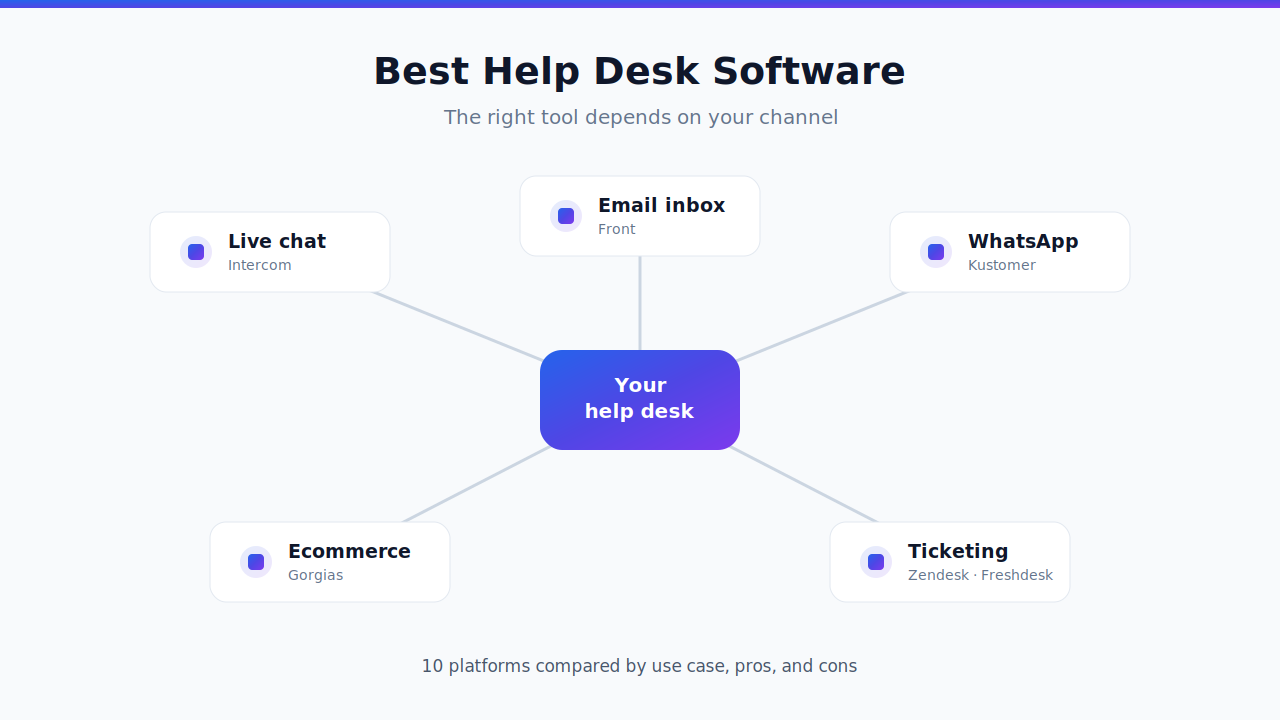
The best Zendesk competitors in 2026 are Intercom, Freshdesk, Front, Featurebase, Gorgias, and Kustomer. The right one depends on your team size, your existing stack, and how much of your support you want AI to actually resolve. This guide compares all 6 on real G2 ratings, verified starting prices, and best-fit use case — and then covers a different path: adding an agentic AI layer on top of the help desk you already run, instead of replacing it. For a wider market view, see our best help desk software guide.
Compiled by Alex Gomez, Sr. Analyst. Last updated 13 October 2026. Disclosure: this guide is published by Aissist.io, which sells an agentic AI layer for customer service and sales — a product that competes in the market described here. Aissist.io appears in this comparison as one of the products discussed. We hold no affiliate, referral or paid-placement relationship with any vendor on this page, and no vendor reviewed it before publication. Vendor figures are taken from each vendor's own published material where one exists; where none exists we say so rather than estimate.
Zendesk is a capable platform. Teams usually start shopping for a Zendesk alternative not because it is bad, but because pricing climbs as you add agents and AI, the setup carries more overhead than a small team needs, or a newer, more conversational or AI-native approach fits the way they work better. Whatever the trigger, the market is deep. Below is a neutral, data-backed comparison so you can shortlist quickly.
What changed since the last update. Two deals reshaped this market in 2026. Salesforce completed its acquisition of Fin, the company formerly called Intercom, on 10 September 2026. Zendesk bought Forethought and on 4 June 2026 began selling Forethought AI agents as a paid add-on. Both are reflected below, along with a new ownership and billing table.
Why teams look for a Zendesk alternative
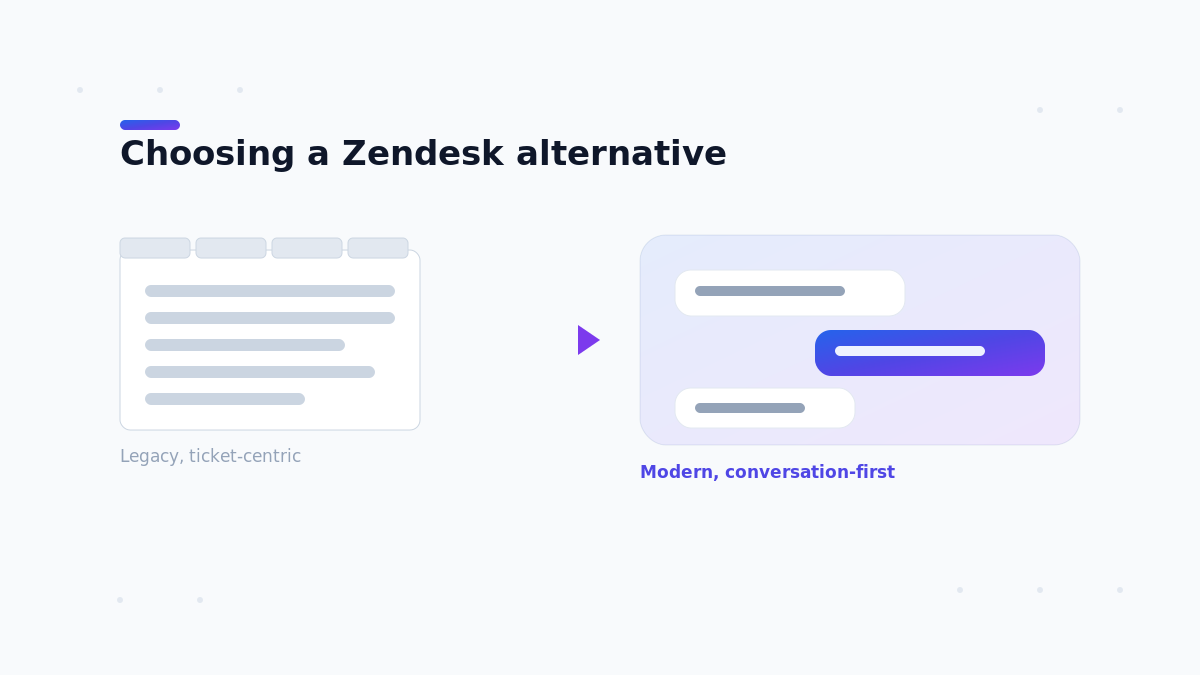
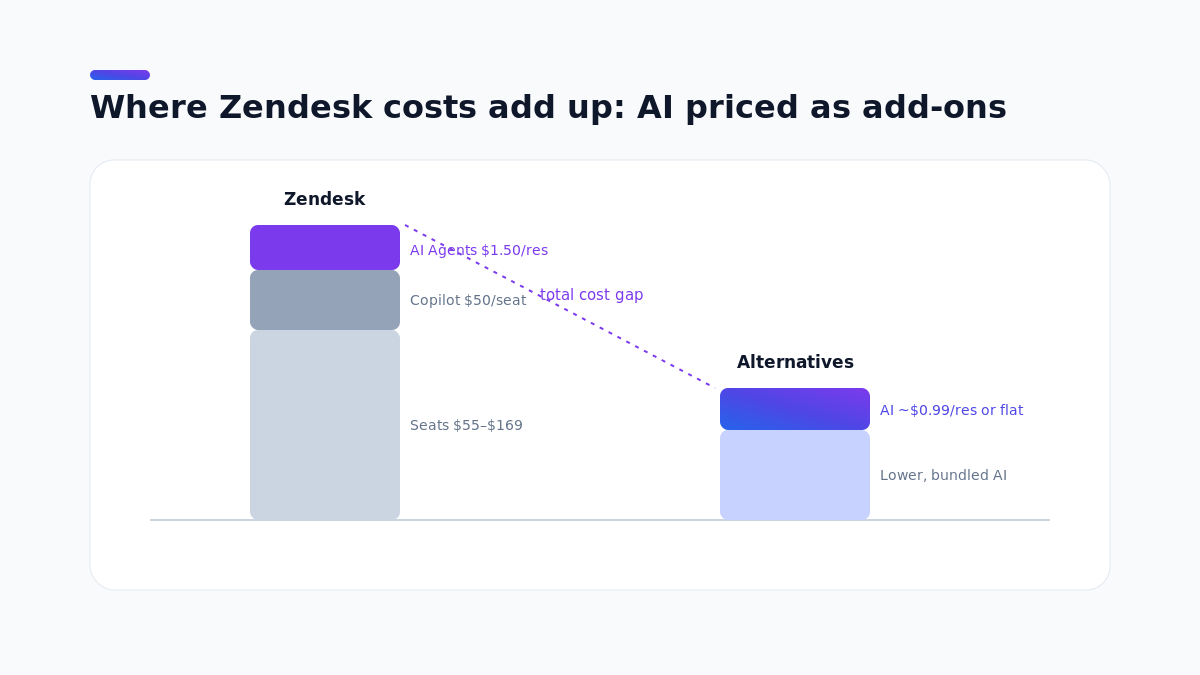
The reasons are consistent across the buyers we talk to. Cost is the most common: Zendesk's per-agent pricing is reasonable at the entry tier but rises quickly once you add higher plan levels and its AI resolution charges, which are metered separately — and since June 2026 Zendesk's most capable AI agents, the Forethought line, are sold as a further add-on whose price Zendesk does not publish. Complexity is the second: full ticketing suites carry configuration and administration overhead that a lean team does not need. The third is fit — ecommerce brands want native Shopify workflows, B2C teams want a customer-centric conversation view rather than a ticket queue, and EU teams want data residency and a more modern conversational model.
The fourth reason is the one reshaping the whole category in 2026: AI resolution rate. Buyers increasingly judge a platform less on how it stores tickets and more on how many conversations it can resolve end-to-end without a human. That single question changes the shortlist, because it splits the market into classic ticketing tools, AI- and conversation-first platforms, and a newer option — an AI layer that sits on top of whatever help desk you keep.
How we evaluated these Zendesk competitors
Every tool below is scored on four dimensions that actually decide the purchase:
- Price — the verified starting price per agent or seat, plus a note on where the real cost lands once AI and higher tiers are added.
- Market fit — the team size and business type each tool is genuinely built for, from SMB to enterprise, B2C to ecommerce.
- Ease of use / UI — how quickly a team can deploy and run it without heavy administration.
- AI and automation — how much of the resolution work the platform can take off your team, which is the fastest-growing decision factor for 2026.
Ratings shown are each product's overall G2 score and review count, re-verified 20 August 2026; prices are each vendor's published entry tier at annual billing. Both move over time, so treat them as a shortlist tool and confirm current numbers on the vendor's pricing page before you buy.
Zendesk competitors compared at a glance
| Platform | G2 rating | Starting price | Best fit |
|---|---|---|---|
| Zendesk (baseline) | 4.3 (7,044) | $19 / agent / mo | The incumbent you're comparing against |
| Intercom | 4.5 (3,904) | $29 / seat / mo + Fin AI usage | AI-first messaging for SaaS and digital teams |
| Freshdesk | 4.4 (3,766) | Free (≤2 agents); Growth $19 / agent / mo | Budget-conscious SMBs that will scale |
| Front | 4.7 (2,507) | $25 / seat / mo | Shared-inbox, operations-heavy teams |
| Featurebase | 4.7 | Free (1 seat); $29 / seat / mo annually + AI usage | Product-led SaaS teams wanting AI support and product feedback in one platform |
| Gorgias | 4.6 (575) | $10 / mo (50 tickets) | Ecommerce and Shopify brands |
| Kustomer | 4.4 (565) | No public rate card (Vendr: ~$89–$149 / agent / mo) | High-volume B2C support-as-CRM |
Pricing model, AI resolution and ownership (October 2026)
Entry prices hide the two numbers that decide most 2026 purchases: what the AI is billed on, and how much it actually resolves. This table puts the billing unit, any resolution rate the vendor publishes, and current ownership side by side. "Not published" means we found no resolution figure from the vendor as of 13 October 2026. Every published figure here is vendor-claimed; none comes with an independent audit.
| Vendor | What it actually does | Pricing model and billing unit | Published AI resolution rate | Ownership as of October 2026 |
|---|---|---|---|---|
| Zendesk (baseline) | Ticketing suite with Zendesk AI agents | Per agent per month; AI agents billed per automated resolution beyond the plan's allowance; Forethought add-on priced separately | Not published | Private — Hellman & Friedman and Permira since November 2022; bought Forethought in 2026, sold as an add-on from 4 June 2026 |
| Intercom (now Fin) | Messenger, help desk and the Fin AI agent | Per seat per month, plus $0.99 per Fin resolution | 76% average across 30,000+ customers (Salesforce, 10 September 2026) | Salesforce — acquisition completed 10 September 2026 |
| Freshdesk | Ticketing suite with Freddy AI Agent and Copilot | Per agent per month; Freddy AI Agent includes 500 sessions, then $49 per 100; Copilot $29/agent/mo | 50% average deflection, up to 80% for mature deployments (Freshworks CEO, 5 August 2026) | Freshworks Inc., publicly listed (Nasdaq: FRSH) |
| Front | Shared inbox and customer operations for B2B teams | Per seat per month; AI features vary by plan | Not published | Independent, venture-backed; acquired Windsor.io (2024) and Idiomatic (2024) |
| Featurebase | AI support, help center and product feedback in one tool | Per seat per month, plus $0.49 per AI resolution | Not published | Independent; no acquisition reported |
| Gorgias | Ecommerce help desk built around Shopify | Tiered by monthly ticket volume; AI Agent billed per automated resolution on top | Markets "60%+" automation as a best case, with no published method | Independent, venture-backed |
| Kustomer | Support-as-CRM on one customer timeline | Per seat, by quote only; AI billed separately | Not published | Independent since its May 2023 spin-out from Meta |
Two readings matter. Freshworks reports deflection, which counts conversations that never reached an agent, not conversations confirmed as solved — so it is not comparable to Fin's resolution figure. And Fin, Featurebase and Gorgias all bill their AI per resolution, as does Zendesk beyond the plan's allowance, so a higher resolution rate raises the bill as well as lowering headcount; our AI agent pricing benchmark and price comparison tool model that trade-off on your own volume.
The 6 best Zendesk competitors and alternatives
1. Intercom — best for AI-first messaging
Intercom has repositioned around Fin, its AI agent, and is now one of the strongest AI-native Zendesk alternatives. It pairs a modern messenger, a help center, and outbound messaging with an AI agent that resolves a meaningful share of conversations. Best for: SaaS, fintech, and digital-first teams that live in chat. Pricing: from $29/seat/mo on Essential, with Fin billed per resolution — the AI is where the real cost sits. Pros: excellent messaging UX, strong AI resolution, one platform for support and engagement. Cons: usage-based AI pricing can be hard to forecast; less suited to heavy email/phone queues. G2: 4.5 (3,904). Ownership: Intercom renamed itself Fin, and Salesforce completed the acquisition on 10 September 2026; Fin's Zendesk and other help desk integrations remain live, but buyers should ask how the roadmap and pricing will sit alongside Salesforce's own Agentforce. Our Intercom Fin review covers what the deal changes. For a deeper look, see our Intercom alternatives guide and the Intercom integration.
2. Freshdesk — best budget Zendesk alternative that scales
Freshdesk (from Freshworks) is the most common like-for-like Zendesk swap: a full ticketing suite covering email, chat, phone, and social, at a gentler price. Best for: budget-conscious SMBs and mid-market teams that want room to grow. Pricing: free for up to two agents, with paid plans from $19/agent/mo on Growth and $55 on Pro (annual); Freddy AI Agent includes 500 sessions, then $49 per 100. Pros: broad feature set, generous free tier, easy onboarding. Cons: the best automation and AI sit on higher tiers; the interface can feel dense as you scale. G2: 4.4 (3,766). Freshdesk is the answer to most "which is better, Zendesk or Freshdesk" comparisons for cost-sensitive teams. More on the Freshdesk integration. If Freshdesk is your likely swap, our Freshdesk alternatives guide compares it against eight others.
3. Front — best shared-inbox alternative
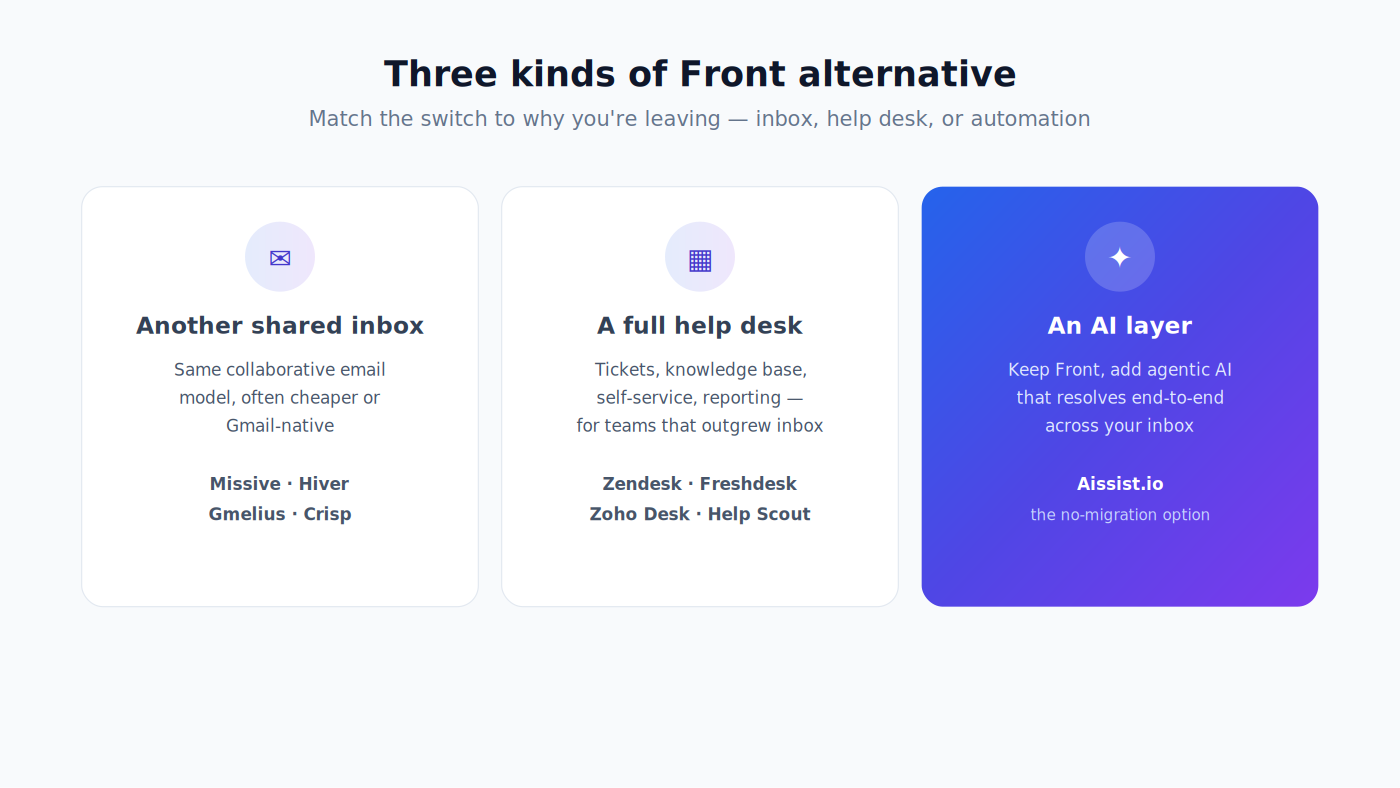
Front reimagines support as a collaborative shared inbox rather than a ticket queue, which resonates with teams that treat email and messaging as real conversations. Best for: operations-heavy, collaborative teams and B2B support. Pricing: from $25/seat/mo on Starter. Pros: outstanding collaboration UX, strong reviews, fast to adopt. Cons: less of a traditional ticketing/knowledge-base powerhouse; AI is comparatively newer. G2: 4.7 (2,507) — among the highest-rated tools here. See the Front integration. If Front is the one you are seriously weighing, our Front alternatives guide compares it against seven others.
4. Featurebase — best for AI support and product feedback
Featurebase is a modern AI customer support platform for product-led SaaS that combines AI-powered support, help center, and feedback management in one place. Fibi AI Agent resolves customer issues on autopilot, while AI Copilot helps your team answer faster. Best for: SaaS teams that want support, feature requests, and product updates in one platform. Pricing: free for 1 seat; paid plans from $29/seat/mo annually, plus $0.49 per AI resolution. Pros: unified support and feedback, built-in public roadmaps and changelog, AI agent and Copilot. Cons: no AI on the free plan; workflows and SLAs require higher tiers. G2: 4.7/5.
5. Gorgias — best for ecommerce
Gorgias is purpose-built for ecommerce, with native Shopify, order data, and revenue-attribution baked into the help desk so agents resolve and sell in one view. Best for: Shopify and DTC brands. Pricing: from $10/mo on Starter (capped at 50 tickets), scaling by ticket volume. Pros: deep ecommerce integrations, revenue tracking, strong automation for order-status questions. Cons: ticket-based pricing can jump with volume; narrow fit outside ecommerce. G2: 4.6 (575). See the Gorgias integration. If ecommerce is your use case, our Gorgias alternatives guide goes deeper on the field.
6. Kustomer — best support-as-CRM for high volume
Kustomer treats support as a CRM, giving agents a single timeline of the whole customer relationship rather than isolated tickets. Best for: high-volume B2C brands that want a unified customer view. Pricing: no public rate card — quotes run roughly $89–$149/agent/mo according to procurement data from Vendr, and AI features cost extra. Pros: powerful data model, strong automation, built for scale. Cons: pricing and minimums put it out of reach for small teams. G2: 4.4 (565). See the Kustomer integration. If the seat minimum is the blocker, our Kustomer alternatives guide covers cheaper routes to the same model.
A different path: add an AI layer instead of switching platforms
Every option above asks you to migrate — move your tickets, retrain your team, and rebuild your workflows on a new platform. That is the right move for some teams. But if the reason you're leaving Zendesk is really about resolution and cost, not the help desk itself, there's a second path worth knowing about.
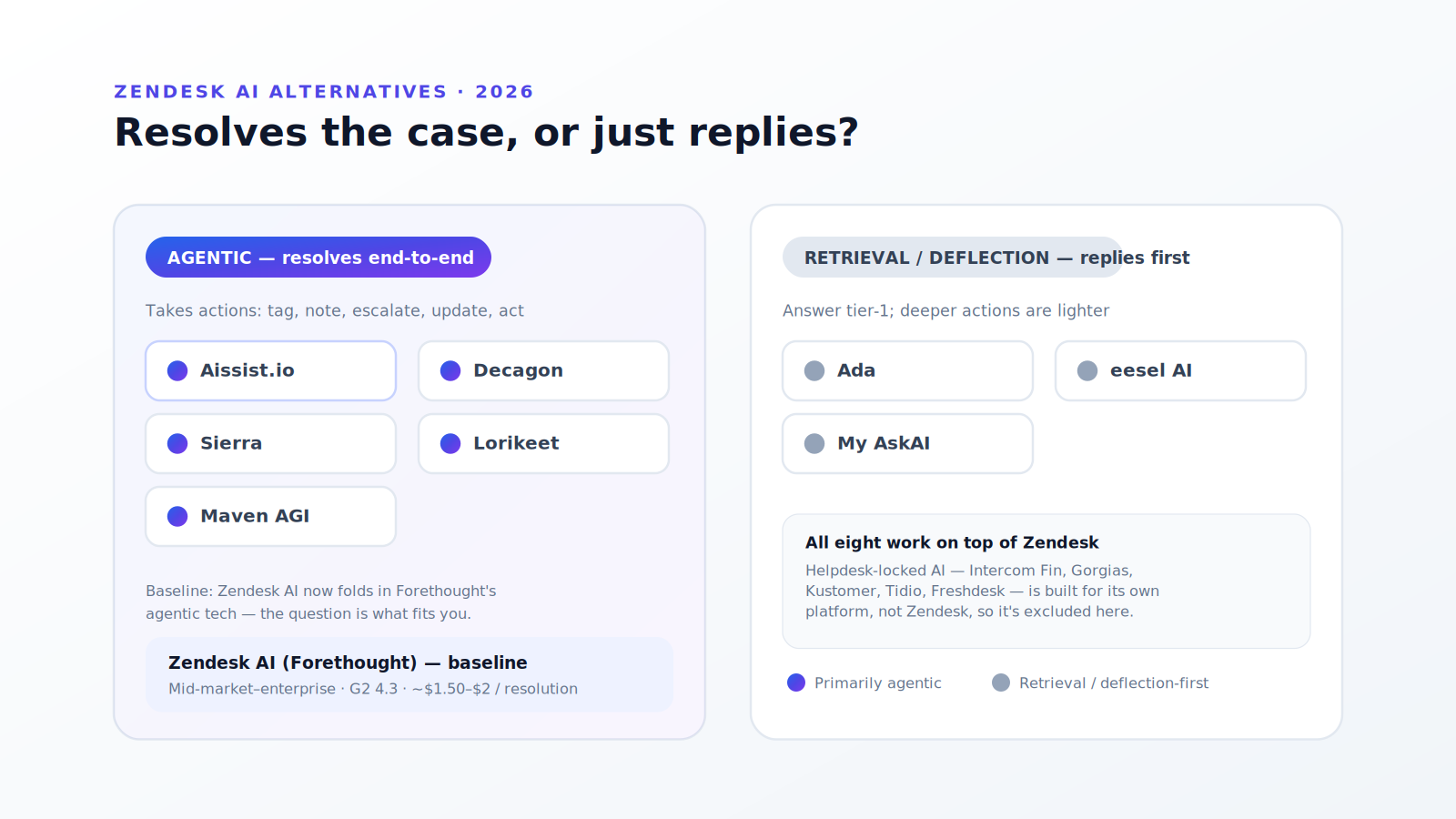
Aissist.io is an AI Operational Layer that sits on top of the help desk you already run — Zendesk, Intercom, Freshdesk, Salesforce, HubSpot, and others — and resolves support and sales conversations end-to-end. Instead of a rip-and-replace, its AgentMesh™ multi-agent workforce plugs into your existing stack, Pulse™ reads every ticket and agent in real time, and Evolve™ keeps improving the operation. It's an agentic system built on multi-agent reasoning with governance and human escalation, not a legacy FAQ chatbot that deflects and breaks on complexity.
Best for: teams that like their help desk but want dramatically higher automated resolution without a migration. Pricing: usage-based, as low as ~$0.60 per resolution. Pros: keep your current platform, deploys in about 10 minutes, resolves rather than deflects, and reports 83% average resolution with 4.8/5.0 CSAT on automated support. G2: 4.9/5 from 45 reviews, AI Verified, as of 7 October 2026 (G2 reviews) — the highest rating in this comparison, though from a far smaller review base than the incumbents. Cons: it's an automation layer, not a standalone ticketing system — you keep a help desk underneath it, so it complements a platform choice rather than replacing one. If your shortlist is really a search for better AI resolution, it's worth weighing against the migration options above. See the AI customer service benchmark for how resolution rates compare.
How to choose the right Zendesk competitor
Start from your constraints, not the feature lists. If budget leads, Freshdesk delivers the most capability per dollar. If fit leads, match the tool to your business: Gorgias for ecommerce, Front for collaborative shared-inbox teams, Kustomer for high-volume B2C, Featurebase for product-led SaaS teams that want support and product feedback in one place. If simplicity leads, Front gets a small team live fastest.
If AI resolution is the real driver — as it is for most 2026 buyers — the decision splits in two. Choose an AI-first platform like Intercom if you're willing to migrate, or add an agentic AI layer over your current help desk if you're not. Run a short pilot on your own ticket data before committing: entry prices are only the starting line, and the number that matters is how many conversations each option resolves without a human, at what real cost per resolution once AI is switched on. If ownership is part of the risk — Fin now inside Salesforce, Forethought inside Zendesk — weigh how easily you could leave each tool; our guide to AI customer service vendor lock-in covers what to put in the contract.
Key takeaways
There is no single best Zendesk alternative — there's a best one for your team size, stack, and resolution goals. For value, look at Freshdesk; for ecommerce, Gorgias; for high-volume B2C, Kustomer; for AI-first messaging, Intercom; and for product-led SaaS that wants support and feedback together, Featurebase. And remember the newer option: if your goal is higher automated resolution rather than a different ticket queue, an agentic AI layer can deliver that on the help desk you already have. Shortlist two or three, pilot them on real tickets, and decide on resolution rate and true cost — not the sticker price.
Keep your help desk, upgrade the resolution. Aissist.io adds an agentic AI layer to Zendesk and every major alternative — resolving support and sales end-to-end, no migration required. Get a free demo →
Sources
Every price above was read from the vendor's own pricing page in August 2026; the ownership and resolution columns were checked on 13 October 2026. Prices move; confirm before you buy.
- Zendesk · Intercom · Freshdesk · Front · Featurebase · Gorgias
- Kustomer publishes no rate card. Its pricing page routes buyers to an assessment form; the range shown is from procurement aggregator Vendr, not from Kustomer.
- Gorgias renders its plan table client-side, so a plain fetch of the pricing URL shows no figures. The Gorgias link above therefore points to its published AI-agent pricing post rather than the interactive calculator.
- Ownership and acquisitions: Salesforce's completion release for Fin (10 September 2026, also the source of the 76% figure); Zendesk's Forethought add-on announcement (4 June 2026); the Hellman & Friedman and Permira completion release (November 2022); Kustomer's standalone announcement (May 2023).
- Freshdesk deflection: Freshworks CEO Dennis Woodside, as reported by CX Today on 5 August 2026.
- G2 ratings and review counts for the vendors were re-verified 20 August 2026 on G2; Aissist.io's rating was read on 7 October 2026.
Frequently asked questions
Who are Zendesk's main competitors?
Zendesk's main competitors are Intercom and Freshdesk, alongside specialized tools like Featurebase for product-led SaaS, Gorgias for ecommerce, Front for shared inboxes, and Kustomer for high-volume B2C. The strongest alternative for a given team depends on budget, existing stack, and how much AI-driven resolution it needs.
What is the best Zendesk alternative in 2026?
There's no universal best — it depends on fit. Freshdesk is the best value swap, Intercom (now Fin) leads on AI-first messaging, Gorgias wins for ecommerce, and Featurebase suits product-led SaaS that wants support and feedback together. Teams chasing automated resolution rather than a new ticket queue increasingly add an agentic AI layer to the help desk they keep.
Who owns Intercom now?
Salesforce. Intercom renamed itself Fin, and Salesforce completed the acquisition on 10 September 2026. Fin still sells its AI agent and help desk, and its integrations with Zendesk and other help desks remain live. The open question for buyers is how Fin's roadmap and per-resolution pricing will sit alongside Salesforce's own Agentforce.
Did Zendesk buy Forethought?
Yes. Zendesk acquired Forethought in 2026 and, from 4 June 2026, sells Forethought AI agents as a paid add-on to Zendesk plans; Forethought also remains available to non-Zendesk customers. Zendesk does not publish the add-on's price, so get a written quote before comparing it with alternatives.
Which is better, Zendesk or Freshdesk?
For most cost-sensitive small and mid-sized teams, Freshdesk: similar core help desk features at a lower price, with a free plan for up to two agents and paid plans from $19/agent/mo. Zendesk wins on marketplace breadth and enterprise scale. Choose Freshdesk if price and setup speed lead, Zendesk if you need deep enterprise features.
Is there a free Zendesk alternative?
Partly. Freshdesk has a free plan for up to two agents, and Featurebase is free for one seat, without AI. On every option, advanced automation and AI need a paid tier.
How much does Zendesk cost compared to alternatives?
Zendesk starts at $19/agent/mo, rising with higher plans, metered AI resolutions and the separately priced Forethought add-on. Alternatives run from free tiers (Freshdesk, Featurebase) to $25/seat for Front and $29/seat for Intercom and Featurebase; Kustomer publishes no rate card. The real gap appears once AI is on, because most vendors bill it per resolution.
What are the best Zendesk alternatives for ecommerce?
Gorgias is the leading ecommerce-focused Zendesk alternative, with native Shopify integration, order data in the agent view, and revenue attribution. Kustomer is a strong choice for larger B2C and retail brands that want a unified customer conversation. For Shopify stores specifically, Gorgias's ecommerce automation for order-status and returns questions is the key differentiator.
Can AI replace my Zendesk agents?
Not entirely. Modern agentic AI resolves a large share of routine support and sales conversations end-to-end and escalates complex ones to people. The practical 2026 model is AI handling volume and repetitive work under governance and human oversight, while agents focus on complex, high-value and relationship-driven conversations.
Do I have to migrate off Zendesk to improve AI resolution?
No. You can switch to an AI-first platform such as Intercom (now Fin), or add an agentic AI layer such as Aissist.io on top of Zendesk or another help desk. The layered route avoids a migration: you keep your platform and workflows while the AI resolves conversations end-to-end, which is why teams evaluate it alongside replacements.