Front Alternatives: 6 Help Desks and AI Agents Compared by Price, Ownership and Resolution
The best Front alternatives in 2026 are Aissist.io, Help Scout, Freshdesk, HubSpot Service Hub, Fin and Zendesk. Whether you call it the Front app or Frontapp, the useful question is no longer which inbox is nicest; it is what each vendor's AI meter counts and who owns it.
TL;DR: Front's seats run $25–$105 a month, but on our 10-agent scenario the AI meter swings the bill by more than $2,000 a month — and Front's own Autopilot, listed from $0.05 per conversation, is the price to beat.
Methodology & sources
- G2 scores and review counts come from each product's G2 reviews page; prices on each vendor's own pricing page.
- Resolution figures are vendor-published; none is independently audited. Deflection is labelled as deflection. "Not published" means we found no average.
- Ownership comes from company releases and funding records.
- All figures verified 19 October 2026.
- Disclosure: this is Aissist's blog, and Aissist sells an AI agent that runs on Front and competes with every AI product here. No vendor reviewed this page, and we hold no affiliate or paid-placement relationships.
Why are teams looking for a Front alternative?
Seat costs, scope and AI pricing. Front's pricing page lists Starter at $25 per seat a month (capped at 10 seats), Professional at $65 (up to 50 seats) and Enterprise at $105, billed annually. Copilot adds $20 per seat on the first two plans. Growing past ten agents means moving to Professional, which more than doubles the seat bill.
Scope is the second reason. Front positions itself as a customer operations platform for B2B teams; buyers who want a full ticketing help desk, a CRM-native service tool or an e-commerce desk look elsewhere. Reviewers also flag gaps in the core inbox.
"The biggest issue I've found with Front has been personal inboxes." — Charlie M., small-business reviewer, G2 review of Front
Front itself is well liked: 4.6/5 from 2,520 G2 reviews. Its AI agent, Autopilot, went from "contact us" to a public $0.05-per-conversation starting rate in June 2026, according to PricingSaaS's change log. Front's Autopilot announcement says its Playbooks and Resolve features are enabled by Front's team via a waitlist.
How do the six Front alternatives compare at a glance?
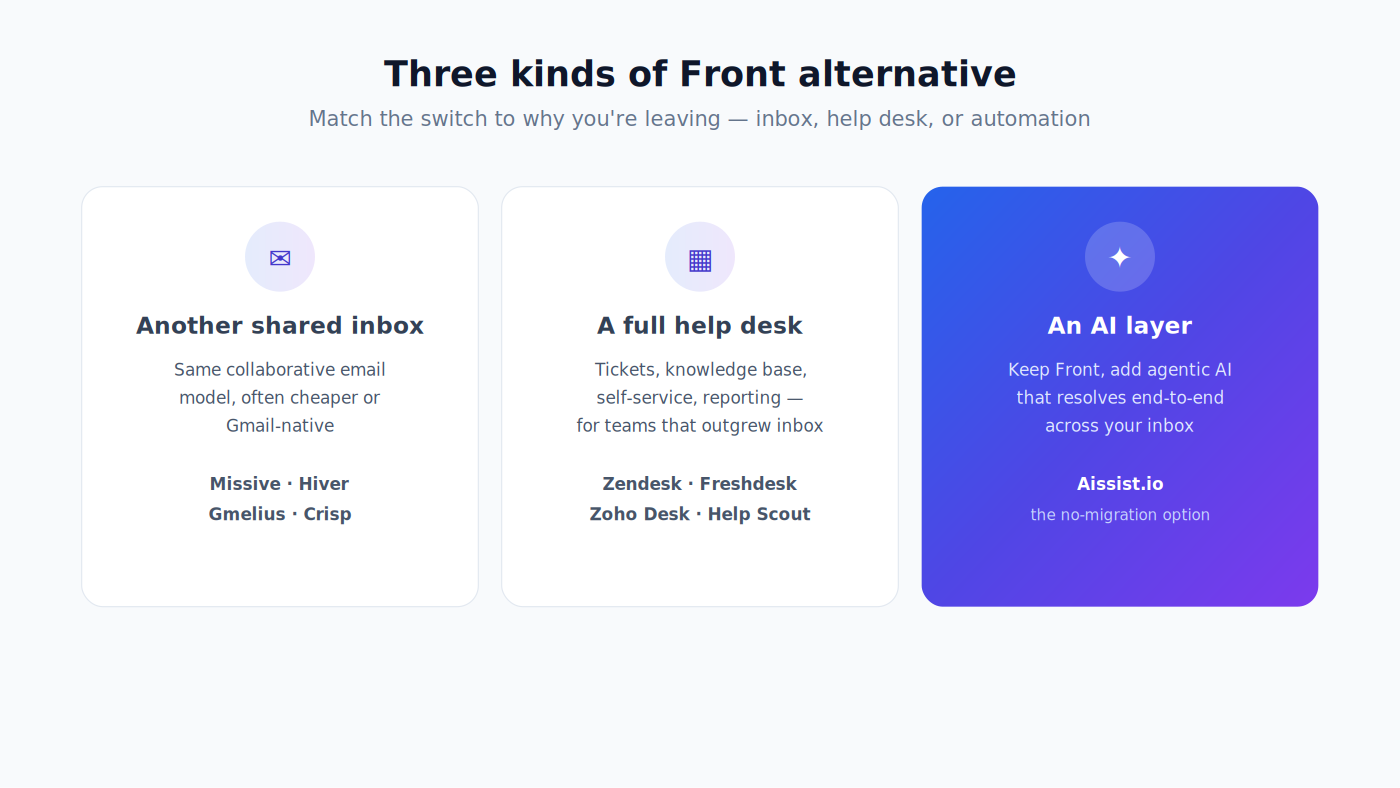
Four replace Front; two can run on top of it. That split decides whether you migrate at all.
| Platform | Best for | Type | Runs on Front | G2 rating (n), Oct 2026 |
|---|---|---|---|---|
| Front (baseline) | B2B teams in shared email | Shared inbox + AI agent | — | 4.6 (2,520) |
| Aissist.io | Keeping Front, adding resolution | AI agent layer | Yes | 4.9 (45) |
| Help Scout | Small email-first teams | Help desk | No, replaces it | 4.4 (431) |
| Freshdesk | Budget full help desk | Help desk | No, replaces it | 4.4 (3,817) |
| HubSpot Service Hub | HubSpot CRM teams | CRM help desk | No, replaces it | 4.4 (3,018) |
| Fin | AI-first support on any desk | AI agent (+ optional help desk) | Via other desks | 4.5 (3,927) |
| Zendesk | Enterprise ticketing | Help desk | No, replaces it | 4.3 (7,102) |
Pricing model, AI resolution and ownership (October 2026)
The seat price is the number buyers compare; the AI billing unit is the one that moves the invoice. Every resolution figure below is the vendor's own.
| Vendor | What it actually does | Pricing model and billing unit | Published AI resolution rate | Ownership as of October 2026 |
|---|---|---|---|---|
| Front | Shared inbox and customer operations platform | $25 / $65 / $105 per seat/month; Autopilot from $0.05 per conversation | Not published | Independent, venture-backed; acquired Windsor.io (Jan 2024) and Idiomatic (Nov 2024) |
| Aissist.io | Multi-agent AI layer on Front or other desks | $0.20–$0.60 per resolution by channel; handoffs free; 1,000 free tickets/month | 83% average, 4.8/5.0 CSAT | Independent (Aissistant Inc.) |
| Help Scout | Email-first help desk | $25 / $45 / $75 per user/month; AI Answers $0.75 per resolution | 73.19% average (AI Answers) | Independent, private (Help Scout PBC) |
| Freshdesk | Full ticketing help desk | $19 / $55 / $89 per agent/month; 500 AI sessions included, then $49 per 100 sessions | 50% average deflection, up to 80% mature | Freshworks Inc. (Nasdaq: FRSH) |
| HubSpot Service Hub | Help desk inside HubSpot CRM | $90–$100 per seat (Professional); Customer Agent 50 credits ($0.50) per resolved conversation | 70% of conversations resolved autonomously (not stated as an average) | HubSpot Inc. (NYSE: HUBS) |
| Fin | AI agent for any help desk | $0.99 per outcome; 50-outcome monthly minimum on other desks; Intercom help desk from $29/seat | 76% average | Salesforce — acquisition completed 10 Sep 2026 |
| Zendesk | Ticketing suite with AI agents | Suite Team $55 per agent; 5–10 automated resolutions included per agent, then $1.50 committed or $2.00 pay-as-you-go | "Up to 80%+" (ceiling, not average) | Private (Hellman & Friedman and Permira since Nov 2022) |
Sources: Front pricing, Front on Windsor.io, Front's Idiomatic release, Aissist pricing, Help Scout pricing, Help Scout AI features, Freshdesk pricing, CX Today on Freshworks, HubSpot pricing, HubSpot credit catalog, CX Today on HubSpot, Fin pricing, Salesforce's Fin completion release, Zendesk pricing.
Read the unit, not just the rate. Front and Freshdesk meter conversations or sessions, resolved or not. Help Scout, HubSpot, Zendesk and Aissist meter resolutions. Fin's outcome includes configured handoffs.
The 6 best Front alternatives
1. Aissist.io — best for keeping Front
Aissist.io is an AI agent layer that resolves support and sales conversations end-to-end inside Front, Zendesk, Intercom, Freshdesk, Salesforce, HubSpot, Kustomer or Gorgias without a migration. Aissist reports 83% average resolution and 4.8/5.0 CSAT.
- Pros: published per-resolution price with free handoffs; no inbox migration.
- Cons: 45 G2 reviews is a thin base; reviewers ask for deeper reporting and UI customization. It is a layer, not a help desk, so Front seats remain.
"If your documentation is messy, the AI will reflect that." — Nathaniel E., Co-Founder, G2 review of Aissist.io
Our take: skip it if seat cost, not resolution, is your problem.
2. Help Scout — best for small email-first teams
Help Scout is an email-first help desk with a free plan for five users and AI Answers billed per resolution. Help Scout reports a 73.19% average resolution rate for AI Answers; eCatholic's Luke Tristani, Director of Onboarding & Success, credits it with "empowering customers to find answers on their own."
- Pros: closest feel to Front; resolution-only AI billing with a spending cap.
- Cons: $0.75 per resolution is above Aissist's and HubSpot's rates; lighter on B2B account workflows.
Our take: skip it if your team lives in shared B2B threads with many collaborators.
3. Freshdesk — best budget full help desk
Freshdesk is Freshworks' ticketing help desk, from $19 per agent a month with 500 Freddy AI Agent sessions included. Freshworks CEO Dennis Woodside told CX Today that Freddy deflection averages 50% and that "over 7,000 customers are paying for an AI SKU."
- Pros: lowest seat price here; AI sessions bundled.
- Cons: sessions bill whether resolved or not; a published deflection figure is not a resolution rate.
Our take: skip it if you want to pay only for resolved conversations. See our Freshdesk competitors guide.
4. HubSpot Service Hub — best for HubSpot CRM teams
HubSpot Service Hub is a help desk built into HubSpot CRM, with a Customer Agent that consumes 50 credits ($0.50) per resolved conversation. CX Today reported in May 2026 that it resolves 70% of support conversations autonomously; CEO Yamini Rangan says customers start with "after-hours or weekend augmentation."
- Pros: CRM context in every ticket; 3,000 credits included on Professional.
- Cons: Professional is $90–$100 per seat plus a required $1,500 onboarding fee; value drops outside HubSpot.
Our take: skip it if your CRM is not HubSpot.
5. Fin — best for AI-first support at scale
Fin, formerly Intercom, is an AI customer agent that runs on Intercom's own help desk or on Zendesk, Salesforce, HubSpot and others. Salesforce's completion release cites a 76% average resolution rate and more than 30,000 customers.
- Pros: deepest AI review base here; transparent $0.99 outcome price.
- Cons: outcome billing includes configured handoffs, so spend is harder to forecast; now a Salesforce product.
Our take: skip it if you chose Front to avoid a CRM giant. More in our Intercom alternatives guide.
6. Zendesk — best for enterprise ticketing
Zendesk is a ticketing suite with AI agents included in every Suite plan and billed per automated resolution. Zendesk markets resolution of "up to 80%+", a ceiling rather than an average.
- Pros: deepest G2 base (7,102 reviews); published per-resolution rates.
- Cons: AI meter stacks on $55 Suite seats; heavier setup than Front.
Our take: skip it below 20 agents. Our Zendesk competitors guide covers the trade-offs.
What do these alternatives actually cost?
On the same volume, the monthly bill runs from about $350 to $2,850. One scenario through each published rate card: 2,000 chat conversations a month, 1,200 resolved by AI, 10 agents. List prices; taxes and discounts excluded.
| Vendor | AI cost, 1,200 resolutions (Oct 2026) | Seats, 10 agents | Monthly total |
|---|---|---|---|
| Front + Autopilot | From $100 (all 2,000 conversations at the $0.05 starting rate) | $250 (Starter) – $650 (Professional) | From $350–$750 |
| Aissist.io on Front | Up to $720 (chat cap $0.60; handoffs free) | Keeps Front seats ($250+) | Up to $970 |
| Freshdesk (Growth) | $735 (1,500 sessions beyond 500 included, one session per conversation) | $190 | $925 |
| Help Scout (Standard) | $900 | $250 | $1,150 |
| Fin on Intercom desk | $1,188, plus any billable handoff outcomes | From $290 | From $1,478 |
| HubSpot (Professional) | $570 (60,000 credits less 3,000 included) | $900–$1,000 + $1,500 one-time onboarding | $1,470–$1,570 |
| Zendesk (Suite Team) | $1,725–$2,300 after 50 included resolutions | $550 | $2,275–$2,850 |
Front's own Autopilot is the price to beat — if the $0.05 starting rate applies at your volume and your workflows clear its waitlist. Ask Front for a written rate before migrating anywhere. Our price comparison tool runs these meters on your own numbers.
How to choose the right Front alternative
- If your only complaint is seat cost, choose Freshdesk or Help Scout, because their seats start at $19–$25 with AI included or metered per resolution.
- If you want more resolution without migrating, test Front's Autopilot against Aissist.io, because both run inside your current inbox.
- If HubSpot is your CRM, choose Service Hub, because CRM context beats a cheaper seat.
- If you need enterprise ticketing, choose Zendesk; if you want AI-first support, Fin.
The meter, not the seat, decides what Front costs to replace
Every product here can run a support team; what separates them is the billing unit. Per-conversation meters look cheapest until resolution rates are low; per-resolution meters charge only for work done. Price your volume on each meter, check who owns the vendor, and pilot two finalists on your own tickets.
Frequently asked questions
Is the Front app the same as Frontapp?
Yes. Frontapp is a common name for Front, from its original frontapp.com domain; the company now operates at front.com. It sells Starter, Professional and Enterprise plans at $25, $65 and $105 per seat a month, billed annually.
How much does Front's AI cost?
Front lists Autopilot, its AI agent, from $0.05 per conversation, and Copilot at $20 per seat a month on Starter and Professional; Enterprise includes Copilot. Autopilot bills conversations, not resolutions.
Who owns Front?
Front is independent and venture-backed, with investors including Sequoia Capital. It acquired Windsor.io in January 2024 and Idiomatic in November 2024. We found no acquisition of Front.
What is the cheapest Front alternative?
On published seat prices, Freshdesk at $19 per agent. On published per-resolution AI rates, Aissist.io at $0.20–$0.60, then HubSpot at $0.50 and Help Scout at $0.75.
Who owns Fin, the former Intercom?
Salesforce. Intercom renamed itself Fin, and Salesforce completed the acquisition on 10 September 2026. Fin still runs on other help desks, including Zendesk and HubSpot.
Is Help Scout better than Front?
For small email-first teams, often. Help Scout has a five-user free plan and resolution-only AI at $0.75. On G2, Help Scout scores 4.4 from 431 reviews; Front 4.6 from 2,520.
Changelog
- 19 Oct 2026 — Added the pricing, resolution and ownership table, Front's Autopilot pricing, Fin's sale to Salesforce and a cost scenario. Re-read all G2 figures. Removed Zoho Desk (no USD rates on its public page), Gorgias (no readable public rates) and Kustomer (no public rate card).