
Reliability is the concern that decides whether AI reaches production.

Most AI pilots do not stall on capability. They stall on trust. When companies are asked what blocks them from scaling AI in real operations, reliability sits at the top of the list, ahead of cost, integration, and talent.
The 2025 World Quality Report, from OpenText, Capgemini, and Sogeti, found that hallucination and reliability concerns were a top adoption challenge for 60% of organizations, alongside data privacy (67%) and integration complexity (64%). Separately, Gong's 2026 research found that 58% of companies had stalled AI projects, and that 46% of planned AI investments were held back specifically by trust concerns — not budget. The pattern is consistent across surveys: enthusiasm is high, but confidence is not keeping pace.
The reason is simple. A demo only has to work once. A production system has to work every time, on inputs no one anticipated, in front of customers, under policy and compliance obligations. That is a different bar, and it is the bar reliability has to clear.
In real operations, one error can cost more than many successes are worth.
Business use cases are asymmetric. The value of a single correct answer is usually small and bounded — one resolved ticket, one accurate summary. The cost of a single wrong answer can be large and unbounded — a refund approved against policy, a fabricated commitment made to a customer, an incorrect compliance statement, account details given to someone who never proved who they are. When the downside of being wrong dwarfs the upside of being right, average accuracy is the wrong thing to optimize. What matters is how bad the worst outputs are, and how often they slip through.
There is a second, quieter cost. Not every weak output is a hard "error," but inconsistent quality erodes confidence just as effectively. A support agent who catches the AI being wrong once will start double-checking everything it produces — which erases the efficiency the AI was meant to deliver. A customer who receives one robotic or subtly incorrect answer discounts every answer that follows. Trust is not scored on a single interaction; it is cumulative, and it is fragile. Once it breaks, adoption quietly stops, even if the system is right most of the time.
This is why reliability cannot be treated as a finishing step. It has to be engineered into how the system produces every output.
Even the strongest models hallucinate — and the honest numbers are higher than most expect.
A hallucination is content that is fluent, confident, and wrong. It is a structural property of how large language models generate text, not a bug that a better prompt fully removes. The rate varies widely by model and by task, but it is never zero.
The clearest way to see this is on grounded summarization — a task where the model is handed the source text and instructed to use only that. It is the closest analogue to how AI is used in customer service and RAG pipelines: given your help docs, answer from them. It is also the easy case, because the facts are right there. Even so, models fabricate.
Vectara's Hallucination Leaderboard, which scores models with its HHEM evaluation model, shows the spread as of May 2026:
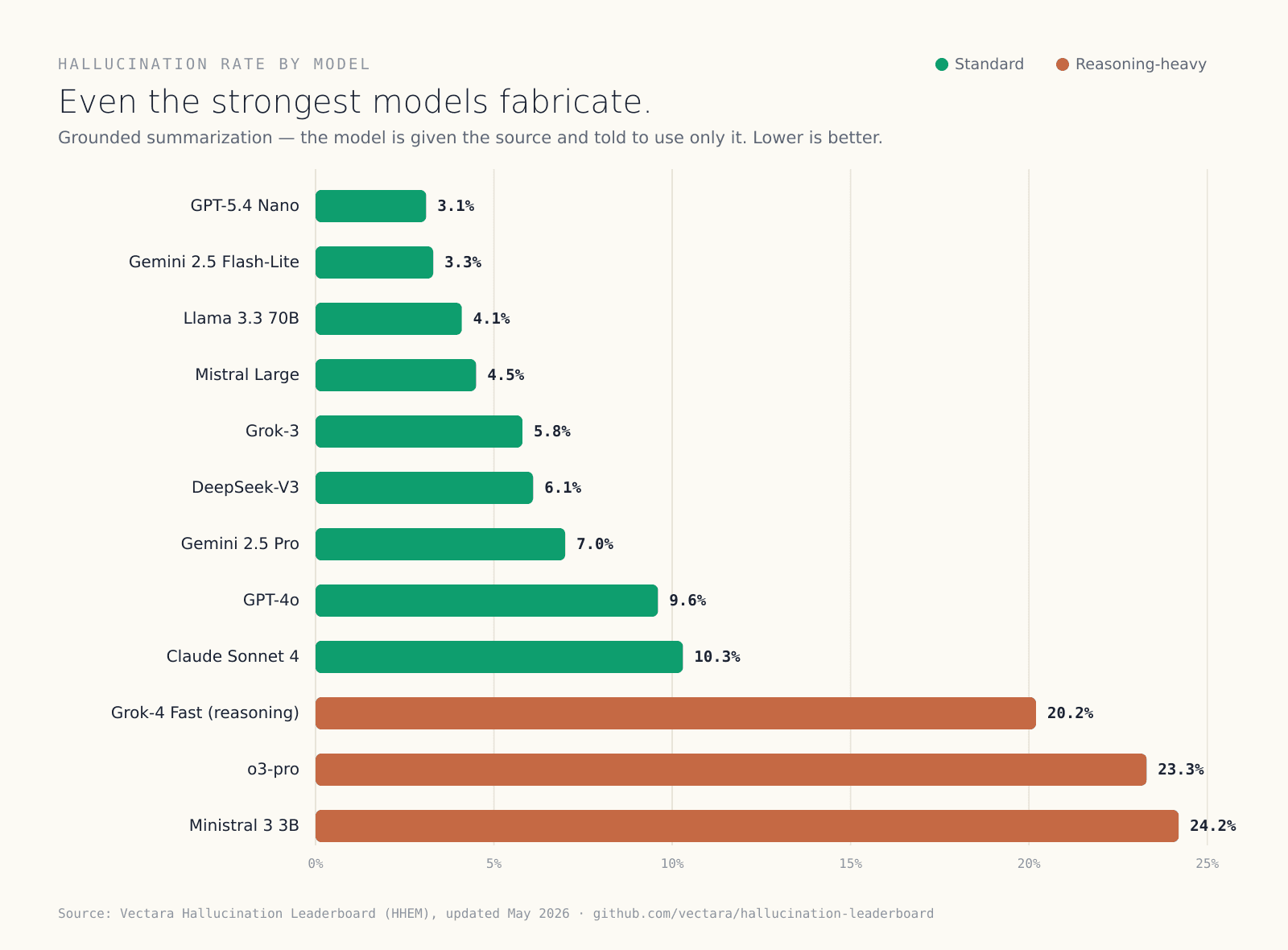
The best models sit around 3%. Familiar flagships cluster between 6% and 15%. Some reasoning-heavy models climb past 20% on the same grounded task, because deeper reasoning gives the model more room to introduce claims the source never made. And this is the favorable setting. When models answer open-ended questions without a source to anchor them, rates rise sharply: Stanford's RegLab and Human-Centered AI Institute found that leading models hallucinate on 69% to 88% of specific legal queries, and on at least 75% of questions about a court's core holding.
The takeaway is not that any one model is bad. It is that no single model, on its own, is reliable enough for high-stakes business operations. A number in the single digits sounds small until you multiply it by the volume of a real support queue — and remember that the cost of those few outputs is not evenly distributed.
Why is reliability a tradeoff between intelligence and controllability?
This is a classic tradeoff in machine learning, and it shows up clearly in AI applications. As systems become more capable, they also become harder to control perfectly.
Intelligence means more than recalling known answers. It means extending from known information into unfamiliar cases, recognizing unclear patterns, and making useful decisions when the input is incomplete. Those are exactly the qualities that make advanced AI valuable.
But those same qualities also increase unpredictability. A system that can think beyond rigid instructions can also make mistakes beyond rigid instructions.
That is why a powerful AI will never be one hundred percent reliable. Reliability can keep improving, and major mistakes can be reduced sharply, but perfect predictability comes only by limiting the intelligence itself. So the practical question is not how to make AI perfect. It is how to make its behavior predictable where that matters, and its mistakes safe where they would be expensive — two different engineering problems.
What is reliable AI? Predictability plus safety.
Reliable AI is AI a business can depend on in production: it consistently produces the outcome the business wants, and it never releases sensitive information or executes a sensitive action it should not. We split that into two properties, because they fail differently and are fixed differently.
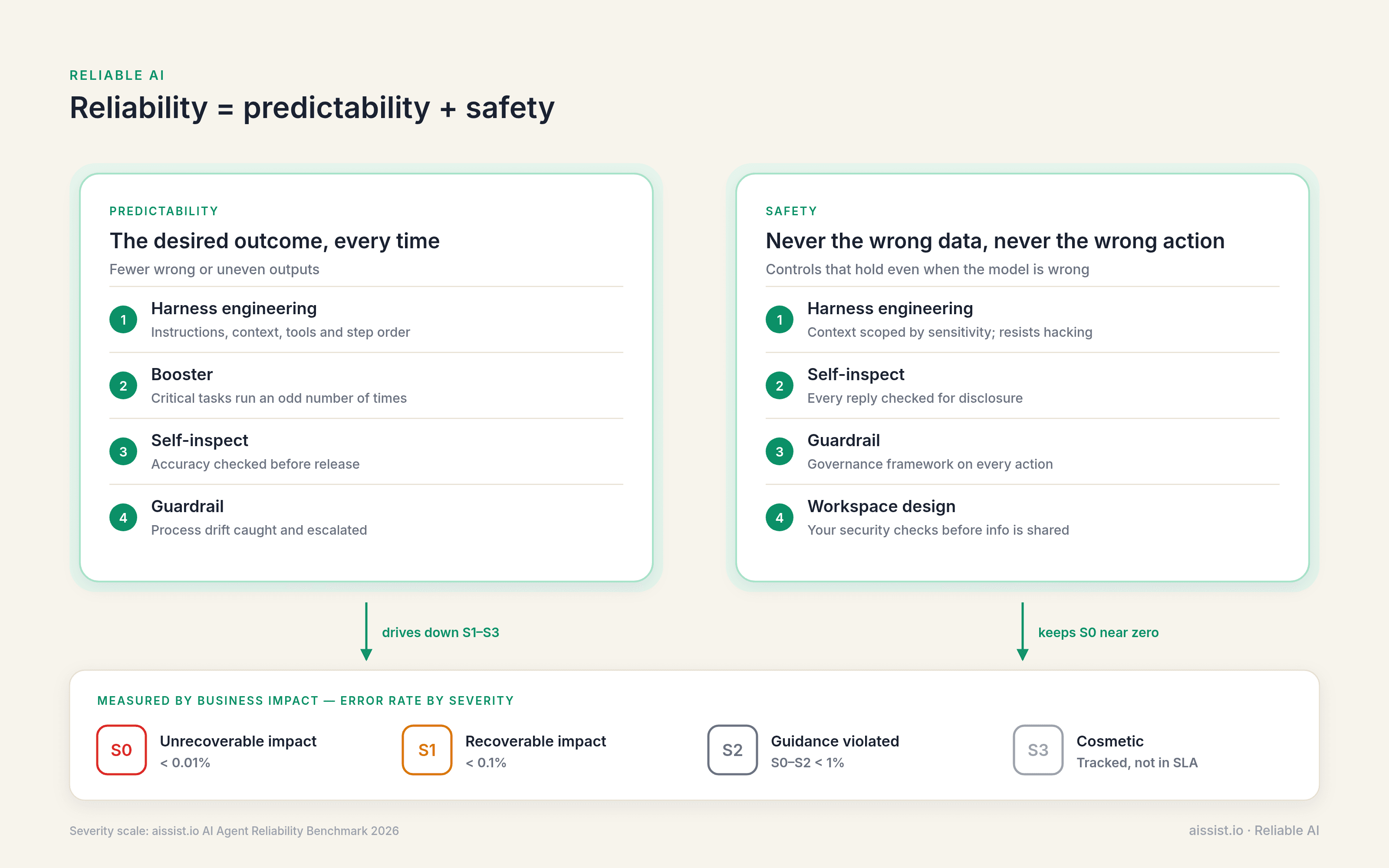
Predictability is how consistently the AI delivers the desired outcome — the right answer, the right workflow branch, the right tone, the same way on the ten-thousandth conversation as on the first. A predictability failure is a wrong or uneven output: a wrong ETA, a skipped step, an answer that reads differently every time it is asked.
Safety is the assurance that sensitive information and sensitive actions are never wrongly executed — no order details handed to someone who has not proven who they are, no refund outside policy, no system instructions given away to someone probing for them. A safety failure is rarely a wrong answer. It is a correct-sounding answer given to the wrong person, or an action that should never have run.
The two share some tools — harness engineering, self-inspection and guardrails serve both — but point them at different things. Predictability is about getting the work right. Safety is about what must never happen, even on the day the work goes wrong.
How is AI reliability measured? Four tiers of business impact.
Both halves end in the same place: what an error costs the business. We measure reliability as error rate graded by severity, using the four-tier scale defined in the AI Agent Reliability Benchmark 2026 — counted over AI-handled conversations, with each tier reported on its own rather than blended.
| Tier | Business impact | Examples | Mainly guarded by | Target |
|---|---|---|---|---|
| S0 | Changes an outcome the business cannot take back | A refund, discount or contract term outside policy; an obligation the business must honor; information disclosed to someone who should not see it | Safety | < 0.01% |
| S1 | Business impact, easily recovered | Wrong promo code, URL, ETA or article; a price quoted that is not honored | Predictability | < 0.1% |
| S2 | No business impact; internal guidance violated | A skipped verification step, the wrong handbook branch, a conversation left untagged | Both | S0–S2 combined < 1% |
| S3 | Cosmetic | Wording, grammar, tone drift, formatting | Predictability | Tracked, outside the SLA |
The tiers explain why the two halves are engineered differently. Predictability work drives down the volume of S1–S3 errors, the ones that cost a follow-up message or a little trust. Safety work exists to keep S0 near zero — a tier where a single incident outweighs thousands of good conversations, so the controls have to hold even when the model is wrong.
S2 sits between them, and it is the tier to watch. A skipped identity check costs nothing on the day it happens; it has simply removed the control that stood between a normal conversation and an S0. That is why both halves claim it.
How do you build reliable AI?
That gap — between what a raw model delivers and what a business can depend on — is exactly what an AI governance layer exists to close. It is why Aissist.io did not treat reliability as a feature to add later, but as the framework every output passes through.
From day one, Aissist.io focused on building an AI governance framework to improve the reliability and quality of every output.
The framework attacks each half with its own set of mechanisms. Predictability uses harness engineering, booster, self-inspect and guardrails. Safety uses harness engineering, self-inspect, guardrails and workspace design. No single mechanism is sufficient by itself, so they are stacked: each one catches a class of failure the others let through.
Predictability: how AI consistently delivers the desired outcome.
A predictable agent does the same right thing every time it meets the same situation. Four mechanisms get it there, roughly in order of cost.
Harness engineering sets the behavior before the work begins.
Harness engineering is the first layer, and it replaces what used to be called prompt engineering. A prompt is one instruction to one model call. A harness is everything around the model that shapes its behavior: the instructions, the context it is given and the context it is denied, the tools it may call, the order of the steps, and the checks between them.
The difference matters most in agentic AI, where one execution expands into many tasks. In Aissist, a single execution can spin out 12 to 20 tasks, and each one has to run inside the same harness for policy, quality, and escalation. One harness keeps them consistent; twenty separately tuned prompts would drift apart.
Harness engineering alone is not enough, but without it, the rest of the reliability stack becomes much weaker.
Booster improves reliability by asking more than once.
Booster runs the same task multiple times, usually in an odd number, then compares the results and moves forward with the strongest agreement.
It is a powerful way to improve reliability, especially in the most uncertain or most critical parts of the system. The tradeoff is cost: it can double or even triple the compute needed for one decision, which is why it is aimed at the decisions that matter rather than at every reply.
Self-inspect adds a quality check before the output is released.
Before the final output goes out, the system asks whether it is actually right given the context and the information available: does it answer what was asked, is every claim supported by a source, does it follow the workflow the business defined.
It works best when the inspection takes a different perspective from the generation — the same model in a different role, or a stronger model reviewing the decision critically. It is the last chance to catch an error before the customer sees it.
Guardrails keep the whole system on course.
A guardrail governs the behavior of the whole system rather than one output. A separate supervising layer, effectively an AI police layer, checks outputs and actions against the business's policy and guidance, and decides whether to let them through, stop them, or escalate to a human.
For predictability, the guardrail's job is consistency: catching process drift — the skipped step, the wrong handbook branch — before it becomes a pattern. It adds compute and some latency, which is why it is tuned to the risk of each workflow rather than applied uniformly.
Safety: how sensitive information and actions are never wrongly executed.
Safety starts from a different assumption: the model will sometimes be wrong, and someone will sometimes try to make it wrong on purpose. So the controls cannot depend on the model choosing well. They have to make the wrong disclosure or the wrong action impossible, or catch it before it leaves.
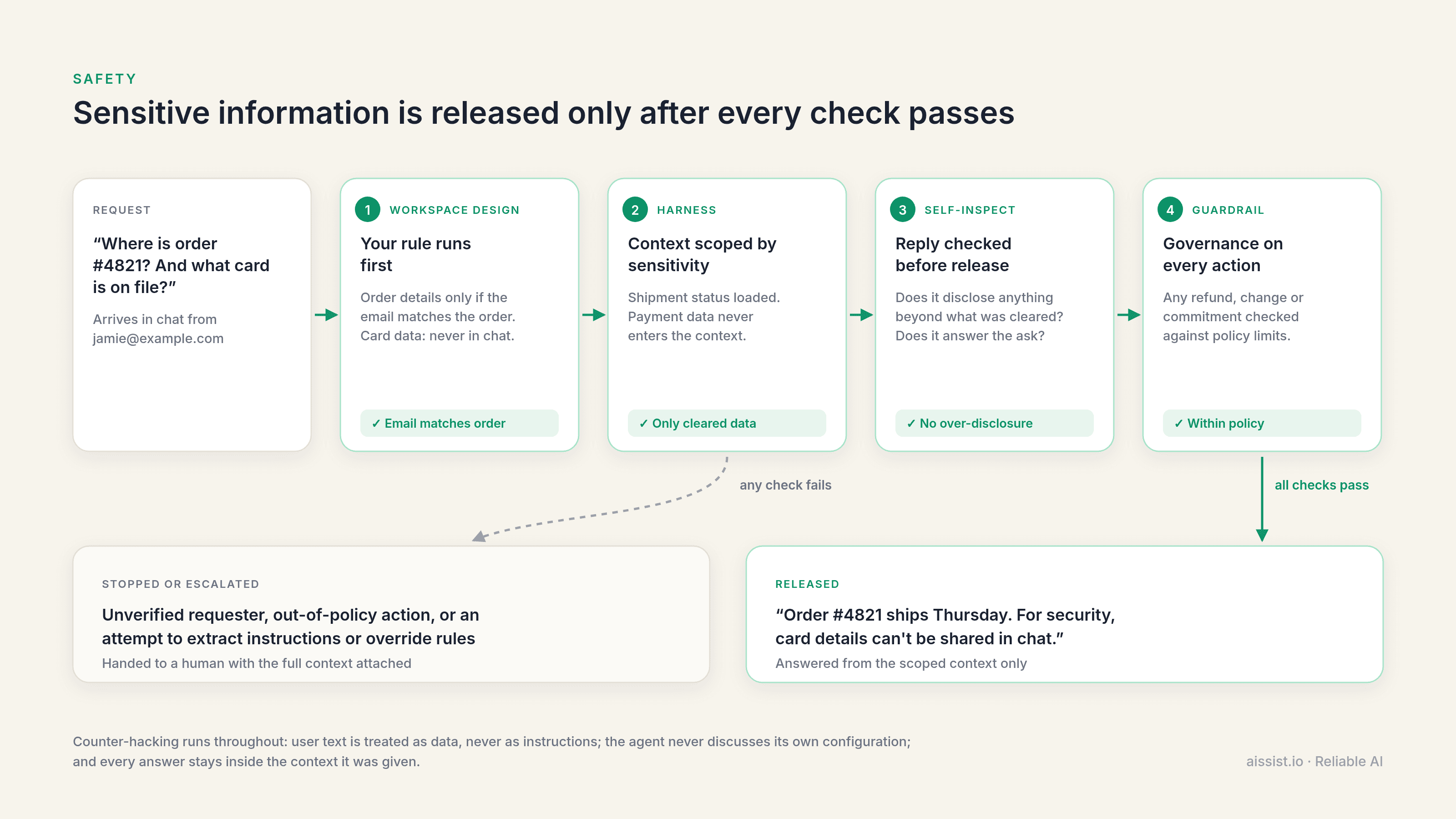
Harness engineering decides what the agent can see — and what it cannot be talked into.
On the safety side, harness engineering manages the scope of information by sensitivity. An agent answering a shipping question is given the shipment status, not the customer's whole account, and data above a sensitivity level is brought into context only after the checks for it have passed. What is never in context can never be leaked.
The harness also carries the counter-hacking defenses. Customers — and people pretending to be customers — will try to talk an agent out of its rules: asking it to reveal its instructions, probing to reverse-engineer how it decides, role-playing past a policy, or pasting text that pretends to be a new command. The harness keeps the agent anchored to the context it was given: it answers from approved knowledge and connected systems, treats everything a user supplies as data rather than instructions, and does not discuss its own configuration.
Self-inspect checks every reply for disclosure, not only for accuracy.
Before anything is released, self-inspection asks a safety question as well as a quality one: does this reply disclose anything the person has not been cleared to see, and does this action match what was actually requested and authorized?
A reply can pass on accuracy and still fail here. A correct order history sent to an unverified requester is a perfectly accurate S0.
Guardrails are the governance framework every action passes through.
The guardrail is the governance framework: policy enforced at the system level, independent of what the model decided. Actions with business consequence — refunds, discounts, account changes, commitments — are checked against the limits the business set, and anything outside them is stopped or escalated to a human with the full context attached.
The model can propose an action. Only the governance layer can let it run.
Workspace design puts the security rules in the business's hands.
Each workspace defines the security checks that must pass before a category of information is provided — for example, the email on the conversation must match the order before order details are shared, or a one-time code must be confirmed before account data is discussed. These are rules the business writes, not behaviors the model is asked to remember, so they hold on every conversation however the request is phrased.
That is also what makes safety auditable. When someone asks why the agent refused, or why it shared, the answer is a rule with an owner, not a guess about what the model was thinking.
How do the mechanisms compare?
The same mechanism can do different work on each side. Here is where each one sits, what it costs, and which severity tiers it mainly guards.
| Mechanism | Pillar | What it does | Cost | Main tiers |
|---|---|---|---|---|
| Harness engineering | Predictability | Shapes instructions, context, tools and step order so every task behaves the same way | Low | S1–S3 |
| Booster | Predictability | Runs a critical task an odd number of times and takes the strongest agreement | High | S1 |
| Self-inspect | Predictability | Checks accuracy and process against the context before release | Medium | S1–S3 |
| Guardrail | Predictability | A supervising layer catches process drift and escalates | Medium to high | S2 |
| Harness engineering | Safety | Scopes information by sensitivity, resists hacking, stays inside the provided context | Low | S0 |
| Self-inspect | Safety | Checks every reply and action for disclosure and authorization before release | Medium | S0 |
| Guardrail | Safety | The governance framework enforces policy limits on actions; stops or escalates | Medium to high | S0, S2 |
| Workspace design | Safety | Business-defined security checks run before information is provided | Low | S0, S2 |
Reliable AI FAQ
What is reliable AI?
Reliable AI is AI a business can depend on in production. It has two halves: predictability, meaning it consistently produces the desired outcome, and safety, meaning sensitive information and sensitive actions are never wrongly executed.
What is the difference between AI predictability and AI safety?
Predictability is about getting the work right every time; its failures are wrong or inconsistent outputs, mostly recoverable (S1–S3). Safety is about what must never happen even when the work goes wrong; its failures are disclosures or actions the business cannot take back (S0).
What is harness engineering, and how is it different from prompt engineering?
A prompt is one instruction to one model call. Harness engineering designs everything around the model that shapes its behavior: the instructions, the context it receives and is denied, the tools it can call, the order of steps and the checks between them. In agentic AI one execution can spin out 12 to 20 tasks, so consistency and safety come from the harness, not from any single prompt.
How do you stop an AI agent from leaking sensitive information?
Keep sensitive data out of the agent's context until the checks for it pass, enforce business-defined verification rules in the workspace, treat user-supplied text as data rather than instructions, self-inspect every reply for disclosure before release, and let a governance layer stop or escalate anything outside policy.
How is AI reliability measured?
As error rate by severity over AI-handled conversations, on four tiers: S0 changes an outcome the business cannot take back, S1 has recoverable business impact, S2 violates internal guidance without impact, and S3 is cosmetic. Aissist.io targets S0 under 0.01%, S1 under 0.1%, and S0–S2 combined under 1%. The full method is in the AI Agent Reliability Benchmark 2026.
Can AI ever be 100% reliable?
No. The qualities that make AI useful — extending to unfamiliar cases and deciding on incomplete input — are the same ones that make it unpredictable, and perfect predictability comes only by limiting intelligence. What can be engineered is predictability where it matters and safety controls that keep the costly errors rare and contained.