
AI Customer Service · Resolution not deflection
AI Customer Support: Resolution vs CSAT
Push an AI support agent to resolve more tickets and satisfaction often falls. The tradeoff is real, but it comes from how you buy resolution, not from automation itself.
6 min read · Updated September 2026
Compiled by Rob Jiang, Chief AI Engineer. Figures read from their sources on 24 August 2026. Published by Aissist.io, which sells a product in the category measured here — our own deployments appear among the figures and are labelled as ours.
- →CSAT is a hill, not a ramp. It is low at both ends.
- →The worst move is to buy resolution by blocking handoff to a human.
- →The best path is real fixes plus fast, graceful escalation.
- →Break the loop with confidence gates, clean handoff, and genuine, escalation-excluded, re-open-checked resolution metrics.
In AI customer support automation, teams often see the same pattern. You turn up automation to take work off your agents. The resolution rate climbs. The dashboard looks good. Then customer satisfaction drops.
Turn automation back down and CSAT improves, but now people are answering questions software could have solved. It feels like a trap.
It is not. There are two curves, and many teams are on the wrong one.
The tradeoff shows up at both ends. CSAT falls with under-automation on the left and with over-automation on the right. The sweet spot is around 60–80% genuine resolution. Push past it chasing a bigger number, and CSAT falls again. That is over-optimization, not under-automation. How you get there decides which curve you ride.
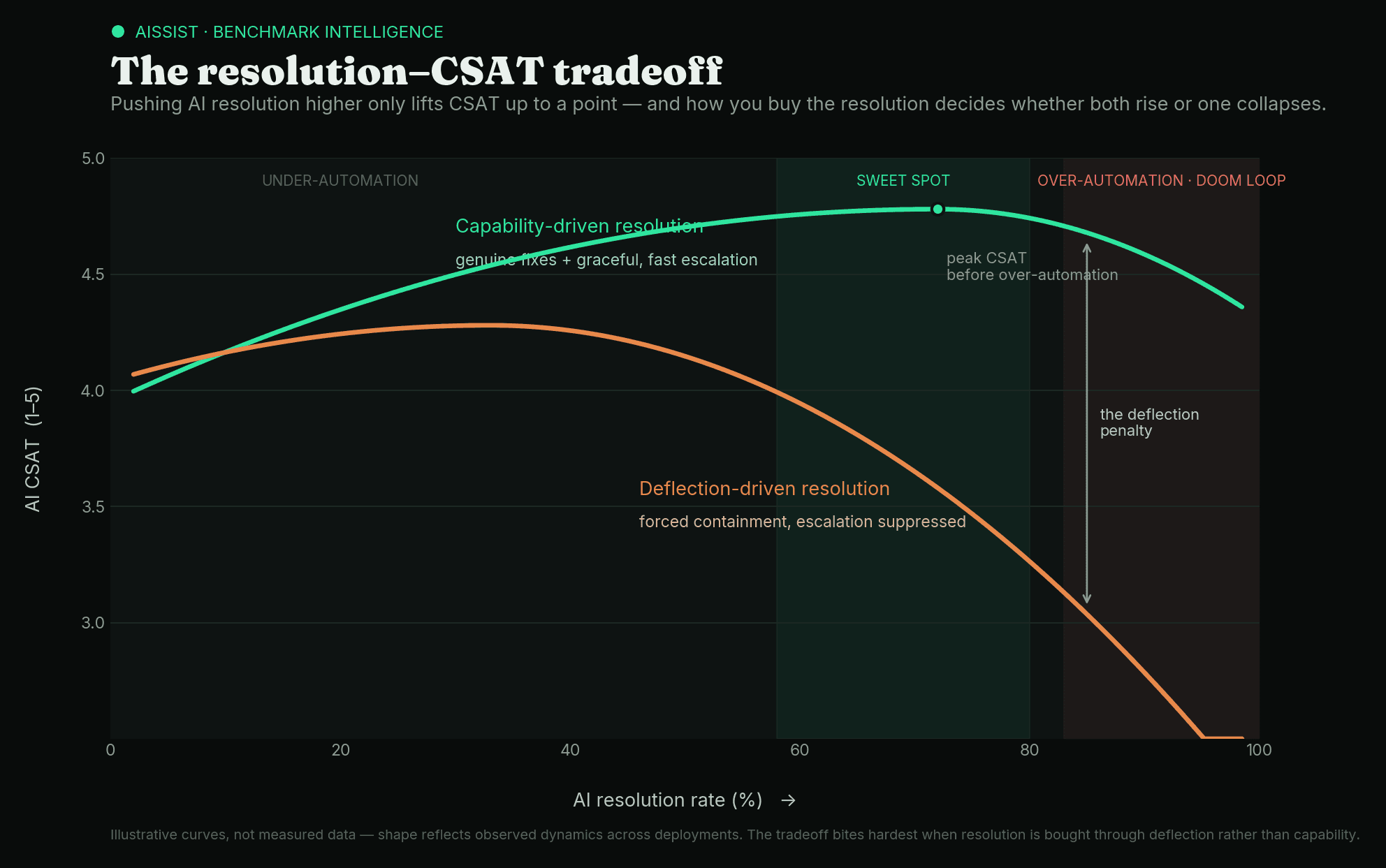
The tradeoff bites at both ends: CSAT suffers from under-automation on the left and collapses into a doom loop from over-automation on the right, peaking in a sweet spot around 60–80%. And how you buy the resolution decides which curve you ride — the gap between them is the deflection penalty. Illustrative.
| AI resolution rate | CSAT result | Why |
|---|---|---|
| Under ~40% (under-automated) | Low | People wait for a human on questions the AI could have answered right away. |
| ~60–80% (the sweet spot) | Highest | Easy cases resolve fast, and hard cases still reach a person. |
| Above ~85% (over-automated) | Falls hard | Escalation gets blocked, so the cases that need a human cannot reach one. |
| Any rate, bought by deflection | Lower than the same rate from real capability | A closed chat and a solved problem look the same on a deflection dashboard. |
This is the deflection penalty. It is the gap between a real fix and a fake win.
The Shape
Two curves, two bad ends
Plot CSAT against how much your AI resolves, and two things become clear.
First, each curve is a hill, not a ramp. Too little resolution means customers are stuck waiting in line for answers a machine could have given at once. Too much resolution pushes the AI into hard, emotional, or unclear cases a person should own. The best experience sits in the middle.
Second, how you buy the resolution matters. If you raise resolution by blocking escalation, you trace the coral curve. It peaks lower and then falls fast. People get trapped in loops, told to rephrase, or given confident but wrong answers. That is the doom loop.
If you raise resolution by making the AI better, you trace the emerald curve. It climbs higher and stays there. It can still bend down past the sweet spot, because over-automation is real, but it does not collapse the way deflection does.
There are two ways to lose: over-automation on the right, and the deflection penalty between the curves.
Root Causes
Why the tradeoff happens
When higher resolution drags CSAT down, it is usually one or more of these:
- 1
Blocked escalation. To hit a containment goal, the bot resists handoff. The “I want an agent” loop is one of the fastest ways to tank satisfaction.
- 2
Too much reach. Chasing the metric, the AI takes on complex, regulated, or emotional issues that it should send to a person.
- 3
Wrong but confident answers. A plausible answer closes the ticket in the metrics while the customer is still unhappy. The complaint shows up later as a re-open or a one-star rating.
- 4
Fake wins. Abandonment and deflection get logged as resolved. The customer did not get help; they gave up. Part of the tradeoff is a measurement illusion.
- 5
More effort and more loops. To avoid escalating, the AI keeps trying across many turns. Time and effort rise, and satisfaction falls.
- 6
Lost care on edge cases. The simple 80% works, but the hard 20% gets a worse experience than a human would have given.
Measurement
It is partly a scoreboard problem
Two of those causes are not really about the AI. They are about the metric.
Deflection counts any conversation that did not reach a human, even if the customer rage-quit. Genuine resolution counts only issues solved end to end. It excludes escalations, and it only counts if the ticket stays closed. The same deployment can differ by 20 or 30 points, depending on how you measure it.
That is why the tradeoff can feel like a law of nature. If your resolution rate includes frustrated exits, then pushing it higher can hurt satisfaction. You are optimizing for the wrong thing.
Measure the honest number, and the curve changes shape.
The Fix
How to break it
Moving from the coral curve to the emerald one is a set of design and measurement choices, not a bigger model.
Confidence-gate the automation
Only auto-resolve intents the system is sure about. Let the long tail go to a human by default. The resolution rate may look lower on paper, but CSAT holds.
Make escalation instant and graceful
Handoff is not a failure. It is a feature. Pass full context so the customer never has to repeat themselves, and never make someone fight the bot to reach a person. A clean escalation should count as a win.
Measure genuine resolution
Exclude escalations. Check that the ticket stays closed for a set window before you count it. Track CSAT only for AI-handled conversations, not blended across all channels.
Do these three things, and accurate, instant, 24/7 answers lift resolution and satisfaction together. The frontier moves up and to the right instead of trading one metric for the other.
For AI customer service teams, the goal is not fewer handoffs. It is better handoffs.
Due Diligence
What to ask your vendor
Before you trust any resolution number, get this in writing:
How do you define resolution?
Do you exclude escalations?
Do you check for re-opens?
Do you measure CSAT on AI-handled chats by itself?
Do you count abandonment as success?
FAQ
Frequently asked questions
- Why can a higher AI resolution rate make CSAT worse?
- Short answer: A higher resolution rate helps only when it means real problem solving. If the number rises because the AI blocks escalation, keeps people looping, or counts abandonment as resolved, CSAT can fall fast. The issue is not automation itself. It is buying resolution through deflection instead of capability.
- What is the ideal AI resolution range?
- Short answer: For most teams, CSAT peaks around 60–80% genuine resolution. In that range, routine issues are handled fast by AI while complex, emotional, regulated, or unclear cases can still reach a human. Pushing beyond that range can create over-automation, especially if escalation gets harder.
- What is the difference between deflection and genuine resolution?
- Short answer: Deflection measures whether a conversation avoided a human handoff. That can include cases where the customer gave up. Genuine resolution means the issue was really solved end to end, escalations are excluded, and the ticket stays closed for a check window. The gap between the two is the deflection penalty.
- How should escalation be treated in an effective AI support system?
- Short answer: Escalation should be treated as a feature, not a failure. When confidence drops or the case needs human judgment, the AI should hand off at once and pass full context so the customer does not repeat themselves. A clean handoff can protect CSAT even if it lowers the raw automation rate.
- What should teams measure to avoid the resolution–CSAT tradeoff?
- Short answer: Teams should measure genuine resolution, not containment or raw deflection. That means excluding escalations, checking that tickets stay closed, and tracking CSAT only for AI-handled conversations. If the metric cannot tell a real fix from a frustrated exit, it will drive the wrong behavior.
Genuine resolution, measured honestly.
Aissist.io is built to sit on the emerald curve: genuine resolution with graceful escalation, measured honestly, not deflection dressed up as success. Real capability and clean handoff are what move the peak to the right. That is how our deployments average 83% genuine resolution while CSAT holds at 4.8 / 5.0.
Resolution rate, CSAT & cost across 6 industries — with claimed vs. verified figures.
Top 10 travel eSIM providers by rating and AI resolution — resolve vs. deflect.
Ten platforms compared across capability, cost, architecture and performance.
The chart shows illustrative curves based on what teams see across deployments, not one measured dataset. Product figures are Aissist's own. Results vary by channel mix, intent complexity, and how each team defines resolution.