

The action engine that turns signals into improvement.
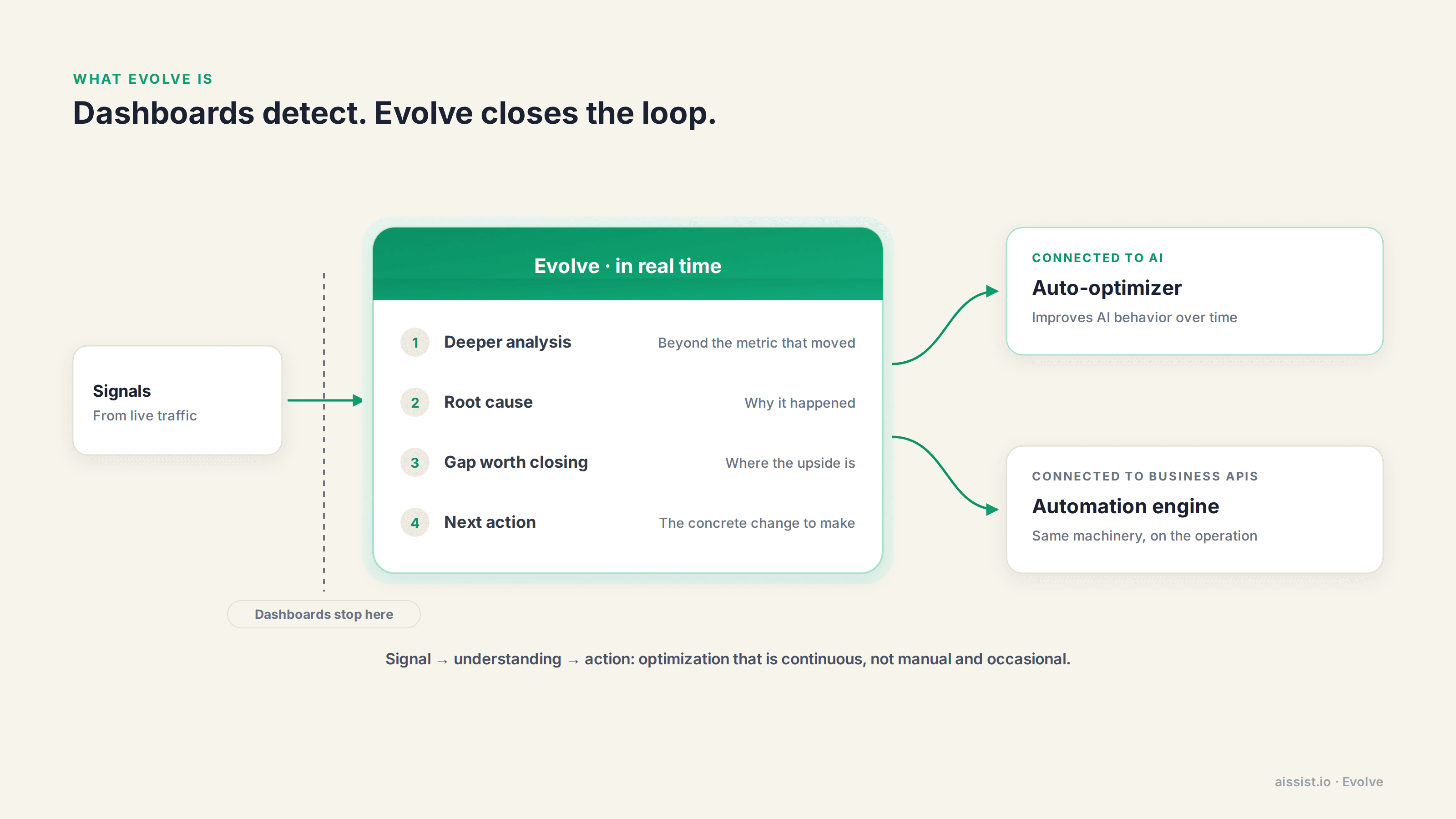
Evolve takes signals, conducts deeper analysis, identifies root causes, finds the gaps worth closing, and recommends the next action — in real time, on the traffic you are running today.
Connected to AI, it becomes an auto-optimizer that continuously improves AI behavior over time. Connected to business APIs, it becomes an automation engine on the business layer itself: the same signal-to-action machinery, pointed at the operation rather than the agent.
The value is not detection. Dashboards detect. The value is the closed loop from signal to understanding to action — which is what makes optimization continuous instead of manual and occasional.
Where this sits. Evolve is the optimization step of a larger loop. AgentMesh does the work and Pulse measures it; Evolve turns what Pulse found into a tested change. The loop itself is described in Self-Evolving AI.
Evolve is what makes AI self-evolving.
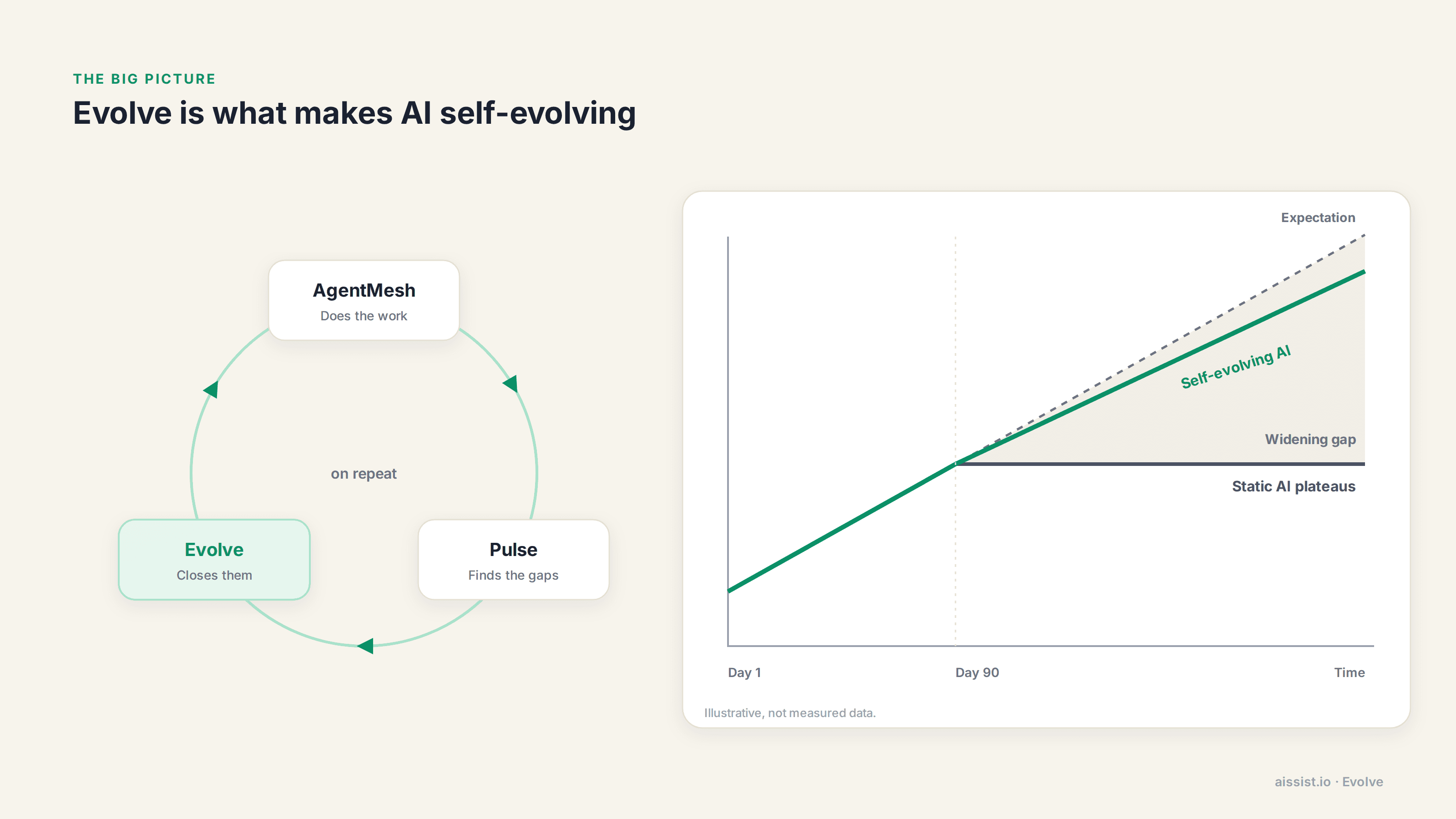
Static AI is impressive on day one and stuck by day ninety. Configuration is a snapshot: products ship, policies change, customer language drifts, and the snapshot ages from the moment it's taken. Worse, at the plateau the levers start fighting each other — tighten guidance to fix one corner case and something else quietly regresses. That's not a prompt problem; it's a structural one, so the answer has to be structural too.
Self-evolve AI is that structure, and it takes three components working as one loop: AgentMesh does the work, Pulse evaluates every conversation into trustworthy signals, and Evolve acts on them. Automation does the work. Evaluation finds the gaps. Evolution closes them — on repeat.
That's why Evolve is the component that changes the trajectory. Without it, evaluation produces reports someone has to act on; with it, the operation improves on the cadence of the work itself.
Why it matters. Our deep dive on self-evolving AI lays out the five forces that stall every static deployment: performance drifts as the world moves, corner cases pile up in the long tail, maintenance costs scale with volume and never end, a single product or policy change invalidates months of tuning, and nothing spreads what your best performers already do well. Meanwhile expectation only rises — the moment the AI impresses, the bar moves — so a flat performance line quietly turns into a widening gap. Self-evolution closes that gap structurally: an AI that maintains and improves itself beats an AI you have to maintain by hand.
How a signal becomes a shipped improvement.
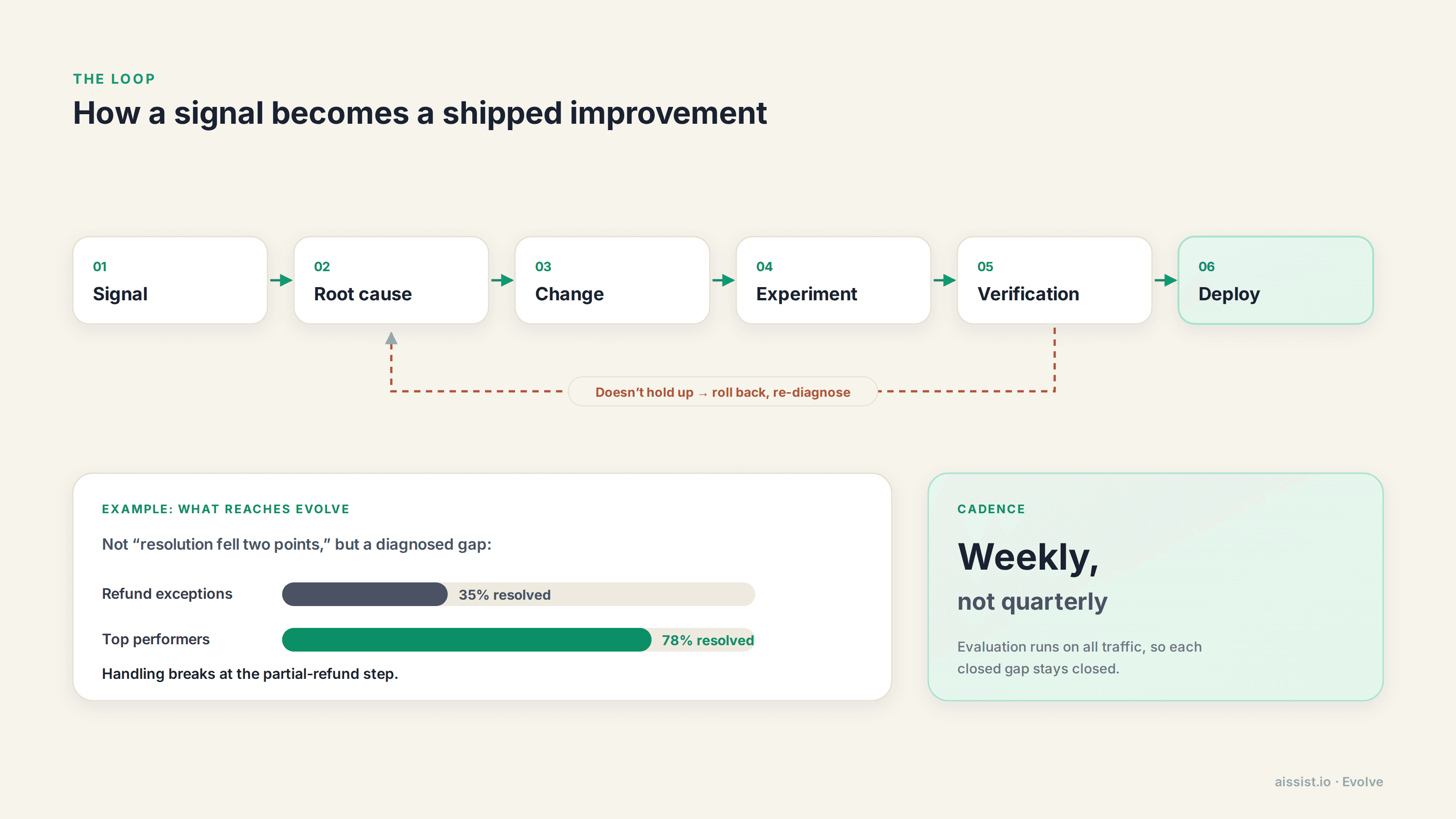
Most optimization stops at a recommendation on a dashboard. Evolve runs the whole path: signal → root cause → change → experiment → verification → deploy, on the cadence of your traffic rather than the cadence of a tuning sprint.
It starts from a diagnosed gap, not a metric drop. Because every conversation — AI-handled and human-handled — is scored and aggregated by issue category, what reaches Evolve isn't “resolution fell two points” but “refund exceptions resolve at 35% while your top performers hit 78%, and the handling breaks at the partial-refund step.” The diagnosis is what makes the fix specific.
From there Evolve proposes the concrete change, applies it as an experiment with a stated expectation, and measures the result on the same yardstick that flagged the gap. What holds up is deployed back into AgentMesh; what doesn't is rolled back and re-diagnosed. Nothing counts as fixed just because it was edited.
The cadence is the compounding. Because evaluation runs on all traffic all the time, the loop turns weekly rather than quarterly, and each closed gap stays closed while the next cycle finds the following one. The month-by-month version of that story is in the next frontier for support and sales AI.

Signals turn monitoring into useful notification.
Automation is boring, especially when it works. That is exactly why signals matter. Our AI governance engine continuously monitors performance and traffic, spots unusual patterns, and turns them into signals. For the broader thinking behind that governance layer, see Reliable AI.
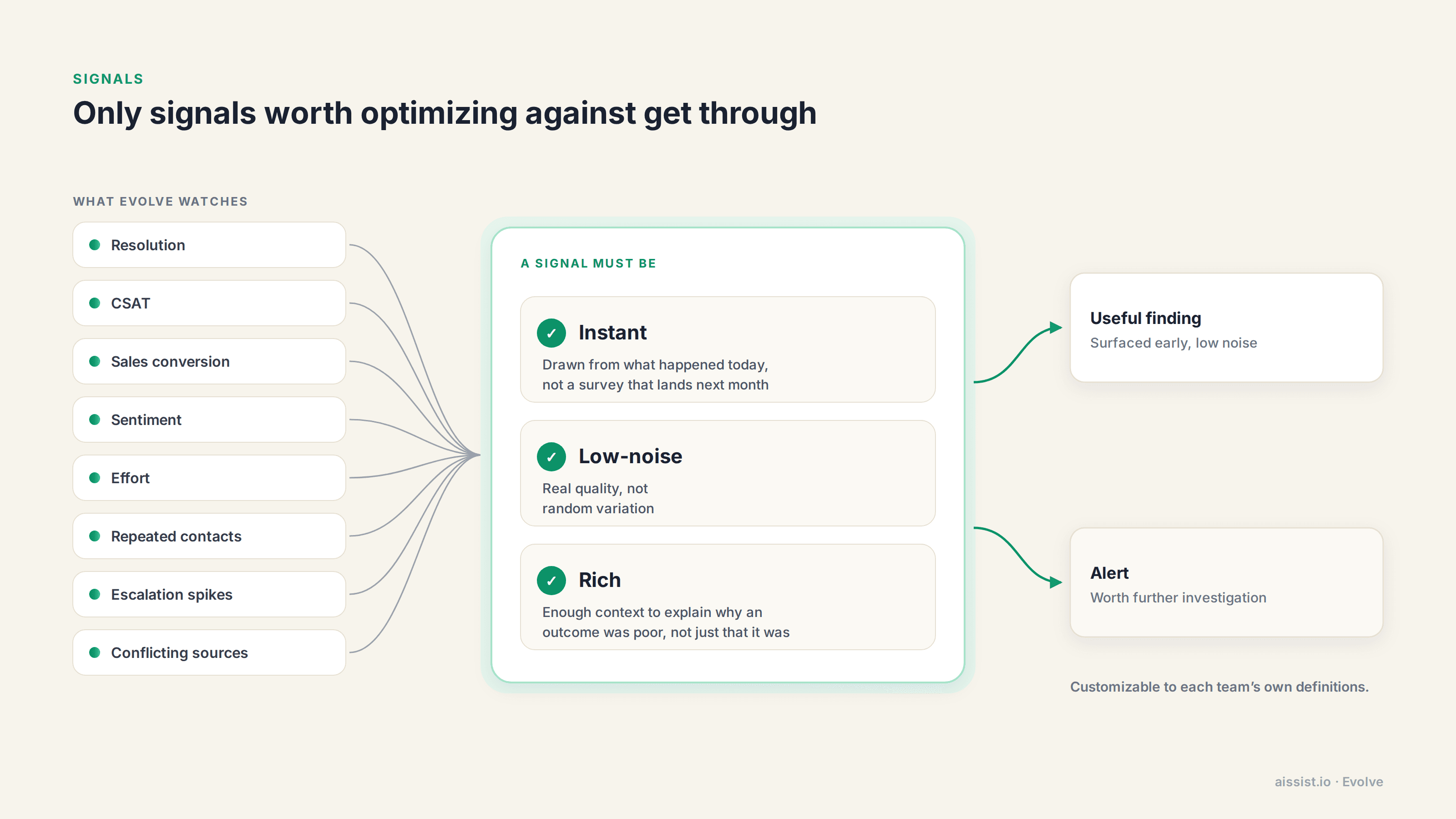
Those signals can be sent as useful findings or as alerts that deserve further investigation. The goal is to reduce noise while making sure important changes are surfaced early.
The signals are deliberately varied, because a single number is easy to win at everyone else's expense: resolution, CSAT, sales conversion, sentiment, and effort, plus operational patterns like repeated contacts, escalation spikes, and conflicting sources. Different contexts deserve different targets, and the loop should optimize for the outcome that matters in each one.
A signal is only worth optimizing against if it is instant (drawn from what happened today, not a survey that lands next month), low-noise (real quality rather than random variation), and rich (enough context to explain why an outcome was poor, not just that it was). Thin signals produce confident, wrong optimizations — which is why signal design comes before autonomy. The argument in full is in evaluable AI.
Signals are also customizable toward each customer's own definition. Teams can define what they care about, how they want signals to be interpreted, and let the system monitor the operation continuously on their behalf.

AgentMesh can optimize itself toward defined goals.
AgentMesh has the ability to automatically optimize for the goals provided by the system. That is why customers often notice small but meaningful behavior changes over time.
For example, it may detect CSAT risk signals around repeated back-and-forth questions, then learn to shorten the conversation and escalate earlier in similar situations the next time. It may identify a process optimization opportunity in refund handling, then adjust instructions to make the procedure clearer, more direct, and easier to execute consistently.
It can also spot conflicting information across multiple resources, compare the sources, identify which one is authoritative, and use that stronger source in future decisions. These are often small changes at the surface, but over time they compound into better quality, less friction, and more reliable automation.
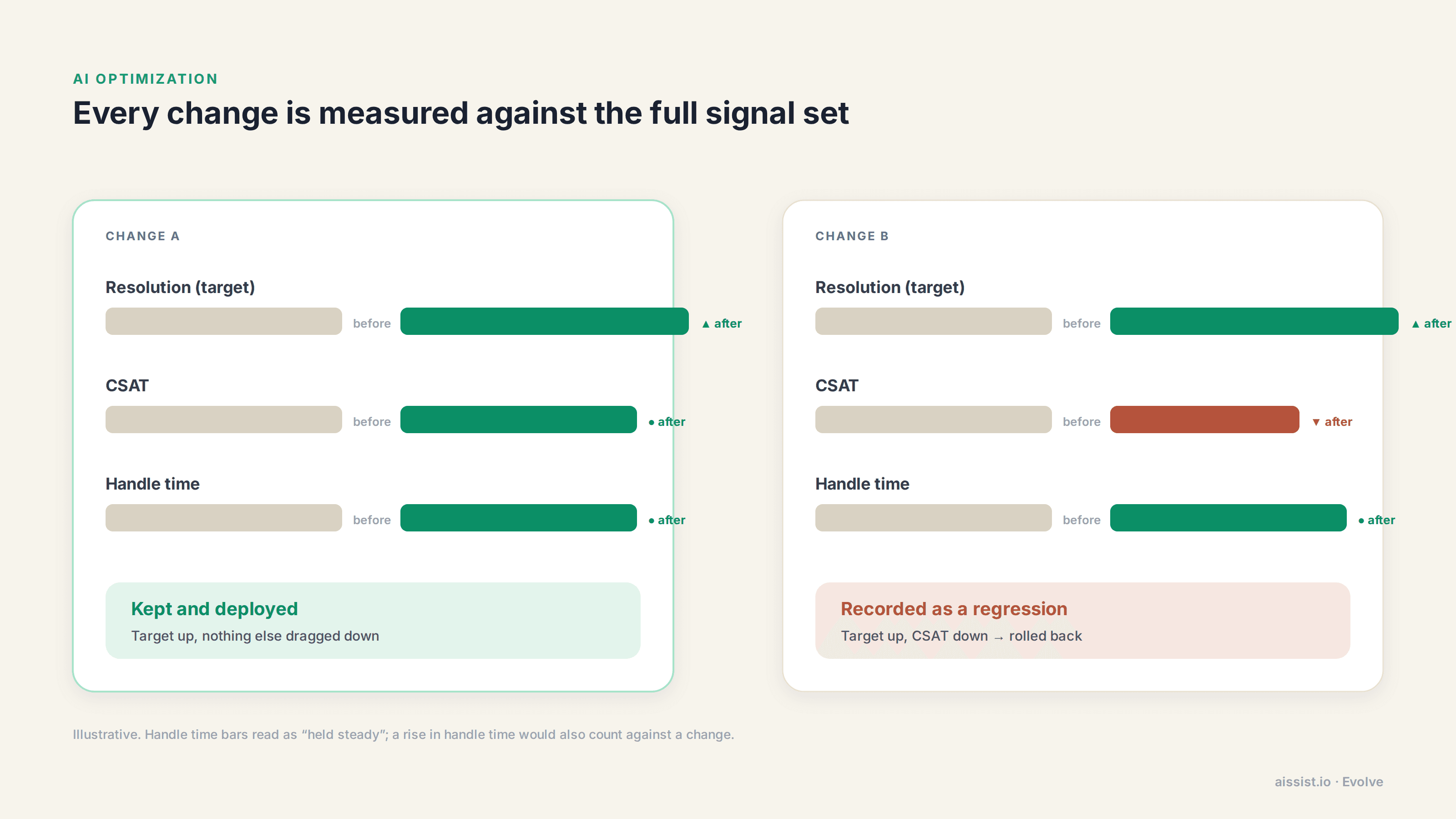
Crucially, optimization is multi-objective. Push resolution alone and CSAT slips; optimize CSAT alone and handle time climbs. Evolve measures every change against the full signal set in parallel, so a fix that lifts its target while dragging something else is recorded as a regression and rolled back — the trade-off that hand-tuning almost always misses.
Today, those optimization goals are system-defined. In the future, we plan to let customers define their own goals directly, so the engine can improve against the outcomes each business cares about most.
Where an improvement actually lands.
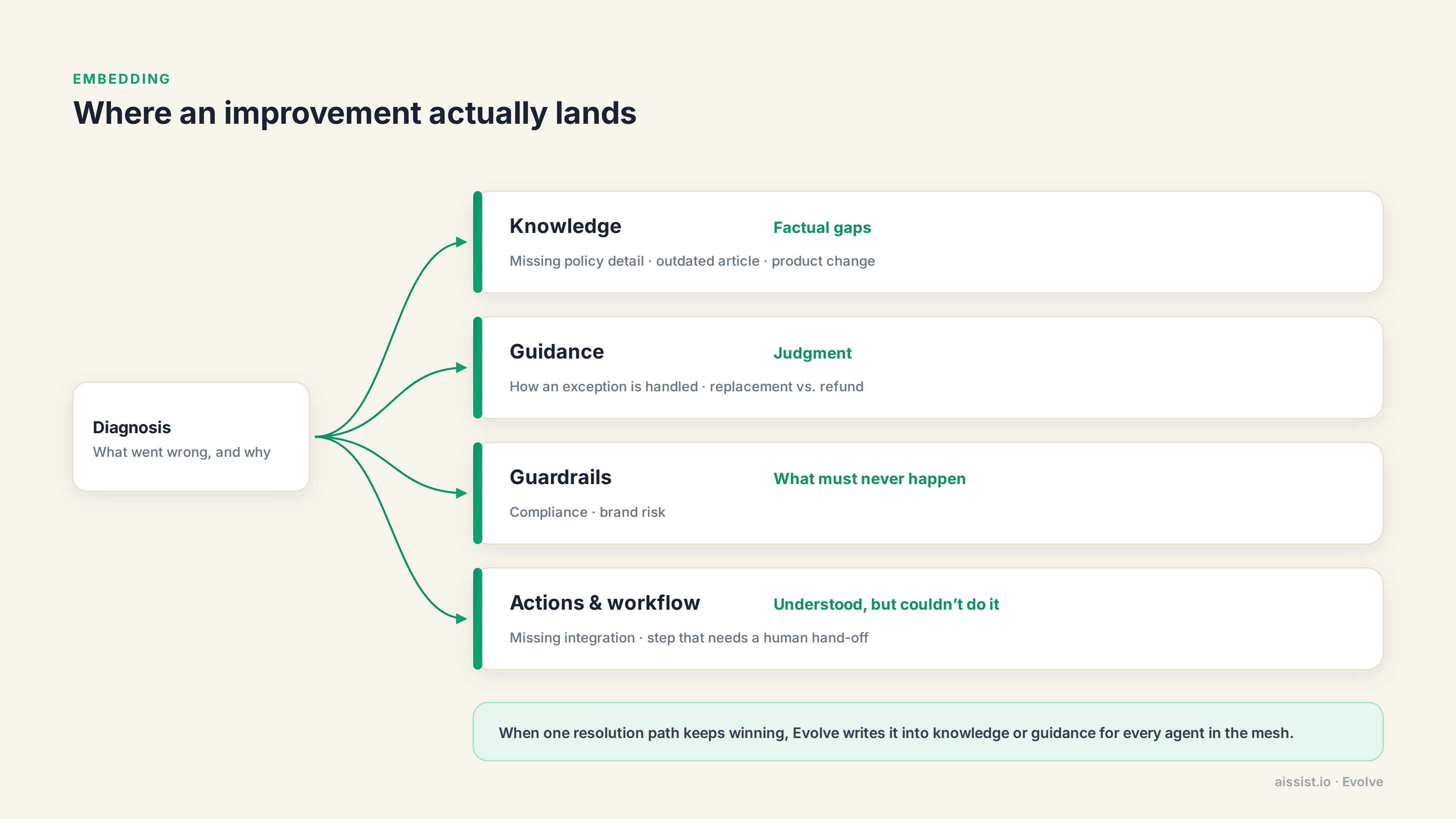
A diagnosis is not an improvement. Once Evolve knows what went wrong, it has to place the fix in the right layer — and picking the wrong one is how teams end up with a bloated instruction set that contradicts itself six months later.
Knowledge takes factual gaps: a missing policy detail, an outdated article, a product change. Guidance takes judgment: how an exception should be handled, when to offer the replacement instead of the refund. Guardrails take what must never happen, which is where compliance and brand risk belong. Actions and workflow take the cases where the AI understood perfectly and simply couldn't do the thing — a missing integration, a step that always needed a human hand-off. Turning a missing-integration problem into more prose is the most common way an optimization cycle is wasted.
Durable placement is also what makes your best people scale. When evaluation shows one resolution path consistently wins a category, Evolve can write that pattern into knowledge or guidance and propagate it across every agent in the mesh, instead of leaving it with the one person who worked it out.
What ships on its own, and what waits for you.
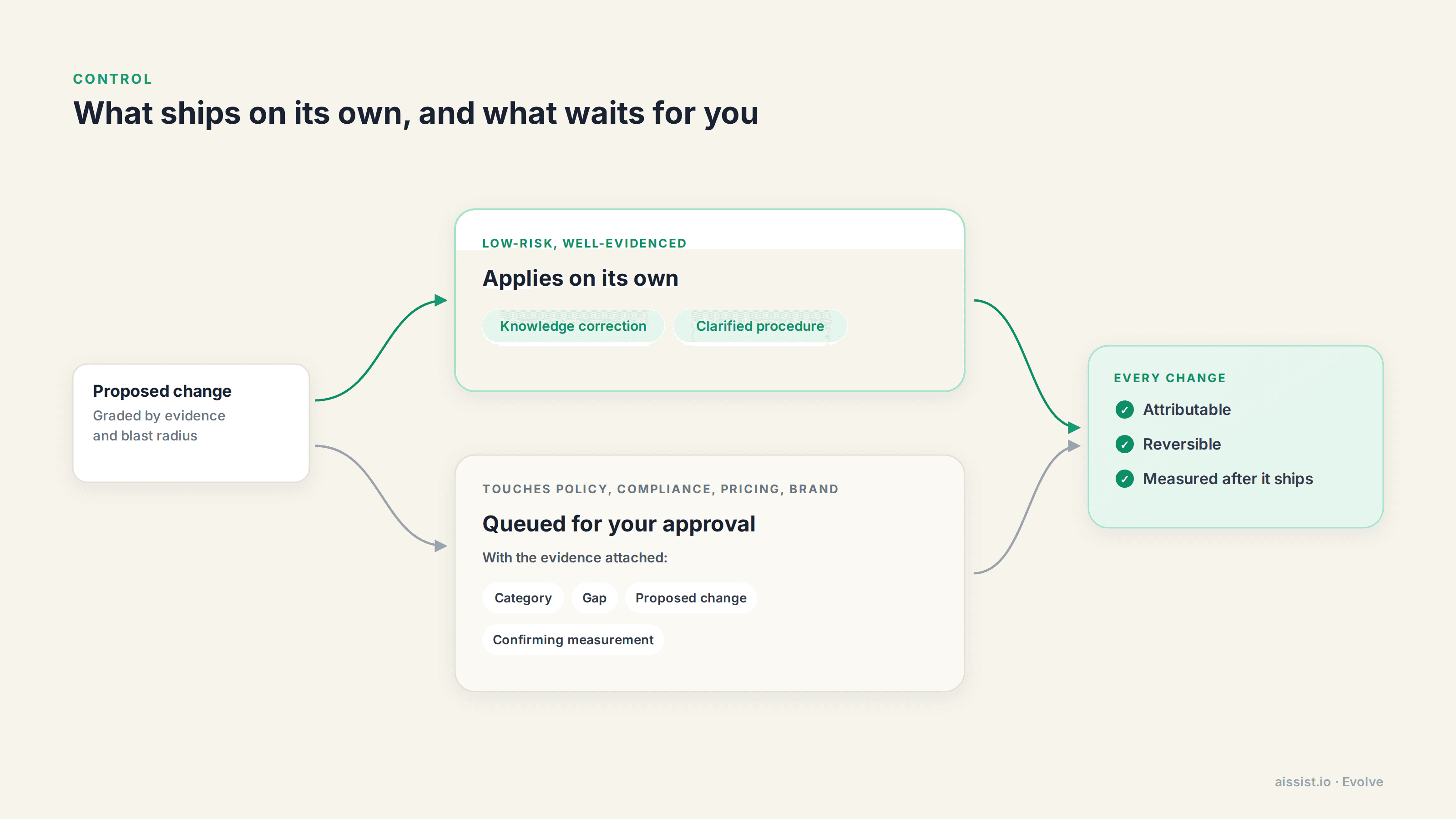
Full autonomy is fast but can drift somewhere the business never intended. Full manual review is safe and doesn't scale. Evolve takes the calibrated path: autonomy is graded by how strong the evidence is and how large the blast radius would be.
Low-risk, well-evidenced changes — a knowledge correction, a clarified procedure — apply on their own. Anything touching policy, compliance, pricing, or brand-sensitive behavior is queued for approval with the supporting evidence attached: the category, the gap, the proposed change, and the measurement that would confirm it.
Every change stays attributable and reversible, and every deployed change keeps being measured after it ships. That is the same governance posture described in Reliable AI — optimization you can audit, not a black box that quietly rewrites itself.
The best AI is invisible AI.
Building, managing, and maintaining AI should be easy. In many cases, it should be largely automatic.
The best AI does not ask for constant attention. Most of the time, people should barely notice it is there. The system should keep working, keep improving, and only surface what is truly worth attention.
That is the direction we are building toward: AI that quietly handles the operational burden in the background while notifying owners only when there is a meaningful signal, an emerging risk, or a real opportunity to act.
Where this stands today.
Being straight about maturity: Evolve runs in production today across our customer base — signals, notifications, root-cause analysis, AI builder, and system-goal optimization. The fully self-evolving loop, where the engine sets its own experiments and closes gaps end to end, is in alpha with a limited set of design partners, with performance data beginning to publish in Q4 2026.
The caution is deliberate. An optimizer that learns from a noisy signal gets worse with great confidence, and the point of the architecture is to compound improvement rather than compound mistakes. That's why the signal design, the multi-metric guard, and the graded approvals above came before the autonomy — not after it.
Questions teams ask about continuous optimization.
What is Evolve?
Evolve is the optimization engine of Aissist's AI Operational Layer. It turns the signals your operation produces into diagnosed root causes, decides what to change, runs the change as a measured experiment on live traffic, and ships what works back into AgentMesh — continuous optimization across AI and business operations.
What is self-evolve AI, and where does Evolve fit?
Self-evolve AI is an operational AI that improves itself from the work it already does. It needs three components in one loop: AgentMesh executes on real traffic, Pulse evaluates every conversation into ranked signals, and Evolve acts on those signals — diagnosing, experimenting, and shipping what works. Evolve is the component that turns measurement into improvement.
Can Evolve improve AI behavior automatically?
Yes. Evolve optimizes AgentMesh behavior toward defined goals by learning from signals such as CSAT risk, process friction, and conflicting information across sources — then verifying each change on live traffic before it stays.
What are signals in Evolve?
Signals are useful notifications generated from continuous monitoring. They help teams notice unusual patterns, emerging risks, and meaningful opportunities without manually watching every part of the operation. Signals are also customizable to each customer's own definition, so teams can decide what should be monitored and how it should be interpreted.
How does Evolve avoid fixing one metric and breaking another?
Every change runs as an experiment measured on the same multi-signal yardstick that flagged the gap — resolution, CSAT, sentiment, effort, and conversion in parallel. A change that lifts its target while dragging another metric is recorded as a regression and rolled back, which is exactly the trade-off manual tuning tends to miss.
Do humans approve the changes Evolve makes?
By calibration rather than blanket review. Low-risk changes with strong evidence apply on their own; anything touching policy, compliance, pricing, or brand-sensitive behavior is queued for human approval with the evidence attached. Every change is attributable and reversible.
What does Evolve optimize for?
Evolve optimizes toward the goals provided by the system. Today, those goals are not yet customizable by users. Our roadmap is to make them partially customizable so each business can automatically optimize for the outcomes that matter most to its operation.
Is the fully self-evolving loop available today?
Evolve's signals, root-cause analysis, AI builder, and system-goal optimization run in production today. The fully self-evolving loop — where the engine sets its own experiments and closes gaps end to end — is in alpha with a limited set of design partners, with performance data beginning to publish in Q4 2026.
How is Evolve charged?
With the use of AgentMesh, some Evolve features come included at no extra charge, such as notifications and AI builder. More advanced features are available through contracts, especially capabilities around customizable optimization goals. Please see the pricing page or contact our sales team for more details.