
Why does Multi-Agent Platform matter?
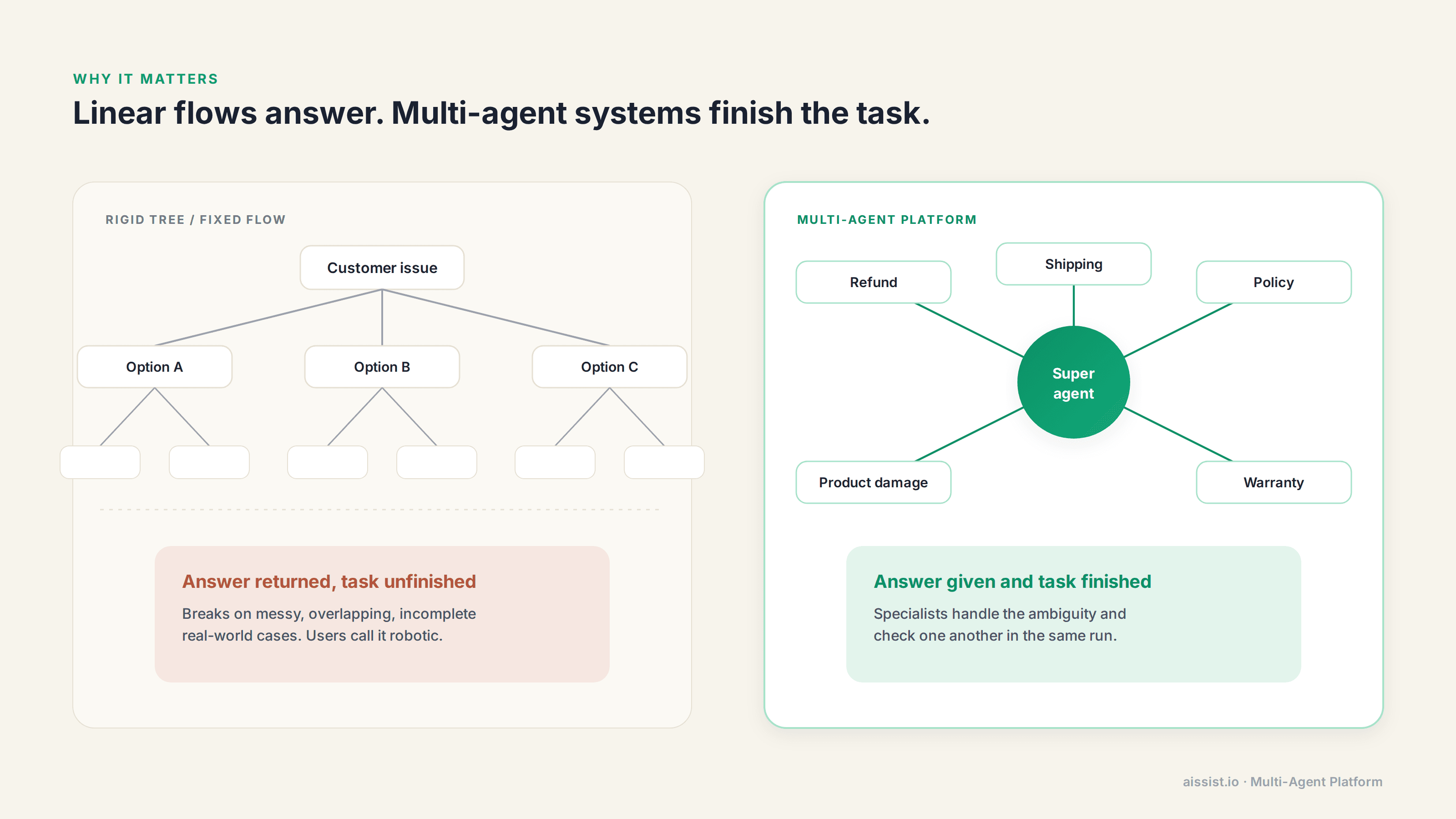
Real business problems are rarely linear. Customer issues, service operations, and sales often get messy, with overlapping systems and incomplete information. That is why rigid legacy trees and fixed flows often fail once real complexity shows up.
In practice, linear systems tend to stop well short of full resolution. Users then call the bot robotic when it returns an answer but does not finish the task. Closing that gap is exactly what a multi-agent chatbot architecture is for: the bot has to both answer and finish the task.
We once put numbers on that plateau — 30% to 50% resolution and 3.5 / 5.0 CSAT — but we could not trace those claims to any published source, so we removed them rather than repeat a number about other people's products that we cannot back up.
For what is actually published across the category, see our AI customer service benchmark.
The first advantage of Aissist.io's Multi-Agent Platform is performance. Across deployments, average performance reached 83% resolution and 4.8 / 5.0 CSAT, based on Q1 2026 data.
The second advantage is reliability. In a multi-agent system, several specialized agents can contribute and check one another in the same run. That usually gives a better result than a single-agent system can produce alone.
What are sub-agents and the Multi-Agent Platform?
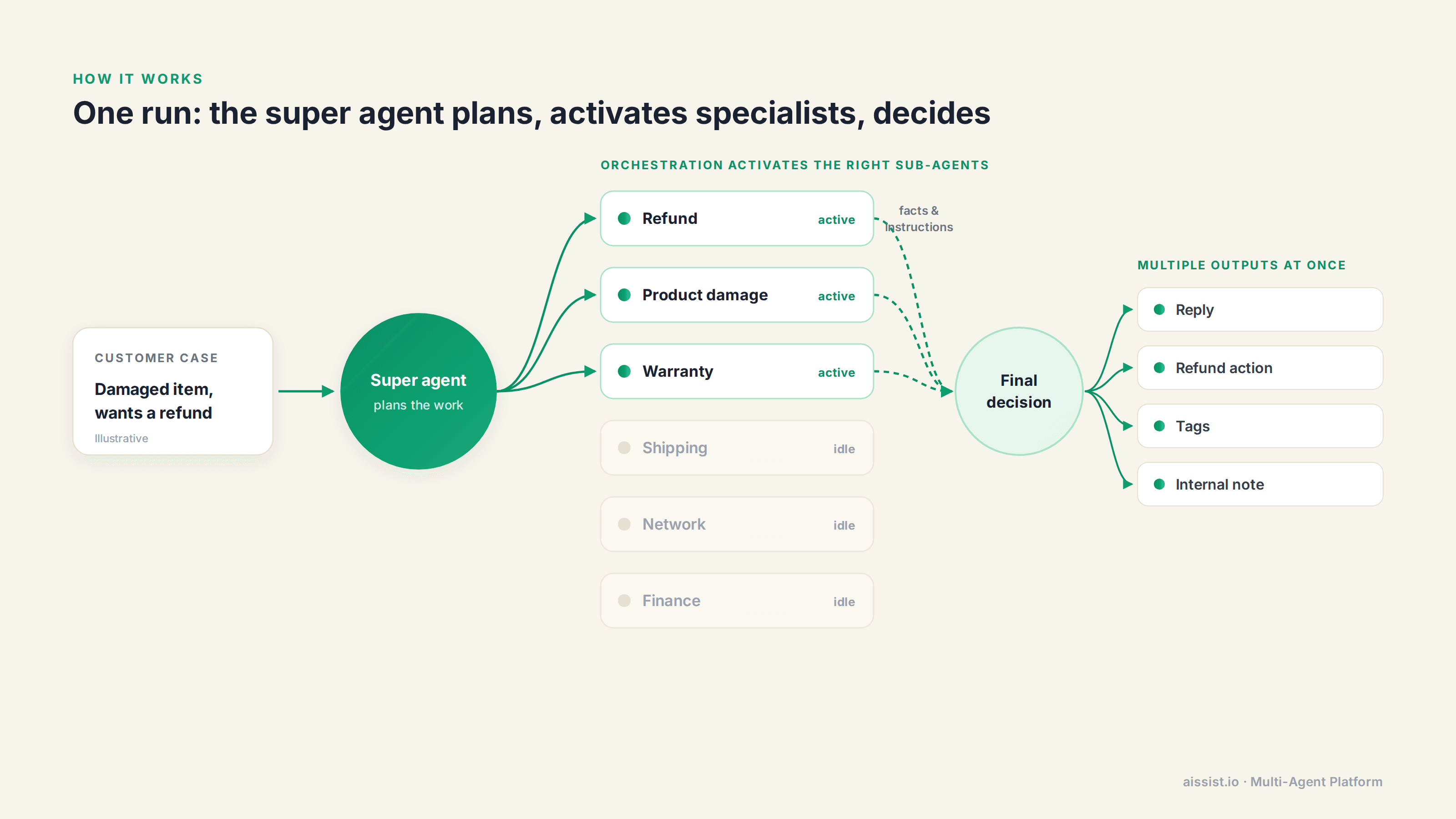
A sub-agent is a specialized AI worker focused on one domain or job. It can answer questions, run steps, and solve issues in areas such as refunds, network, shipping, warranty, finance, or product damage.
You can define sub-agents in whatever way fits your business best. In theory, sub-agents are close to what many people know as skills. The difference is how they are used. Skills are usually described for consumer use. Sub-agents are built for business teams that need clearer control over domain-specific behavior.
Multi-Agent Platform is Aissist.io's own technology for grouping those sub-agents into one coordinated system. On each run, a super agent plans the work, uses agent orchestration to activate the right sub-agents, gathers facts and instructions from them, and then makes the final decision to generate multiple outputs at once.
This platform is the foundation behind AgentMesh, Pulse, and Evolve. It is the core of the sub-agent architecture, and it lets AI sub-agents work together as one team.
What can be defined as a sub-agent?
The practical answer is simple: anything that deserves focused attention. Sub-agents do not need to be mutually exclusive. That is one of the strengths of the system.
You can define them by process, issue type, product line, policy area, customer segment, or any other pattern that matters to your operation.
As long as you provide enough detail and instructions, the platform can use those definitions and decide how they should work together at runtime.
- Refund
- Network
- Shipping
- Warranty
- Finance
- Product damage
- Technical troubleshooting
- Policy handling
What makes Multi-Agent Platform unique and powerful?
The core idea is divide and conquer. Businesses are full of overlapping products, processes, rules, and customer needs.
That complexity is hard to model with rigid trees, linear flows, or static maps. That is why many legacy systems break down when real-world uncertainty appears.
In a multi-agent architecture, each important area becomes easier to define for humans. If one area is still too broad, it can be split again into smaller specialists.
The platform then coordinates those specialists to drive the best outcome rather than forcing everything through one generic model. The result is not only higher resolution, but also stronger reliability.
Because multiple sub-agents can be activated in one run, they can cross-check context, add different expertise, and lower the risk of weak single-path decisions.
The platform is also built to steer behavior toward the business goals that matter most, especially resolution and CSAT. It can also support more custom tuning over time. The sub-agent architecture is what turns that design into measurable results.
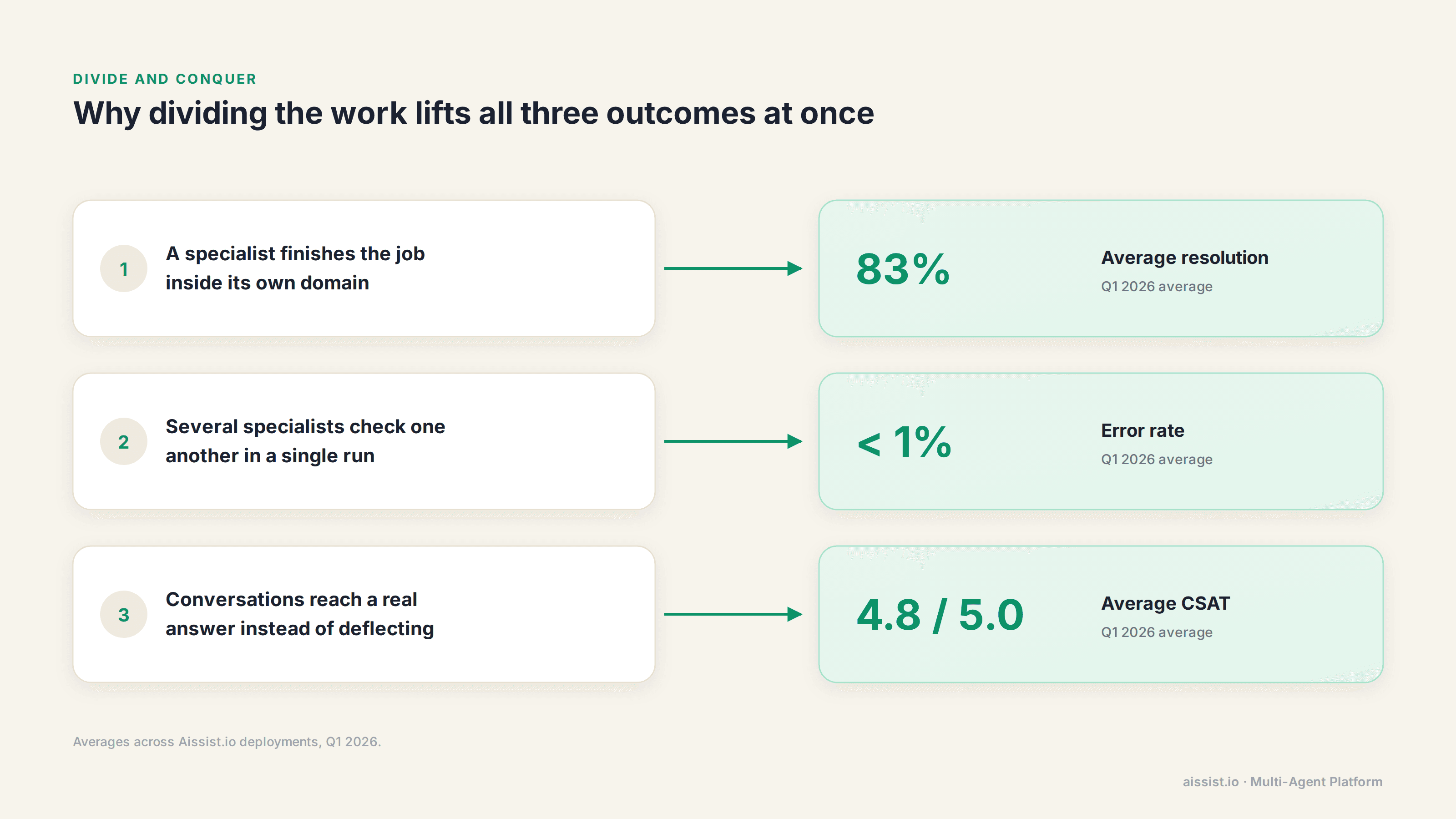
Across Aissist.io deployments, based on Q1 2026 data, average resolution reached 83%, error rate stayed under 1%, and average CSAT reached 4.8 / 5.0.
Dividing the work is what makes all three possible at the same time: a specialist can finish the job inside its own domain, which lifts resolution; several specialists can check one another within a single run, which helps keep errors under 1%; and a conversation that reaches a real answer instead of deflecting is what drives a 4.8 / 5.0 CSAT score.
For what counts as an error in that number, see how we grade AI agent errors by severity.
How do you know whether a specific sub-agent is working?
Through Pulse, the performance of each sub-agent can be measured and tracked. That includes traffic, resolution, NPS, and CSAT at the sub-agent level.
This means you do not only learn whether a sub-agent performs well. You also gain insight into your users, products, and processes, especially when a sub-agent represents a meaningful slice of the business.

Is Multi-Agent Platform more expensive?
Naturally, it should be. One run may involve multiple sub-agents, and some may be used more than once, which sounds more expensive than a single-model approach.
In practice, we have steadily tuned the engine to be highly efficient. That is why the platform is often more cost-effective than alternatives in the market, even while delivering deeper reasoning and more reliable execution.