
The teaching methods stopped matching the student
AI has advanced from elementary school to high school, to college, and in some domains to graduate work. The way we teach it has not kept up.
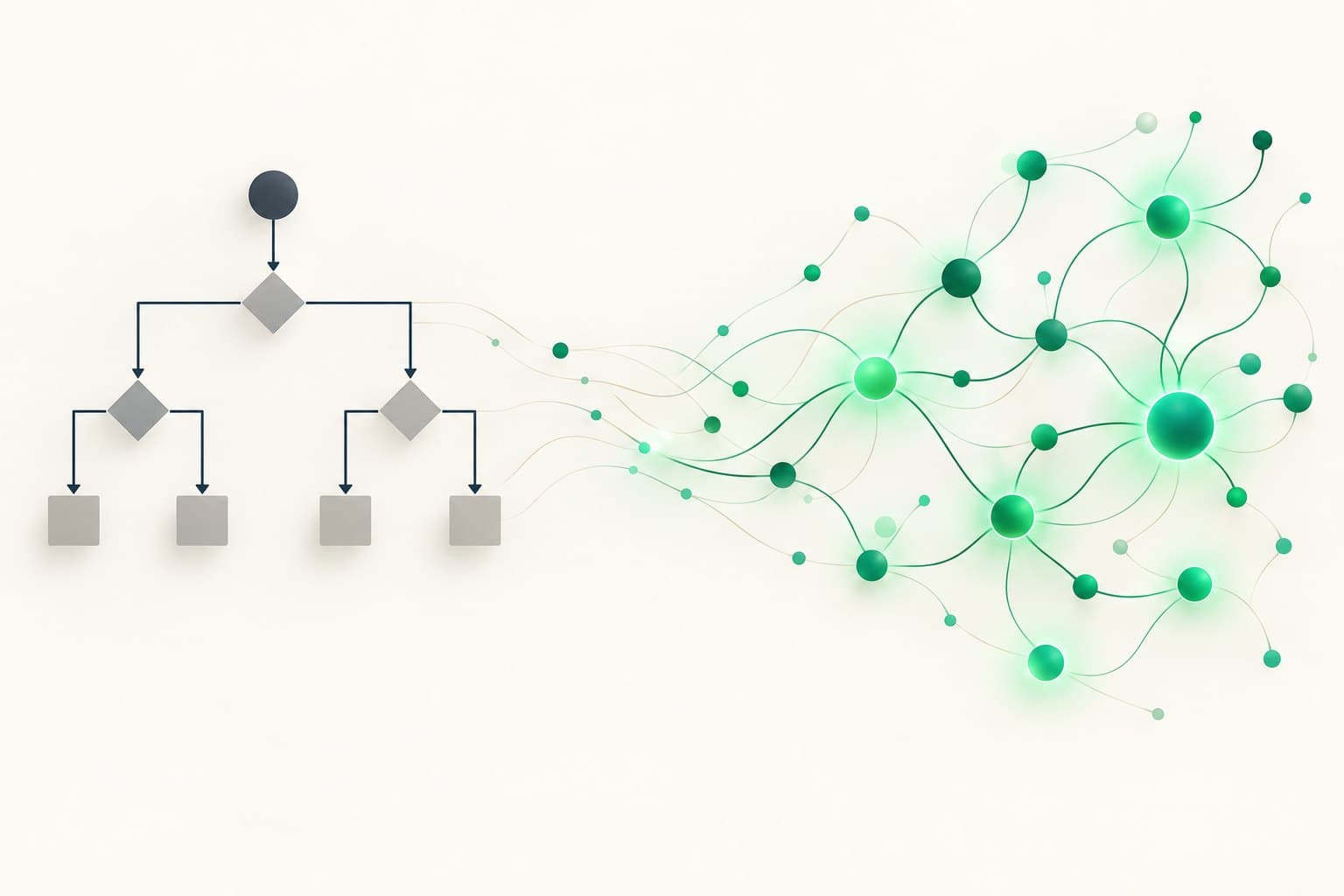
For a decade, teaching an AI system meant authoring it: rules, intents, decision trees, flows. That worked because the systems were linear — one input, one branch, one path. When the AI got something wrong, a human traced the path and fixed the branch.
Advanced agentic systems are not linear. Behavior emerges from instructions, context, tool results, and conversation history interacting, which is exactly what makes them capable and exactly what makes them hard to understand, manage, and optimize. Often there is no branch to fix, because there was never a branch.
The consequences show up every week. Optimization becomes whack-a-mole: a change that improves refund handling quietly regresses cancellations, and because the system isn't modular, neither are its regressions, so nobody notices until a metric moves. Product changes outrun content updates: a price change ships Tuesday, and the knowledge the AI reasons from is updated whenever someone gets to it. And when an incident hits, the AI stays static — an outage or a viral complaint is hours old and moving fast, and the AI still answers as though it's last month.
Same problem in different clothing: the system adapts on a human's timescale, not its own.
How this differs from the product pages. This page describes the loop — how execution, evaluation and optimization close on each other. The components that implement it have their own pages: AgentMesh executes, Pulse evaluates, and Evolve optimizes, all on the Multi-Agent Platform. Read this one for the architecture and those for what each part actually does.
What teams do today — and why it stops working
Faced with that mismatch, teams keep authoring: careful prompt design, knowledge structuring, guidance, workflow configuration. Done well, this covers roughly 40–60% of cases — a genuine achievement, and where most vendors declare victory.
For the rest, they bolt on human review. Someone reads transcripts, guesses at root causes, edits prompts, rewrites articles, and waits to see whether next week's numbers move. Around it sits the standard playbook: a QA sample scored against a rubric, a queue of escalations, a content calendar, a Slack thread when something urgent breaks. Every serious team runs some version of this.
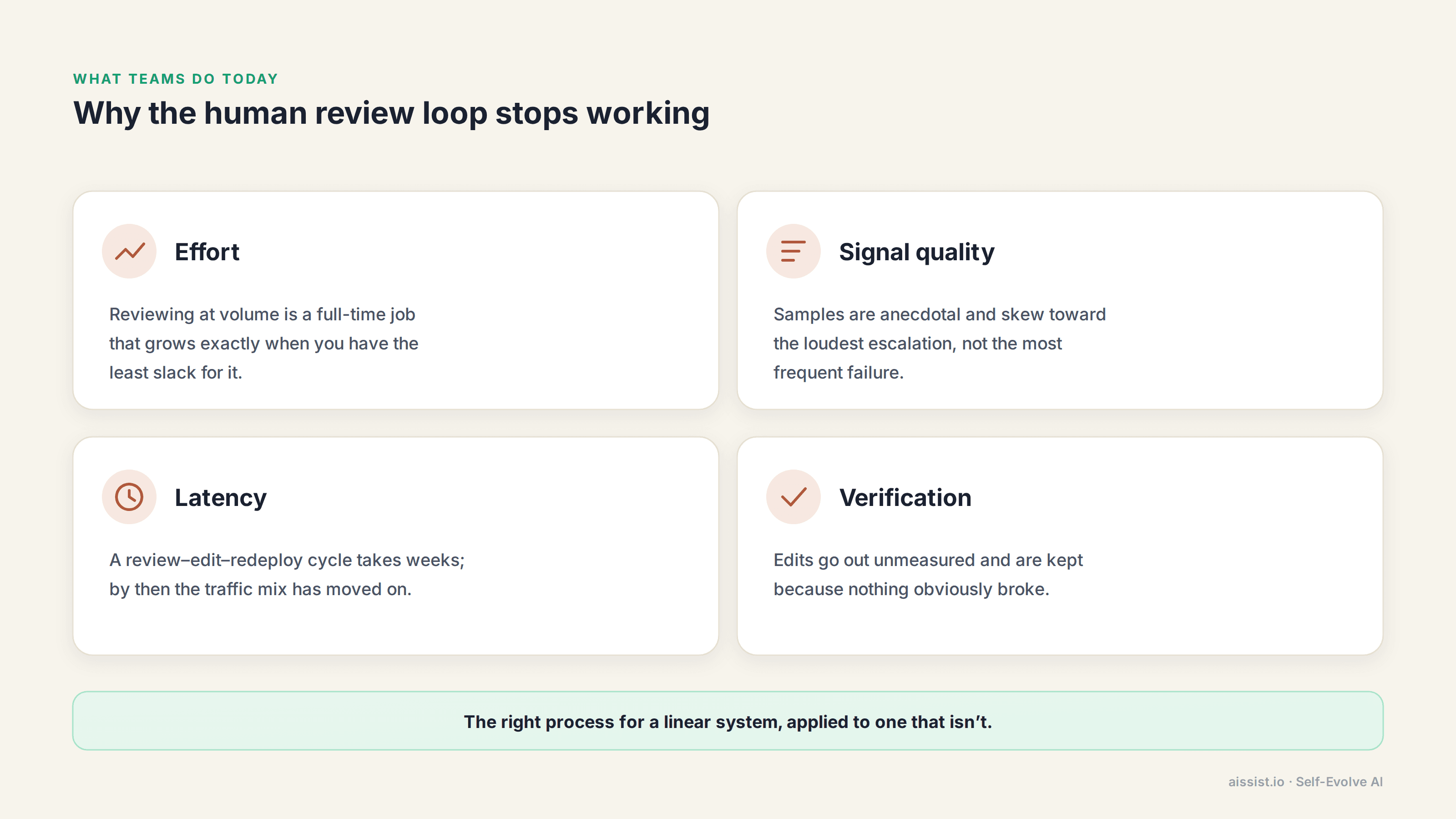
It isn't a bad process. It's the right process for a linear system, applied to one that isn't — and it fails on four fronts. Effort: reviewing conversations at volume is a full-time job that scales with traffic, so the improvement work grows exactly when you have the least slack for it. Signal quality: humans sample, sampling is anecdotal, and anecdote is biased toward the loudest escalation rather than the most frequent failure — you fix the ticket that reached the founder's inbox instead of the category quietly costing you a thousand resolutions a month. Latency: a review-edit-redeploy cycle takes weeks, by which time the traffic mix has shifted, so the system is always tuned for last month's business. Verification: almost nobody measures the edit — a change goes out, the numbers move for a dozen unrelated reasons, and the team keeps it because nothing obviously broke.
It gets harder near the plateau, where the levers work against each other. Push resolution and CSAT slips; optimize for CSAT and handle time climbs. Past a certain point the work isn't finding a fix — it's balancing objectives without losing the performance you already earned, exactly the kind of bookkeeping humans do badly and a measured loop does well. We trace that arc, month by month, in the next frontier for support and sales AI.
| Approach | Coverage | Signal source | What happens over time |
|---|---|---|---|
| FAQ bot | Documented questions only | None | Static; deflects rather than resolves |
| Hand-authoring / prompt engineering | ~40–60% of cases | Upfront configuration | A snapshot of the business at build time; decays from day one |
| Human review loop | Incremental | Sampled transcripts, escalations | Weeks per cycle; biased toward the loudest case, rarely verified |
| Self-evolve AI | Compounds toward top-performer level | All real traffic — AI + top human performers | Continuous: evaluate → experiment → optimize → verify |
Three components, wired into one loop
Self-evolution isn't a feature bolted onto an agent. It's an architecture — three components, each with a distinct job, connected in a closed cycle: automation that does the work, evaluation that finds the gaps, and optimization that closes them.
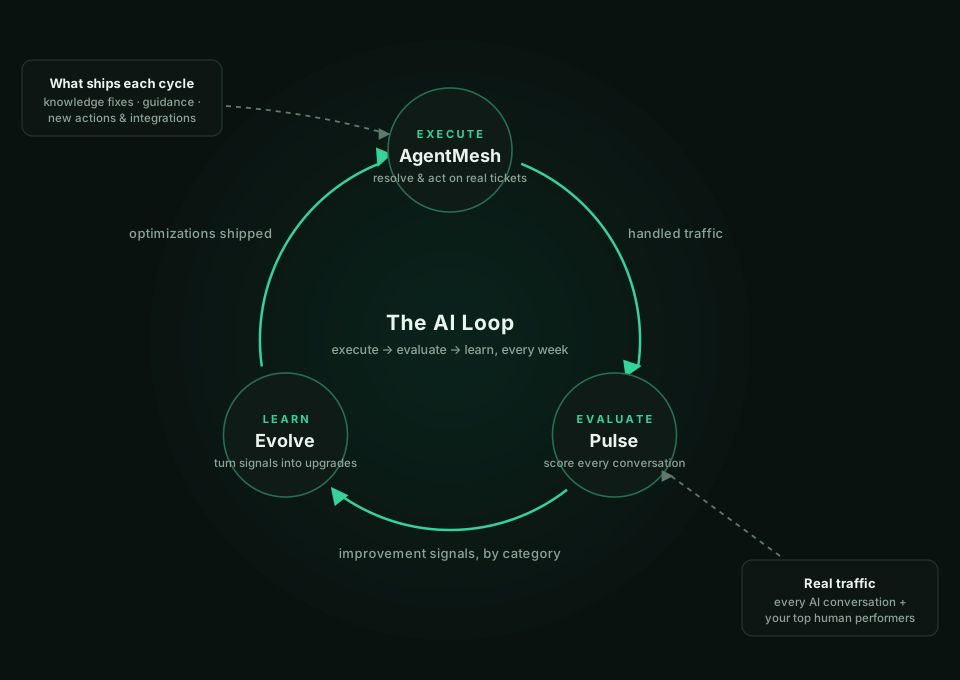
AgentMesh executes. Specialized agents handle live traffic across chat, email, and social, retrieve the right knowledge, follow your policies, and take real actions in your systems — refunds, order changes, account updates. Execution produces the raw material for everything downstream: real conversations with real outcomes.
Pulse evaluates all of it — not a sample, and not only the AI's share. Every conversation, whether an agent or a human on your team handled it, is scored and diagnosed: what the issue was, whether it was genuinely resolved, where handling fell short, and why. The output isn't a dashboard of vanity metrics; it's a ranked set of improvement signals, organized by category.
Evolve closes the loop. It takes Pulse's signals, diagnoses the root cause, and turns it into a concrete, reviewable change — a knowledge article to correct, guidance for an exception path, an action the AI is missing. It runs that change as an experiment on live traffic, measures it on the same yardstick that flagged the gap, and deploys what works back into AgentMesh.
Any one of these alone is table stakes. An executor without evaluation flies blind. An analytics layer without a path to action produces reports nobody acts on. An optimizer without trustworthy signals confidently makes things worse. The loop works because the three are wired together — the output of each stage is the input of the next, and every change is measured on the same yardstick that requested it. It's the same architecture behind our Multi-Agent Platform, unpacked further in self-evolving AI.
The signal: real traffic, and your definition of good
Every learning system lives or dies on its signal. Synthetic test suites are useful guardrails, but they only measure the questions you already thought to ask. Self-evolve AI learns from real traffic — the actual distribution of issues your customers bring, including the ones that didn't exist when the system was configured.
And the signal isn't limited to AI conversations. Pulse evaluates human-handled traffic too, so the measured performance of your top performers becomes part of the loop. Self-referential learning — an AI grading its own homework — plateaus quickly and reinforces its own blind spots. Benchmarking against top performers gives the loop an external, continuously updated standard drawn from the people who understand your customers best.
The ceiling for your AI shouldn't be “how it did last week.” It should be “how your best agent handles the same issue.”
A signal worth learning from has three properties. It's instant, drawn from what happened today rather than a survey that lands next month. It's low-noise, so the system isn't chasing random variation and mistaking luck for skill. And it's rich, carrying enough context to explain not just that an outcome was poor but why — the category, the step where handling broke down, what better handling looked like. Thin signals produce thin and sometimes actively misleading learning; the case is made at length in evaluable AI.
Signals are plural on purpose. A loop that optimizes a single number will find a way to win it at the expense of everything else — a containment-maximizing agent becomes a better wall. Pulse scores resolution, CSAT, sales conversion, sentiment, and effort in parallel, so a change that lifts one metric while dragging another shows up as what it is: a regression.
There's also no universal rubric for what good looks like. A refund-first reflex that delights a DTC shopper would be reckless at a regulated fintech; a tone that fits a gaming community reads as flippant in healthcare. You define the standard — what genuine resolution means for your workload, which behaviors are off-limits, how tone, policy, and escalation should be handled. Pulse evaluates against your definition and Evolve optimizes toward it. Change the definition and the loop re-optimizes toward the new one.
From signal to fix
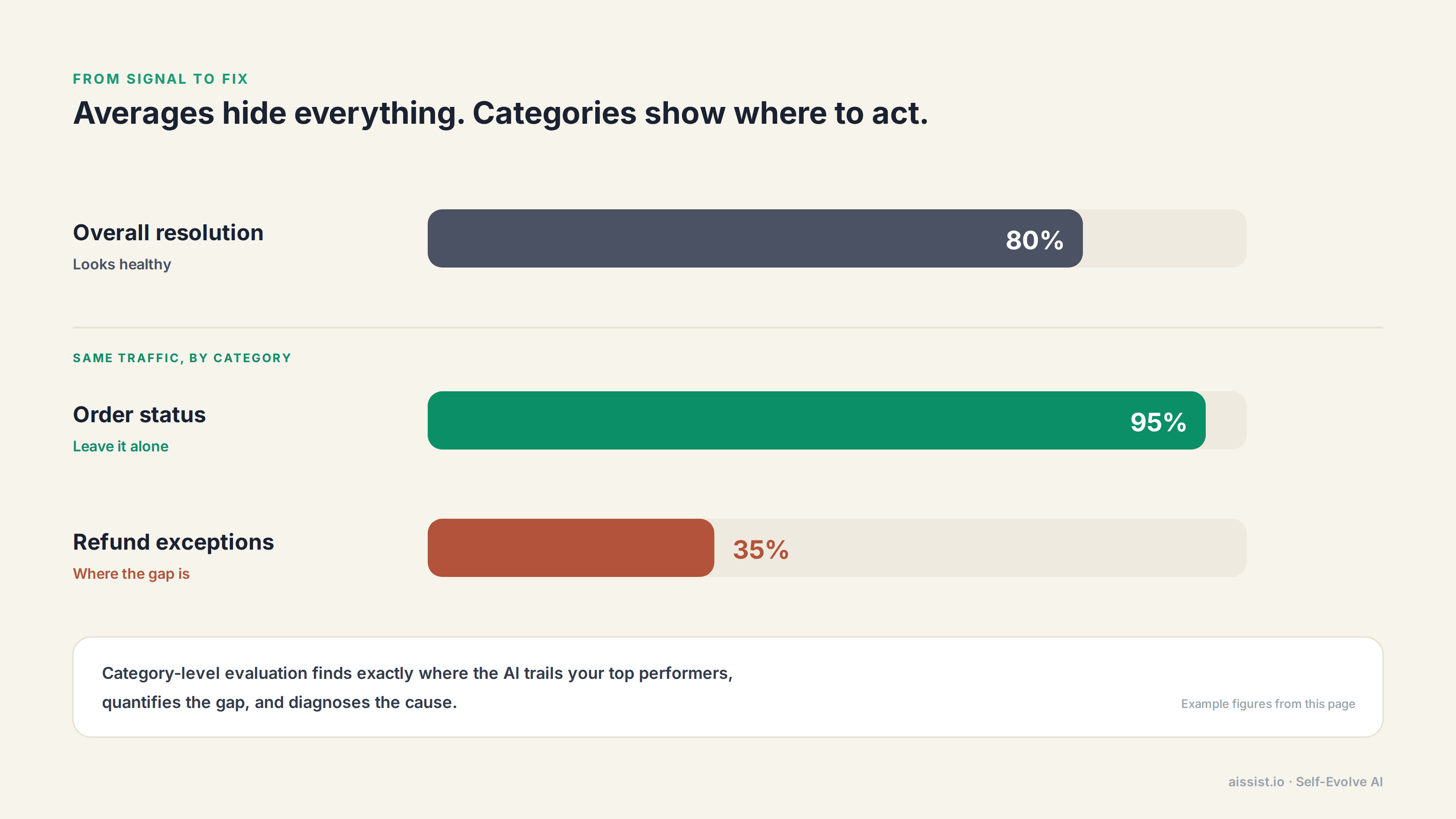
Knowing that performance differs is easy. Knowing which handling is better, in which category, and why is the hard part. Scores are aggregated by category, because averages hide everything: an 80% overall resolution rate can conceal a refund-exception category running at 35% while order-status runs at 95%. Category-level evaluation surfaces exactly where the AI trails your top performers, quantifies the gap, and diagnoses the cause.
A diagnosis is not an improvement. The loop still has to decide where the fix belongs, and picking the wrong layer is how teams end up with a bloated prompt that contradicts itself six months later.
There are four places a lesson can live. Knowledge takes factual gaps — a missing policy detail, an outdated article, a product change; cheap to update and easy to verify. Guidance carries judgment: how an exception path should be handled, when to offer the replacement instead of the refund. Guardrails encode what must never happen, and they're the right home for anything with compliance or brand risk. Actions and workflow cover the cases where the AI understood perfectly and simply couldn't do the thing — a missing integration, a step that always needed a human hand-off. Routing a missing-integration problem into more prose is the most common way an optimization loop wastes a cycle.
Durable embedding is also what makes the best-performer signal usable. When evaluation shows one resolution path consistently wins a category, that pattern can be written into knowledge or guidance and propagated across every agent in the mesh — instead of staying trapped in the one human who figured it out.
Change that has to prove itself
The step that separates self-evolution from auto-editing is verification. Evolve treats each change as an experiment with a stated hypothesis — this guidance fix should lift resolution in the refund-exception category without moving CSAT or handle time — and runs it on live traffic. Measured on the same multi-signal yardstick that flagged the gap, the two failure modes that break hand-tuning are caught automatically: a change that does nothing, and a change that fixes its target while quietly regressing something else. What holds up is kept; what doesn't is rolled back, and the diagnosis goes back into the queue.
Humans stay in the loop by calibration, not by ceremony. Fully autonomous optimization is fast but can drift somewhere the business didn't intend; fully manual review is safe and doesn't scale. So autonomy is graded by signal strength and blast radius: low-risk, well-evidenced changes ship on their own, while anything touching policy, compliance, or brand-sensitive behavior is queued for approval with the evidence attached. Every change stays attributable and reversible — the governance posture described in reliable AI.
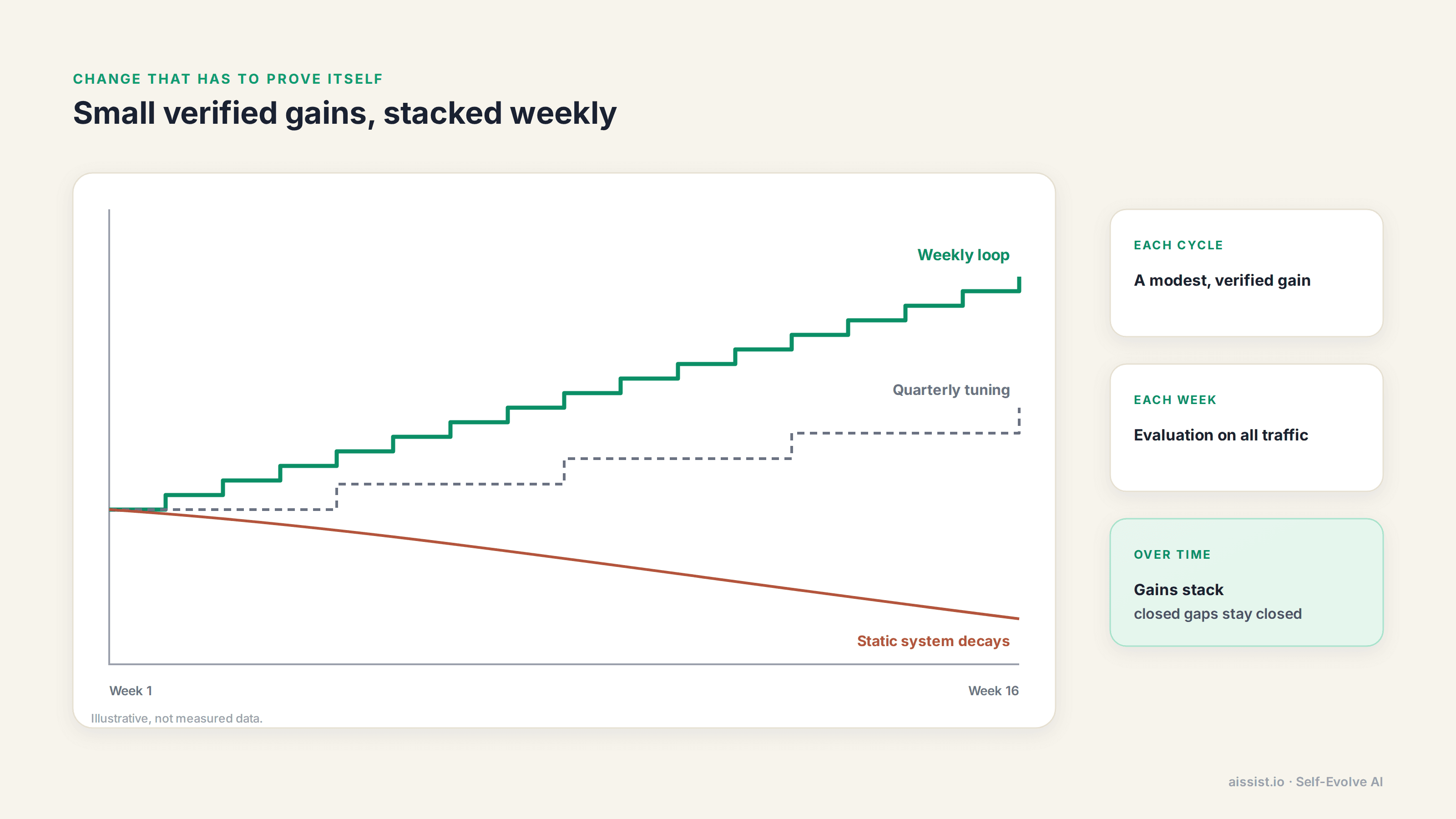
A single cycle produces a modest gain. The power is in the cadence: because evaluation runs on all traffic all the time, the loop turns weekly instead of quarterly, and small gains stack while static systems decay on the same schedule. Your business is dynamic — new products, promotions, policies, price changes, seasons — and the loop keeps the system reflecting the business as it is today, not as it was at go-live.
It's worth being precise about what the loop optimizes. A system that learns to maximize containment will learn to be a better wall — more customers giving up, counted as success. Self-evolve AI scores against genuine resolution, so every cycle pushes toward the only number that pays the bill: issues actually solved, end to end. That's the difference between an AI that gets better at deflecting and one that gets better at the job, a distinction we unpack in The Resolution–CSAT Tradeoff.
Where this stands — and what's still open
Being straight about maturity: the full loop runs today as a pilot program with several customers — deliberately small, deliberately early, and deliberately public about what remains unsolved. The components underneath it are not new; AgentMesh, Pulse, and Evolve run in production across our customer base. The autonomy in the optimization step is what we're rolling out slowly, with performance data beginning to publish in Q4 2026.
The caution is structural. A loop that learns from a noisy signal gets worse with great confidence, which is why the signal design, the multi-metric guard, and the graded approvals came before the autonomy. Several questions are still open, and we'd rather name them.
What counts as good? Reinforcement needs a reward signal, and every business defines it differently. A fast close is a win for one customer and a rushed churn risk for another. Resolution, CSAT, sentiment, effort, and conversion frequently disagree. Assuming a universal definition produces AI that optimizes confidently in the wrong direction.
Knowledge gap or behavior gap? Either the AI didn't know something, or it knew and handled it wrong. Those need completely different fixes, and from the outside they look nearly identical.
Partial observability. The system sees outcomes, rarely what produced them. The customer had already called twice. The agent who handled it well knew something written down nowhere the AI can read. Learning from outcomes without their causes is how a system acquires confident superstitions.
Where does human guidance fit? Operators know things the metrics don't: that reply was fine, but not for this account. Ask for too little and the AI learns from proxies; ask for too much and you're back to hand-authoring. How much human input the loop needs, and where, is still open.
Experimentation design. What experiment should run, and why? In a sandbox, which is safe but only a model of the customer, or on real traffic, where quality has to be protected while you learn? And how do you judge the result when the business, the season, and the customer mix all moved at once?
None of this makes the direction doubtful. Self-evolve AI isn't a feature release; it's a shift in who does the improving — from humans authoring the system to the system authoring itself, under supervision, against goals humans define. That shift is just beginning.
Frequently asked questions
What is self-evolve AI?
Self-evolve AI is an operational AI that improves itself from the work it already does, instead of staying frozen at the level it launched with. It executes on real traffic, evaluates the outcomes, diagnoses where handling fell short, runs experiments to close the gap, and keeps the changes that measurably work — continuously, rather than on a manual tuning schedule.
What are the three components of self-evolve AI?
Automation, evaluation, and optimization. AgentMesh executes on real traffic and takes actions in your systems. Pulse evaluates every conversation — AI-handled and human-handled — into ranked improvement signals by category. Evolve turns those signals into experiments, measures the result on the same yardstick, and ships what works back into AgentMesh for the next cycle.
Why isn't prompt engineering enough for AI customer service?
Well-executed prompt engineering and knowledge setup typically covers 40–60% of cases, but it is authoring: a snapshot of the business at configuration time, written for a system assumed to behave linearly. Agentic behavior emerges from instructions, context, tool results, and history interacting, so there's often no branch to trace and fix. Meanwhile products, policies, and customer language keep changing. Reaching top performance requires a learning system, not a bigger prompt.
What makes a good learning signal, and where does it come from?
It has to be instant, low-noise, and rich: drawn from what happened today rather than a survey that arrives next month, stable enough that the system isn't chasing random variation, and detailed enough to explain why an outcome was poor — the category, the step that broke down, what better handling looked like. It comes from real traffic, not synthetic tests, and not only AI conversations: Pulse evaluates human-handled conversations too, so your top human agents become the benchmark.
How does the system avoid fixing one metric and breaking another?
Every change is run as an experiment and measured on the same multi-signal yardstick that flagged the gap — resolution, CSAT, sentiment, effort, and conversion in parallel. A change that lifts its target while dragging another metric is recorded as a regression and rolled back, which is precisely the trade-off that hand-tuning tends to miss.
Do humans stay in the loop?
Yes, by calibration rather than blanket review. Low-risk changes with strong evidence apply on their own; anything touching policy, compliance, or brand-sensitive behavior is queued for human approval with the supporting evidence attached. Every change is attributable and reversible.
Is self-evolve AI available today?
The components — AgentMesh, Pulse, and Evolve — run in production today. The fully autonomous loop runs as a deliberately small pilot program with several customers, with performance data beginning to publish in Q4 2026.