Agentic AI for Sales: Connection First, Then Conversion
TL;DR — Inbound sales is won on connection before it's won on the pitch: understanding what the buyer actually wants, asking the right questions, and reacting to their sentiment and urgency. A scripted chatbot can't do that — it answers narrowly, misreads the moment, and quietly damages your brand at the exact point a prospect was ready to buy. Agentic AI for sales is different: it reasons through the ambiguity of a live sales conversation, connects emotionally, and moves the buyer toward the right outcome. Across multiple real projects, Aissist.io's agentic AI has reached human parity on inbound sales — at machine speed and scale.
A note on scope: this article is about inbound sales — where the buyer reaches out to you. That's where response quality and speed decide who wins the deal, and where agentic AI has the clearest advantage.
The Real Challenge of Inbound Sales Is Connection, Not Answers
Short answer: The part of inbound sales that moves a deal is connection, and it happens before any selling does.
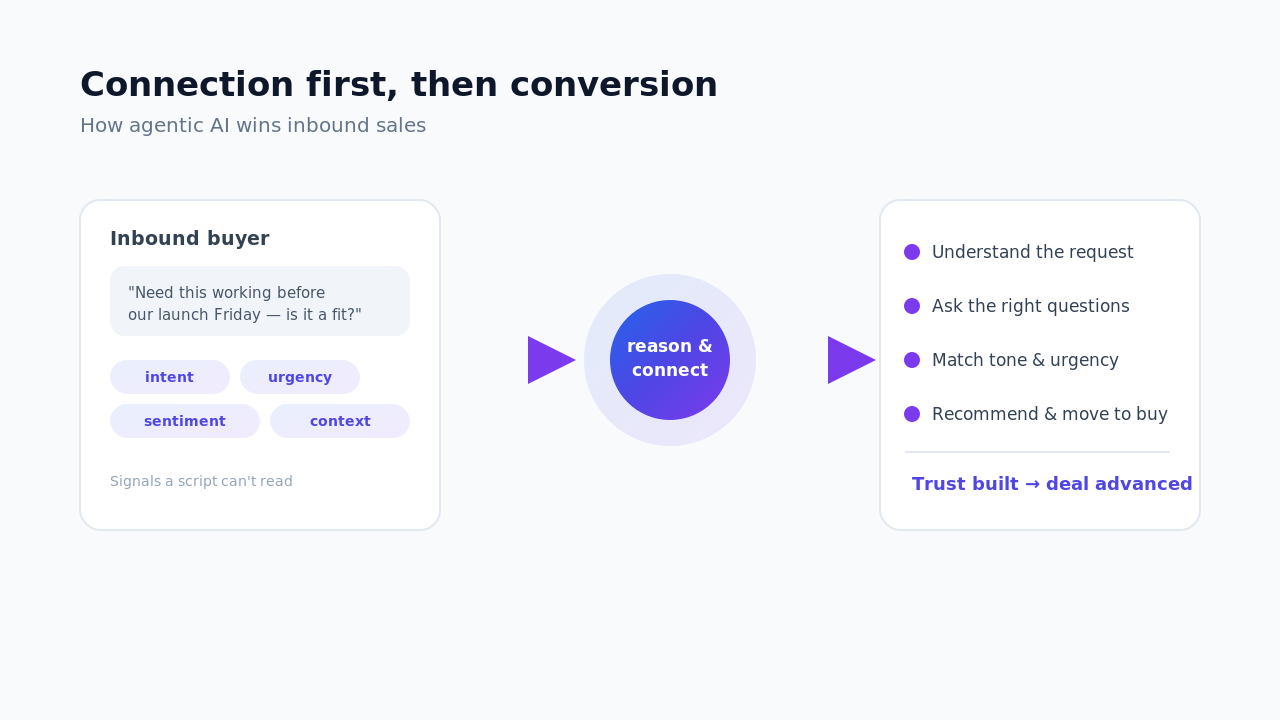
When a buyer reaches out, they aren't looking for a brochure read back to them. They're looking to be understood. Connection is a sequence of judgment calls: understanding what the person is really asking (not just the words they typed), asking the right follow-up questions to surface the real need, and reading their sentiment and urgency so you respond in the right register.
A buyer who writes "I need this working before our launch Friday" is telling you about a deadline, a risk, and a readiness to buy — all at once. A rep who hears that leans in. Only after that connection is established does the actual selling — recommending the right fit, handling objections, moving to close — have any chance of landing.
This is exactly why a robotic chatbot doesn't deliver results in sales. It skips the connection entirely. It matches a keyword to a canned answer, ignores the urgency, misses the sentiment, and pushes a generic response at someone who needed to feel heard. The mechanics of the sale never get a foundation to stand on.
Why a Robotic Chatbot Doesn't Just Fail — It Jeopardizes Your Brand
Short answer: A bad inbound experience doesn't just fail to convert — it actively costs you, because the prospect came to you.
They raised their hand. When your chatbot answers a nuanced, high-intent question with a rigid, off-target reply, you haven't given a neutral non-answer; you've told a ready-to-buy customer that your company doesn't get them. That impression sticks to the brand, not the bot.
The damage compounds in three ways:
- You lose the deal that was closest to closing. Inbound leads are your warmest, and mishandling them wastes the most valuable pipeline you have.
- You train buyers to distrust the channel. One robotic exchange and they route around it, or leave.
- You hand the moment to whoever responds better. Research on inbound consistently finds that 78% of buyers purchase from the company that responds first, and 35–50% of sales go to the vendor that responds first (InsideSales / Lead Response).
Speed matters enormously — contacting a lead within five minutes makes you 21x more likely to qualify it than waiting 30 minutes (MIT / InsideSales) — but speed with a robotic answer just gets you to the wrong outcome faster. Being first and human-quality is the bar. A brittle bot clears neither, and every mishandled conversation chips at the trust you spent real money to earn.
How Agentic AI Approaches Inbound Sales Differently
Short answer: It connects first, using reasoning rather than a script.
Three things set agentic AI apart:
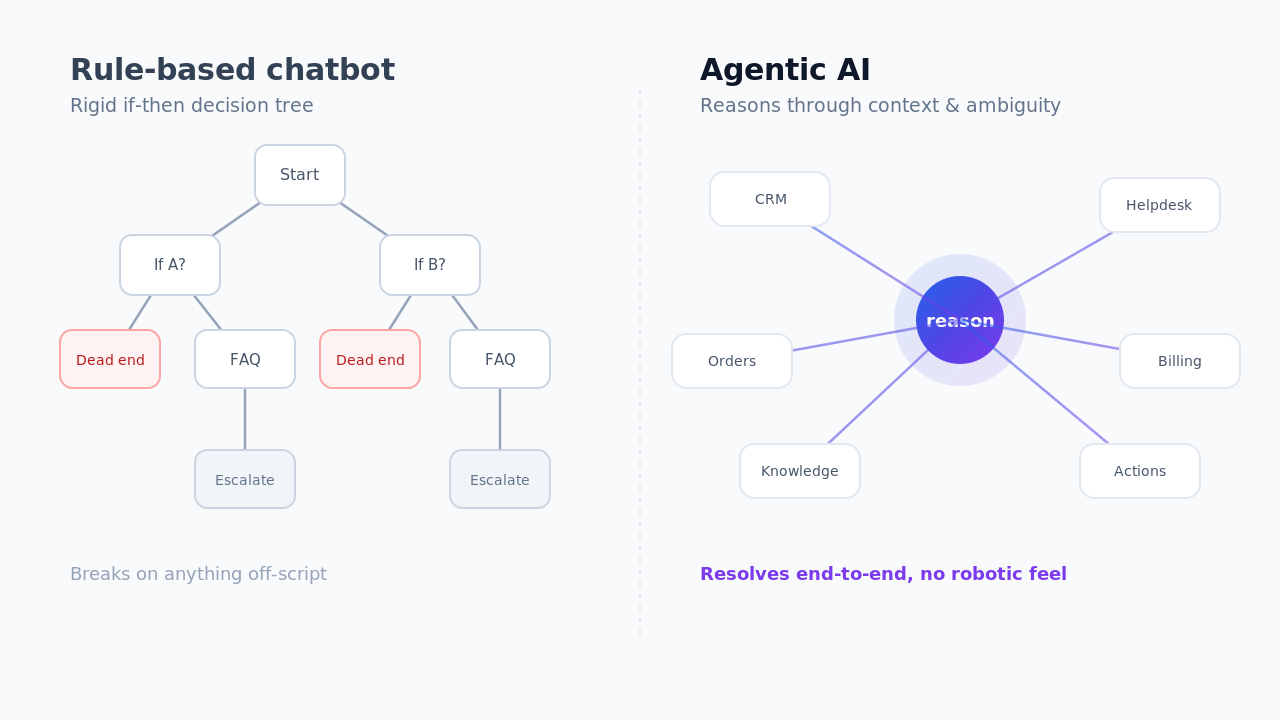
- It isn't robotic. Because responses are generated from understanding the full conversation and context — not retrieved from a pre-written branch — the interaction feels human. It adapts its wording, pacing, and tone to the person in front of it.
- It navigates complexity and ambiguity. Real sales conversations are messy: unclear requirements, multiple questions at once, hesitation, comparison shopping. Agentic AI reasons through that ambiguity in real time, asking clarifying questions and adjusting its recommendation as the picture sharpens — the way a strong rep would.
- It connects emotionally and delivers what the buyer wants. It reads sentiment and urgency and responds to them — reassuring the anxious buyer, moving quickly for the deadline-driven one — and then guides them to the outcome that actually fits, instead of pushing a generic pitch.
Contrast that with how most "AI" sales tools are still built. A large share of sales chatbots are structured around intent classification, flows, and decision trees — the buyer's message is sorted into one predefined bucket, then a fixed script runs. That architecture is fundamentally far from capturing the dynamic, shifting need of a real sales conversation, where intent evolves mid-thread and the emotional subtext carries as much weight as the literal question. You can't tree your way to rapport.
This is the same distinction Aissist.io draws for service with its AI Operational Layer and AgentMesh™ agentic workforce: a bot deflects, an agentic system reasons — and on a reliable, no-hallucination foundation, that reasoning is safe to put in front of your buyers. It's the sales side of the same shift covered in agentic AI for customer service.
The Result: Reaching Human Parity on Inbound Sales
Short answer: When you fix the connection problem, agentic AI converts and qualifies inbound buyers at a level comparable to skilled human reps.
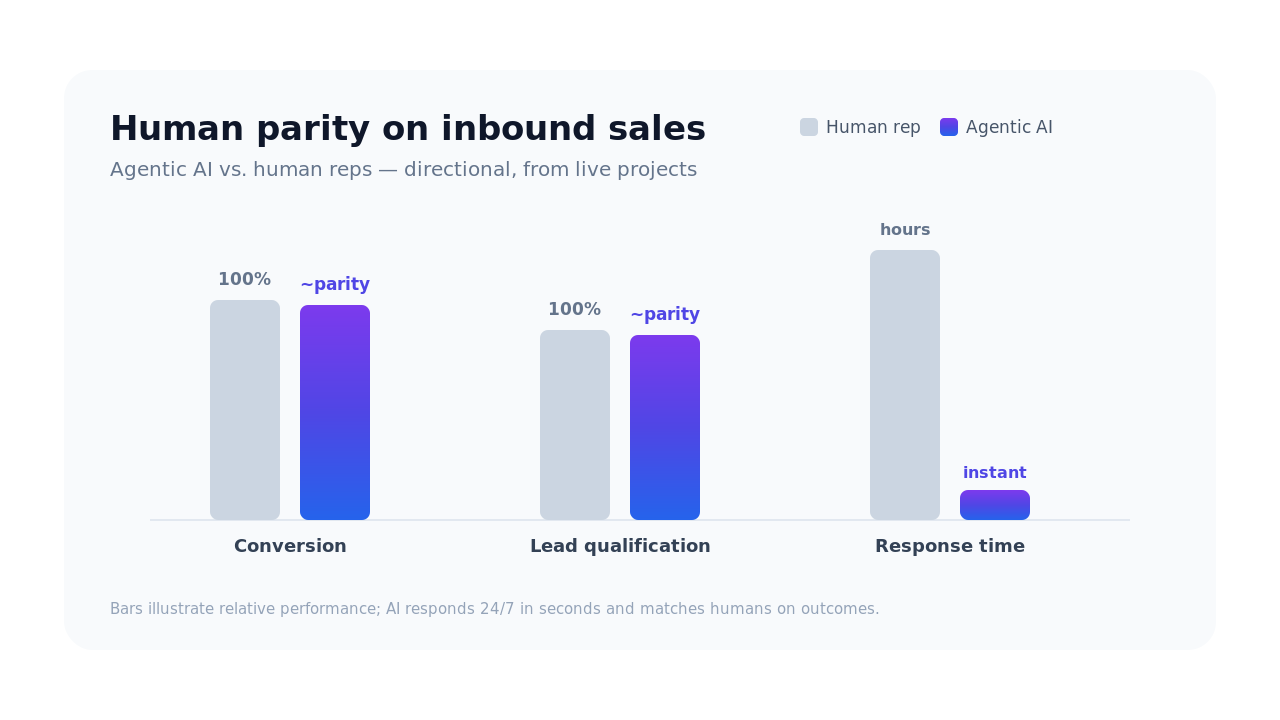
Across multiple relevant projects, Aissist.io's agentic AI has reached human parity on inbound sales — not merely deflecting or booking meetings, but matching the outcome quality of a strong rep.
Parity is a meaningful bar, and it's worth being precise about what it means here. It's not "as fast as a human" — the AI is far faster, responding in seconds, 24/7, to every inbound lead at once, so no warm prospect waits hours (the industry average lead response time is around 47 hours (Lead Response)). Parity is about quality of outcome: the same ability to understand the request, ask the right questions, read the room, and guide the buyer to a decision — the human-judgment part that scripted bots never touched. Reaching that level consistently, across different products and buyer types, is what separates agentic AI from a faster chatbot.
The compounding effect is the real story. A human rep can hold one great conversation at a time; agentic AI holds thousands simultaneously, each with full context, each at the quality bar you'd want your best rep to hit — and every one answered instantly. Human-quality connection at machine speed and scale is a combination inbound teams have never been able to buy before. It also frees your human sellers to spend their time where judgment, relationships, and negotiation matter most, instead of racing the clock on first response.
Summary
Inbound sales is won on connection first — understanding the buyer, asking the right questions, and responding to sentiment and urgency — and only then on the sell. Robotic chatbots skip that entirely; built on intent, flows, and trees, they can't read the moment, so they miss the warmest deals and quietly erode the brand that earned the lead. Agentic AI for sales inverts the approach: it reasons through complexity, connects like a person, and delivers what the buyer actually wants. The result, across multiple Aissist.io projects, is human parity on inbound sales — matched outcome quality, delivered instantly and at scale.
Selling on a script? See how an agentic AI workforce connects with inbound buyers and closes at human parity. Get a free demo →
Frequently Asked Questions
What is agentic AI for sales?
Agentic AI for sales is software that reasons through a live sales conversation — understanding the buyer's intent, asking the right questions, reading sentiment and urgency, and guiding them to the right outcome — rather than following a fixed script. For inbound sales, it connects with the buyer first and then sells, handling ambiguity the way a skilled human rep would, but instantly and at scale.
How is agentic AI different from a sales chatbot?
A sales chatbot classifies each message into a predefined intent and runs a fixed flow or decision tree, so it answers narrowly and misses emotional and situational context. Agentic AI reasons over the whole conversation, adapts its tone, asks clarifying questions, and responds to urgency and sentiment. The result is a natural, human-feeling interaction that builds connection instead of just returning canned answers.
Can AI really connect emotionally with buyers in inbound sales?
Yes, in the practical sense that matters for sales. Agentic AI reads a buyer's sentiment and urgency from the conversation and responds appropriately — reassuring a hesitant buyer or moving fast for a deadline-driven one. Because its replies are generated from understanding rather than scripted, they feel human and build the trust that connection requires, which is what moves inbound deals forward.
Why do chatbots hurt sales instead of just failing to help?
Because inbound leads are your warmest prospects — they reached out. A robotic, off-target reply to a high-intent question signals that your company doesn't understand them, and that impression attaches to your brand, not the bot. You lose the deal closest to closing, train buyers to distrust the channel, and hand the moment to whichever competitor responds better.
Does response speed matter for inbound sales conversion?
Enormously. Contacting a lead within five minutes makes you about 21x more likely to qualify it than waiting 30 minutes, and most buyers purchase from the company that responds first. But speed alone isn't enough — a fast, robotic answer just reaches a poor outcome sooner. The winning combination is instant response with human-quality connection, which is exactly what agentic AI delivers.
What does "human parity" on inbound sales mean?
Human parity means the AI converts and qualifies inbound buyers at a level comparable to a skilled human rep — matching the quality of understanding, questioning, and guidance, not just deflecting or booking a meeting. It's a statement about outcome quality. On speed the AI far exceeds humans, responding in seconds, 24/7, to every lead at once.
Is agentic AI meant to replace human sales reps?
No — it changes where reps spend their time. Agentic AI handles the high-volume inbound work at a consistent, human-quality bar and instant speed, so no warm lead waits. Human sellers then focus on the situations where relationships, negotiation, and complex judgment matter most. The pairing lifts total capacity without sacrificing the connection buyers expect.
What kinds of inbound sales conversations can agentic AI handle?
Agentic AI handles nuanced, ambiguous, multi-part inbound conversations — qualifying leads, answering product-fit and pricing questions, addressing objections, and guiding buyers toward a decision — across chat and messaging channels. Because it reasons rather than following a tree, it adapts as the buyer's need evolves mid-conversation, which is where intent-and-flow chatbots typically break down.