Agentic AI in Customer Service: Why It Beats the Chatbot
TL;DR — Traditional chatbots run on rigid if-then decision trees and single-"intent" routing. They answer FAQs, then break the moment a customer goes off-script or raises intertwined issues (fewer than 30% of cases fit one clean category) — which is why most contain only 20–40% of conversations and feel robotic. Agentic AI in customer service replaces the tree with reasoning: it reads the full conversation and context, navigates ambiguity, and resolves cases end-to-end. That lifts resolution rates and CSAT (often above human levels). It costs more per interaction because it computes over far more data — but with the right token efficiency, the cost per resolution stays around a dollar or less, and the ROI is decisively positive across every service metric that matters.
Most "AI" in customer service is still a chatbot wearing a nicer coat. Whether you call it AI customer support, AI customer care, or artificial intelligence customer service, the difference between a scripted bot and true agentic AI is the difference between deflecting tickets and actually resolving them. This guide breaks down what agentic AI is, why rigid chatbots fall short, what it costs, how to measure the return, and what to look for when you choose AI customer support software.
Why Traditional Chatbots Fall Short
Short answer: A chatbot is a decision tree — every path has to be mapped in advance, so anything off-script collapses.
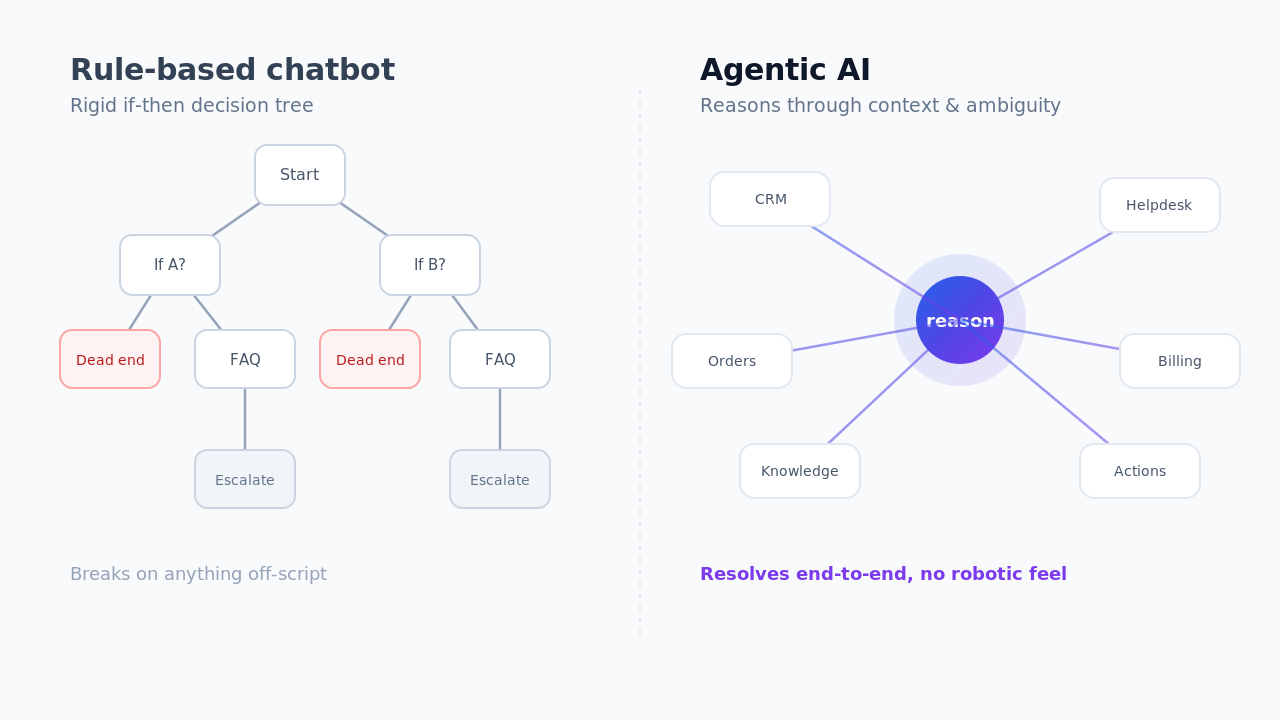
The classic support chatbot — the first-generation AI customer service bot — anticipates each route a customer can take and wires it in as an "if this, then that" flow. That design has four compounding problems:
- It only handles FAQs. Scripted bots are good at "where is my order" and "what are your hours." Ask something the flow's author didn't foresee, and the bot has nowhere to go.
- It breaks on complexity. Real issues are messy — multiple questions in one message, missing details, emotion. A decision tree can't improvise, so anything off the mapped path becomes a dead end or a handoff.
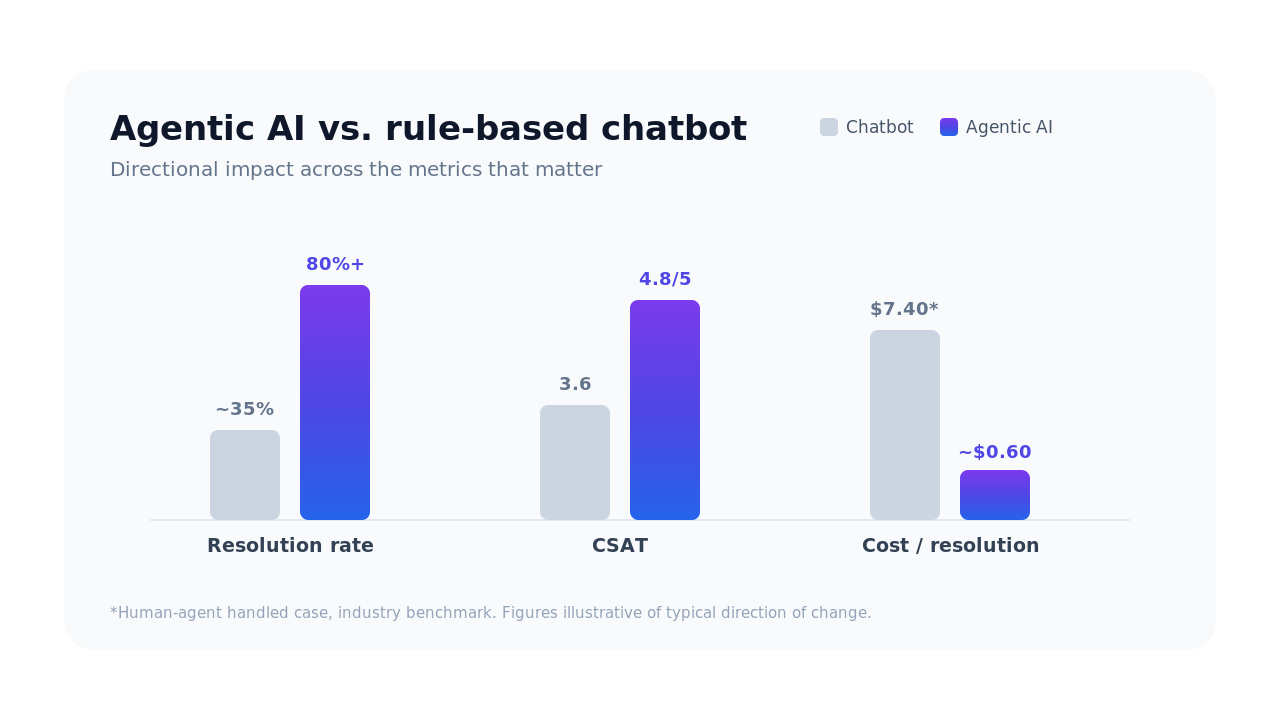
- Its performance is low, measured by resolution. Most chatbots resolve just 20–40% of conversations on their own, and rule-based bots without real AI typically land below 35% (Botpress, Alhena). The rest spill over to human agents — or to a customer who gives up.
- Its quality is low, measured by CSAT. Because the bot recites pre-written branches, it sounds robotic, makes people repeat themselves, and can't adapt its tone. Even a technically "contained" conversation can leave a customer unsatisfied.
There's a deeper flaw in how chatbots even understand a request: they are intent-based. The bot first classifies each case into a single predefined "intent" — a swim lane — then runs that lane's flow. In the real world, that's rarely realistic. Issues are intertwined. A product defect is tangled up with the warranty terms and the refund policy, and those terms may differ depending on the product and how it failed. Force that into one intent and the bot answers part of the question while missing the rest. Aissist.io's analysis shows fewer than 30% of cases can be cleanly categorized into a single intent; the other 70%+ span multiple concerns at once — exactly where swim-lane routing falls apart.
The root cause underneath all of this is rigidity. The tree/flow "if-then" structure and its intent-classification front door both assume the world can be mapped and sorted in advance, and customers reliably prove it can't. You can add more branches and more intents forever and still never cover reality. The architecture — not the wording — is the problem.
The #1 Complaint About Chatbots: They Block the Path to Real Help
Short answer: Across 500,000+ user reviews, the most common chatbot complaint is that it's too hard to reach a human.
We studied more than 500,000 publicly available pieces of user feedback across a range of industries, and one grievance rises above all others: it is too hard to escalate from the chatbot to a person. Customers don't just dislike bad answers — they resent being trapped by a system that won't let them out.
Worse, that friction is often deliberate. Every extra loop that keeps a user "contained" lifts the deflection number, so some chatbots are tuned to stall, redirect, and repeat themselves until the customer simply wears out and gives up. On a dashboard that looks like a resolved case; in reality it's an abandoned customer and a bruised brand. Optimizing for deflection at the expense of the person is exactly the resolution-versus-CSAT trade-off that scripted bots get wrong.
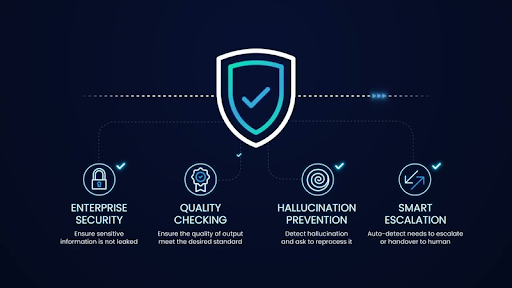
A good agentic AI does the opposite: it escalates automatically and smoothly, most of the time without the user ever having to ask. To do that well, it stays aware of two things. First, its own limits — what information and capabilities it actually has access to — so it recognizes when a case is genuinely beyond it instead of flailing. Second, the user's sentiment — so it can sense mounting frustration and hand off before the person has to demand it. Escalating at the right moment, gracefully and with full context, means the customer never feels trapped. That single behavior — knowing when to step aside — is one of the biggest reasons agentic AI earns higher CSAT than a scripted bot.
What Is Agentic AI, and How Is It Different?
Short answer: Agentic AI reasons toward a goal across your systems instead of following a fixed script.
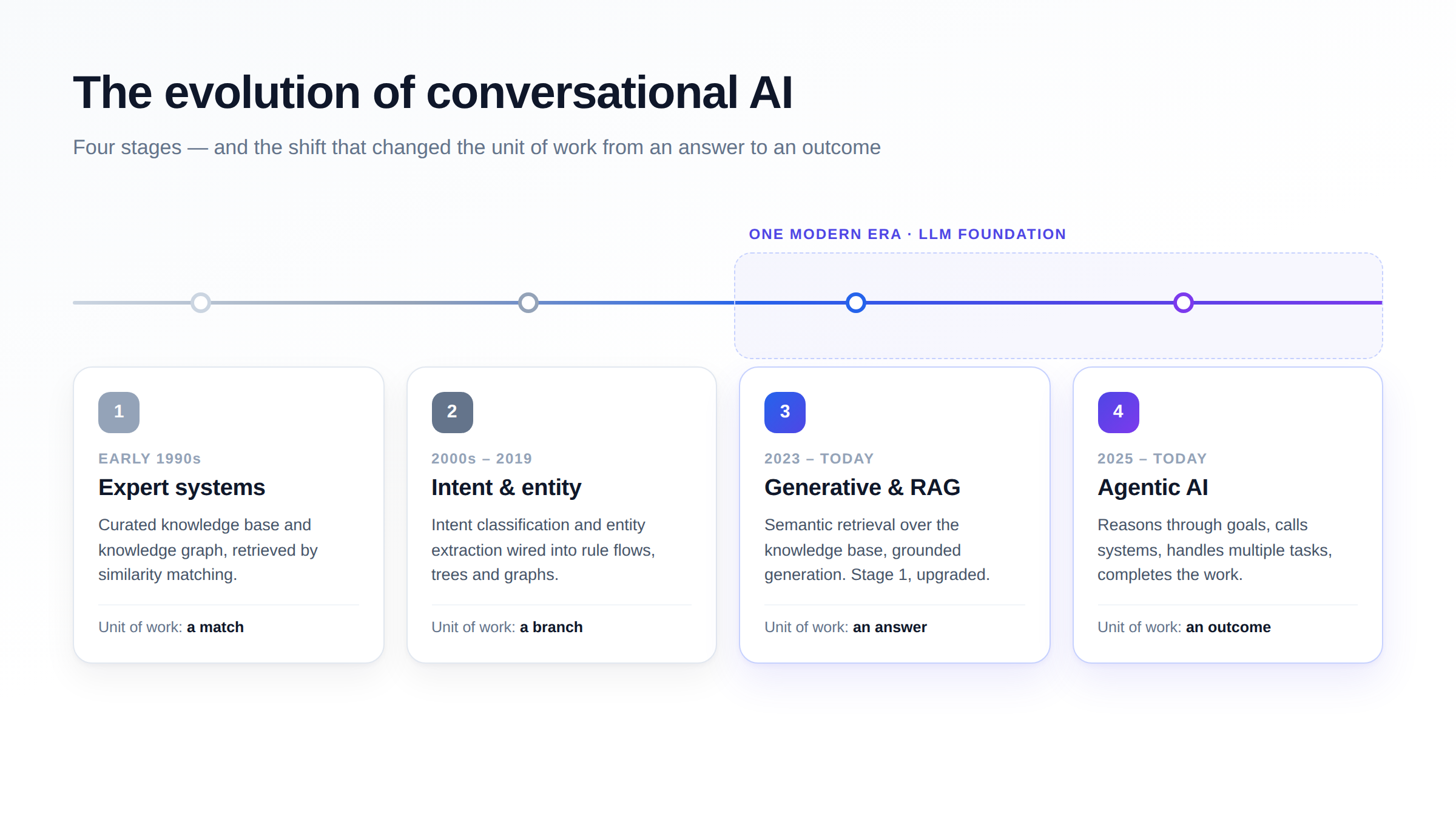
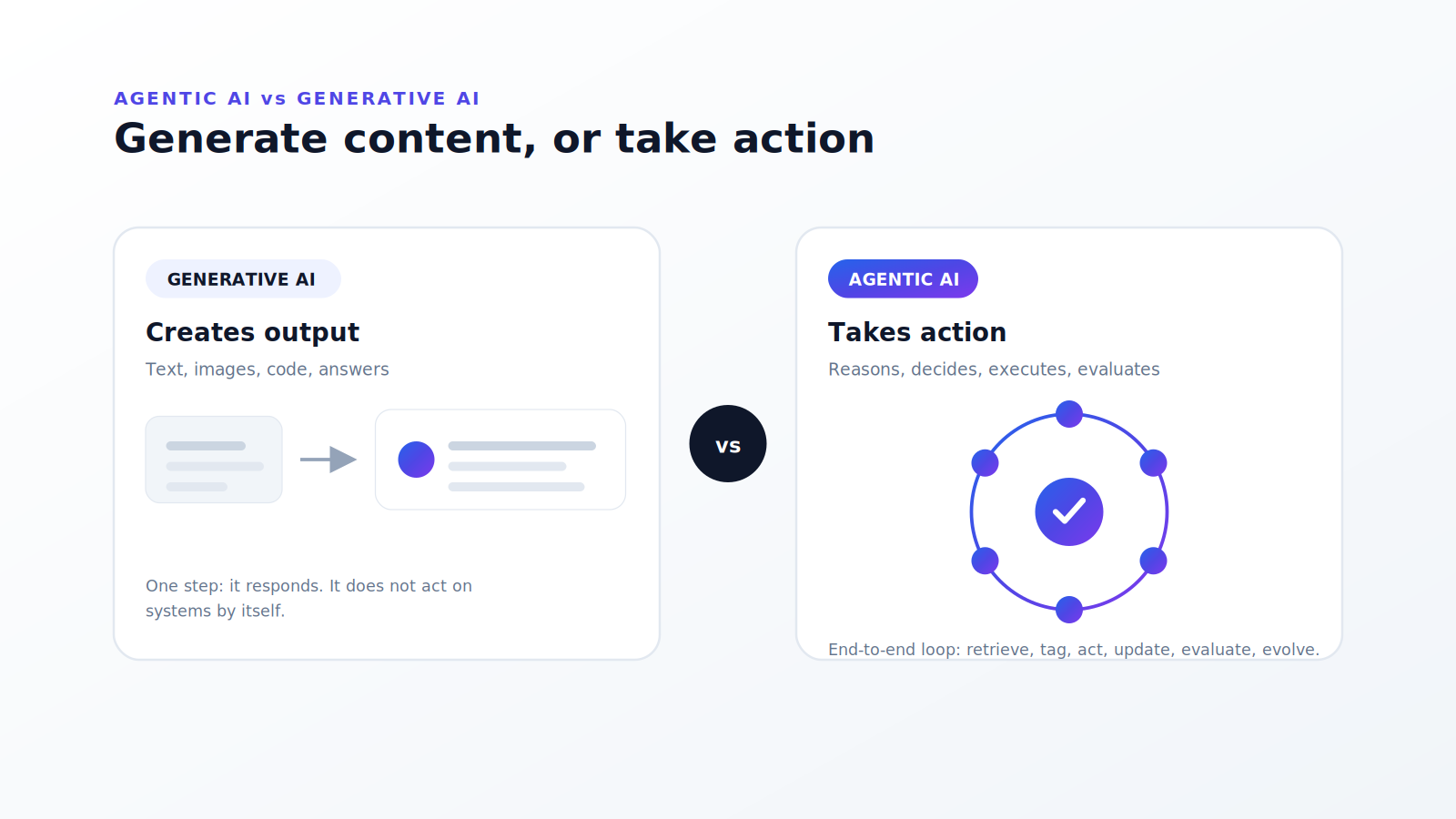
Agentic AI is software that can reason toward a goal, make decisions, and take action across systems — rather than follow a fixed script. In customer service, that takes the form of an AI customer service agent (sometimes called a virtual agent): a customer support AI agent that doesn't ask "which branch does this message match?" It asks "what is this person actually trying to accomplish, given everything I know about the conversation and this account, and what steps will resolve it?"
The single biggest difference is reasoning capability. Instead of matching inputs to pre-built paths — or forcing a case into one intent — agentic AI interprets the current conversation and the surrounding context (order history, prior tickets, account state, the customer's tone) and works through complexity and ambiguity in real time. It can hold several intertwined concerns at once: the defect, the warranty terms, and the applicable refund policy get reasoned about together, not routed to separate swim lanes. There is no rigid tree to fall off of and no single-intent bottleneck. That's also why it doesn't feel robotic: responses are generated from understanding, not retrieved from a branch, so the interaction reads as natural and adapts as the conversation moves.
This is the line Aissist.io draws between a legacy bot and an AI Operational Layer: a chatbot deflects, while an agentic AgentMesh™ workforce reasons like an expert, connects to the systems you already run, and resolves the case end-to-end. Where a decision tree breaks on complexity, a well-built multi-agent system thrives on it.
This is what AI-powered customer service should mean. The outcome shows up in the numbers. Gartner predicts agentic AI will autonomously resolve 80% of common customer service issues without human intervention by 2029 (Gartner). And on satisfaction, agentic systems frequently match or beat humans — JetBlue's AI agent reported a 92% CSAT, higher than its frontline human agents (Salesforce). Aissist.io's own deployments average 83% resolution at 4.8/5.0 CSAT from automated support.
What Does Agentic AI Cost Compared to a Chatbot?
Short answer: More per interaction — but token efficiency keeps the cost per resolution near a dollar.
A scripted chatbot runs a cheap lookup against a decision tree. Agentic AI computes over far more data on every turn — reading context, reasoning through options, often calling multiple models and tools — so the raw compute per conversation is higher.
Recent research underscores that this is not trivial. Industry benchmarks currently put an AI-resolved case near $0.62 versus roughly $7.40 for a case a human agent handles (CMSWire). But Gartner has warned that as vendor pricing shifts from subsidized to profitable and use cases grow more complex, the cost per resolution for generative AI could exceed $3 by 2030 — in some cases surpassing offshore human agents (CMSWire). Agentic AI is powerful, but it is not automatically cheap.
The deciding variable is token efficiency. How a system is engineered — how tightly it manages context, routes to the right-sized model, caches, and avoids redundant reasoning — swings the per-resolution cost by an order of magnitude. A well-architected agentic platform keeps resolutions around ~$0.60 even while reasoning deeply, which is why Aissist.io customers see 40%+ cost savings rather than a cost blowup. Agentic AI being "expensive" is a design outcome, not a law of physics. See the cost benchmark of AI service for how the math plays out.
Why You Need Agentic AI — and How to Measure ROI
Short answer: A chatbot's ceiling is its script; agentic AI removes it, and the return is measurable across every metric.
You need agentic AI because the alternative caps out. You cannot branch your way to handling real customers. Agentic AI removes that ceiling — and the return shows up across every core metric, not just one:
- Resolution rate: from the ~20–40% typical of chatbots to 80%+ for well-built agentic systems — the single largest lever on cost-to-serve.
- CSAT: from robotic, repeat-yourself interactions to natural, context-aware ones that match or beat human agents.
- Cost per resolution: with token efficiency, roughly an order of magnitude below a human-handled case.
- Escalations and handle time: fewer cases dumped on humans; the ones that do escalate arrive with full context.
- Coverage: 24/7, omni-channel, multi-language, without linear headcount growth.
To measure ROI, compare fully-loaded cost per resolution before and after, multiply the per-case savings by resolved volume, and layer in the retention and revenue effect of higher CSAT. The blended picture is strong: organizations investing in AI-powered support report an average return of $3.50 for every $1 spent, with leaders reaching up to 8x (Fin.ai). For a full framework, see how to measure the true ROI of agentic AI. The point isn't that agentic AI is cheap — it's that it resolves far more, far better, at a cost per resolution a scripted bot can't touch on quality or a human can't touch on price.
How to Choose AI Customer Support Software
Short answer: Judge AI customer support platforms on resolution, actions, helpdesk fit and cost per resolution — not on how many AI features they list.
The market for AI customer service software is crowded: helpdesk suites with AI add-ons, standalone chatbots, and agentic platforms all claim the same outcomes. Whether you are comparing AI customer support tools for a small ecommerce store or looking for scalable AI solutions for global customer support teams, the same questions separate real resolution from AI washing:
- Does it resolve, or only deflect? Ask for the resolution rate — cases closed without a human, confirmed by the customer — not the containment or deflection rate. Most of the "best AI chatbot for customer service" lists rank bots on features; rank them on resolved cases instead.
- Can it take actions? Real customer support automation means issuing the refund, updating the order, or changing the plan inside your systems, not linking to a help article. This is where an ecommerce AI chatbot for customer service automation earns its keep: order status, returns and exchanges handled end-to-end.
- Does it work in your helpdesk? AI helpdesk automation should run inside the tools your team already uses — Zendesk, Intercom, Freshdesk, Salesforce, Gorgias and others — rather than forcing a migration. If you are still choosing help desk software with AI automation built in, weigh the vendor lock-in that comes with a bundled bot; see also our help desk software comparison and help desk automation playbook.
- Does it scale across languages and channels? The best scalable AI customer support solutions cover email, chat, social and messaging in every language your customers use, without a separate setup per market. See the best multilingual AI customer service platforms.
- Does it escalate well? As covered above, a good system knows its limits and hands off with full context before the customer has to ask.
- Is the cost predictable? Compare cost per resolution, not seat price or per-conversation fees, and check what happens to the bill as complex cases grow.
Using these criteria, the best AI customer service software for most teams is an agentic AI platform that resolves inside the existing helpdesk, not a chatbot bolted on beside it. For a ranked view of the market's AI customer service solutions, see our top agentic AI for customer service benchmark; the same criteria also answer "what is the best AI agent platform" for support teams.
Key Takeaways
Chatbots fail because their if-then, single-intent architecture is rigid; they deflect FAQs and break on everything else, producing low resolution and robotic, low-CSAT experiences. Agentic AI replaces the tree with reasoning over live context, so it navigates complexity, holds intertwined issues together, resolves end-to-end, and often beats humans on satisfaction. It costs more to compute — but with real token efficiency, the cost per resolution stays near a dollar, and the ROI lands firmly positive across resolution, CSAT, cost, and coverage.
Ready to move beyond the chatbot? See how an agentic AI workforce resolves support and sales end-to-end. Get a free demo →
Frequently Asked Questions
What is agentic AI in customer service?
Agentic AI in customer service is software that reasons toward a goal, decides, and takes action across your systems to resolve a customer's issue — rather than following a fixed script. It interprets the full conversation and account context in real time, so it can handle complex, ambiguous requests end-to-end instead of only matching pre-written FAQ branches.
How is agentic AI different from a chatbot?
A chatbot follows a rigid if-then decision tree, so it only handles anticipated questions and breaks when a customer goes off-script. Agentic AI reasons over the current conversation and context, adapts on the fly, and takes real actions across connected systems. The practical result is higher resolution rates, more natural interactions, and true end-to-end resolution rather than deflection.
Why do chatbots have such low resolution rates?
Because their decision-tree architecture is brittle. Every path must be mapped in advance, and real customer issues constantly fall outside those paths. Most chatbots contain only 20–40% of conversations, and rule-based bots without AI often fall below 35%, spilling the rest to human agents or frustrated customers.
What is the problem with intent-based chatbots?
Intent-based chatbots classify each case into a single predefined category, then run that category's flow. Real issues are usually intertwined — a defect ties into warranty and refund terms that vary by product — so one intent can't capture them. Aissist.io's analysis finds fewer than 30% of cases can be cleanly categorized, which is why single-intent routing so often gives partial or wrong answers.
Why is it so hard to reach a human through a chatbot?
It's the number one chatbot complaint in our study of 500,000+ user reviews. Often the difficulty is deliberate: making escalation hard raises the deflection rate, so the bot stalls and loops until users give up. Good agentic AI reverses this — it monitors its own limits and the customer's sentiment and hands off to a human smoothly, usually before the person even asks.
Does agentic AI deliver higher CSAT than human agents?
It can. Because agentic AI generates responses from understanding rather than reciting scripts, interactions feel natural and adapt to tone and context. Benchmarks show well-designed agentic systems matching or beating humans — for example, JetBlue reported a 92% CSAT from its AI agent, higher than its frontline human agents.
Is agentic AI more expensive than a chatbot?
Per interaction, yes. Agentic AI computes over much more data than a chatbot's simple lookup, so raw compute is higher, and Gartner warns per-resolution costs could rise over time. But total cost per resolution depends heavily on token efficiency and system design — a well-engineered platform keeps it around $0.60, roughly an order of magnitude below a human-handled case.
How much does agentic AI customer service cost per resolution?
Industry benchmarks put an AI-resolved case near $0.62 versus about $7.40 for a human-handled one, though costs vary widely by vendor and complexity. The figure is driven less by the model and more by architecture — context management, model routing, and caching — which is what keeps an efficient agentic system affordable at scale.
How do you measure the ROI of agentic AI in customer service?
Compare fully-loaded cost per resolution before and after deployment, multiply the per-case savings by resolved volume, then add the retention and revenue impact of higher CSAT. Track resolution rate, CSAT, cost per resolution, escalation rate, and handle time together. Reported returns average about $3.50 per $1 spent, with leaders reaching up to 8x.
What is the best AI customer support software?
The best AI customer support software is the one that resolves the most cases end-to-end inside your existing helpdesk at a predictable cost per resolution. Compare platforms on verified resolution rate, the actions they can take in your systems (refunds, order changes, account updates), helpdesk integration, language coverage, escalation quality, and pricing model — not on the length of the feature list.
How does AI customer support automation work with an existing help desk?
An agentic AI platform connects to your helpdesk (such as Zendesk, Intercom, Freshdesk or Salesforce) and to back-end systems like your order or billing tools. It reads each incoming ticket or chat, resolves what it can by answering and taking actions, and escalates the rest to human agents in the same helpdesk with full context — so your team keeps its workflow and reporting.
Will agentic AI replace human support agents?
No — it changes their role. Agentic AI autonomously resolves the high-volume, repetitive cases (Gartner projects 80% of common issues by 2029), while humans focus on the genuinely complex, high-empathy, or high-stakes situations. The best setups escalate cleanly, handing agents full context so the customer never has to repeat themselves.