
AI Customer Service Benchmark · Updated July 2026
AI Customer Service Benchmark 2026: Resolution Rate, CSAT & Cost by Industry
Three metrics decide whether AI support actually works: how often it resolves an issue end-to-end (not merely deflects it), how satisfied customers are afterward, and what each resolution costs. Here is where every major vertical lands in 2026 — with vendor marketing claims held side-by-side against independently verified results.
Updated July 2026
Compiled by Alex Gomez, Sr. Analyst. Figures read from their sources on 24 August 2026. Published by Aissist.io, which sells a product in the category measured here — our own deployments appear among the figures and are labelled as ours.
What the 2026 data actually says
Independent cross-program aggregate of tier-1 automation. Source definitions vary — some publishers report this same figure as deflection — so read it as a directional floor, not an audited resolution median. Top quartile ~59%.
AI-handled interactions typically score 5–10 points below human-handled for the same team.
Our estimate: ~$1–$3 unit price plus amortized integration and engineering at typical B2B volumes. Versus ~$30 for a human-resolved B2B ticket — an 80–90% cut on eligible volume.
The vendor-claimed vs. field-aggregate gap is structural. Headline rates of 76–90% come from cherry-picked, high-structure case studies; our synthesis of secondary compilations lands near 41% (tier-1 automation — some sources report this as deflection), top quartile ~59%. Both numbers can be "true" — neither is the whole story.
Intent structure predicts everything. Order-status and billing questions resolve at 70–84%; ambiguous, regulated or emotional issues resolve far lower. Industry rank-order follows intent structure, not vendor choice.
Ecommerce leads, telecom and healthcare trail on genuine resolution — the same order in which their intents move from structured-and-data-rich to ambiguous-and-regulated.
"Resolution" must be defined before it's compared. Counting "customer didn't ask for a human" as resolved inflates the metric by 20–40 points versus counting only genuinely solved issues.
Cost per resolution beats cost per contact. A 2.3× repeat-contact rate means your real cost per issue is more than double your cost-per-contact figure — deflection that doesn't resolve quietly raises total cost.
Is resolution rate the same as deflection rate?
No — and confusing the two is how vendor dashboards overstate AI performance by 20–40 points. Resolution rate counts only conversations where the customer's issue was genuinely solved end-to-end. Deflection rate counts any conversation that never reached a human, including customers who simply gave up.
The share of conversations where the customer's issue was genuinely solved end-to-end by AI, with no human handoff and no silent abandonment. This is the metric that maps to real cost savings and retention.
The share of conversations that simply never reached a human — including customers who gave up. It flatters dashboards and runs 20–40 points higher than true resolution on the same deployment.
Two adjacent metrics complete the picture. Automation rate = involvement rate × resolution rate (how much of total volume AI actually closes). Self-service success from legacy help centers fully resolves only about 14% of issues — the floor that conversational AI is meant to beat. Throughout this benchmark, all figures are genuine resolution unless explicitly tagged as deflection.
How much does AI actually resolve?
Our synthesis of secondary compilations puts the tier-1 automation median near 41%, with a top quartile around 59% — but read this as a directional floor: the underlying compilations vary in definition, and some report it as deflection rather than genuine end-to-end resolution. Well-run deployments on mature knowledge bases reach 60–67%; new deployments typically launch at 40–50% and improve by roughly a point per month as workflows and documentation mature.
76% average resolution rate
Fleet-wide, stated across its customer base
Up from 66% in October 2025. Fin defines a resolution under its own billing rules.
80% deflection (Duolingo); 90%+ of issues (Flashfood)
Individual case studies — no fleet-wide average published
Decagon's own glossary benchmarks e-commerce at 55–75% and financial services at 25–45%, well below its case-study headlines.
83% of conversations automated
Stated as a cross-customer figure
Ada's own guide to automated resolution puts a typical enterprise launch at 50–65% and the industry average at 52%.
90% case resolution rate (Ramp)
Single named case study — no fleet-wide average published
A separate Sierra post cites 70%+ for unnamed customers. Sierra's Sonos page, sometimes cited for this range, publishes no percentage at all.
Every figure above is the vendor’s own published claim, linked to the page it appears on and dated where that page shows a date. They are not directly comparable: each vendor defines “resolution” differently, some report deflection instead, and two of the four publish only individual case studies rather than a fleet-wide average. We are not aware of any independent audit or multi-vendor study measuring these products’ real-world resolution rates — so this page does not print one. The only way to know what a vendor will do on your traffic is a pilot on your own tickets.
| Industry | Typical verified range | Best-in-class | Representative deployments | Why it lands here |
|---|---|---|---|---|
| Ecommerce & Retail | 70–84% | 93% | Lightspeed 72% · Nuuly 49% instant · Fin ecommerce 70–84% | Highest-volume intents (order status, returns, shipping) are structured and data-rich. |
| Consumer Fintech | 60–75% | 75%+ | Klarna ~66–67% automated (75% self-resolution) · Chime 40→70% · Kriptomat 62% | Authenticated accounts + finite high-volume intents; but hard tickets are regulator-attention, not churn. |
| SaaS & Software | 50–70% | 87%† | Grammarly 87% deflection · Atlas 70% automation · Hospitable 60% | Account/billing/setup automate well; technical troubleshooting drags the long tail down. |
| Travel & Hospitality | 45–70% | 70%+ | Hertz 10% defl. → 70%+ resolution · tado° up to 70% of workflows | Booking/status structured; disruptions, rebookings and refunds spike complexity and emotion. |
| Marketplaces / Platforms | 50–65% | 90%+ | Topstep 65% · Rippling 38→50%+ · Substack 90%+ (high-structure) | Two-sided support mixes simple buyer queries with complex seller/payroll/compliance cases. |
| Telecom & Utilities | 40–60% | — | 95% adoption, but complex billing & outages depress genuine resolution | Structural friction: tangled billing, service outages, limited alternatives, low baseline trust. |
| Healthcare & Insurance | 40–60% | — | Higher human-in-the-loop floor; compliance constrains autonomous action | Sensitive data, regulation and high-stakes errors keep more volume with humans. |
Ranges reflect genuine end-to-end resolution after a tuning ramp. † marks deflection or unusually high-structure intent mix. Sources: Intercom/Fin, Decagon, Sierra, Klarna/OpenAI, Lorikeet, Zendesk, Gartner, vendor case studies.
A practical read for anyone building or buying a chat agent in 2026: benchmark against roughly two-thirds resolution as a support-case median, treat 70–75% as a strong deployment, and 80%+ as best-in-class — on a high-structure intent mix.
— Read against Intercom's own published cross-customer averages: 66% in October 2025, 76% in March 2026
The lesson of the most-cited deployment — Klarna's OpenAI assistant — is the cautionary one. It automated two-thirds of chats and cut resolution time from 11 minutes to under 2, then in 2025 committed to an always-available human option after CSAT dropped on complex, emotional tickets and confidently-wrong answers surfaced on a minority of edge cases. (Klarna frames this as an addition, not a reversal, and says it never removed human support.) The right read is “AI owns the high-volume tier; humans move up the value chain,” not “AI replaces support.”
Are customers satisfied with AI-handled support?
Cross-industry CSAT averages about 78/100, and 92% of businesses report CSAT improving after deploying AI — because routine issues get instant answers. But AI-handled CSAT typically runs 5–10 points below the same team's human-handled score. The right baseline is your own teammate CSAT, not an industry average.
| Industry | Overall CSAT | Realistic AI-handled CSAT | Notable AI results |
|---|---|---|---|
| Financial Services | 81–83 | 75–88 | Klarna "on par with human," NPS 73 |
| Hospitality & Travel | 82 (airlines 72) | ~90 | tado° ~90% at peak season |
| Ecommerce & Retail | 76–80 | 90–95 | WeightWatchers 4.6/5 · Nuuly 95% |
| SaaS & Software | 78–80 | 80–85 | Grammarly 4.2/5 · +11 pt CSAT cases |
| Healthcare & Insurance | 57–81 (volatile) | — | Higher human floor preserves scores |
| Telecom & Cable / ISP | 62–68 | — | Structural billing & outage drag |
Overall CSAT from ACSI / Zendesk CX Trends / Salesforce State of Service 2025–26. AI-handled figures are vendor case studies on high-structure intents and skew optimistic. Channel matters too: live chat averages 85, phone 83, email 74, social 68.
What moves AI CSAT
First-contact resolution is the strongest CSAT lever — issues solved on first contact rate highly regardless of channel, which is exactly why resolution rate and CSAT rise together. The fastest way to wreck AI CSAT is a weak handoff: when escalation forces customers to re-explain themselves, satisfaction collapses even when the AI's answers were correct. AI-driven personalization lifts CSAT 12–27% when the agent has authenticated context before the first message.
What does each AI resolution actually cost?
A human-handled ticket ranges from about $2.70 in retail to $60 in complex B2B. AI resolutions cost $0.50–$2.37 at the unit level. The honest all-in figure — counting connectors, engineering and platform fees — lands near $5 per AI resolution in many B2B deployments. That $5 is our estimate, not a published benchmark: roughly $1–$3 unit price plus amortized integration and engineering. Even so, it stays roughly 6× cheaper than the ~$30 human equivalent.
| Industry | Human cost / ticket | AI cost / resolution | Reduction on eligible volume |
|---|---|---|---|
| Retail & Ecommerce | $2.70–$5.60 | $0.50–$2.00 | 40–70% |
| SaaS & Software | $18–$35 | $1–$3 | 60–90% |
| High-Tech Product | $28–$35 | $1–$3 | 70–90% |
| B2B Enterprise | $30–$60 | $2–$5 | 80–90% |
| Telecom & Utilities | $20–$30 | $1–$3 | 50–85% |
| Finance & Fintech | $15–$30 (fraud $50+) | $1–$5 | 60–85% |
| Cross-industry baseline | ~$6–$7 | ~$0.50–$2 | 30–60% |
Human cost from LiveChatAI / MaestroQA / Nextiva / ContactBabel 2025. AI unit costs reflect $0.50–$2.37 full-ownership range. All-in (with engineering and connectors) trends higher than list price.
Pricing models change the real number
How a vendor charges matters as much as the rate. Per-resolution models (Intercom Fin at $0.99; Zendesk publishes no rate, and the ~$1.50–$2.00 widely quoted for it is a third-party estimate) bill only when the issue is solved. Per-conversation models (Salesforce Agentforce at ~$2.00) and per-session models (Freshworks Freddy at $0.10) bill even when the AI fails and escalates — so a low unit price can hide a high cost per actual resolution across multiple touches. Decagon (~$0.50–$1.50), Fini ($0.69) and Crescendo (~$1.25) round out the spread; enterprise platforms like Sierra and Ada sell $40K–$300K+ annual contracts. Our AI agent pricing benchmark normalizes 18 vendors to effective cost per resolved conversation, with every figure tagged published, reported or estimated.
The biggest hidden cost multiplier is repeat contacts. A 2.3-contact-per-issue rate means real cost per issue is 2.3× your cost-per-contact benchmark — which is why deflection that doesn't truly resolve can raise total cost while looking cheaper on a dashboard.
— Cross-industry cost-per-resolution analysis, 2026
The 2026 benchmark at a glance
A single reference matrix across all six industries and all three metrics. Resolution rate is genuine end-to-end; CSAT is the overall industry baseline (AI-handled runs 5–10 pts lower); costs are 2025–26 ranges.
| Industry | Resolution rate | Overall CSAT | Human $/ticket | AI $/resolution |
|---|---|---|---|---|
| Ecommerce & Retail | 70–84% | 76–80 | $2.70–$5.60 | $0.50–$2 |
| Consumer Fintech | 60–75% | 81–83 | $15–$30 | $1–$5 |
| SaaS & Software | 50–70% | 78–80 | $18–$35 | $1–$3 |
| Travel & Hospitality | 45–70% | 82/72 | $10–$25 | $1–$3 |
| Telecom & Utilities | 40–60% | 62–68 | $20–$30 | $1–$3 |
| Healthcare & Insurance | 40–60% | 57–81 | $20–$40 | $1–$4 |
Travel CSAT shown as hospitality / airlines. AI-handled CSAT runs 5–10 pts below overall baseline.
What makes AI performance vary in different industries?
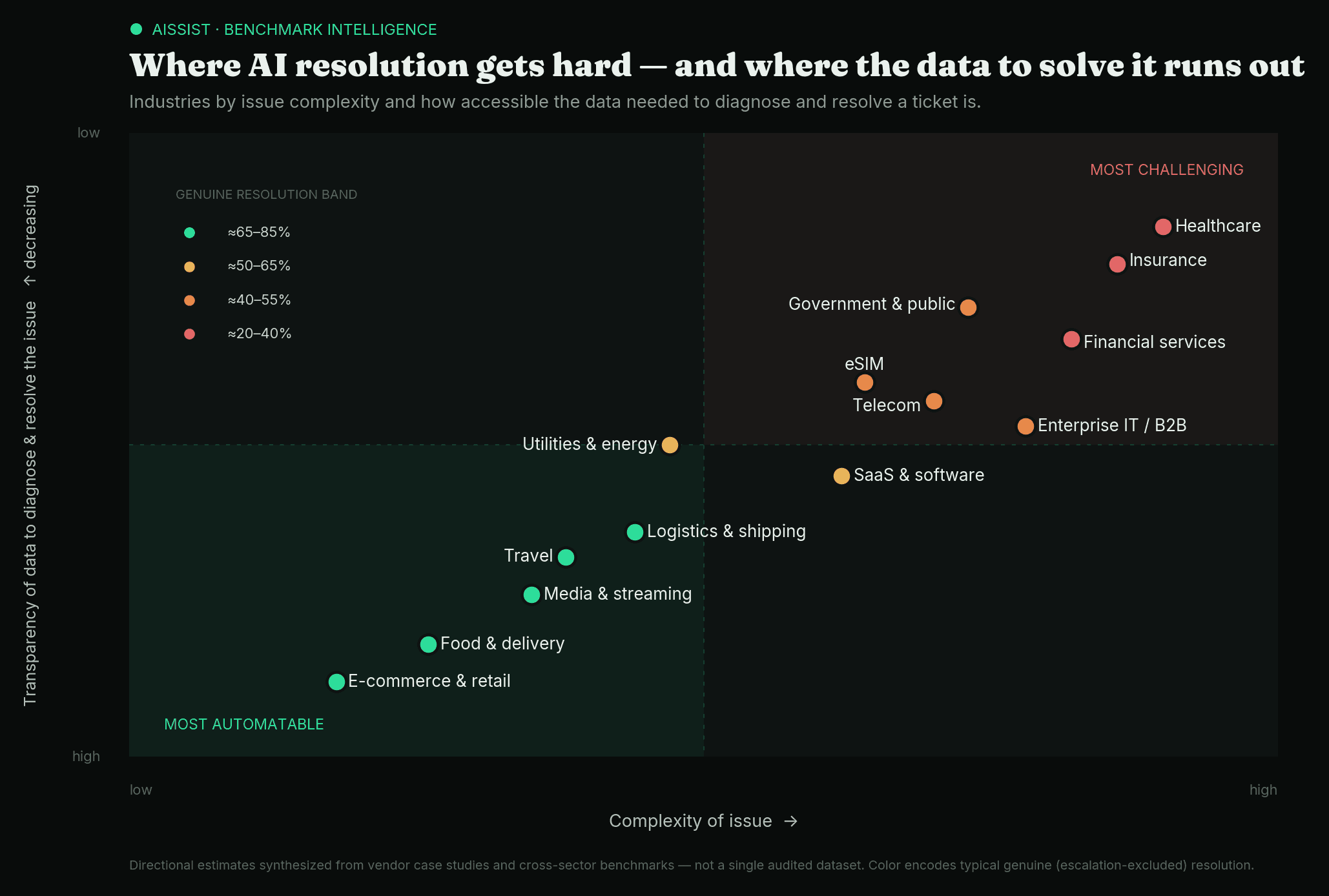
Two factors drive most of the gap between industries. The first is the complexity of the issue: some tickets are simple, self-contained requests, while others require multi-step reasoning, policy judgment, or specialized domain knowledge before they can be resolved. The second is the transparency of the data needed to diagnose and resolve the issue — how accessible, complete, and structured the underlying records are. When the data is scattered across siloed systems, gated behind compliance rules, or simply missing, even a capable model cannot close the loop on its own.
Together these axes explain the pattern below. Industries with simple issues and open, well-structured data — e-commerce, food & delivery, media & streaming — are the most automatable and post the highest genuine resolution rates. Industries with complex issues and low data transparency — healthcare, insurance, financial services — are the most challenging, which is why their resolution ceilings sit far lower.
Why do two companies in the same industry land 30 points apart?
Industry sets the ceiling; architecture and configuration decide where you sit under it. Five factors explain most of the spread between a 45% and a 75% deployment — and all five are within a team's control.
System architecture. The engine underneath sets the ceiling. Agentic AI typically resolves 10–20 points higher than retrieval/RAG-based bots, and a multi-agent design adds another 10–15 points on top. The gap is widest in complex industries — regulated, multi-step, cross-system workflows — where a single retrieval model stalls but coordinated specialized agents keep resolving.
Intent structure. The share of volume that is transactional and data-backed (order status, password resets, billing) versus ambiguous, regulated or emotional. This is the dominant workload factor.
System access. Whether the agent can take action — issue refunds, reschedule payments, update accounts — or only retrieve information. Action access can lift resolution 20–30 points.
Knowledge quality. Well-structured documentation raises resolution 15–25%. Thin or stale content produces confident wrong answers that cost more to recover from than no AI at all.
The improvement loop. Top deployments review a weekly sample, fix the top escalation drivers, and measure whether the fix moved the metric. Static "set-and-forget" deployments decay as products and policies change.
Before comparing any vendor numbers, pin a definition: a conversation is resolved if the customer does not reply within a fixed window (24 hours is common) and did not escalate. Then run a 50-question eval set across your real top intents. Without that, you are comparing marketing claims, not systems.
Questions buyers actually ask about AI customer service benchmarks
The six most common questions we receive about AI resolution rates, CSAT scores, and cost benchmarks — each answered directly from the 2026 data.
What is a good AI resolution rate for customer service in 2026?
Our synthesis of secondary compilations puts the tier-1 automation median near 41% (top quartile ~59%), though source definitions vary and some publishers report this same figure as deflection — so treat it as a directional floor, not an audited resolution median. New deployments launch at 40–50% and climb past 60% after 6–12 months of tuning. Treat 60–67% as a strong horizontal benchmark, 70–75% as a strong deployment, and 80%+ as best-in-class — but only on a workload with high-structure intents.
What is the difference between resolution rate and deflection rate?
Deflection counts any conversation that didn't reach a human, including customers who gave up. Resolution counts only conversations where the issue was genuinely solved. The same deployment looks 20–40 points better on deflection than on resolution, which is why definitions must be fixed before any comparison.
What is the average AI customer service CSAT score?
Cross-industry CSAT averages about 78/100. AI-handled CSAT typically runs 5–10 points below human-handled CSAT for the same team, even though 92% of businesses report overall CSAT improving after deploying AI. Aim for 70–80% on AI interactions initially, with 90%+ achievable on high-structure intents.
How much does an AI-resolved ticket cost vs. a human one?
Human tickets run $2.70 (retail) to $60 (complex B2B). AI resolutions cost $0.50–$2.37 at the unit level, with vendor list prices of roughly $0.69–$2.00. Counting connectors, engineering and platform fees, a realistic all-in estimate lands near $5 per AI resolution (our synthesis — ~$1–$3 unit price plus amortized integration and engineering, not a published benchmark) — still an 80–90% reduction on eligible ticket types.
Which industries get the highest AI resolution rates?
Ecommerce and retail lead at 70–84% because their highest-volume intents are structured and data-rich. Consumer fintech and SaaS follow. Travel, telecom and healthcare resolve lower because their intents are more ambiguous, regulated or emotionally charged.
Why do vendor-claimed resolution rates differ from production results?
Headline figures come from cherry-picked, high-structure case studies and sometimes measure deflection rather than genuine resolution. Secondary compilations and production deployments include the full intent mix and its hard long tail. The gap between vendor-published headlines (76–90% among the vendors we checked) and our synthesis of secondary compilations (~41% tier-1 automation, definitions vary; top quartile ~59%) is structural, not anomalous — but note the two measure different things, and no independent audit of any individual vendor's real-world resolution rate has been published.
How this benchmark was built
What this is. A synthesis, not a study. We ran no survey and gathered no sample of deployments, so there is no N to quote — every figure on this page is read from someone else’s published material or from deployments we run ourselves. Where a number is ours, it is labelled as ours.
How we define resolution. An issue the customer brought is finished end to end by the AI, with no human agent completing it and no follow-up contact on the same issue. That is deliberately narrower than the two metrics vendors more often publish: deflection, which counts conversations that never reached a human and therefore includes people who gave up, and containment, which counts conversations that stayed in the bot regardless of outcome. Vendors publish all three under the word “resolution”, which is the single largest reason published figures disagree.
Collection window. Source material spans publications dated 2024 to 2026. Every vendor figure in the table above was re-read from the vendor’s own live page on 24 August 2026and carries the date that page displayed — several vendor pages show no date at all, and those say so. The sources below are marked according to whether they were re-read for this revision.
What this cannot tell you. No independent audit of any individual vendor’s real-world resolution rate has been published, by us or by anyone we could find, so this page compares published claims rather than verified performance. Ranges describe post-ramp performance and vary with intent mix, system access and knowledge quality. Aissist.io sells a product in this category, which is a reason to check the linked sources rather than take the synthesis on trust.
Resolution is the only number that pays the bill. Measure it honestly, then raise it.
aissist.io is the stack-agnostic AI operational layer for customer service — built to lift genuine end-to-end resolution across your existing helpdesks, not just deflect tickets off a dashboard. AgentMesh resolves; Pulse surfaces why it doesn't; Evolve fixes it.
Top 10 travel eSIM providers ranked by AI resolution rate and customer satisfaction.
10 wearable & smart home deployments — resolution rate, CSAT, and cost per resolution.
9 consumer fintech deployments — payments, trading, crypto — 75% median resolution rate.