Best Agentic AI for Customer Service in 2026: 5 Platforms Compared
TL;DR: The best agentic AI for customer service in 2026 depends on where your tickets live, not on resolution rate: every platform here reports 70–83%, each measured differently, while published per-resolution prices run from $0.60 (Aissist) to $0.99 (Fin).
- Best for resolving cases on the helpdesk you already run, at the lowest published price per resolution: Aissist
- Best for teams on Intercom, with the broadest channel and compliance coverage: Fin
- Best for teams already standardised on Zendesk: Zendesk AI Agents
- Best for companies whose customer data already lives in Salesforce: Salesforce Agentforce
- Best for large consumer brands building a custom, voice-first agent: Sierra
The biggest buying trap in this category is comparing resolution rates as if they meant the same thing. They don't: each vendor defines "resolved" its own way, and some bill for conversations that never were.
Methodology & sources
- Every price, rating and performance figure was read from the vendor's own page, G2, or named press on 28 September 2026. Where a vendor publishes no price, we say "quote only."
- Performance figures are labelled by provenance: vendor-claimed (the vendor about itself), case study (a named customer), or independently reported (press or a review site).
- G2 scores and review counts come from each product's G2 reviews page, read September 2026. Review bases differ widely, from 45 reviews (Aissist) to 7,084 (the Zendesk suite).
- This page has covered the same five AI customer service platforms since June 2026; for a wider field, see our top agentic AI for customer service comparison.
- No resolution rate on this page has been independently audited, including ours. Vendors define "resolution" differently; the section on deflection vs resolution explains why that matters.
- Disclosure: this is Aissist's blog, and Aissist sells one of the five products compared here. We hold no affiliate or paid relationship with any other vendor, and no vendor reviewed this page.
How did we compare these agentic AI platforms?
We rated each platform on six criteria, and ordered the list by the two our thesis says matter most: whether the agent deploys onto your existing helpdesk, and whether a resolution has a published price. The other four criteria are resolution evidence, action depth, channel and language coverage, and security and governance.
We'll declare the bias up front: this is our blog. But Aissist leads the list for a structural reason, not loyalty. Aissist is the only platform here built to run on helpdesks it doesn't own and to publish a per-resolution price. Fin also publishes a price, but it is built first for Intercom, and its price is higher. On channels and compliance, Fin is ahead of us, and the table below says so.
| Criterion | What "strong" looks like | Aissist | Fin | Zendesk AI Agents | Agentforce | Sierra |
|---|---|---|---|---|---|---|
| Deploys onto existing helpdesk | Runs inside the helpdesk you already pay for | Strong (8 named helpdesks) | Good (Intercom-native; add-on elsewhere) | Partial (via Forethought) | Limited (Salesforce org) | Not documented |
| Published price per resolution | A dollar figure, public, per resolved case | Strong ($0.60 cap) | Strong ($0.99) | Limited (unit public, rate not) | Limited (per action) | None (quote only) |
| Resolution evidence | Named case studies plus a disclosed aggregate | Strong | Strong | Good | Strong | Good |
| Actions it can execute | Writes to CRM, orders, billing; not just answers | Strong | Strong | Strong | Strong | Strong |
| Channels & languages | Chat, email, messaging, live voice; 40+ languages | Good (no live voice) | Strong | Strong | Good (voice English-only) | Strong |
| Security & governance | Audited certifications, clear data-use terms | Good | Strong | Strong | Strong | Strong |
A platform was disqualified if it could not take actions in a business system — an FAQ bot with a new logo does not count as agentic AI customer support. All five cleared that bar comfortably, which is itself the news: in 2026, "can it act?" is no longer the question that separates vendors.
The 5 agentic AI platforms at a glance
The five platforms bill on four different units — per resolution, per outcome, per action and per negotiated contract — which is why their headline prices can't be compared directly. The table normalises them.
| Platform | Best for | Technology | Billing unit | Entry AI price (Sep 2026) | Deploys onto existing stack | G2 rating (Sep 2026) |
|---|---|---|---|---|---|---|
| Aissist | Resolving cases on your current helpdesk | Multi-agent, agentic | Per interaction, capped per resolution | $0.09/interaction, capped at $0.60/resolution (chat) | Yes | 4.9 (45 reviews) |
| Fin | Teams on Intercom | Agentic, proprietary models | Per outcome | $0.99/outcome, 50/month minimum off Intercom | Partial — built for Intercom | 4.5 (3,917 reviews) |
| Zendesk AI Agents | Zendesk-native teams | Agentic | Per verified automated resolution | Rate not published; $2–$10/seat/month allowance | Partial | 4.3 (7,084 reviews, whole suite) |
| Salesforce Agentforce | Salesforce-native companies | Agentic | Per action (Flex Credits) or per user | $0.10/action; $125/user/month add-on | No — needs Salesforce | 4.3 (1,697 reviews) |
| Sierra | Custom enterprise agents | Agentic, custom-built | Outcome-based contract | Quote only | Not documented | 4.5 (131 reviews) |
Who each agentic AI platform is built for
Aissist fits teams that want to keep their current helpdesk; Fin, Zendesk and Agentforce fit teams that have already committed to Intercom, Zendesk or Salesforce; Sierra fits enterprises commissioning a bespoke agent. The table shows what each one handles and how fast it goes live.
| Platform | Best-fit team | Channels the agent handles | Where it runs | Time to first live ticket (vendor-stated) | Stated security & compliance |
|---|---|---|---|---|---|
| Aissist | SMB and mid-market | Web and in-app chat, WhatsApp, SMS, email, forms, social; voice messages | Zendesk, Intercom, Freshdesk, Salesforce, HubSpot, Kustomer, Front, Gorgias | About 10 minutes for a basic Zendesk setup (Aissist) | ISO 27001 certified, GDPR compliant, SOC 2 aligned (Aissist) |
| Fin | SMB to enterprise | Live chat, email, voice, WhatsApp, Instagram, SMS, Slack, Discord, API | Intercom, Zendesk, Salesforce, HubSpot, Freshworks, Dixa, Front, Zoho, Sprinklr, Gorgias | Under an hour | SOC 2 Type II, ISO 27001/27701/27018/42001, HIPAA; US, EU or AU hosting |
| Zendesk AI Agents | Zendesk customers of any size | Messaging, email, voice, social, web, mobile | Zendesk; other platforms via Forethought AI Agents by Zendesk | Not quantified on Zendesk's AI agents page | ISO 27001 and 42001, SOC 2 Type II, FedRAMP Low, HIPAA (with BAA), data residency |
| Salesforce Agentforce | Enterprise and mid-market on Salesforce | Chat, messaging (WhatsApp, SMS, Messenger, Apple Messages), email, voice | A Salesforce org (Enterprise edition or above) | Help Agent "deploys in minutes" (Salesforce) | Einstein Trust Layer with zero data retention; SOC 2 report covering Agentforce |
| Sierra | Large consumer brands | Voice, chat, email, WhatsApp | Sierra's platform, connected to your systems of record | "Deploy in weeks" (Sierra) | SOC 2, HIPAA, GDPR, PCI, FedRAMP High, ISO 27001, ISO 42001 |
1. Aissist — best for resolving cases on the helpdesk you already run
Aissist is an AI operational layer for customer service and sales that deploys onto an existing helpdesk and resolves tickets end to end with a team of specialised AI agents, called AgentMesh™.
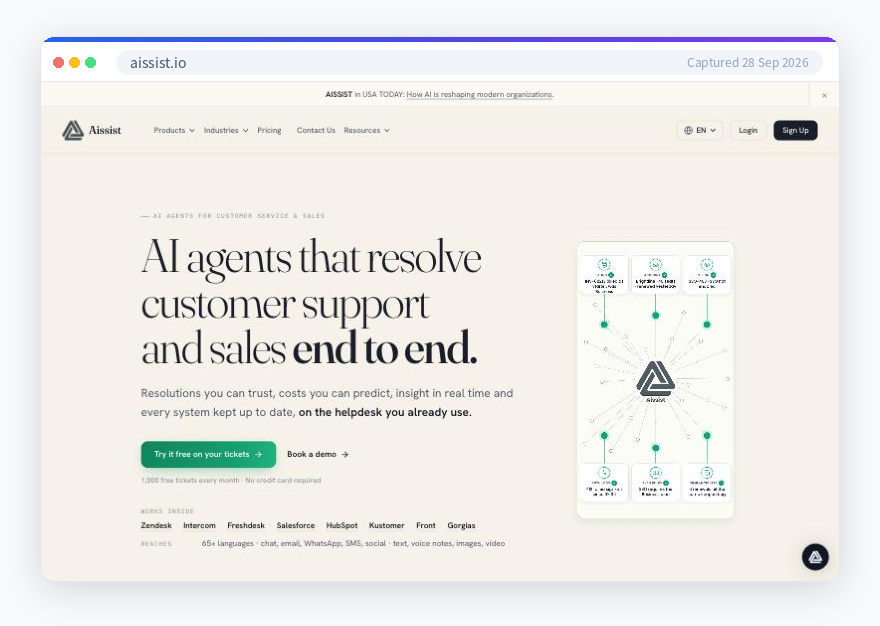
Technology: Agentic, multi-agent. Several specialised agents collaborate on one case — one reads the order, one checks policy, one writes the reply.
Deploys onto vs. replaces: Deploys onto. Aissist's homepage lists Zendesk, Intercom, Freshdesk, Salesforce, HubSpot, Kustomer, Front and Gorgias. It has no helpdesk of its own, so you need one.
Channels & languages: Web chat, in-app chat, WhatsApp, SMS, email, online forms and social media, in 65+ languages with automatic detection, per the AgentMesh product page. It reads voice messages but does not take live calls.
Actions it can take: Writes fields and tags back to the helpdesk, calls APIs, and triggers actions in CRM, ecommerce, shipping and ERP systems. Aissist lists 100+ off-the-shelf integrations, including Shopify, ShipStation, WooCommerce and BigCommerce.
Performance: Aissist reports an 83% average resolution rate, an error rate under 1% and 4.8/5 CSAT across all projects through 31 March 2026 (vendor-claimed, AgentMesh page). Aissist's customer stories back the aggregate with named deployments: support resolution rates of 85% at EDIS Global and SMT Group (with 4.6/5 CSAT at SMT), 80% at Coros, 75% at Holafly and Payphone, 65% at Weltrade and 60% at Game Room Shop (case studies). Aissist says it serves 600+ businesses processing 10M+ interactions a month (vendor-claimed).
G2: 4.9/5 from 45 reviews — a small base next to Fin's 3,917 (G2, read September 2026).
Cost: $0.09 per AI interaction, capped at $0.60 per resolution for chat, WhatsApp and SMS; email averages about $0.25 per resolution. Handovers to a human are not charged, the first 1,000 tickets a month are free, and there is no contract (Aissist pricing, September 2026).
"The best of Aissist.io is its strong performance, very human-like interaction, and how controllable and customizable it is through sub-agents. At the same time, it's incredibly easy to use." — Olga Kuharskaya, AI Lead, Weltrade
Pros
- Lowest published price per resolution in this comparison: $0.60 for chat versus Fin's $0.99 per outcome.
- Independent of any helpdesk or CRM vendor, so no lock-in. Aissist runs inside eight named helpdesks with no migration, and switching helpdesks later doesn't mean switching AI. Fin now belongs to Salesforce and Forethought to Zendesk; Aissist is owned by neither.
- Escalated conversations cost nothing, so a hard ticket that reaches a human adds no AI charge.
Cons
- No real-time voice. AgentMesh handles voice messages, not live phone calls — a gap Fin, Zendesk, Agentforce and Sierra don't have.
- No helpdesk of its own. Aissist works inside the helpdesk you already run, so a team without one needs to buy one first.
- Aissist's case studies are SMB and mid-market, and its G2 score rests on 45 reviews; there is no Fortune 500 reference to point a procurement team at.
Our take: Aissist is the cheapest published way to put an agent that acts, not just answers, on top of the helpdesk you already run, without tying your AI to a helpdesk or CRM vendor. If live phone support is part of the brief, it is not your platform yet. For the pricing maths, see our cost benchmark of AI customer service.
2. Fin — best for teams on Intercom
Fin is an AI customer agent from Fin (formerly Intercom), now part of Salesforce, that is built natively into the Intercom helpdesk, can be added to a named list of other helpdesks, and bills per outcome.
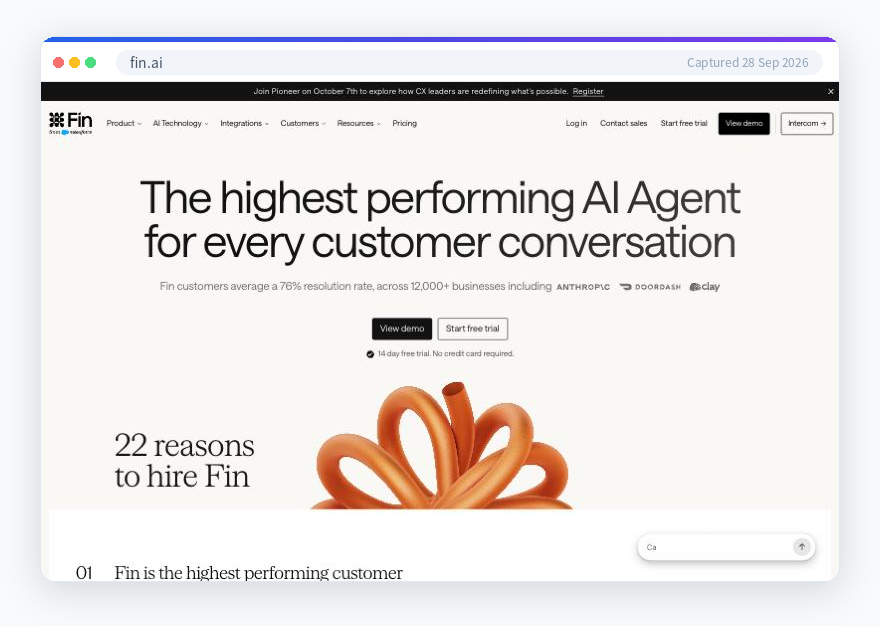
Technology: Agentic, running on Fin's own model suite trained for customer service.
Deploys onto vs. replaces: Intercom first. Fin's own site says "Fin works best on Intercom," where it is "built natively into the Intercom Helpdesk." Fin also markets itself as working on "any helpdesk," but the platforms it names are Salesforce, HubSpot, Freshworks, Dixa, Front, Zoho, Sprinklr and Gorgias (Fin pricing FAQ), plus Zendesk (Fin help centre). Off Intercom, Fin runs as an add-on with a 50-outcome monthly minimum, and Fin's documentation does not say whether Procedures and data connectors work the same way there. Check that your helpdesk is on the list; Kustomer, for example, is not.
Channels & languages: Voice, email, live chat, WhatsApp, Instagram, SMS, Slack, Discord and the Fin Agent API, in 45 languages — 28 of them for voice (Fin channels page).
Actions it can take: Fin's Procedures (configurable multi-step workflows) and data connectors let it read and update external systems, with any API-based tool in scope.
Performance: Fin's homepage states that customers "average a 76% resolution rate, across 12,000+ businesses" (vendor-claimed, fin.ai). In a published case study, Anthropic reached a 50.8% resolution rate in just over a month and saved 1,700 hours in the first month (Fin customer story).
G2: 4.5/5 from 3,917 reviews, listed as "Fin" (G2, read September 2026).
Cost: $0.99 per outcome, charged once per conversation, with a 50-outcome monthly minimum on another helpdesk. On Intercom's helpdesk, add from $19 per helpdesk seat per month. There is a 14-day free trial (Fin pricing, September 2026).
"We're only a month into this journey, and honestly, it's hard for us to imagine how things happened before." — Emily Lampert, Head of Product Support, Anthropic
Pros
- On Intercom, the agent, inbox and ticketing come from one vendor, so there is no integration to maintain; Fin says it goes live in under an hour, with a free trial that includes outcomes.
- The widest channel list here, including live voice in 28 languages and Slack and Discord.
- The deepest compliance stack in the group: SOC 2 Type II, four ISO certifications including ISO 42001 for AI, HIPAA, and a choice of US, EU or Australian hosting (Fin trust page).
Cons
- An "outcome" is broader than a resolution: a completed Procedure that hands off to a human is billed at the same $0.99.
- New ownership. Salesforce completed the acquisition on 10 September 2026 and says Fin will keep working with the helpdesks companies already use (Salesforce press release); it has said nothing publicly about future pricing.
- Named case studies (50.8% at Anthropic after a month) sit below the 76% average, which is normal for a ramp-up but worth modelling.
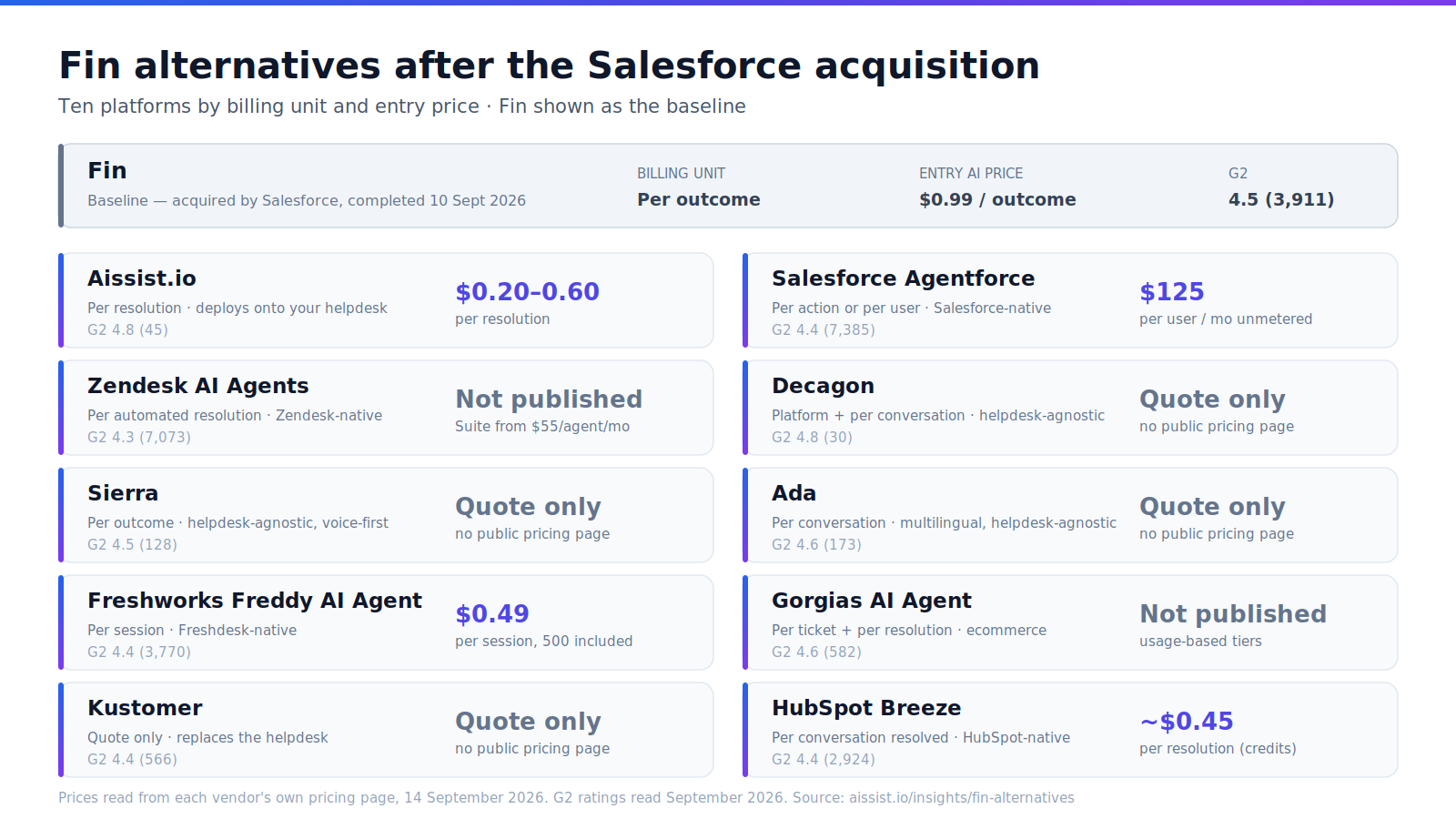
Our take: On Intercom, Fin is the most complete product in this group and the safest pick for a team that needs live voice and heavy compliance. On another helpdesk it is an add-on, so confirm which features carry over before you sign. Buyers who worry about renewal terms under Salesforce should read our Fin alternatives after the Salesforce acquisition.
3. Zendesk AI Agents — best for teams already standardised on Zendesk
Zendesk AI Agents are AI agents built into every Zendesk Suite and Support plan, billed per verified automated resolution. Since Zendesk bought Forethought, a version called Forethought AI Agents by Zendesk can also run on other platforms.
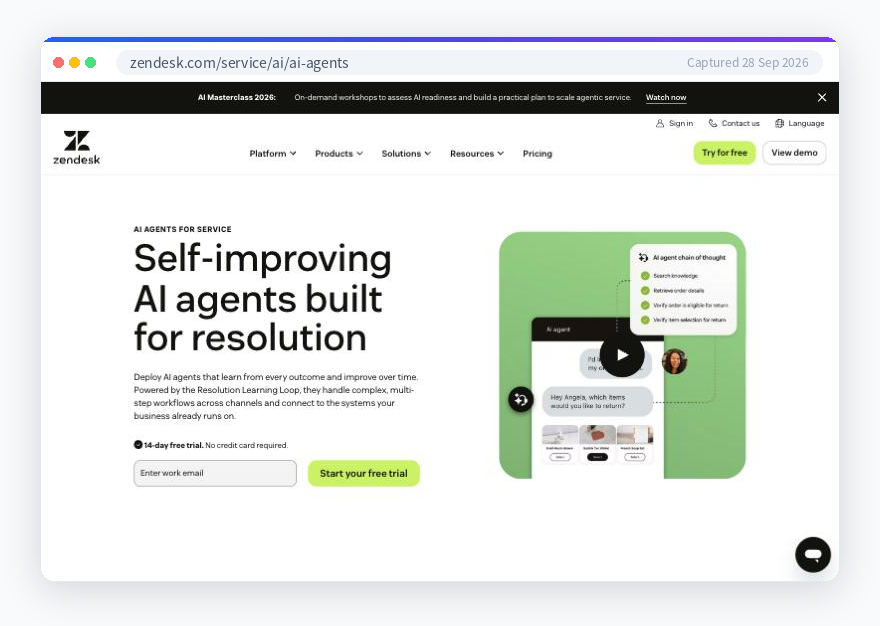
Technology: Agentic, with a "Resolution Learning Loop" that Zendesk says makes its agents improve from every outcome.
Deploys onto vs. replaces: Native to Zendesk. Zendesk completed its Forethought acquisition on 26 March 2026 and says Forethought AI Agents by Zendesk "work seamlessly within Zendesk and across any platform" (Zendesk press release).
Channels & languages: Social, web, mobile, voice and email, in "80 languages at native fluency," per Zendesk's AI agents page.
Actions it can take: Configured actions, API integrations, action flows and custom actions, including an integration builder that connects to any API.
Performance: Zendesk says its AI agents "resolve up to 80% of customer interactions" (vendor-claimed, Zendesk AI agents page). In a published case study, TeamSystem's AI agents handle 100,000 questions a month and automate up to 80% of requests (Zendesk customer story).
G2: 4.3/5 from 7,084 reviews for Zendesk for Customer Service, the whole suite; there is no separate AI agents listing (G2, read September 2026).
Cost: Billed per automated resolution, and only the "Verified resolution" tier — conversations an LLM check confirms were actually solved — counts — assisted escalations and contained resolutions don't draw down your allowance (Zendesk help centre). Each plan includes a dollar allowance of $2 to $10 per agent seat a month, capped at $5,000 a year, and overage is on by default (Zendesk help centre). The per-resolution rate itself is not published. Seats start at $55 (Suite Team) and $115 (Suite Professional) per agent per month, billed yearly (Zendesk pricing, September 2026).
"Zendesk's AI Agents automatically detect intent and respond to frequent email questions. Now, our human agents have more time to tackle challenging problems for our customers." — Davide Donini, IT Lead for Integrations, TeamSystem
Pros
- AI agents are included in every Suite and Support plan, with no separate procurement.
- Fair billing definition: you pay only for resolutions that pass Zendesk's verification, not for conversations the AI merely touched.
- Broad compliance, including ISO 42001 for AI management, FedRAMP Low and a HIPAA BAA (Zendesk trust center).
Cons
- You cannot calculate a per-resolution cost from Zendesk's public pages.
- The G2 rating covers the whole Zendesk suite, so there is no independent score for the AI agents on their own.
- The cross-platform Forethought version is six months into Zendesk ownership, so most of the product's depth still assumes you run Zendesk.
Our take: If your team already lives in Zendesk, its native agents are the least-friction place to start, and the billing definition is one of the cleanest here. Teams that want a published rate before they sign should compare against our Zendesk AI pricing breakdown.
4. Salesforce Agentforce — best for companies whose customer data lives in Salesforce
Salesforce Agentforce is Salesforce's platform for building AI agents that act on CRM data inside a Salesforce org, billed per action through Flex Credits or per user through add-on licences.
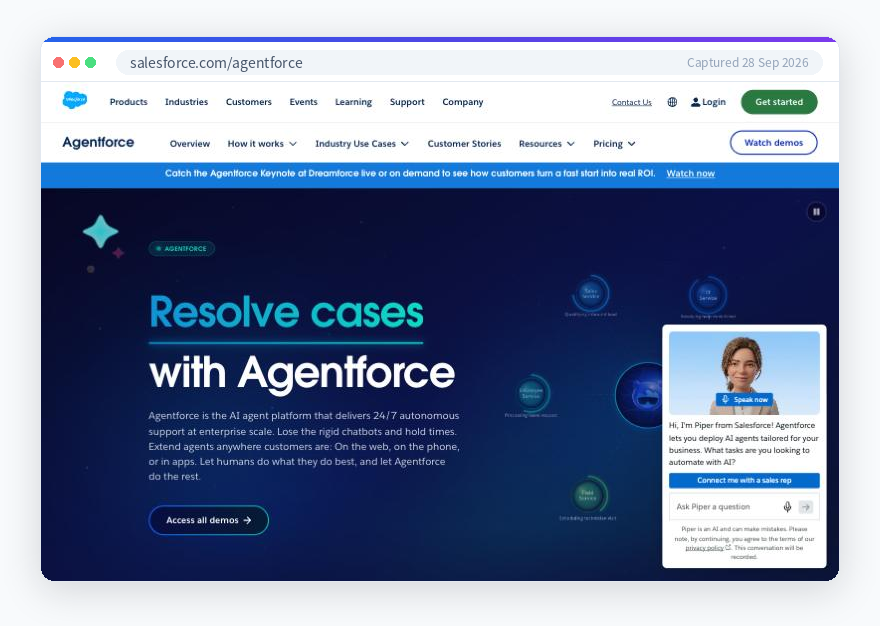
Technology: Agentic, grounded in Salesforce data through the Einstein Trust Layer.
Deploys onto vs. replaces: Needs Salesforce. Agentforce Service Agent is available in Enterprise, Performance, Unlimited and Developer editions, per Salesforce's help documentation, and non-Salesforce systems are reached through MuleSoft connectors.
Channels & languages: Web and in-app chat; WhatsApp, SMS, Facebook Messenger, Apple Messages and LINE; and email, per Salesforce's Service Agent documentation. Agentforce Voice is generally available in English (US, UK and Australia), with more languages on a phased rollout.
Actions it can take: Updates records, creates cases, triggers workflows, calls APIs, and handles returns and refunds.
Performance: On Salesforce's own help site, Agentforce has handled 4.3 million inquiries and resolved 70% of them, according to Salesforce's Help Agent announcement of 25 June 2026 (vendor-claimed).
G2: 4.3/5 from 1,697 reviews for Salesforce Agentforce (G2, read September 2026).
Cost: Flex Credits cost $500 per 100,000; one Agentforce action uses 20 credits ($0.10) and a voice action 30 ($0.15). Per-user add-ons for Service cost $125 per user per month, and Agentforce 1 Editions start at $550 per user per month. Per-conversation pricing is "contact us" (Agentforce pricing, September 2026). The new Help Agent is priced per resolution, with "no charge" when a customer asks for a human or walks away unhappy; its rate is not listed on the pricing page.
"PenFed is building toward a future where every member gets fast, self-driven and personalized service at scale, and Agentforce is making that real." — Nicole LaCamp, SVP of Platform Strategy and Engineering, PenFed Credit Union
Pros
- The largest disclosed first-party dataset in the group: 4.3 million inquiries on Salesforce's own help site.
- Acts directly on CRM records, so no integration project is needed for Salesforce data.
- Mature data controls: zero data retention with third-party model providers under the Einstein Trust Layer.
Cons
- Requires a Salesforce org at Enterprise edition or above; there is no route onto Zendesk or Freshdesk.
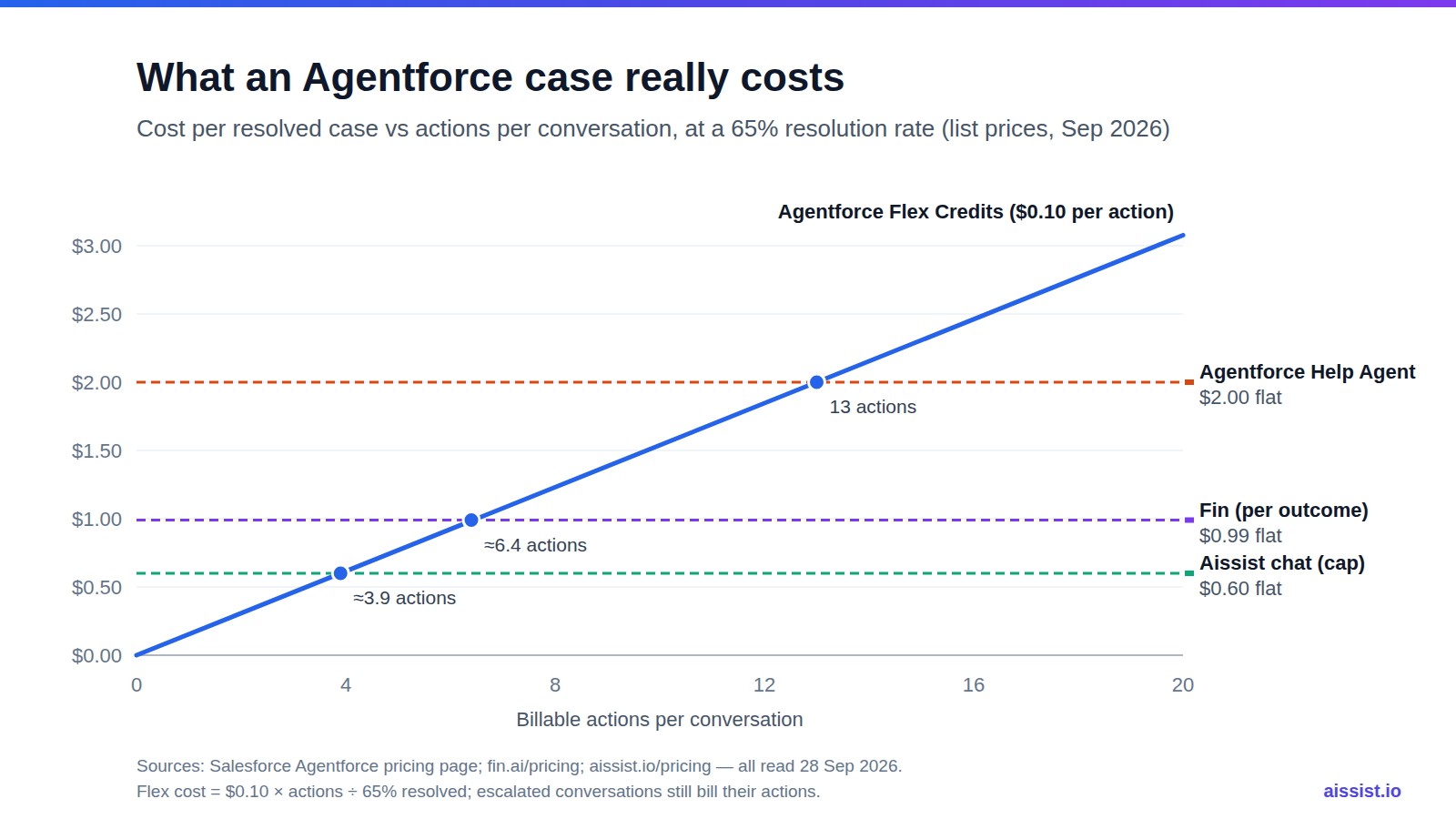
- Flex Credits bill every action whether or not the case is resolved, so cost per resolution rises with the number of steps.
- Voice is English-only today, per Salesforce's Agentforce Voice page.
Our take: If your customer records live in Salesforce, Agentforce is the natural choice, and the Fin acquisition gives you a second Salesforce-owned option for faster deployments. Everyone else should model per-action costs first — our Agentforce pricing explainer does the arithmetic.
5. Sierra — best for large consumer brands building a custom, voice-first agent
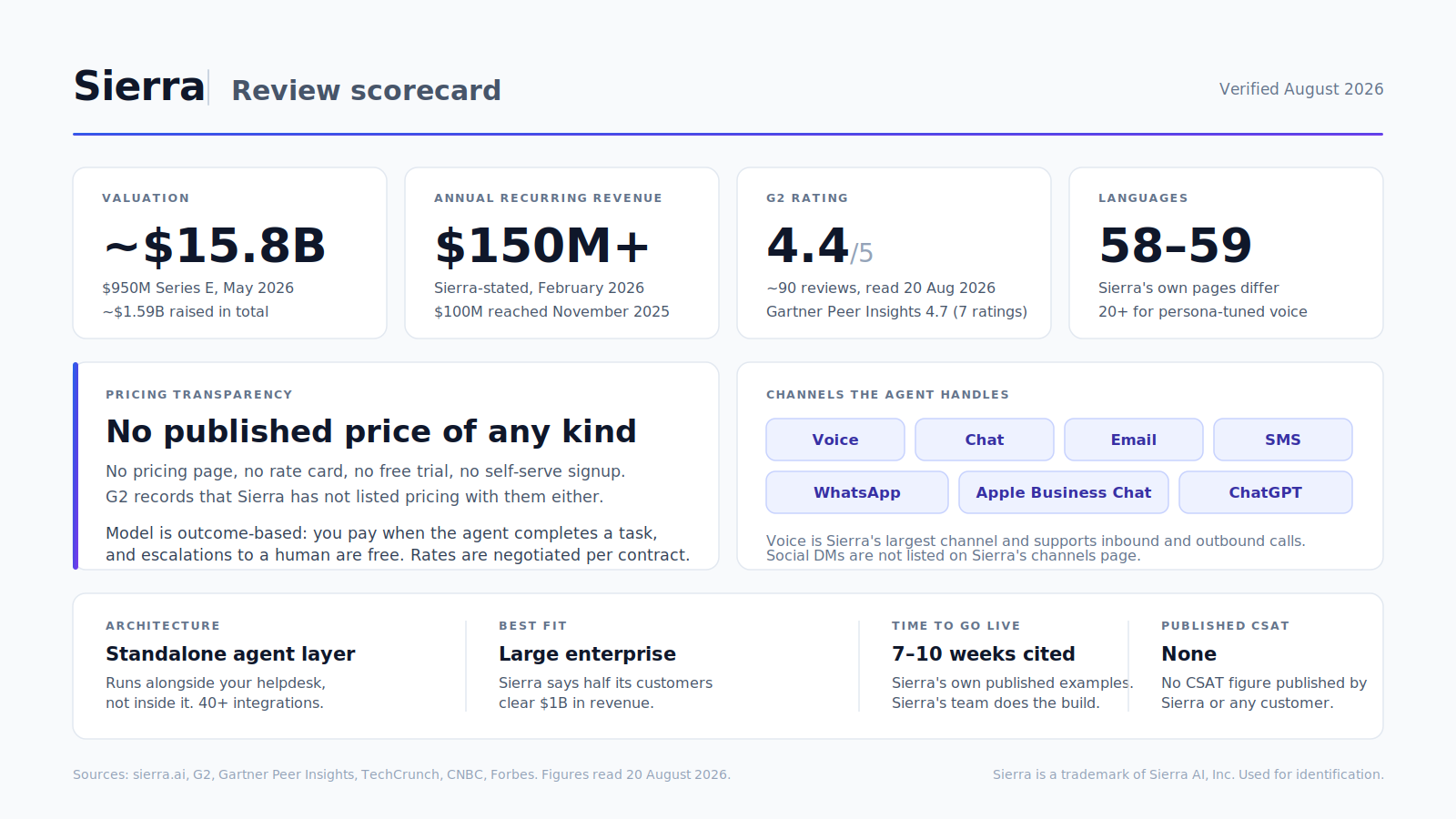
Sierra is a conversational AI platform for large consumer brands that builds a custom, branded AI agent on Sierra's own platform, connects it to the company's systems of record, and prices by outcome under an enterprise contract.
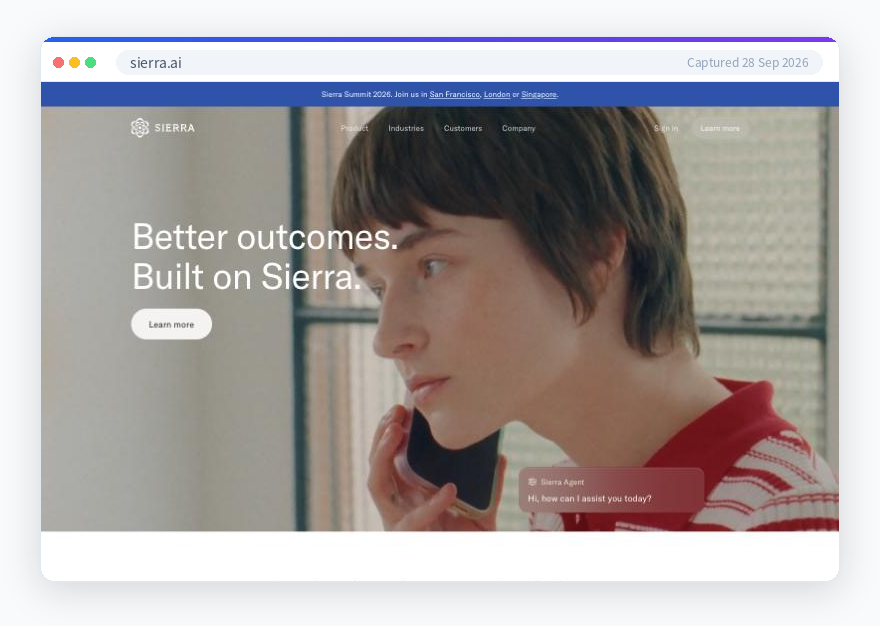
Technology: Agentic, built with Sierra's Agent Studio (no-code) or Agent SDK, wrapped in supervisory models that Sierra says reduce hallucinations (Sierra trust page).
Deploys onto vs. replaces: Sierra's platform connects to your systems of record, "from order management to CRM," per its product page. Helpdesk integrations are not named publicly.
Channels & languages: Voice, chat, email and WhatsApp, in 59 languages (Sierra product page).
Actions it can take: Handles tasks "from start to finish, like processing an insurance claim, returning an order, or originating a mortgage."
Performance: Sierra publishes no aggregate rate; its case studies carry the numbers. Airtable's AI resolution rate hit 80%, with Sierra carrying the equivalent workload of about 95 full-time support agents (Sierra customer story). At Chime, resolution rates rose from 50% to over 70% (Sierra customer story). Sierra says 40% of the Fortune 50 partner with it (vendor-claimed, Sierra product page).
G2: 4.5/5 from 131 reviews (G2, read September 2026).
Cost: Quote only. Sierra describes its model as outcome-based pricing, in which "if the conversation is unresolved, in most cases, there's no charge" (Sierra blog).
"We always aim to provide banking solutions for our customers that feel simple, human, and on their side. Partnering with Sierra helps us deliver on that promise by making support even faster and more personalized." — Janelle Sallenave, Chief Operating Officer, Chime
Pros
- The strongest named enterprise references in the group, with published resolution figures from Airtable (80%) and Chime (over 70%).
- Built for brand voice: agents are designed around a company's tone, which matters when support is part of the product.
- A long compliance list, including FedRAMP High, PCI and ISO 42001, according to Sierra.
Cons
- No public pricing, so you can't estimate cost before a sales process.
- "Deploy in weeks," per Sierra. That reflects bespoke enterprise builds, but it is still a longer path to a first live ticket than the basic setups the other four advertise in minutes to an hour.
- Helpdesk fit is not documented publicly; teams on Zendesk or Salesforce need to confirm it during evaluation.
Our take: Sierra suits a large consumer brand that wants a bespoke, voice-heavy agent and has the budget and time for an enterprise build. A 20-person support team on Zendesk should not start here. Our Sierra AI review covers the trade-offs in depth.
What does agentic AI for customer service actually cost?
At 2,000 chat conversations a month and a 65% resolution rate, the monthly AI cost on these AI customer service platforms runs from about $780 (Aissist) to about $1,600 (Agentforce at eight actions per conversation), with Fin at about $1,287; Zendesk and Sierra can't be computed from public pages. That scenario yields 1,300 resolved conversations, and ignores free tiers such as Aissist's 1,000 tickets.
| Platform | How the scenario is billed | Monthly AI cost (Sep 2026 list prices) | Not included |
|---|---|---|---|
| Aissist | 1,300 resolutions × $0.60 cap; escalations free | ≈ $780 in resolution charges | Your existing helpdesk seats |
| Fin (on your helpdesk) | 1,300 resolutions × $0.99 | ≈ $1,287, plus any Procedure handoffs | Your existing helpdesk seats |
| Salesforce Agentforce | 2,000 conversations × 4 actions × $0.10 | ≈ $800 (≈ $1,600 at 8 actions) | Salesforce edition and licences |
| Zendesk AI Agents | Verified resolutions beyond the seat allowance | Rate not published | Suite seats from $55 per agent per month |
| Sierra | Outcome-based contract | Quote only | — |
The assumptions are ours: four and eight actions per conversation are illustrative, not Salesforce figures. The billing units are the vendors'. The pattern that matters is structural. Per-resolution and per-outcome meters stay flat however hard the agent works; per-action meters charge for effort, whether or not the case is closed.
Watch three hidden costs. First, host-platform seats: Fin on Intercom adds from $19 per seat, Zendesk's agents require a Suite or Support plan, and Agentforce requires Salesforce Enterprise edition or above. Second, what counts as billable: Fin bills Procedure handoffs, Zendesk bills only verified resolutions, and Aissist and Agentforce Help Agent don't bill escalations. Third, minimums: Fin requires 50 outcomes a month on a third-party helpdesk. Everyone's pricing is simple until the invoice arrives.
One more question belongs on every vendor call: how is a conversation that is only "hi" or "thanks!" billed? Aissist's pricing page says chitchat does not count as a resolution; a per-conversation or per-action meter would charge for it. The answer will tell you more than the rate card.
How do you choose the best agentic AI for customer service?
Start with where your tickets live today, then pick the billing unit you can forecast — the best AI agents for customer service differ far more on those two points than on features. These rules cover the common cases:
- If you run Zendesk, Freshdesk, Intercom, Gorgias, Kustomer, Front or HubSpot and want the lowest published cost per resolution, choose Aissist, because it deploys inside those helpdesks and caps chat at $0.60 per resolution.
- If you want to avoid being locked in to one helpdesk or CRM vendor, choose Aissist, because it is independent and runs inside eight helpdesks, so your AI moves with you if you change helpdesks.
- If you run Intercom, or need live phone support in many languages, choose Fin, because it is built natively into Intercom and handles voice in 28 languages.
- If your whole team lives in Zendesk and you'd rather not add a vendor, choose Zendesk AI Agents, because they're included in every Suite plan and bill only verified resolutions.
- If your customer data and workflows already run in Salesforce, choose Agentforce, because it acts on CRM records natively — and model your actions per conversation before you sign.
- If you are a large consumer brand wanting a bespoke, brand-voiced agent across voice and chat, shortlist Sierra, because its case studies are enterprise-scale — and budget weeks, not minutes.
- If regulated data is in scope (health, government, payments), shortlist Fin, Zendesk or Sierra first, because they publish HIPAA and ISO 42001 claims.
- If you can't get a price per resolved case in writing, don't sign a multi-year term, because in 2026 alone one of these five vendors was acquired (Fin, by Salesforce) and another bought a rival (Zendesk, which acquired Forethought).
What is agentic AI for customer service?
Agentic AI for customer service is software that understands a customer's request, decides what to do, and completes the task in business systems — issuing a refund, updating an order, changing a subscription — rather than only replying with an answer. A chatbot tells a customer how to get a refund; an AI agent issues it.
The difference shows up in three places. First, actions: an agent writes to your order system, CRM or billing tool, not just to the chat window. Second, reasoning across steps: an agent checks eligibility, looks up the order, applies the policy and confirms, instead of matching one question to one article. Third, escalation: a good agent knows when to stop and hands a human the case with context attached.
That shift is what separates the best AI customer service software of 2026 from the chatbots before it, and the metric changes with it. Older chatbots were measured on deflection — whether the customer stopped asking. Agentic AI is measured on resolution — whether the customer's problem was actually solved. Every vendor above now reports resolution. But each defines it differently. Zendesk runs an LLM check on the transcript; Fin counts "no further help requested"; Aissist excludes chitchat and escalations; Salesforce's Help Agent excludes anyone who asks for a human or leaves unhappy. Our AI customer service benchmark compares published rates across industries with those definitions in view.
"AI is not here to replace people—it's here to help us scale." — Pablo Jorquera Jorquera, Head of Customer Experience, TeamSystem
What agentic AI does not do is remove the need for a support team. Every case study above describes humans handling the hard remainder — Airtable's team was redefined, not replaced, according to Sierra's write-up. The practical goal is to let the AI take the high-volume, well-defined work end to end, so people get the problems that need judgement.
Resolution rate is a system property, not a vendor property
Every platform here reports resolution in the 70–83% range, so that number won't decide your purchase; where the agent runs and what a resolved case costs will. A resolution rate describes a deployment — your ticket mix, your knowledge base, your policies — at least as much as it describes the software.
That's why the same vendor can show 76% on its homepage and 50.8% in a named customer's first month. The number moves with the system around the agent, not only with the agent.
So run the evaluation on your own system. Pick the two or three platforms that fit your stack, and give each two weeks of real volume. Before the trial starts, write down three things:
- Your definition of "resolved": no reply within 72 hours, a positive CSAT, no reopened ticket, or all three.
- Your cost per resolved case: the vendor's invoice divided by your count of resolutions, not theirs.
- Your escalation quality: do agents receive the case with the order, the customer and the attempted fix attached, or do they start over?
The platform that wins on those three numbers is the best agentic AI for customer service for you. If you want to keep your helpdesk, start the trial with Aissist. If you've standardised on Intercom, Zendesk or Salesforce, include that vendor's agent — Fin, Zendesk AI Agents or Agentforce. If you're a large brand commissioning a bespoke agent, add Sierra.
Want to see Aissist resolve your own tickets? The first 1,000 tickets a month are free, on the helpdesk you already run. Try it on your tickets →
Frequently asked questions
Which AI customer service platforms work with Zendesk?
Aissist deploys onto Zendesk without a migration, Fin can be added to Zendesk as an add-on to its Intercom-native product, and Zendesk's own AI agents are built in. Forethought AI Agents by Zendesk also run on other platforms. Salesforce Agentforce needs a Salesforce org, and Sierra does not publicly name its helpdesk integrations.
What's the cheapest AI customer service agent for a small team?
Among these five AI customer service platforms, Aissist publishes the lowest price: $0.09 per interaction, capped at $0.60 per chat resolution, with 1,000 free tickets a month and no contract. Fin costs $0.99 per outcome, with a 50-outcome monthly minimum on another helpdesk.
Is Intercom Fin the same as Fin, and does Salesforce own it?
Yes to both. Intercom renamed the company Fin in 2026, and Salesforce completed its acquisition on 10 September 2026. Salesforce positions Fin for "rapid deployment on existing systems" alongside Agentforce. Fin is still built natively into Intercom and can be added to several other helpdesks.
Can AI agents handle phone calls?
Four of the five platforms handle live calls. Fin supports voice in 28 languages, Zendesk AI Agents and Sierra list voice among their channels, and Agentforce Voice is available in English. Aissist handles voice messages but not live calls.
How do AI agents for customer service charge for resolutions?
Billing units differ. Aissist caps charges per resolution and doesn't bill escalations; Fin bills per outcome, including Procedure handoffs; Zendesk bills verified resolutions against a seat allowance. Agentforce bills per action or per user, and Sierra negotiates outcome-based contracts.
Do I have to replace my helpdesk to use agentic AI customer support?
No. Aissist deploys onto existing helpdesks such as Zendesk, Freshdesk and Salesforce; Fin is built for Intercom but can be added to several others; and Zendesk's Forethought AI Agents can run on other platforms. Agentforce needs a Salesforce org, and Sierra runs on its own platform connected to your systems.
How accurate are published AI resolution rates?
None of the rates on this page has been independently audited. They are vendor-claimed or drawn from named case studies, and vendors define "resolution" differently. Treat them as a shortlist filter, then measure resolution on your own tickets during a trial.
Is agentic AI better than a traditional chatbot?
For requests that need an action, yes. A traditional chatbot answers from a knowledge base; an AI customer service agent can look up the order, apply the policy and issue the refund. For simple FAQ traffic, the gap is smaller.
Changelog
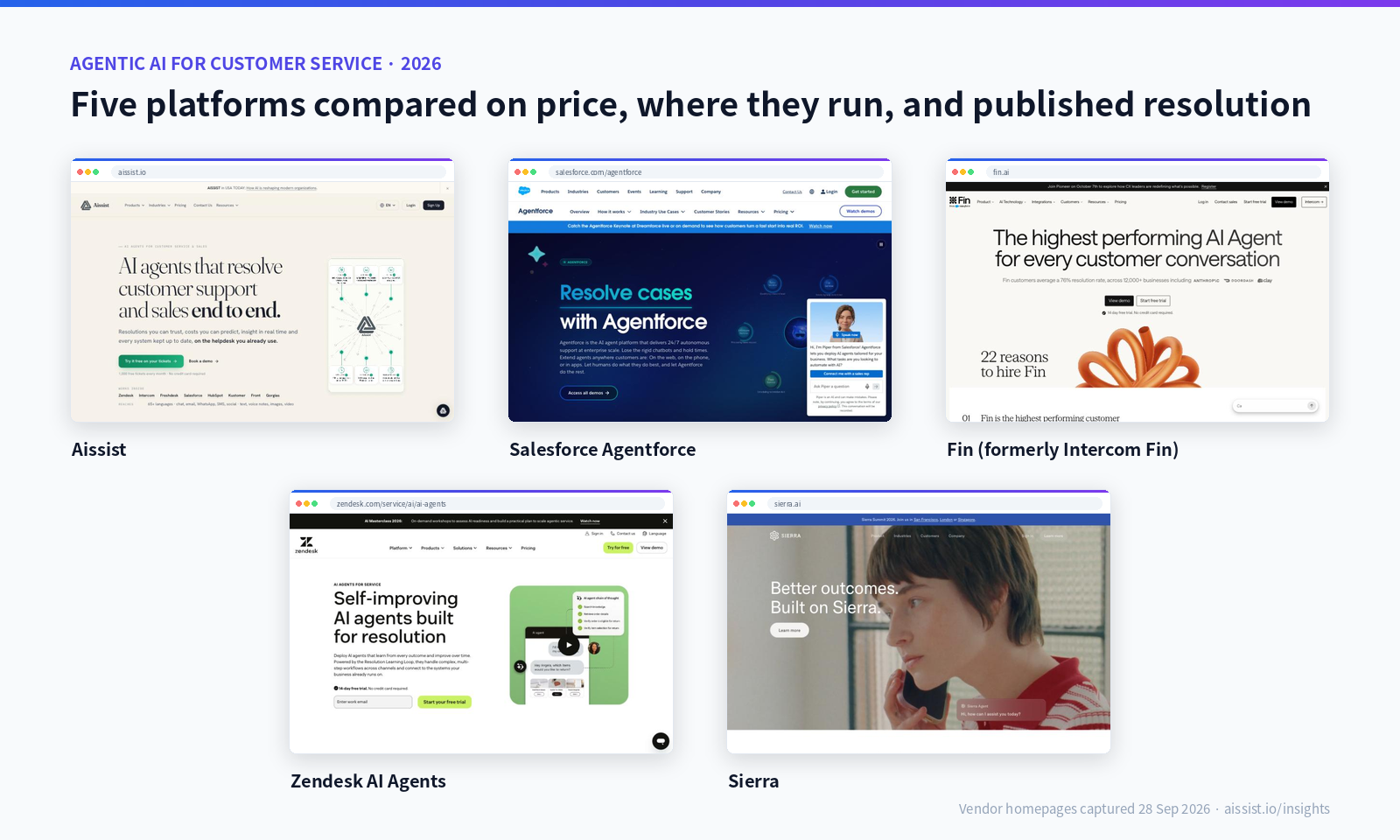
- 28 September 2026 — Rebuilt as a full comparison of the same five platforms. Added verified pricing, G2 ratings, performance figures with provenance, pros and cons for every vendor including Aissist, two comparison tables, a worked cost example, and the Salesforce–Fin (10 September 2026) and Zendesk–Forethought (26 March 2026) acquisitions. Replaced stock images with vendor homepage captures.
- 2 June 2026 — First published.