Self-Evolving AI: The Next Frontier for Support and Sales AI
Aissist.io launches the alpha of self-evolving AI — an operational AI that finds its own gaps, runs its own experiments, and improves without waiting for a human to tune it.
Every AI deployment climbs the same mountain. We know the trail well — it's the arc most of our clients follow, almost to the month.
Month 1: excitement. The AI is live in days, not quarters. A few touches — a handful of instructions, a knowledge source or two — and it's already solving real problems at high performance. The team can hardly believe how easy it was to stand up. And the moment they see it work, expectations start to climb.
Month 2: confidence. Now the hill-climb begins in earnest. More instructions, better documentation, sharper policies — and the performance curve keeps rising with every push. Effort in, results out. It feels like this can go on forever.
Month 3: the first plateau. It can't. The curve flattens. The easy volume is handled and what's left are the corner cases — the stubborn ones. You push the same levers and the needle barely moves. Worse, the levers start working against each other: tighten the instructions to fix one corner case and something that used to work quietly regresses; push resolution rate and CSAT slips; optimize for CSAT and handle time climbs. Every gain has to be paid for somewhere else, and balancing the trade-offs — while holding on to the performance you already earned — becomes harder than the original climb. The excitement is still there, but so is a quiet anxiety: is this as good as it gets?
Month 4: friction. Then the mountain starts to move. The product changes. The business changes. The process changes. Suddenly it's not a climb anymore — it's maintenance and catch-up, and performance oscillates with every change: a dip when something new ships, a scramble to update, a recovery, then the next change. The frustration is real, and it's not because anyone stopped caring. It's because a static system can't climb a mountain that keeps moving under its feet.
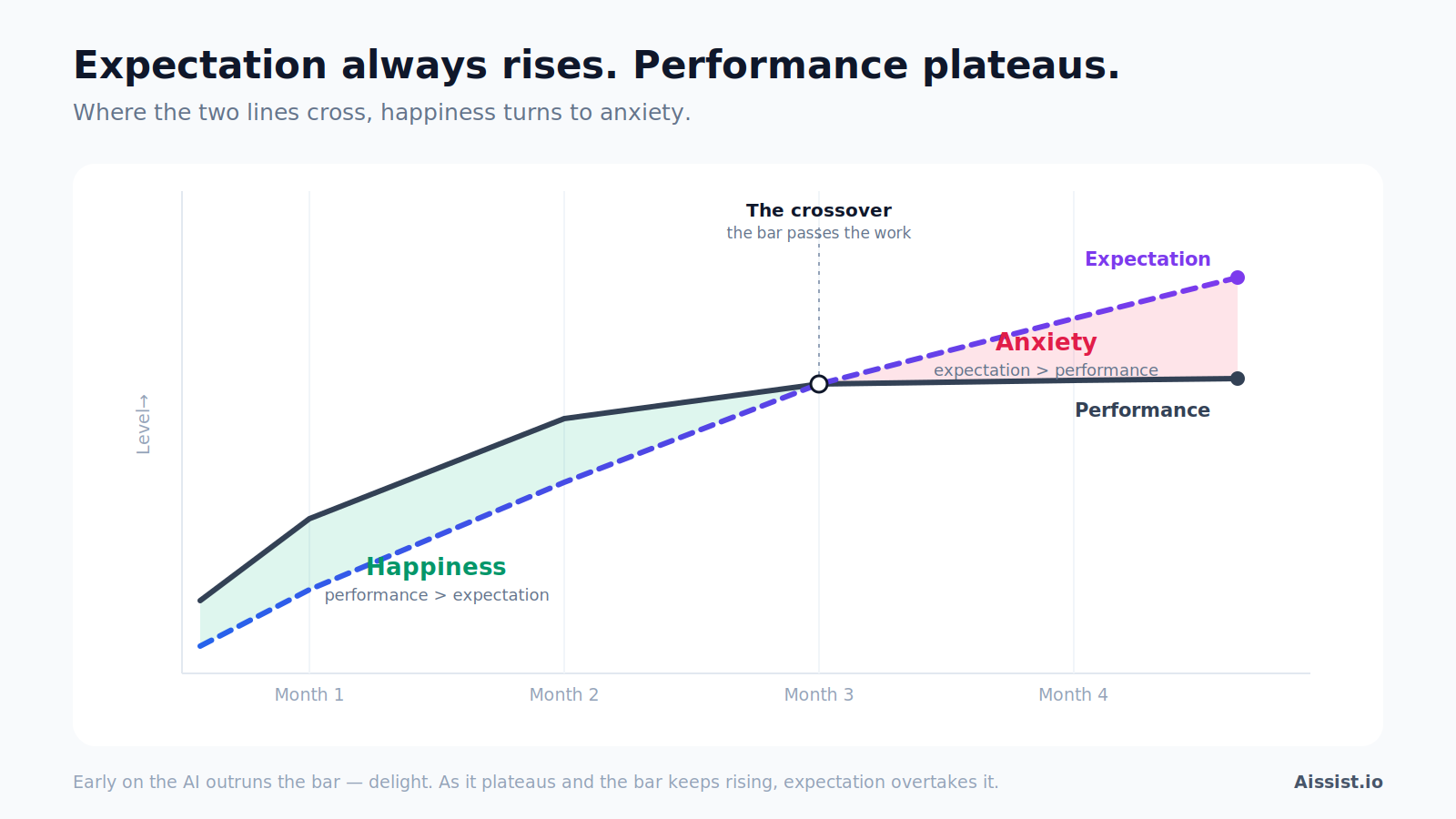
And underneath the whole climb, one force never rests: expectation. Every time the AI impresses, the bar moves up. Early on, performance runs ahead of expectation — and that surplus feels like happiness. But as performance plateaus and the bar keeps rising, the two lines cross. Expectation overtakes performance, the gap flips negative, and happiness turns to anxiety. That gap, not the raw performance number, is where the tension and the frustration actually live.
The break
Every team hits this wall, and until now the only answer was more manual effort. There's a better one: stop hand-carrying the AI up the mountain and let it evolve on its own.
A self-evolving system automatically discovers the signals for what needs updating, runs small experiments to test a fix, collects real feedback on what worked, turns that into concrete optimization suggestions — and uses them to improve, continuously. No tuning sprint. No waiting for someone to notice the gap. When the mountain moves, the AI re-routes itself.
This is the next breakthrough in operational AI — and today we're launching the alpha.
What it takes: three components
An AI that evolves needs at least three parts working as one loop:
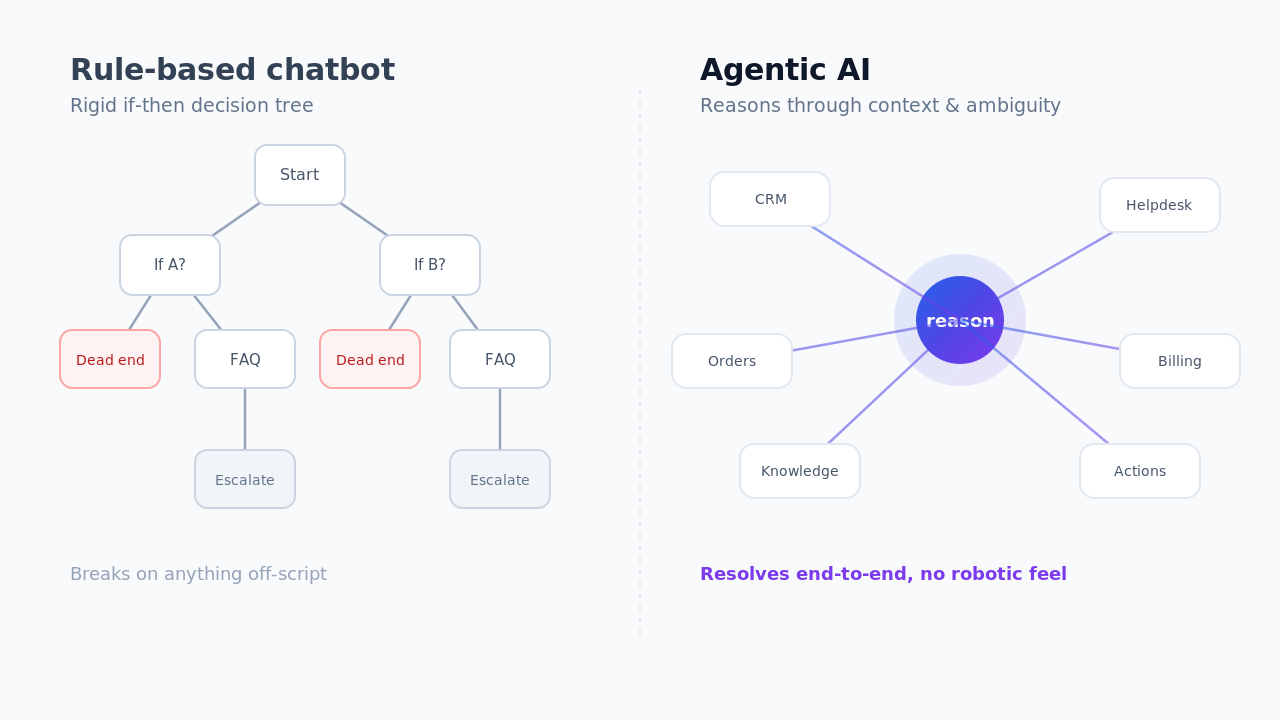
Automation — AgentMesh™. The layer that does the work: a multi-agent AI workforce handling live traffic across every channel, reasoning through requests and taking action in your backend systems.
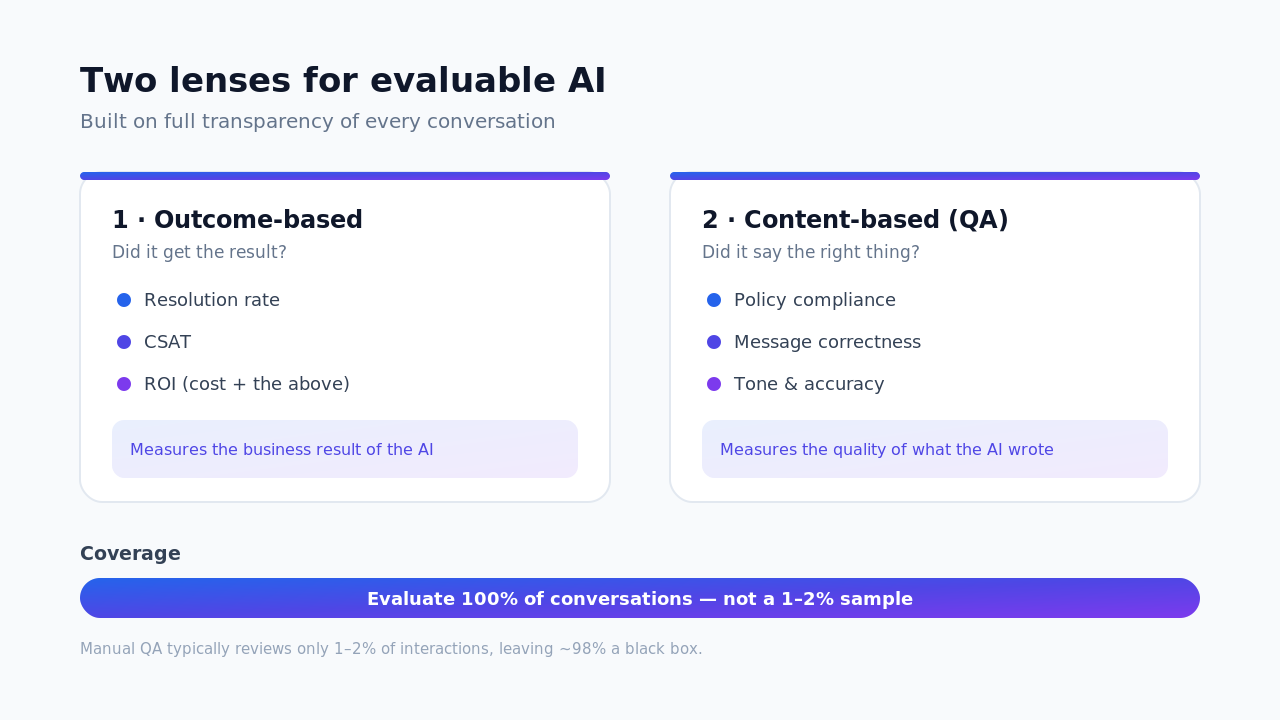
Evaluation — Pulse™. The layer that watches. It reads every conversation, generates insight into what's changing and where the AI falls short, and turns that into clean, trustworthy signals — benchmarked against your best human agent, not the AI's own past. And the signals are diverse: not just resolution rate, but CSAT, sales conversion, sentiment, and effort — so the AI optimizes for the outcome that matters in each context, not a single number.
Evolution — Evolve™. The layer that acts. It takes those signals and carries out the plan — the experiments or the optimizations — measures the result, and deploys what works back into AgentMesh. Then the loop runs again.
Automation does the work. Evaluation finds the gaps. Evolution closes them — on repeat.
Why it matters
Static AI is impressive on day one and stuck by day ninety. The bar only rises the moment your customers see the AI work — and the business it runs on never stops moving. Self-evolving AI is the first system built to move with both: the difference between an AI you keep rescuing and one that keeps pace on its own.
As M.W., co-founder of Aissist.io, puts it: "The bar keeps rising and the business keeps moving. Self-evolving AI is the first system built to move with it."
The alpha is available now to a limited set of design partners.
Want AI that keeps pace instead of plateauing? See how Pulse and Evolve close the loop from signal to performance. Get a free demo →