Self-Evolving AI: Turning Operational Signals Into Continuous Improvement
TL;DR — Most AI peaks shortly after go-live and then drifts: performance plateaus, corner cases pile up, maintenance never ends, and every product or business change breaks something. Self-evolving AI fixes this structurally — it learns from the signals its own work produces and keeps improving instead of decaying. It takes two parts: an evaluation system that turns everyday operations into clean learning signals, and an optimization engine that converts those signals into higher performance. In Aissist's stack, Pulse™ generates the signals and Evolve™ acts on them. The hard part is implementation — what signal to learn from, what learning to embed, and where humans stay in the loop. Our self-evolving AI is in Alpha with 10 pilot customers, with data coming in Q4 2026.
Self-evolving AI is AI that gets better on its own by learning from the signals its own work produces, instead of staying frozen at the level it launched with. A static system executes and forgets; a self-evolving system executes, measures the outcome, extracts what worked, and folds that back into how it behaves next time. That's the difference between maintenance you schedule and improvement that happens on its own.
Why Static AI Plateaus — and Then Slips
Short answer: A model tuned for last quarter's traffic slowly falls out of step with this quarter's, and quality erodes quietly rather than failing loudly.
Teams that deploy AI for support, sales, or operations tend to hit the same wall. The system launches strong, the curve flattens, and then it slides. Five forces are usually at work.
First, performance plateaus and can even degrade over time. A model tuned for one moment slowly drifts from live reality, and accuracy decays without anyone noticing.
Second, corner cases are hard. The long tail of unusual tickets, edge-case products, and rare intents is exactly where static automation breaks — and it's the part hardest to anticipate in a prompt or a rule.
Third, continuous maintenance is expensive. Keeping an AI sharp means someone constantly reviewing transcripts, rewriting prompts, and patching gaps. That effort scales with volume and never really ends.
Fourth, change breaks things. A new product, a pricing update, a policy shift, or a seasonal spike can invalidate months of tuning overnight, and re-tuning by hand is slow.
Fifth, most systems don't learn from their best performers. When one resolution path or one agent consistently produces great outcomes, a static system has no mechanism to notice that and spread it everywhere.
None of these are prompt-engineering problems you can fix once. They're structural — which is why the answer has to be structural too.
What Self-Evolving AI Actually Means
Short answer: It treats every interaction as a source of learning, not just a task to finish — improving on the cadence of the work rather than on a retraining schedule.
This is the practical, operations-grade version of recursive self-improvement: not an AI rewriting its own source code, but an AI continuously improving its behavior against real business goals. The distinction from a chatbot that "gets retrained sometimes" matters. Periodic retraining is a batch event on someone's roadmap. Self-learning AI agents improve as the work happens, catching drift and edge cases as they emerge instead of months later.
To build it, you need two engines working together.
The Two Engines Behind Self-Evolving AI
Short answer: One part generates trustworthy signals; the other turns those signals into better performance. Remove either and the loop stops.
Self-evolving AI is not one model with a clever prompt. It's a closed loop with a clear division of labor.
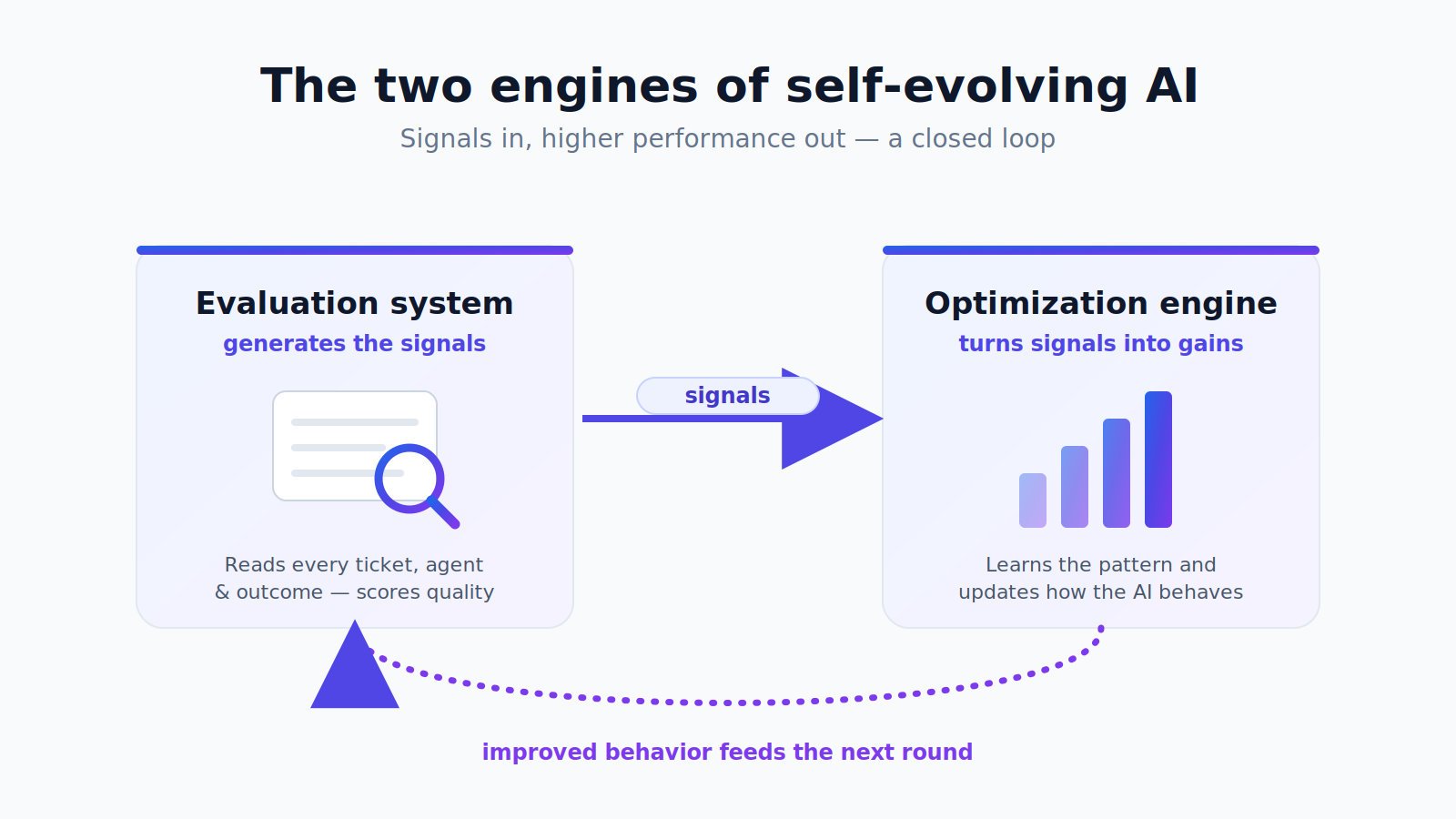
The evaluation system generates the signals. This is the measurement layer. It reads every ticket, conversation, agent action, and outcome and scores them — what resolved cleanly, where friction appeared, which answers customers actually valued, and where the AI got it wrong. At Aissist, this is the job of Pulse™, the deep insight engine that continuously evaluates both human and AI agents, tracks CSAT and NPS by category, and surfaces the patterns and outliers worth acting on. Without a strong evaluation layer, an AI has nothing reliable to learn from — a point we make at length in evaluable AI.
The optimization engine turns signals into gains. Signals only matter if something acts on them. The optimization engine ingests the evaluation output, works out what to change, and updates how the AI behaves — closing the loop from signal to understanding to action. That's the role of Evolve™, which monitors operational signals, diagnoses root causes, and drives AgentMesh to improve its own behavior toward defined goals. Together, Pulse and Evolve form the continuous-improvement core of the AI Operational Layer — and the wider execute → evaluate → learn cycle we call the AI loop for continuous improvement.
The Hard Part Is the Implementation
Short answer: Three questions decide the outcome — what signal to learn from, what learning to embed and where, and whether humans stay in the loop.
The concept is clean. The engineering is where self-evolving AI lives or dies.
The first question is what signal to learn from. A good signal has three properties: it's instant, so the system learns from what happened today rather than a survey that arrives next month; it's low-noise, so the AI isn't chasing random variation and mistaking luck for skill; and it's rich, carrying enough context to explain not just that an outcome was good or bad but why. Thin or lagging signals — a raw thumbs-up, a delayed CSAT score — produce thin or misleading learning. Getting the signal right is most of the battle.
The second is what learning to extract, and how it gets embedded. Once you have good signals, you have to decide what lesson they contain and where it should live — in how the AI reasons, in the knowledge it draws on, in the guardrails that constrain it, or in the specific workflow. Learning that isn't embedded durably is learning that evaporates. This is also where learning from the best performers finally becomes possible: when the system can see which approaches consistently win, the optimization engine can propagate them across every agent instead of leaving them trapped in one.
The third is whether humans belong in the loop. Fully autonomous optimization is fast but can drift in directions the business didn't intend; fully manual review is safe but doesn't scale. The workable answer is calibrated: let the system act on its own where signals are strong and the risk is low, and route higher-stakes changes to a human for approval. Keeping people in the loop by design is also what keeps a self-evolving system aligned with reliable, governed AI rather than optimizing for the wrong target.
Where This Stands Today
Short answer: Aissist's self-evolving AI is in Alpha with 10 pilot customers, and we'll begin releasing performance data in Q4 2026.
It's honest to say this is early. We're being deliberate because the failure modes here are subtle — a system that learns from a noisy signal can get worse with great confidence — and the whole point is to compound improvement, not compound mistakes.
Summary
Static AI plateaus because it can't learn from its own operation; self-evolving AI fixes that structurally by pairing an evaluation system that produces instant, low-noise, rich signals with an optimization engine that turns those signals into better behavior. In Aissist's stack, Pulse generates the signals and Evolve acts on them, with humans in the loop where it counts. It's still early — Alpha, 10 pilots, data coming in Q4 2026 — but the direction is clear: AI that maintains and improves itself beats AI you have to maintain by hand.
Want AI that improves itself instead of drifting? See how Pulse and Evolve close the loop from signal to performance. Get a free demo →
Frequently Asked Questions
What is self-evolving AI?
Self-evolving AI is AI that improves its own performance over time by learning from the signals its work generates, instead of staying static after launch. It continuously measures outcomes, extracts what worked, and updates its behavior — so quality compounds rather than plateauing or degrading. In practice it requires two parts: an evaluation system that produces learning signals and an optimization engine that acts on them.
How is self-evolving AI different from self-improving or self-learning AI?
The terms overlap heavily. "Self-improving AI" and "self-learning AI agents" describe the same core idea — systems that get better from experience rather than fixed retraining cycles. "Self-evolving" emphasizes that the improvement is continuous and operational: the AI adapts on the cadence of the work itself, catching drift and edge cases as they appear instead of waiting for a scheduled retrain.
Is self-evolving AI the same as recursive self-improvement?
Not quite. Recursive self-improvement often refers to an AI rewriting its own code to become more capable. Self-evolving AI, as used here, is the operations-grade version: the system improves its behavior against defined business goals by learning from real outcomes, with humans able to approve higher-stakes changes. It's continuous improvement you can govern, not an open-ended intelligence explosion.
What makes a good learning signal for AI?
A good signal is instant, low-noise, and rich. Instant means it reflects what happened today, not a survey weeks later. Low-noise means it captures real quality rather than random variation. Rich means it carries enough context to explain why an outcome was good or bad. Weak signals — delayed scores, a bare thumbs-up — lead to weak or misleading learning, which is why signal design is the hardest part.
Do you need humans in the loop for self-evolving AI?
Usually, yes — by design. Fully autonomous optimization is fast but can drift from business intent; fully manual review is safe but doesn't scale. The practical approach is calibrated: let the system act automatically where signals are strong and risk is low, and route higher-stakes changes to a person for approval. That keeps a self-evolving system aligned and governed.
Why does AI performance degrade over time without self-evolution?
Because the world moves and a static model doesn't. New products, pricing, policies, and shifting customer questions pull live traffic away from what the AI was tuned for, so accuracy quietly erodes. Corner cases accumulate, and without a mechanism to learn from outcomes the system can't correct itself — leaving teams to patch it by hand, which never fully keeps up.
How does self-evolving AI handle corner cases?
By learning from them as they occur. Because the evaluation system scores real outcomes, unusual tickets and edge cases that the AI mishandles become explicit signals. The optimization engine can then adjust reasoning, knowledge, or guardrails so the same corner case is handled better next time — turning the long tail from a permanent weak spot into a continuous source of improvement.
When will Aissist's self-evolving AI be generally available?
Aissist's self-evolving AI is in Alpha today, running with 10 pilot customers, with performance data starting to be released in Q4 2026. If you'd like to follow the results or discuss a pilot, you can request a demo.