What Is an AI Operational Layer? Definition, Examples, & Why It Matters

An AI operational layer is basically a shared "brain & nervous system" that sits across your existing tools. It coordinates and executes your tasks using AI agents. It goes beyond answering FAQs; this operational layer monitors your work as well. Let's learn more here.
What Is an AI Operational Layer?
When it comes to operational AI infrastructure, this layer practically connects your core systems to AI models and agents. When we say your core systems, it means your CRM, helpdesk, billing, product, ops tools, etc.
Then, this layer orchestrates real work across them. It isn't just a single feature running inside one app; it behaves more like infrastructure when it routes different tasks, reads and writes data, runs your workflows, and escalates matters to humans.
Just think of it as a horizontal layer that lives above your applications, but stays below your user-facing interface. It exposes reusable AI capabilities, such as reasoning, retrieving data, taking action, and governing policy matters.
So, your team can easily integrate these features. Data shows that companies like SuperPlane have secured $26 million to turn production operations into an AI-native workflow layer. It shows how operational layers are gaining traction.
How It Differs From Regular Chatbots
As the tech industry wonders why AI projects keep stalling, others have figured out the reason. Most traditional chatbots happen to be front-end experiences. They sit in a chat widget and interpret a question so they can reply based on scripts, FAQs, or basic NLP. Even when they are not powered by large language models, they remain confined to a single channel and a narrow set of actions, like answering questions or handing off to an agent.
But operational layers:
- Operate behind different interfaces (chat, email, forms, internal tools, etc.)
- Have deep, structured access to your back-end systems to create tickets and updates on their own
- Treat conversations as just a single input (the core job of this layer is to coordinate tasks and decisions across your stack)
It means that while a chatbot might tell a customer their order status, an AI operational layer can also decide when to refund, apply a credit, notify the warehouse, and update the CRM as one orchestrated flow. It's many steps above what standard chatbots are capable of.

How It Differs From Helpdesk-Embedded AI
As vendors pitch an operating layer for enterprise AI, many people wonder what makes the AI workflow automation layer different from embedded AI. Helpdesk AI offers customer support in just one tool. It can suggest replies, auto-tag tickets, power self-service, or predict SLA risk. But an operational layer performs broader functions. Also, it's more neutral.
- Cross-system instead of single-system: It spans support, sales, finance, and operations, unifying logic across multiple platforms.
- Infrastructure, not a feature: It offers shared primitives like orchestration, governance, and observability that different teams can build on.
- Vendor-agnostic by design: It can sit alongside different CRMs, support tools, and ERPs, so your AI foundation outlives any single app choice.
AI Workflow Automation Layer Examples
- Customer service refunds and escalations: A customer complains about a damaged order. The AI layer reads the conversation, checks order and shipment status, applies your refund policy, issues a refund if criteria are met, updates the order system, logs a QA tag, and only then escalates edge cases to a human.
- Sales follow-ups and pipeline hygiene: After a demo, the AI layer drafts and sends a tailored follow-up email, updates opportunity stages in the CRM, sets tasks for reps, and flags stalled deals based on recent activity across emails, calls, and product usage.
- Operational incident handling: When an incident alert fires, the AI layer opens a ticket, assembles relevant logs, notifies the on-call channel, tracks mitigation steps, and generates a post-incident summary for your knowledge base.
- Product feedback and lifecycle insight: The layer classifies inbound feedback and support tickets, tags them by feature and sentiment, links them to user cohorts, and surfaces recurring product gaps to product managers automatically.
Why an AI Operational Layer Matters
When it comes to enterprise AI orchestration, keep in mind that a coherent operational layer solves three major problems that appear once AI moves beyond the pilot:
- Avoiding fragmented "AI spaghetti": Without a shared layer, every team launches its own bot or automation, creating duplicate logic, inconsistent policies, and fragile integrations.
- Governing AI at scale: Centralized guardrails, audit trails, role-based access, and policy enforcement are far easier when AI actions run through one backbone, not dozens of isolated projects.
- Turning experiments into real operations: Many AI POCs fail because they can't reliably read/write across systems or be monitored like production services. An AI operational layer provides a stable runtime, integrations, and observability so AI can become part of your operating model.

Get the Best Agentic AI for Your Small Business
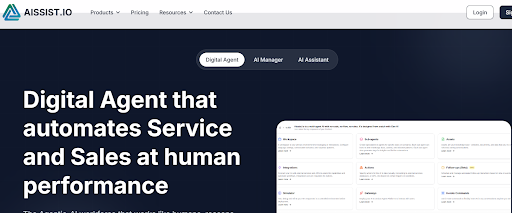
Aissist is an example of a full AI Operational Layer built around execution, governance, and continuous optimization rather than just conversation. Its platform combines specialized agents, an orchestration engine (AgentMesh), an insight layer (Pulse), and an optimization engine (Evolve) to create one cohesive "AI operating system" across support and sales.
In production, Aissist.io resolves about 83% of support and sales work end-to-end while maintaining a 4.8/5.0 CSAT, then uses the same layer to generate deep insights across users, agents, and products. This lets teams move beyond isolated chatbots and into a model where AI not only handles work but also continuously improves the underlying operations.
FAQs
Is an AI operational layer just a fancy chatbot?
No. A chatbot mainly answers questions, while an AI operational layer executes workflows and updates systems across your stack.
Do I need to replace my existing tools to use one?
Usually not. The layer is designed to sit on top of CRMs, helpdesks, and ERPs you already use.
Is this only for large enterprises?
It's most common in larger orgs, but fast-growing teams also use it to avoid building dozens of one-off automations.
How is it different from an iPaaS or integration tool?
An iPaaS connects systems with rules; an AI operational layer adds reasoning, agents, and continuous optimization on top of those connections.
What's the main benefit in one line?
You get a single, AI-driven layer that can execute, monitor, and improve work across your entire business, not just answer support tickets.