The 7 Best Intercom Alternatives and Competitors for 2026
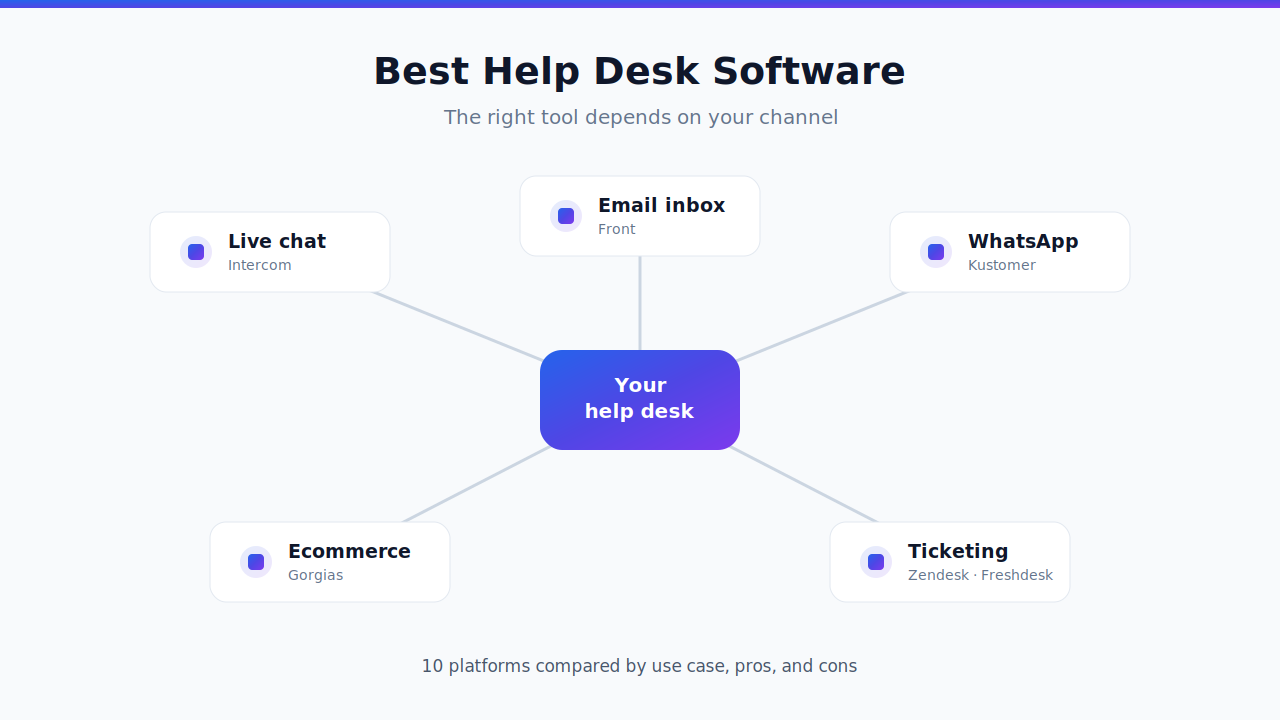
The best Intercom alternatives in 2026 are Zendesk, Freshdesk, Front, Gorgias, Kustomer, HubSpot Service Hub, and Zoho Desk. The right one depends on your team size, whether you want live chat or a full help desk, and how much you want AI to actually resolve. This guide compares all 7 Intercom competitors on real G2 ratings, verified starting prices, and best-fit use case — and then covers a different path: adding an agentic AI layer on top of the help desk you already run, instead of migrating. For a wider market view, see our best help desk software guide.
Compiled by Alex Gomez, Sr. Analyst, read on 24 August 2026. Disclosure: this guide is published by Aissist.io, which sells an agentic AI layer for customer service and sales — a product that competes in the market described here. Aissist.io appears in this comparison as one of the products discussed. We hold no affiliate, referral or paid-placement relationship with any vendor on this page, and no vendor reviewed it before publication. Vendor figures are taken from each vendor's own published material where one exists; where none exists we say so rather than estimate.
Intercom is a strong, AI-forward messaging platform. Teams start looking for an Intercom alternative for three reasons that all sharpened in 2026, and it is worth naming them before you shortlist.
Why teams look for an Intercom alternative
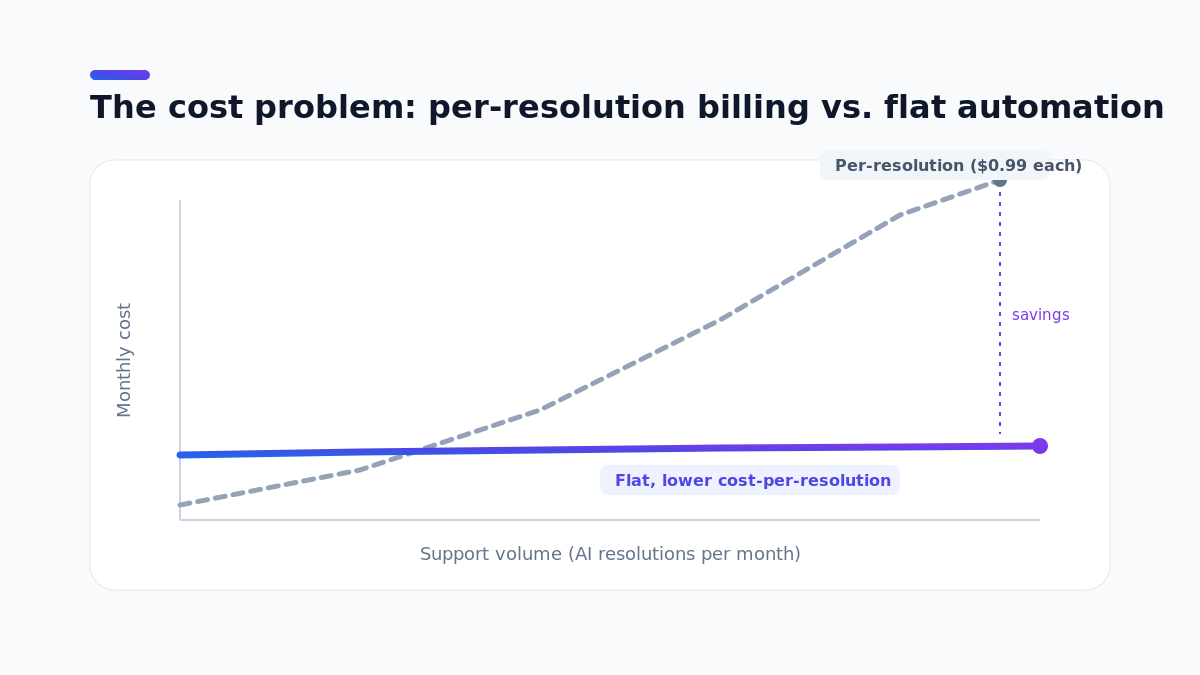
Cost. Intercom's Fin AI Agent is priced at roughly $0.99 per resolution on top of per-seat plans that start at $29/seat/month on annual billing. The model bills on "assumed" resolutions, so a customer who reads a reply and goes quiet can still count as a paid resolution — which means the bill rises exactly as automation succeeds. For a team with real volume, the AI line item can dwarf the seat cost, and it is hard to forecast.
Fit. Intercom's chat-first, B2C-leaning design is a mismatch for many B2B and support-heavy teams. Research cited across the market puts the share of B2B companies naming this as their main reason for evaluating a switch at around 73%. If your support is email- and ticket-heavy, or you need a customer-relationship view rather than a chat inbox, the shape of the product works against you.
Acquisition uncertainty. On 15 June 2026 Salesforce signed a definitive agreement to acquire Intercom — rebranded Fin — for roughly $3.6 billion. The deal has not closed; Salesforce expects it in the fourth quarter of its fiscal 2027, subject to regulatory clearance. Deals of this size introduce real questions: how the product folds into the Salesforce ecosystem, whether standalone pricing and integrations survive, and whether the roadmap still serves smaller, non-Salesforce customers. For teams that chose Intercom precisely because it was not a heavyweight suite, that uncertainty alone is reason to evaluate alternatives now.
Underneath all three sits the question reshaping the category: how much can the platform actually resolve end-to-end? That is the number that should drive your decision in 2026, not the sticker price.
How we evaluated these Intercom competitors
Every tool below is scored on four dimensions that decide the purchase:
- Price — the verified starting price per seat, plus where the real cost lands once AI and higher tiers are added. Watch for per-resolution AI billing, not just the per-seat sticker.
- Market fit — B2B vs. B2C, chat-first vs. ticket/CRM, SaaS vs. ecommerce. The best tool for a Shopify store is the wrong tool for a B2B software team.
- Ease of use / UI — how fast agents get productive and how much admin overhead the platform demands.
- AI and automation — whether the AI resolves multi-step cases end-to-end or just deflects FAQs, and how that automation is priced.
Ratings shown are each product's overall G2 score and review count, captured in August 2026; prices are each vendor's published entry tier at annual billing. Both move over time, so confirm current numbers on the vendor's pricing page before you buy.
Intercom alternatives compared at a glance
| Platform | G2 rating | Starting price | Best fit |
|---|---|---|---|
| Intercom (baseline) | 4.5 (3,898) | $29 / seat / mo + Fin ~$0.99 / resolution | The platform you're comparing against |
| Zendesk | 4.3 (7,012) | $19 / agent / mo | Enterprise-standard, ticket-centric support |
| Freshdesk | 4.4 (3,754) | Free (≤2 agents); paid from ~$15 | Best value full suite for scaling SMBs |
| Front | 4.7 (2,505) | $25 / seat / mo | Collaborative shared inbox, B2B and ops |
| Gorgias | 4.6 (565) | $10 / mo (50 tickets) | Ecommerce and Shopify brands |
| Kustomer | 4.4 (562) | $89 / seat / mo (8-seat min) | High-volume B2C support-as-CRM |
| HubSpot Service Hub | 4.4 (2,918) | $15 / seat / mo | Teams standardizing on HubSpot CRM |
| Zoho Desk | 4.4 (7,810) | $7 / agent / mo | Best value, and teams already on Zoho |
The 7 best Intercom alternatives and competitors
1. Zendesk — the enterprise helpdesk standard
Zendesk is the default Intercom alternative for teams that want a deep, ticket-centric system with a huge app marketplace, mature reporting, and AI agents via its Advanced AI add-on. Best for: support orgs that have outgrown a chat-first tool. Pricing: from $19/agent/mo, with AI resolutions metered separately. Pros: proven at scale, vast ecosystem, robust workflows. Cons: the interface is feature-dense, and the most useful AI sits in higher tiers and add-ons. G2: 4.3 (7,012). See our Zendesk competitors guide and the Zendesk integration.
2. Freshdesk — best value full suite
Freshdesk (from Freshworks) covers email, chat (Freshchat), phone, and social in one affordable suite, with Freddy AI for automation. Best for: budget-conscious SMBs and mid-market teams that want room to grow. Pricing: free for up to two agents, paid from roughly $15/agent/mo. Pros: broad feature set, generous free tier, easy onboarding. Cons: the best AI and automation sit on higher tiers; the UI gets dense at scale. G2: 4.4 (3,754). More on the Freshdesk integration. See our Freshdesk alternatives guide for the full field.
3. Front — best collaborative shared inbox
Front blends a shared inbox with helpdesk workflows so email, chat, and social feel like one collaborative workspace with comments, assignments, and clean handoffs. Best for: B2B and operations-heavy teams whose bottleneck is coordination, not deflection. Pricing: from $25/seat/mo on Starter. Pros: outstanding collaboration UX, among the highest-rated tools here. Cons: less of a traditional knowledge-base powerhouse; AI is comparatively newer. G2: 4.7 (2,505). See the Front integration. Our Front alternatives guide breaks down where it wins and where it does not.
4. Gorgias — best for ecommerce
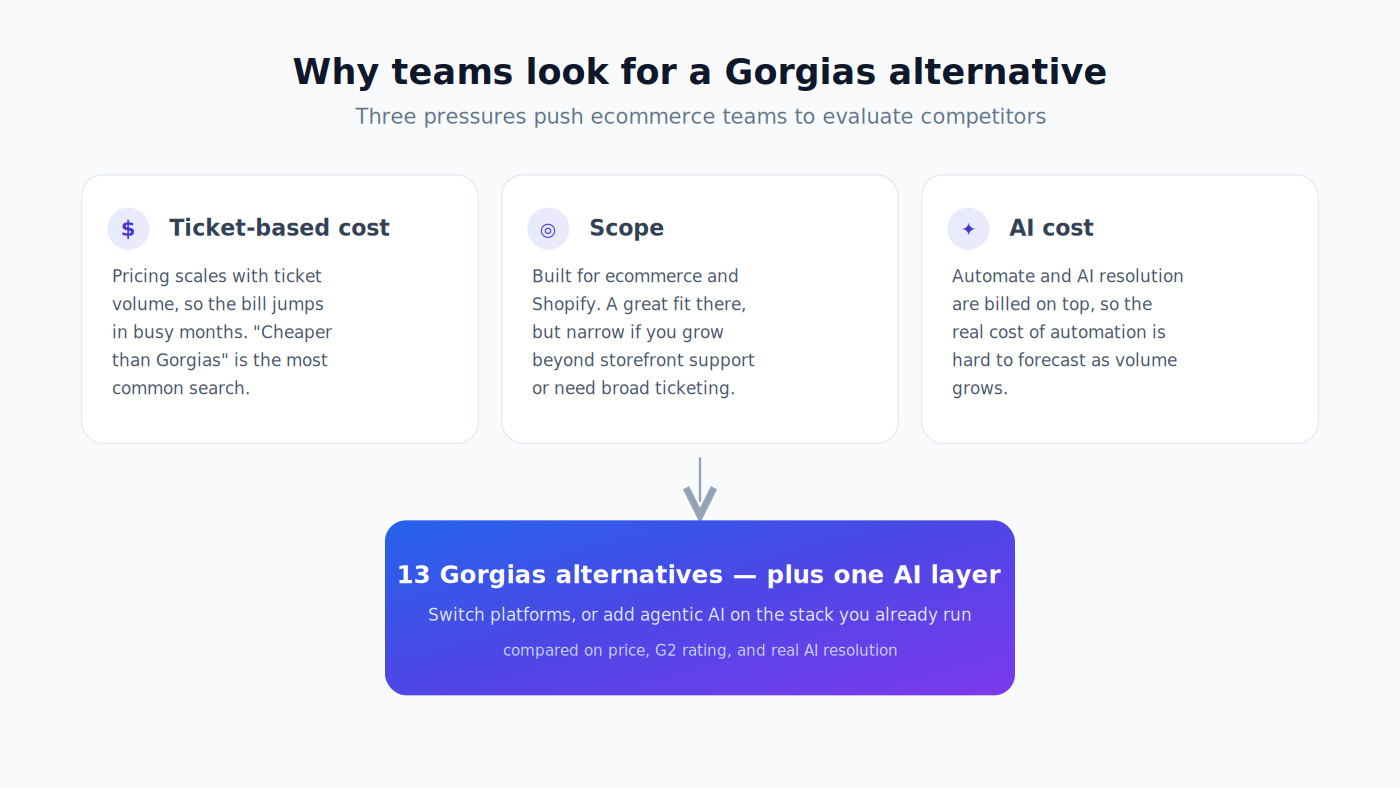
Gorgias is purpose-built for ecommerce, with native Shopify, order data, and revenue attribution in the agent view so teams resolve and sell in one place. Best for: Shopify and DTC brands. Pricing: from $10/mo (capped at 50 tickets), scaling by volume. Pros: deep ecommerce integrations, revenue tracking, strong order-status automation. Cons: ticket-based pricing can climb; narrow fit outside ecommerce. G2: 4.6 (565). See the Gorgias integration. See our Gorgias alternatives guide for the ecommerce-specific comparison.
5. Kustomer — best support-as-CRM for high volume
Kustomer treats each customer as a unified timeline rather than a stream of tickets, which suits high-volume B2C teams that need context across channels. Best for: high-volume B2C and retail. Pricing: from $89/seat/mo on Enterprise with an eight-seat minimum; AI costs extra. Pros: powerful data model, strong automation, built for scale. Cons: pricing and minimums rule it out for small teams. G2: 4.4 (562). See the Kustomer integration. See our Kustomer alternatives guide for the full comparison.
6. HubSpot Service Hub — best for teams on HubSpot CRM
Service Hub turns HubSpot into a support platform, with tickets, help desk, knowledge base, and AI on the same record as marketing and sales. Best for: teams already standardized on HubSpot. Pricing: from $15/seat/mo on Starter. Pros: unified CRM context, clean UI, strong reporting. Cons: costs rise with contacts and higher hubs; less specialized than a dedicated help desk. G2: 4.4 (2,918). See the HubSpot integration.
7. Zoho Desk — best value
Zoho Desk delivers the most capability per dollar on this list, especially paired with Zoho SalesIQ for chat and the wider Zoho suite. Best for: value-focused SMBs and existing Zoho customers. Pricing: from $7/agent/mo — the lowest entry point here. Pros: very affordable, deep feature set, tight Zoho integration. Cons: functional-not-polished UI; full value assumes you're in the Zoho world. G2: 4.4 (7,810).
A different path: add an AI layer instead of switching platforms
Every option above asks you to migrate — move conversations, retrain your team, and rebuild workflows on a new platform. That is the right move for some teams. But if the reason you're leaving Intercom is really about resolution and cost — Fin's per-resolution bill and forecast anxiety — not the product itself, there's a second path.
Aissist.io is an AI Operational Layer that sits on top of the help desk you already run — Intercom, Zendesk, Freshdesk, Salesforce, HubSpot, and others — and resolves support and sales conversations end-to-end. Instead of a rip-and-replace, its AgentMesh™ multi-agent workforce plugs into your existing stack, Pulse™ reads every ticket and agent in real time, and Evolve™ keeps improving the operation. It's an agentic system built on multi-agent reasoning with governance and human escalation, not a legacy FAQ chatbot that deflects and breaks on complexity.
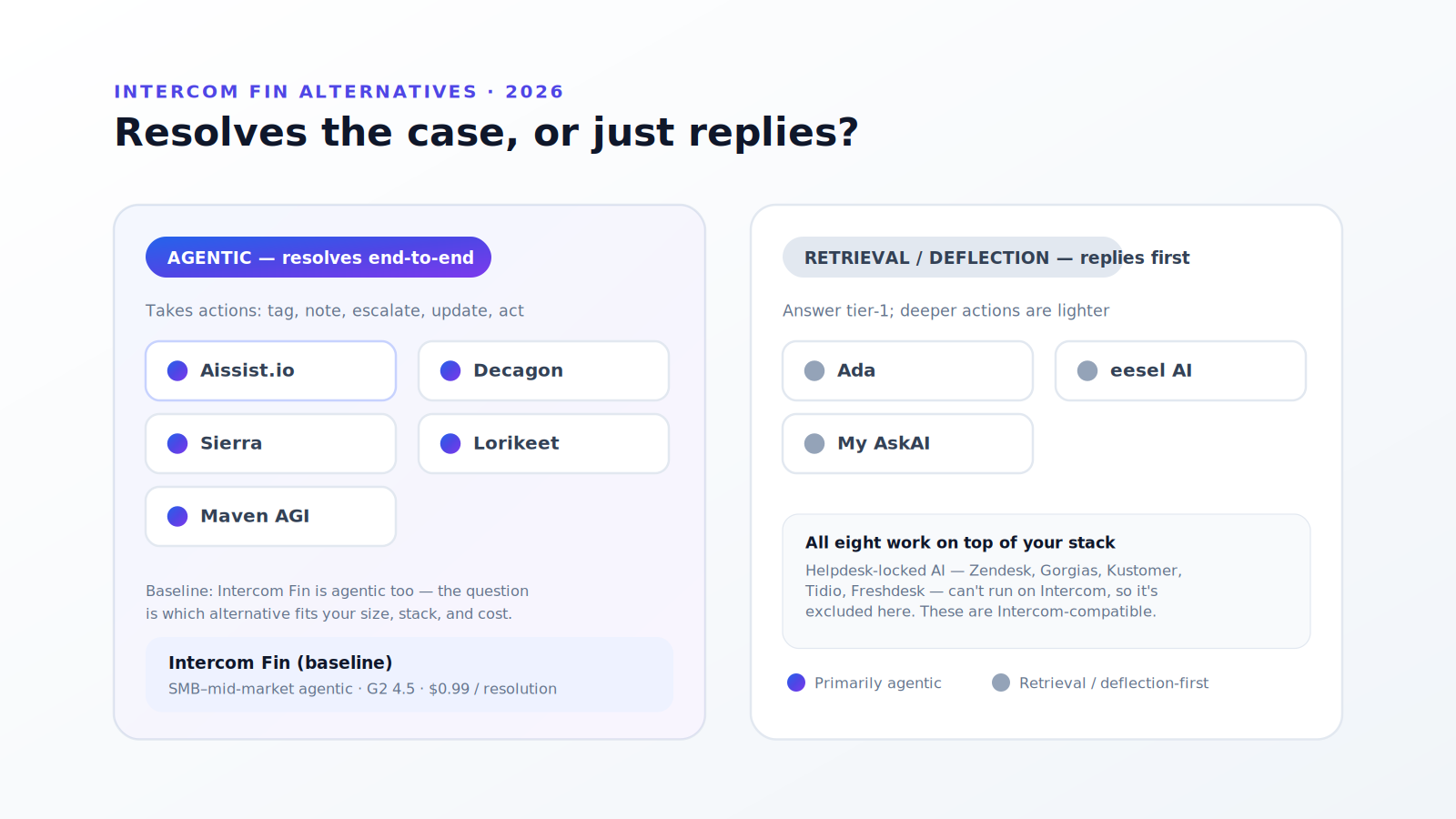
Best for: teams that like their platform but want dramatically higher automated resolution without a migration — and predictable economics. Pricing: usage-based, as low as ~$0.60 per resolution. Pros: keep your current platform, deploys in about 10 minutes, resolves rather than deflects, and reports 83% average resolution with 4.8/5.0 CSAT on automated support. Cons: it's an automation layer, not a standalone chat/ticketing product — you keep a help desk underneath it. If you specifically want to displace Intercom's Fin, see our best Intercom Fin alternatives guide and the AI customer service benchmark for how resolution rates compare.
How to choose the right Intercom alternative
Start from your constraints. If budget leads, Zoho Desk and Freshdesk give the most capability per dollar. If channel leads, pick by primary channel: Front for collaborative email, Gorgias for ecommerce, Zendesk for full ticketing. If B2C experience leads, Kustomer is built for it. If you're standardizing on a CRM, HubSpot Service Hub or Salesforce is the natural home.
If AI resolution is the real driver — as it is for most 2026 buyers leaving Intercom over Fin's pricing — the decision splits in two. Switch to another AI-forward platform if you want a new home, or add an agentic AI layer over your current stack if the platform is fine and only the automation and economics need to change. Either way, pilot on your own conversations before committing: the number that matters is how many you resolve without a human, and the true cost per resolution once AI is switched on.
Key takeaways
There is no single best Intercom alternative — there's a best one for your channel mix, team size, and resolution goals. For value, look at Zoho Desk and Freshdesk; for ecommerce, Gorgias; for high-volume B2C, Kustomer; for enterprise ticketing, Zendesk; and for CRM-native teams, HubSpot Service Hub. And remember the newer option: if your goal is higher automated resolution and predictable cost rather than a different inbox, an agentic AI layer can deliver that on the platform you already have. Shortlist two or three, pilot them on real conversations, and decide on resolution rate and true cost — not the sticker price.
Keep your platform, upgrade the resolution. Aissist.io adds an agentic AI layer to Intercom and every major alternative — resolving support and sales end-to-end at a predictable cost per resolution, no migration required. Get a free demo →
Frequently asked questions
What are the best Intercom alternatives in 2026?
The best Intercom alternatives in 2026 are Zendesk, Freshdesk, and Front for support teams, Gorgias for ecommerce, and Kustomer for high-volume B2C. The right pick depends on your channel mix, team size, and how much AI-driven resolution you need. Teams focused on resolution rather than a new inbox increasingly add an agentic AI layer to their existing stack instead.
Why do companies switch away from Intercom?
Companies switch away from Intercom mainly for three reasons: cost, fit, and uncertainty. Fin's per-resolution AI pricing (about $0.99 per resolution, billed on assumed resolutions) makes bills rise as automation succeeds; its chat-first, B2C-leaning design fits B2B and ticket-heavy teams poorly; and Salesforce's 2026 acquisition of Intercom raises roadmap and pricing questions. Together these push many teams to evaluate alternatives.
What is the cheapest Intercom alternative?
Zoho Desk is among the cheapest at $7/agent/mo, and Freshdesk offers a free tier for small teams. Gorgias starts at $10/mo for low ticket volumes. These are the most budget-friendly Intercom alternatives, though advanced automation and AI features generally require paid or higher-tier plans, so model your real usage before committing.
Which Intercom alternative is best for B2B SaaS?
For B2B SaaS, Front (collaborative shared inbox) and Zendesk (deep ticketing and integrations) are the strongest fits, since Intercom's main B2B complaint is its chat-first, B2C-oriented design. Teams wanting high AI resolution without leaving their current tool often add an agentic AI layer on top instead of migrating.
What is the best Intercom Fin alternative for AI resolution?
If your goal is specifically to replace or beat Fin on AI resolution and cost, the two options are switching to another AI-forward platform or adding an agentic AI layer such as Aissist.io on top of your existing help desk. The layer approach avoids a migration and prices per resolution (as low as ~$0.60), which addresses the forecast problem with Fin's assumed-resolution billing.
Is Intercom being acquired by Salesforce?
Yes. On 15 June 2026 Salesforce signed a definitive agreement to acquire Intercom (rebranded Fin) for approximately $3.6 billion, subject to regulatory clearance, with a close expected in the fourth quarter of Salesforce's fiscal 2027. The deal introduces uncertainty about how the product integrates into Salesforce, whether standalone pricing and integrations continue, and whether the roadmap keeps serving smaller, non-Salesforce customers — which is prompting some teams to evaluate alternatives.
Do I have to migrate off Intercom to cut AI costs?
No. You can switch platforms, or you can keep Intercom and add an agentic AI layer that resolves conversations end-to-end at a predictable per-resolution price. The layered approach avoids a migration entirely while changing the economics — useful when the platform itself is fine and only Fin's cost and forecastability are the problem.