Freshdesk Alternatives: 7 Help Desks and AI Agents Compared by Price, Ownership and AI Meter
The best Freshdesk alternatives in 2026 are Aissist.io, Zendesk, Fin, HubSpot Service Hub, Zoho Desk, Front and Salesforce Service Cloud. Five replace the help desk; two add an AI agent on top.
TL;DR: Freshdesk bills Freddy AI Agent per session, resolved or not, at $49 per 100 after 500 included, per Freshworks' pricing page, so compare alternatives on their AI billing unit before their seat price.
Methodology & sources
- G2 scores and review counts come from each product's G2 reviews page; prices from each vendor's pricing page, except Zoho Desk's USD rates, taken from its vendor-supplied G2 listing.
- Resolution figures are vendor-published; none is independently audited. Deflection (the customer did not reach an agent) is labelled as such and is not resolution.
- Ownership is taken from completion releases and company filings.
- All figures verified 19 October 2026.
- Disclosure: this is Aissist's blog, and Aissist sells an AI agent that competes with several products here. No vendor reviewed this page, and we hold no affiliate or paid-placement relationships.
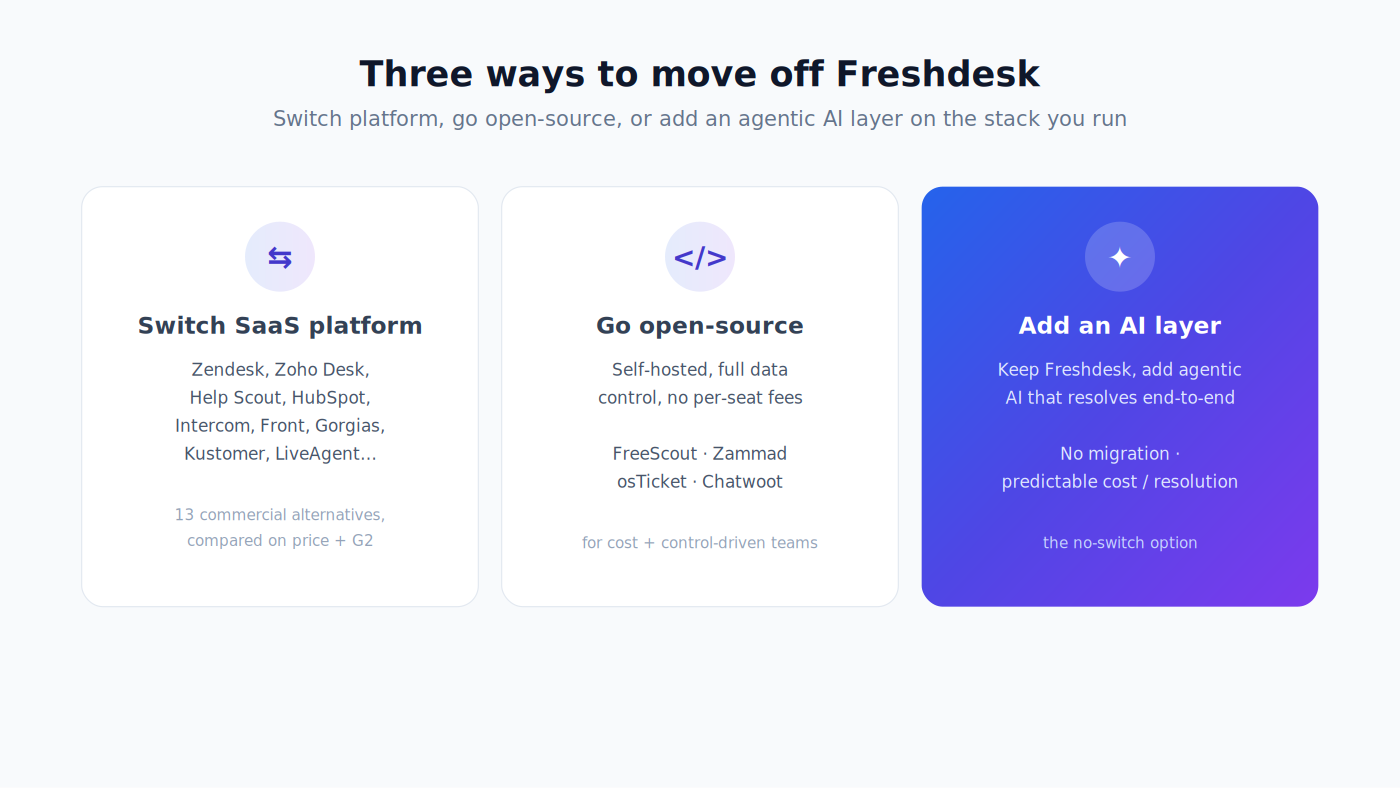
Why are teams looking for Freshdesk alternatives?
Freshdesk is cheap to seat and harder to price once AI is on. Freshworks' pricing page lists Growth at $19, Pro at $55 and Enterprise at $89 per agent per month, billed annually. Freddy AI Agent includes 500 sessions; more cost $49 per 100. Freddy AI Copilot is a $29 per-agent add-on on Pro and Enterprise.
The meter is the catch. Freshdesk's add-on documentation defines a chat session as everything within 24 hours of a conversation's start, and an email session as 72 hours. Chat AI Agent requires Freshdesk Omni, from $29 per agent. A session is billed whether or not the AI resolved anything.
"the pricing structure becomes a notable concern when moving beyond the basic version" — Brijesh A., Tax Consultant, Capterra review of Freshdesk
Freshworks' own benchmark is a deflection figure: CEO Dennis Woodside told CX Today that Freddy AI Agent deflection averages 50%, reaching 80% in mature deployments. Freshdesk still holds 4.4/5 from 3,817 G2 reviews. The product works; the question is the price per answer.
How do the seven Freshdesk alternatives compare at a glance?
Five of the seven replace Freshdesk; two run on top of it. That decides migration cost first.
| Platform | Best for | Technology | Deploys onto your current help desk | G2 rating (n), Oct 2026 |
|---|---|---|---|---|
| Freshdesk (baseline) | SMBs wanting low seat prices | Help desk with AI agent | Is the help desk | 4.4 (3,817) |
| Aissist.io | Teams keeping Freshdesk | Agentic, multi-agent | Yes, including Freshdesk | 4.9 (45) |
| Zendesk | Teams outgrowing Freshdesk | Help desk with AI agents | Replaces it | 4.3 (7,102) |
| Fin | SaaS teams wanting a proven AI agent | Agentic | Yes | 4.5 (3,927) |
| HubSpot Service Hub | HubSpot CRM users | Help desk and CRM with AI agent | Replaces it | 4.4 (3,018) |
| Zoho Desk | Budget teams on Zoho | Help desk with AI agents | Replaces it | 4.4 (8,007) |
| Front | B2B teams working in shared inboxes | Shared-inbox help desk with AI agent | Replaces it | 4.6 (2,520) |
| Salesforce Service Cloud | Salesforce-standardized enterprises | CRM service suite with Agentforce | Replaces it | 4.4 (8,462)* |
*G2 lists the product as Agentforce Service (formerly Salesforce Service Cloud); Salesforce's pricing page calls it Service Cloud.
Pricing model, AI resolution and ownership (October 2026)
Seat prices cluster; AI meters do not. Every resolution figure is the vendor's own.
| Vendor | What it actually does | Pricing model and billing unit | Published AI resolution rate | Ownership as of October 2026 |
|---|---|---|---|---|
| Freshdesk | Ticketing help desk with Freddy AI | $19–$89/agent/month annual; AI Agent per session, 500 included, then $49/100 | Not published; 50% average deflection (CEO, Aug 2026) | Freshworks Inc. (Nasdaq: FRSH) |
| Aissist.io | Multi-agent AI layer on your help desk | $0.20–$0.60 per resolution by channel; handoffs free; 1,000 free tickets/month | 83% average, 4.8/5.0 CSAT | Independent (Aissistant Inc.) |
| Zendesk | Help desk with AI agents | $19–$115/agent/month annual; 5–10 automated resolutions included per agent, then $1.50 committed or $2.00 pay-as-you-go | "Up to 80%+" (ceiling, not average) | Private — Hellman & Friedman and Permira since Nov 2022 |
| Fin | AI agent for any help desk | $0.99 per outcome; 50-outcome monthly minimum | 76% average (Salesforce; 30,000+ customers) | Salesforce — acquisition completed 10 Sep 2026 |
| HubSpot Service Hub | Help desk on HubSpot CRM | Seats from $7/month (Starter); Customer Agent 50 credits ($0.50) per resolved conversation | "65%+" (vendor claim, no method given) | HubSpot Inc. (NYSE: HUBS) |
| Zoho Desk | Help desk with Zia AI | Free for 3 users; $7–$40/agent/month; AI agents on token allowance | Not published | Zoho Corporation, privately held |
| Front | Shared-inbox help desk | $25–$105/seat/month; Autopilot AI agent from $0.05 per conversation | Not published | Independent, private |
| Salesforce Service Cloud | CRM service suite | $25–$550/user/month; Agentforce $2 per conversation or $500 per 100k Flex Credits | 83% on Salesforce's own help site | Salesforce (NYSE: CRM) |
Sources: Freshdesk pricing, Freshdesk Omni pricing, CX Today on Freshworks, Aissist pricing, Zendesk pricing, Fin pricing, Salesforce's Fin completion release, HubSpot Service Hub pricing, HubSpot Credits Rate Sheet, Zoho Desk pricing, G2 Zoho Desk pricing, Revenue Memo on Zoho ownership, Front pricing, Service Cloud pricing, Agentforce pricing, Salesforce customer-zero story.
Four meters, four answers. Freshdesk counts sessions, Fin counts outcomes, Aissist, Zendesk and HubSpot count resolutions, and Front and Agentforce count conversations. Our price comparison tool runs them on your own volume.
The 7 best Freshdesk alternatives
1. Aissist.io — best for keeping Freshdesk
Aissist.io is an AI agent layer that resolves support and sales conversations end-to-end on Freshdesk, Zendesk, Intercom, Salesforce, HubSpot and other help desks without a migration. Aissist reports 83% average resolution and 4.8/5.0 CSAT.
- Pros: per-resolution price with free handoffs; no help-desk migration.
- Cons: 45 G2 reviews is a thin base; it is a layer, not a help desk, so you still pay Freshdesk seats.
"Reporting requires some customization to align with our internal metrics." — Joseph K., Service Operations Manager, G2 review of Aissist.io
Our take: skip it if you want to replace the help desk itself.
2. Zendesk — best for outgrowing Freshdesk
Zendesk is a help desk with AI agents built into every Suite plan, billed per automated resolution. Zendesk markets resolution of "up to 80%+", a ceiling rather than an average.
- Pros: published per-resolution AI rates; the largest G2 review base here.
- Cons: the AI meter stacks on seats from $19; Suite Professional costs $115 per agent.
Our take: skip it if Freshdesk's seat price is why you chose it. See our Zendesk competitors guide.
3. Fin — best for a proven AI agent
Fin, formerly Intercom, is an AI customer agent that runs on its own help desk or on other help desks. Salesforce reports a 76% average resolution rate for Fin, which serves more than 30,000 companies.
- Pros: deepest review base among AI agents; transparent $0.99 outcome price.
- Cons: now a Salesforce product; outcomes include configured handoffs, not only resolutions.
"The pricing model creates some uncertainty, since costs depend on resolution." — Daniel R., small-business reviewer, G2 review of Fin
Our take: skip it if you want a vendor no CRM company owns. See our Intercom alternatives.
4. HubSpot Service Hub — best for HubSpot CRM users
HubSpot Service Hub is a help desk built on HubSpot's CRM, with a Customer Agent billed in HubSpot credits. The rate sheet charges 50 credits, or $0.50, per resolved conversation.
- Pros: tickets sit beside CRM data; resolution-based AI meter.
- Cons: Professional adds a $1,500 onboarding fee; included credits are small (3,000 a month on Professional).
Our take: skip it if your CRM is not HubSpot.
5. Zoho Desk — best for tight budgets
Zoho Desk is a help desk with Zia AI on Professional and higher plans, plus AI agents on a monthly token allowance and a free three-user plan.
- Pros: lowest entry price here; privately held, never venture-funded.
- Cons: no published AI resolution rate; USD prices were not shown on Zoho's own page when we checked.
Our take: skip it if you need a predictable AI price.
6. Front — best for shared-inbox B2B teams
Front is a shared-inbox help desk for B2B teams, with an Autopilot AI agent priced per conversation and a $20 per-seat Copilot add-on.
- Pros: email-native workflow; Autopilot starts at $0.05 per conversation.
- Cons: "starting at" pricing means sales sets the real rate; no published resolution rate.
Our take: skip it if most of your volume is chat or WhatsApp.
7. Salesforce Service Cloud — best for Salesforce enterprises
Salesforce Service Cloud is a CRM service suite with Agentforce AI agents. Salesforce reports 83% resolution across about 32,000 weekly conversations on its own help site.
- Pros: native CRM actions; two published Agentforce pricing models.
- Cons: the $2 Conversations plan bills unresolved conversations; Agentforce is included only in the $550 Max edition.
Our take: skip it if you are not already on Salesforce.
What do these alternatives actually cost?
On the same volume, the AI bill ranges from about $100 to $4,000 a month. We ran one scenario through each published rate card: 2,000 chat conversations a month, 1,200 resolved by AI, 10 agents.
| Vendor | AI cost for 2,000 chats, 1,200 AI-resolved (Oct 2026) |
|---|---|
| Front Autopilot | From $100 at the $0.05 starting rate; final rate via sales |
| HubSpot Customer Agent | About $600 (60,000 credits), before included credits |
| Aissist.io | Up to $720 (chat cap of $0.60; handoffs free) |
| Freshdesk Freddy AI Agent | $735 (1,500 sessions beyond 500 included, resolved or not), plus Omni seats |
| Fin | $1,188, plus any billable handoff outcomes |
| Zendesk AI agents | $1,725–$2,300 after 50 included resolutions, plus seats |
| Agentforce (Conversations) | $4,000 — all 2,000 conversations billed |
| Zoho Desk | Not computable from the public page |
Per-resolution meters charge for answers; session and conversation meters charge for attempts. Our AI agent pricing benchmark covers more vendors.
How to choose the right Freshdesk alternative
- If Freshdesk works but Freddy's sessions don't, add Aissist.io or Fin, because migrating tickets costs more than switching AI.
- If you have outgrown Freshdesk's workflows, choose Zendesk, because its per-resolution AI is published and its plans scale to enterprise.
- If your CRM decides everything, choose HubSpot Service Hub or Salesforce Service Cloud to match it.
- If budget is the constraint, choose Zoho Desk; if email is the work, choose Front.
The AI meter, not the seat price, decides the switch
Most teams' seat prices here sit between $7 and $115. The AI line is where bills diverge, because sessions, outcomes, resolutions and conversations count different things. Price your volume on each meter, check who owns the vendor, then pilot two finalists on your own tickets.
Frequently asked questions
How much does Freddy AI cost in Freshdesk?
Every Freshdesk plan includes 500 Freddy AI Agent sessions; more cost $49 per 100. Freddy AI Copilot is $29 per agent per month on Pro and Enterprise. Chat AI Agent requires Freshdesk Omni.
Does Freshdesk still have a free plan?
Freshworks' pricing page no longer lists a free plan. It offers a 14-day trial, then Growth at $19 per agent per month billed annually. Zoho Desk is the only alternative here with a free plan, for three users.
Is Freshworks' 50% figure a resolution rate?
No. CEO Dennis Woodside described it as average deflection, meaning the customer did not reach an agent. Deflection is not confirmed resolution, so it is not comparable with Fin's 76% or Aissist's 83%.
What is the cheapest Freshdesk alternative?
Zoho Desk has the lowest seat price and a free plan. On AI, Front's Autopilot starts at $0.05 per conversation; Aissist.io is lowest per resolution at $0.20–$0.60.
Is Zendesk better than Freshdesk?
Zendesk publishes per-resolution AI rates, but its Suite plans cost more per seat. On G2, Zendesk scores 4.3 from 7,102 reviews; Freshdesk 4.4 from 3,817.
Can I keep Freshdesk and add a different AI agent?
Yes. Aissist.io and Fin both deploy onto existing help desks. Aissist charges $0.20–$0.60 per resolution with free handoffs; Fin charges $0.99 per outcome, 50-outcome monthly minimum.
Changelog
- 19 Oct 2026 — Added Freddy AI session pricing, Zendesk's per-resolution rates and a cost scenario; corrected Aissist pricing, HubSpot's credit cost and Freshdesk's free plan. Re-read all G2 figures. Removed Gorgias, Kustomer and open-source options.