AI Agent Pricing Models in 2026: Per-Resolution vs Per-Seat vs Per-Conversation
Five AI agent pricing models are in commercial use in 2026 — per seat, per conversation, per resolution, per action and platform plus usage — and on identical volume they produce bills that differ by nearly 7×. At 10,000 monthly conversations, the same workload costs $3,000 on HubSpot Breeze and $20,000 on Salesforce Agentforce, on each vendor's own published rate. The model you sign decides what you are paying for; the rate only decides how much.
By Rob Jiang, Chief AI Engineer · Published 31 August 2026 · Last updated 31 August 2026
TL;DR:
- Per seat bills headcount, per conversation bills arrival, per resolution bills outcome, per action bills each step, platform + usage bills both a floor and a unit. Only one of those tracks whether the work got done.
- At 10,000 conversations and a 60% resolution rate, monthly AI cost runs from $3,000 to $20,000 across ten vendors.
- Only 8 of 18 vendors publish a rate at all. Eight more are known only through procurement records and buyer disclosures, and one has no public price of any kind.
- The headline rate is rarely the bill. Platform floors, seat requirements and monthly minimums sit underneath four of the five models.
- Per-resolution pricing exists because inference got cheap in a specific way: cache reads cost 0.1× the base input rate at Anthropic, and most agentic tokens are cached.
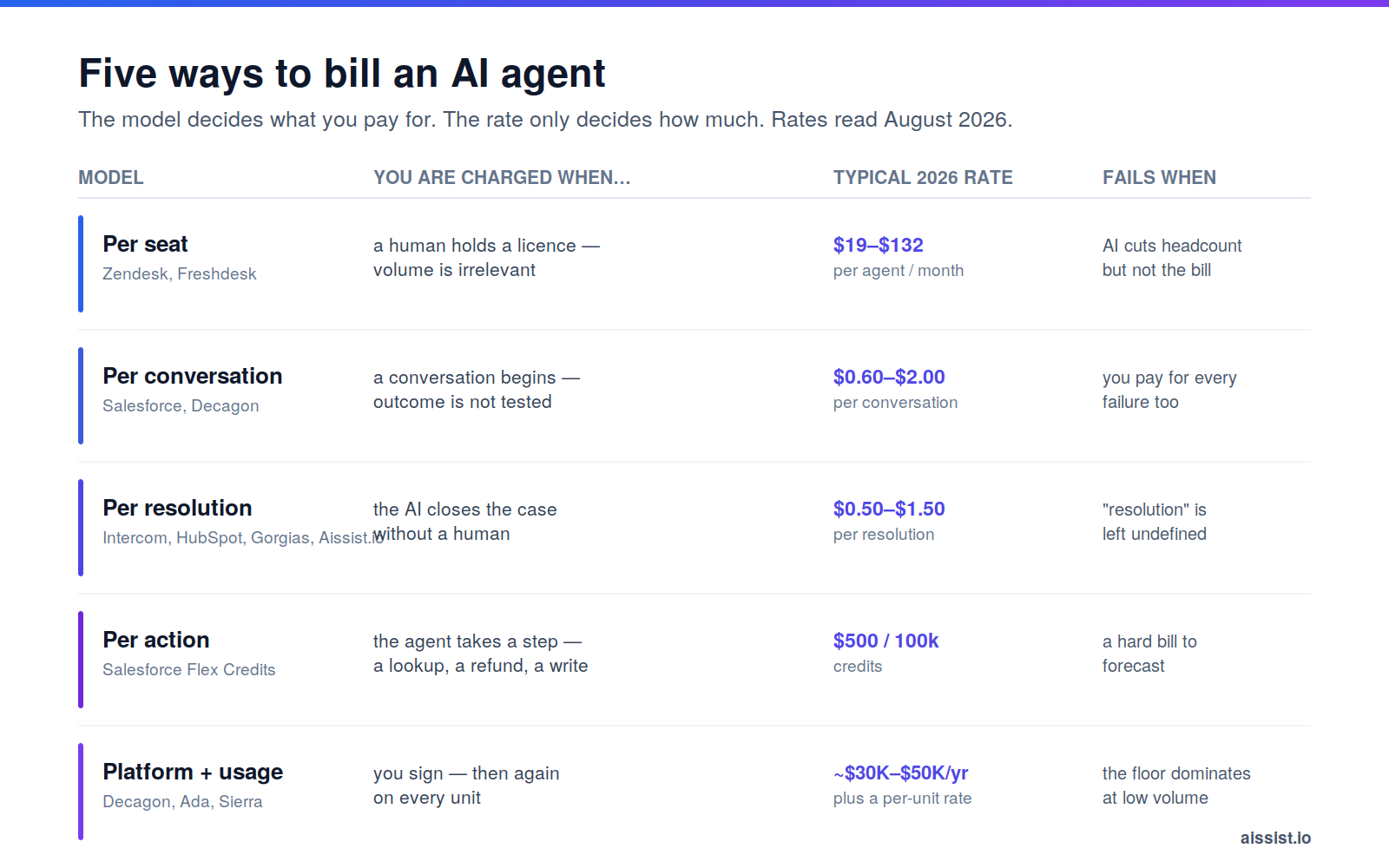
What are the AI agent pricing models in 2026?
Five models, distinguished entirely by which event triggers a charge. Per seat charges when a human holds a licence. Per conversation charges when a conversation arrives. Per resolution charges when the AI closes a case without a human. Per action charges for each step the agent takes. Platform + usage charges an annual floor and then a unit rate on top.
| Model | You are charged when… | Typical 2026 rate | Who it favours | Failure mode |
|---|---|---|---|---|
| Per seat | A human holds a licence — volume is irrelevant | $19–$132 per agent/month | Buyers with high volume and stable headcount | AI cuts the headcount but not the bill |
| Per conversation | A conversation begins, whatever the outcome | $0.60–$2.00 per conversation | The vendor | You pay for every failure at full price |
| Per resolution | The AI closes the case with no human | $0.50–$1.50 per resolution | The buyer, if "resolution" is defined | The definition is left vague |
| Per action | The agent takes a step — a lookup, a refund, a write | $500 per 100k Flex Credits | Precise, low-step workflows | Nearly impossible to forecast |
| Platform + usage | You sign — then again on every unit | ~$30K–$50K/yr plus a per-unit rate | Vendors with enterprise deal sizes | The floor dominates the bill at low volume |
Rates read from vendor pricing pages in August 2026: Zendesk lists seats at $19, $55 and $115 per agent/month billed yearly (Zendesk pricing); Salesforce lists $2.00 per conversation and Flex Credits at $500 per 100,000 credits (Agentforce pricing); Freshworks lists $49 per 100 Freddy sessions after the first 500 (Freshdesk pricing).
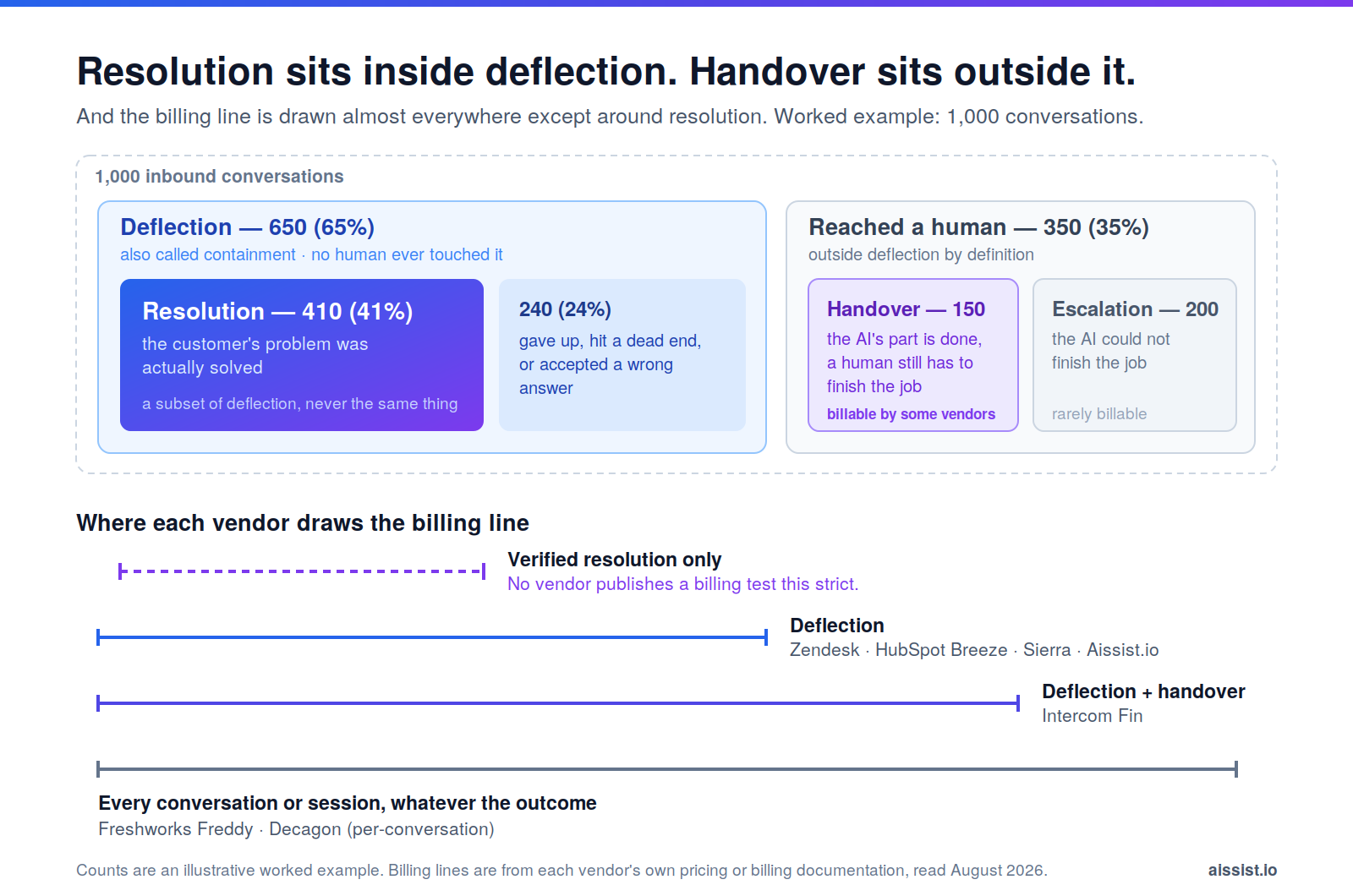
The distinction that matters commercially is narrower than the five labels suggest: only per resolution ties the charge to an outcome. The other four bill for activity, presence or arrival.
Which pricing model is cheapest at your volume?
At 10,000 monthly conversations and a 60% resolution rate, ten vendors produce monthly AI costs from $3,000 to $20,000 — a 6.7× spread on identical work. The 60% is a stated assumption for the arithmetic, not a benchmark; costs scale linearly, so a different rate shifts every row in the same direction. Four rows carry Reported rates, which are procurement estimates rather than quotes.
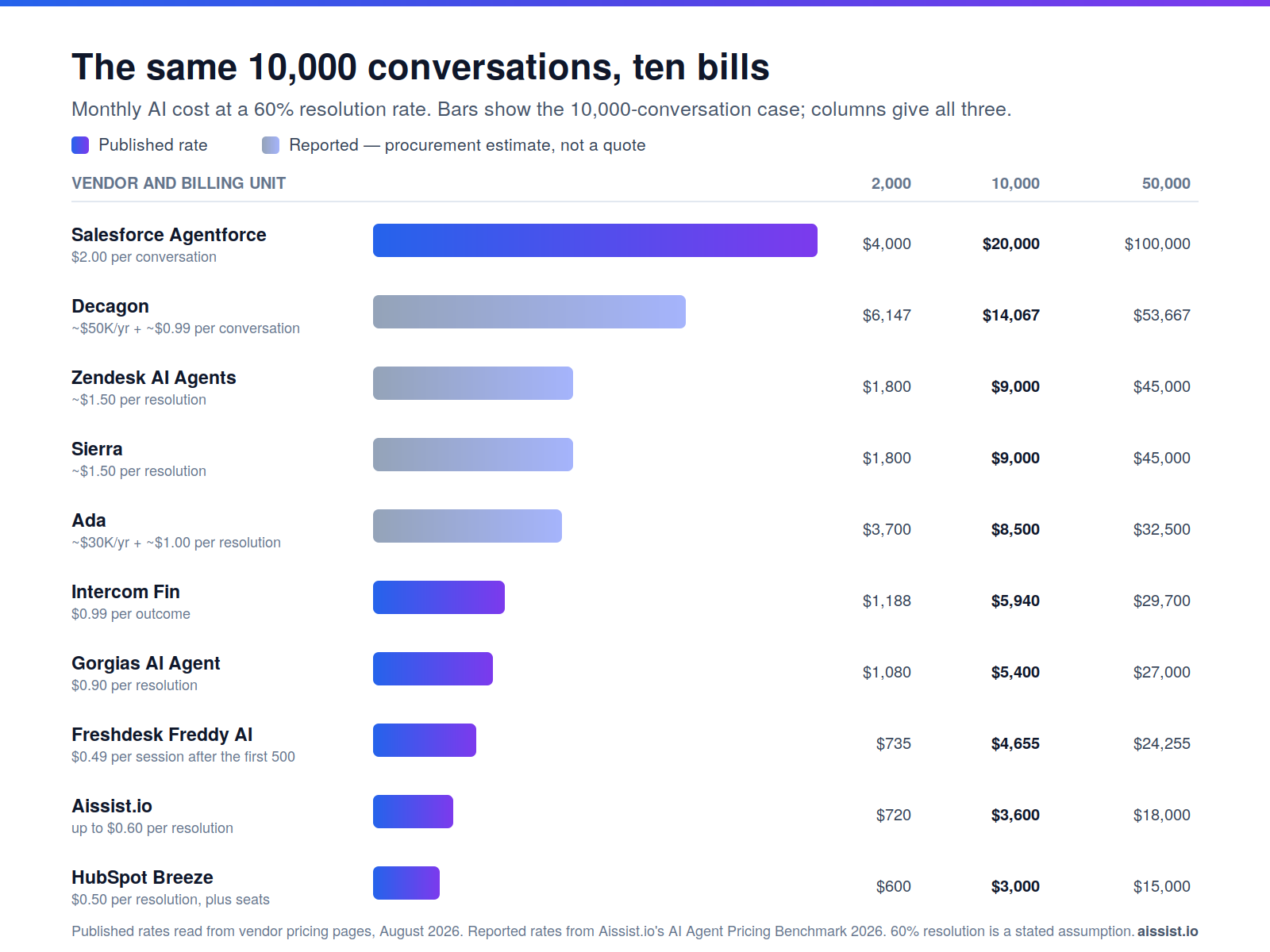
| Vendor and unit | Provenance | 2,000 conv. | 10,000 conv. | 50,000 conv. | Sits on top of |
|---|---|---|---|---|---|
| Salesforce Agentforce — $2.00/conversation | Published | $4,000 | $20,000 | $100,000 | Agentforce User Licence at $5/user/month |
| Decagon — ~$50K/yr + ~$0.99/conversation | Reported | $6,147 | $14,067 | $53,667 | The platform fee is the floor |
| Zendesk AI Agents — ~$1.50/resolution | Reported | $1,800 | $9,000 | $45,000 | A Zendesk Suite plan, $19–$115/agent/month |
| Sierra — ~$1.50/resolution | Reported | $1,800 | $9,000 | $45,000 | Reported setup of $50K–$200K, one-off |
| Ada — ~$30K/yr + ~$1.00/resolution | Reported | $3,700 | $8,500 | $32,500 | The platform fee is the floor |
| Intercom Fin — $0.99/outcome | Published | $1,188 | $5,940 | $29,700 | Seats at $29–$132/seat/month, or standalone |
| Gorgias AI Agent — $0.90/resolution | Published | $1,080 | $5,400 | $27,000 | A Gorgias helpdesk plan |
| Freshdesk Freddy AI — $0.49/session after 500 | Published | $735 | $4,655 | $24,255 | A Freshdesk plan — and a session is not a resolution |
| Aissist.io — up to $0.60/resolution | Published | $720 | $3,600 | $18,000 | Nothing — no platform or seat fee |
| HubSpot Breeze — $0.50/resolution | Published | $600 | $3,000 | $15,000 | Service Hub Professional or Enterprise |
The arithmetic is deliberately visible: per-conversation and per-session rates multiply by all 10,000 conversations, while per-resolution rates multiply by the 6,000 the AI closes. That single difference is why Salesforce's $2.00 and Intercom's $0.99 are not a 2× gap in practice — they are a 3.4× gap, because one bills arrival and the other bills outcome.
Two caveats before treating any row as a quote. Gorgias states that when its AI cannot resolve a conversation and hands it to a human, "that ticket shifts over to your regular Helpdesk plan… You're not charged for both" (Gorgias, read August 2026). And several rows carry floors the table cannot show — see the hidden-costs section below.
Why do so few AI vendors publish a rate?
Only 8 of 18 vendors publish a rate on their own pricing page or documentation. Eight more are known only through procurement records and buyer disclosures, one publishes a platform fee but not its usage rate, and one has no public or reported price of any kind, per Aissist.io's AI Agent Pricing Benchmark 2026, compiled July 2026 with sources re-read 24 August 2026.
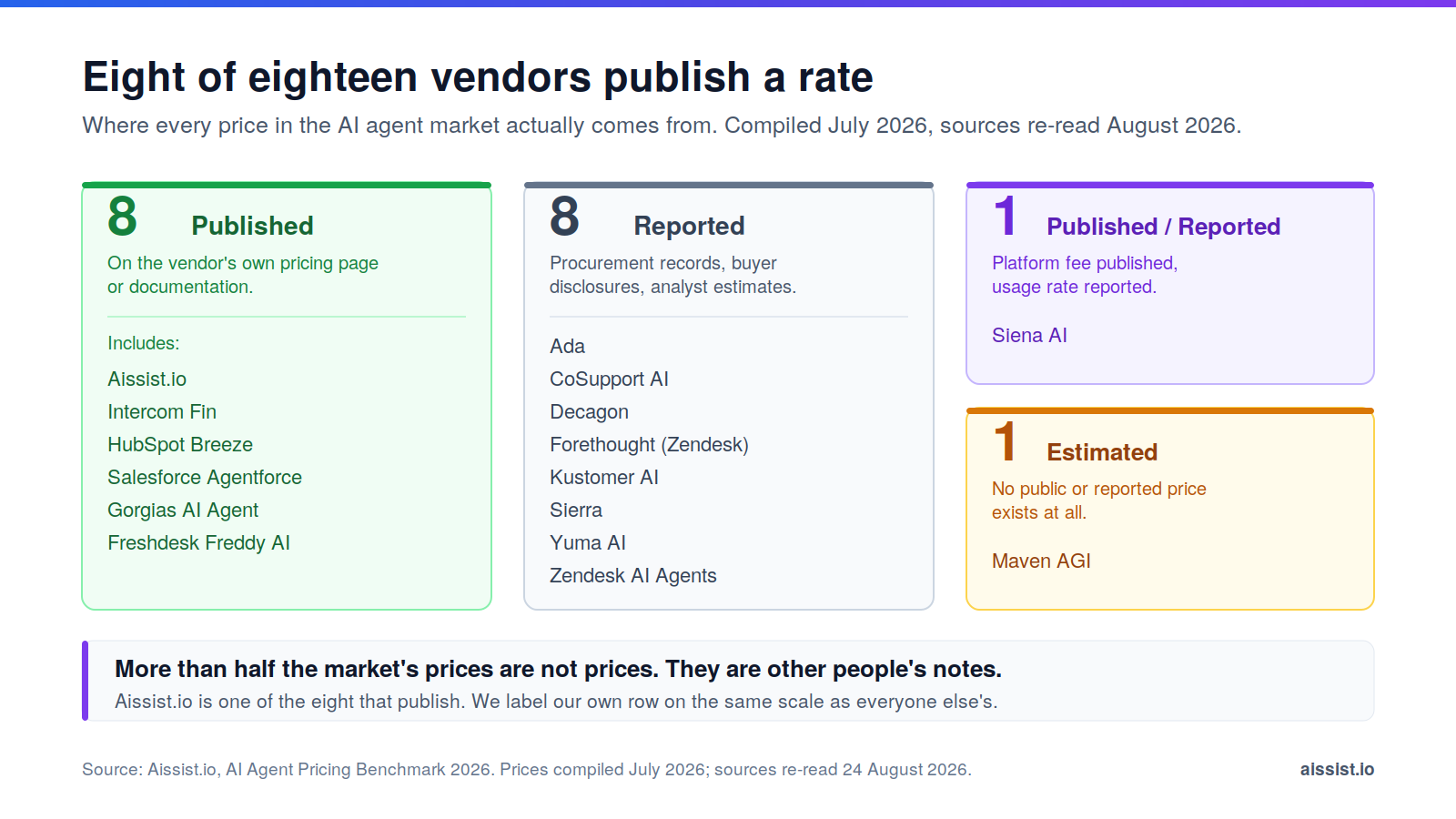
The split tracks the enterprise end of the market almost perfectly. Ada, Decagon, Sierra, Zendesk, Forethought, Kustomer, CoSupport and Yuma are all "Reported" — meaning the numbers come from Vendr marketplace records, buyer disclosures in public forums, or analyst estimates. Vendr's Decagon page shows a median annual contract of $432,750 across a range of $105,000 to $923,183, on a 20 August 2026 read (reported, not contractual).
That is a legitimate commercial choice, not a scandal. Enterprise deals are negotiated, and a published rate anchors every negotiation against the vendor. But it has a practical consequence for buyers: for more than half this market, the "price" in any comparison article — including the one you are reading — is somebody's note about a deal, not a rate anyone will honour.
Aissist.io is one of the eight that publish, and its row carries the same provenance label as everyone else's. Declaring the bias up front: this is our blog, and our own rate is on the pricing page.
Why did the market move to per-resolution pricing?
Because inference costs collapsed in a specific, asymmetric way that makes outcome pricing survivable for vendors. Anthropic prices cache reads at 0.1× the base input token rate — a 90% discount — with cache writes at 1.25× for a five-minute cache and 2× for an hour, per Anthropic's prompt caching documentation (read August 2026).
That discount matters because agents are cache-heavy by construction. OpenRouter data compiled by analyst Peter Walker and distributed through a16z's Charts of the Week on 21 August 2026 shows agents consuming nearly five times more tokens per task than human users on the same models, with agentic token use up roughly 14× since February 2025 against 2.8× for humans (PPC Land, 24 August 2026; The Decoder, 23 August 2026).
The two write-ups disagree on how much of that burn is cached — PPC Land reports "more than 85%," The Decoder "nearly 70%" — which is worth knowing before anyone builds a model on either figure. Either way the direction holds: a vendor quoting a fixed price per resolution is selling something whose marginal cost is a fraction of the sticker.
This is the honest answer to the "per-resolution tax" argument that independent builders raise. The margin is real. What buyers get in exchange is a bill that only arrives when something worked — which no other model on this page offers.
What hidden costs does the headline rate miss?
Four of the five models sit on top of a floor the per-unit rate does not include. A $0.50 resolution attached to a mandatory $90-per-seat platform is not a $0.50 resolution at any volume a small team runs.
The recurring ones, from vendor documentation read August 2026:
- Required host platform. HubSpot's Breeze Customer Agent runs inside Service Hub Professional or Enterprise; Gorgias AI Agent requires a Gorgias helpdesk plan; Salesforce's Agentforce User Licence is $5 per user per month and requires Flex Credits.
- Seat licences that survive automation. Intercom lists seats at $29, $85 and $132 per seat per month alongside $0.99 per outcome, though Fin can also be bought standalone.
- Platform floors at the enterprise end. Decagon is reported at roughly $50,000 a year plus usage, Ada at roughly $30,000 entry, and Siena AI publishes $750 a month plus $0.90 per ticket.
- Monthly minimums. Small deployments can pay for capacity they never use.
- Unit definitions that quietly inflate volume. Freshworks bills $49 per 100 Freddy sessions after the first 500, and a session is not a resolution — several sessions can belong to one unsolved issue.
Bihan Jiang, Director of Product at Decagon, put the underlying problem plainly when setting out the company's own model: "If a frustrated customer stops responding, does that count as 'resolved'?" (Decagon, December 2024). Every per-resolution rate on this page depends on an answer to that question, and the answers differ.
How should you choose an AI agent pricing model?
Choose the model whose billing event matches the outcome you actually want, then negotiate the rate second. The rate is the negotiable part; the model is the part that determines whether you and the vendor are pulling in the same direction for the next three years.
Four decision rules that hold at the volumes above:
- If your volume is low and spiky, choose per resolution, because platform floors dominate the bill below roughly 2,000 conversations a month — Decagon and Ada are reported at $50K and $30K a year before a single conversation is handled.
- If your volume is high and your headcount is fixed, per seat can win, because the marginal conversation is free — but only if the AI allowance attached to those seats is large enough, which is where Zendesk's resolution allowances bite.
- If you cannot get a written definition of "resolution," treat per-resolution pricing as per-conversation pricing, because that is what it becomes when silence counts as success.
- If the work is multi-step and system-touching, model per-action pricing before signing, because a single refund can span half a dozen billable actions.
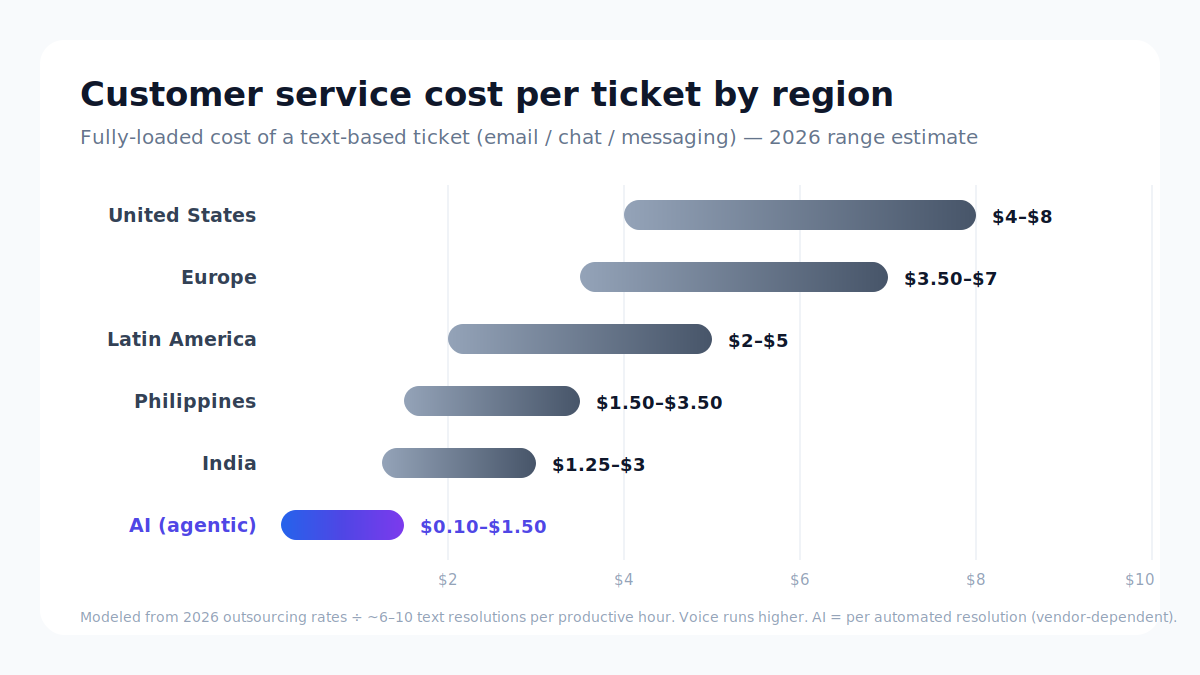
Run your own numbers rather than borrowing anyone's scenario — the price comparison tool does the arithmetic against your volume, and cost per ticket covers the human side of the same equation. Aissist.io's reasoning for metering interactions with a per-resolution cap is set out in why we charge on interactions.
Want this run against your own volume? The price comparison tool does the arithmetic on your ticket mix, and every rate behind it is provenance-labelled in the AI Agent Pricing Benchmark 2026. Book a consultation →
Key takeaways
AI agent pricing models differ in one respect that matters: which event opens the meter. Per seat bills presence, per conversation bills arrival, per action bills effort, platform plus usage bills both a floor and a unit, and only per resolution bills an outcome — which is why the model, not the rate, is the thing to negotiate hardest. Before comparing any two prices, get three answers in writing: what triggers the charge, what platform or seats sit underneath it, and what happens when the AI fails. More than half this market will not give you the first answer in public, which is itself a useful signal.
Frequently asked questions
What are the main AI agent pricing models?
Five models are in use in 2026: per seat, per conversation, per resolution, per action, and platform plus usage. They differ by which event triggers a charge — a licence, an arrival, an outcome, a step, or a signature. Only per resolution bills an outcome.
Is per-resolution pricing cheaper than per-conversation?
Usually, because per-resolution bills only the share the AI closes. At 10,000 conversations and a 60% resolution rate, Intercom Fin's $0.99 per outcome costs $5,940 a month while Salesforce Agentforce's $2.00 per conversation costs $20,000 — a 3.4× gap, not 2×.
How much does an AI agent cost per month?
At 10,000 monthly conversations, ten leading vendors produce monthly AI costs from $3,000 to $20,000, depending largely on the pricing model. Platform floors, seat licences and monthly minimums sit on top of that for most vendors, and are frequently larger than the usage charge itself.
What is per-action pricing for AI agents?
Per-action pricing charges for each step an agent takes — a record lookup, a refund, a system write — rather than per conversation or outcome. Salesforce sells it as Flex Credits at $500 per 100,000 credits. Step counts vary per case, making it hard to forecast.
Which AI vendors publish their pricing?
Eight of eighteen publish a rate, including Aissist.io, Intercom Fin, HubSpot Breeze, Salesforce Agentforce, Gorgias AI Agent and Freshdesk Freddy AI, per Aissist.io's pricing benchmark compiled July 2026. Ada, Decagon, Sierra, Zendesk, Forethought and Kustomer do not.
Why do enterprise AI vendors hide their prices?
Enterprise deals are negotiated, and a published rate anchors every negotiation against the vendor. The effect for buyers is that reported figures come from procurement records like Vendr rather than a rate anyone must honour — directionally useful, not contractual.
Does per-seat pricing still make sense for AI?
It can, when volume is high and headcount stable, because the marginal conversation costs nothing. It fails in the case AI is bought for: a per-seat bill falls only when you remove licences, not when the AI does more of the work.
What should I ask a vendor about their pricing model?
Ask what event triggers the charge, what platform or seat licence is required underneath it, whether there is a monthly minimum, and what happens when the AI fails or hands off. Two per-unit rates are not comparable until all four are answered.
Why is per-resolution pricing profitable for vendors?
Because cached inference is cheap. Anthropic prices cache reads at 0.1× the base input rate, and most agentic tokens come from cached prompts, so marginal cost per resolution is a fraction of the price charged. The margin is worth negotiating against.
How do I compare AI agent prices fairly?
Normalise to cost per resolved issue at your own volume, then add platform fees, seat licences and minimums. Compare only rates with the same provenance — a published rate and a procurement-reported estimate should not sit untagged in one column.
Changelog
- 31 August 2026 — First published. Published rates read on this date from Zendesk, Salesforce Agentforce, Intercom, HubSpot, Gorgias and Freshdesk pricing pages, and from Aissist.io's own pricing page. Reported rates for Ada, Decagon, Sierra and Zendesk AI Agents are procurement estimates carried from the AI Agent Pricing Benchmark 2026 (compiled July 2026, sources re-read 24 August 2026) and use the low end of each reported range. Token-economics figures sourced to OpenRouter data compiled by Peter Walker via a16z, 21 August 2026, and to Anthropic's prompt caching documentation.