Customer Service Cost Per Ticket: 2026 Regional Benchmarks and the Human-vs-AI Gap
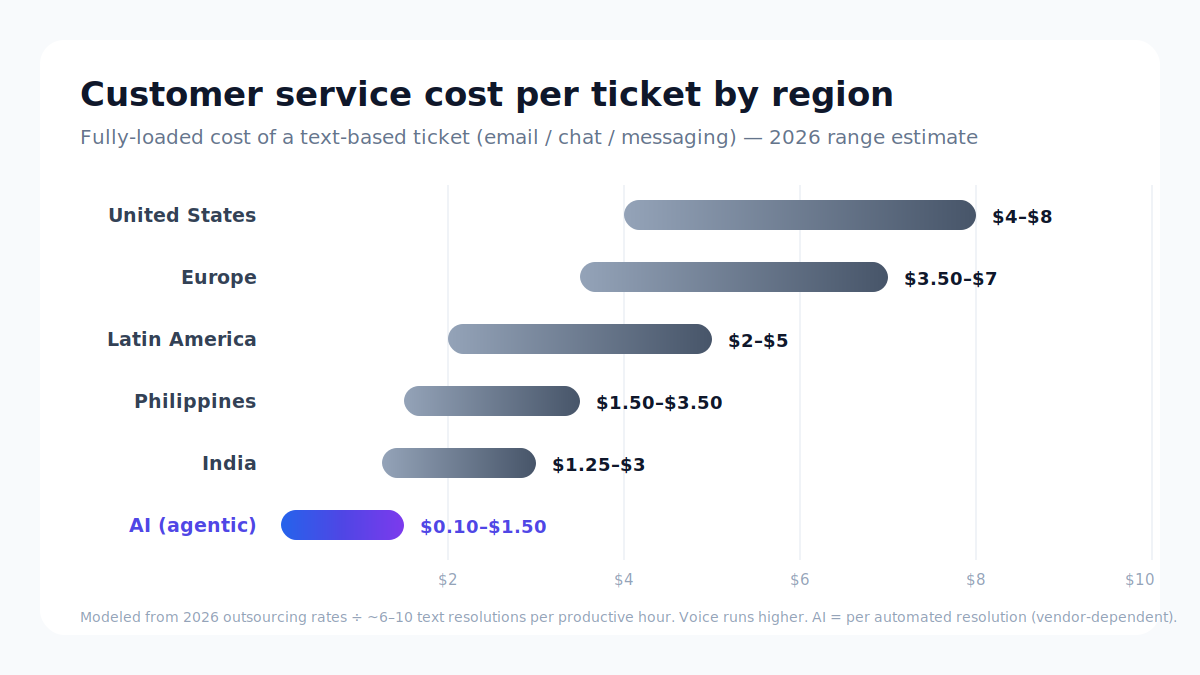
Customer service cost per ticket in 2026 spans a wide range. A fully-loaded human contact runs roughly $8–$20 blended (voice included), while an AI-resolved ticket typically costs $0.10–$1.50, depending on the tool and how much it actually resolves. For text-based support specifically (email, chat, and messaging — not voice), a fully-loaded human ticket costs roughly $4–$8 in the United States, $3.50–$7 in Europe, $2–$5 in Latin America, $1.50–$3.50 in the Philippines, and $1.25–$3 in India — while agentic AI lands around $0.10–$1.50 per resolution (≈$0.50 typical). Region moves the human number by roughly 3x; AI moves it by an order of magnitude. This guide breaks down the customer service cost per ticket by region, explains what actually sits inside that number, and shows why the per-ticket rate is only the tip of your true total cost of ownership.
What "cost per ticket" actually means
Cost per ticket is the fully-loaded operating cost of your support function divided by the number of tickets it resolves in a period. "Fully loaded" is the important part. It is not just agent wages. Per HDI and MetricNet benchmarking, it includes agent salaries and benefits, indirect staff (team leads, supervisors, QA, trainers, workforce planners, managers), technology and licensing, telecom, facilities, and training. That is why a $20/hour agent never produces a $20/hour ticket cost. Practitioner guidance commonly puts the loaded figure at 1.25–1.4x base pay; we could not find an authoritative source (SHRM, DOL or BLS) publishing a formal multiplier, so treat it as a rule of thumb rather than a statistic.
Two clarifications keep the metric honest. First, cost per ticket is not cost per resolution. A ticket that bounces through three agents and a reopen costs far more than the raw per-ticket average implies, so leading teams also track cost per resolved contact. Second, channel matters enormously. This guide focuses on text-based support — email, live chat, and messaging — because that is where AI automation is most mature and where the economics shift most sharply. Voice consistently runs higher and is out of scope here.
A useful reference point, with its vintage attached: Gartner's benchmark (February 2024) puts the median cost per contact at $13.50 for assisted channels against $1.84 for self-service. The often-quoted HDI desktop-support figure of $62 per ticket (range $27–$490) comes from HDI/MetricNet's Metric of the Month, published 2011 on 2010 data — it is desktop support rather than customer service, and it is fifteen years old, so we cite it as history, not as a current benchmark. MetricNet's current service-desk figures sit behind membership and we could not verify a specific number from the public page, so we do not quote one. The spread across published benchmarks is enormous because it depends on channel, complexity, industry, and — the focus of this article — region.
Customer service cost per ticket by region (2026)
Labor is the single largest input into cost per ticket, so where your agents sit largely determines what a ticket costs. The table below models the fully-loaded cost of a text-based ticket by region, derived from 2026 outsourcing and in-house rate data. Treat the figures as directional benchmarks, not quotes — see the methodology note.
| Region | Fully-loaded hourly rate (text/digital) | Modeled cost per text ticket | Notes |
|---|---|---|---|
| United States | $25–$50/hr (in-house ~$28–$40) | ~$4–$8 (rep. $6) | Highest wages; strong for complex, regulated, brand-sensitive work |
| Western Europe / UK | ~$22–$45/hr | ~$3.50–$7 (rep. $5) | Similar to US; Eastern Europe nearshore is cheaper (~$13–$22/hr → ~$2–$3.50) |
| Latin America (nearshore) | $10–$22/hr | ~$2–$5 (rep. $3) | Mexico/Colombia higher; Central America & DR lower; time-zone aligned to US |
| Philippines | $6–$18/hr (commonly $8–$14) | ~$1.50–$3.50 (rep. $2.50) | Long-standing English-language CX hub; strong for chat/email |
| India | $6–$15/hr (commonly $8–$14) | ~$1.25–$3 (rep. $2) | Lowest labor cost; deep talent pool for scaled digital support |
| AI (agentic) | Per-resolution, not hourly | ~$0.10–$1.50 (rep. $0.50) | Flat as volume scales; no ramp, attrition, or peak staffing |
Blended, voice-inclusive benchmarks sit higher — North America around $15.56–$20 per ticket, Europe $12–$18, Asia-Pacific $5–$10 — because voice is slower and single-threaded; the text figures above are lower for exactly that reason. Move a queue from the US to India and you can cut labor cost per ticket by 41–73%. Move it to AI and the ceiling drops toward a dollar or less — which is the shift this whole category is now pricing in.
A note on method
Regional per-ticket figures are modeled estimates, not measured averages. They combine published 2026 fully-loaded outsourcing rates by country with a throughput assumption of roughly six to ten text resolutions per productive agent-hour — text agents clear email and concurrent chats far faster than voice calls, which is why these numbers land below blended, voice-inclusive averages. Your actual number will differ with ticket complexity, average handle time, occupancy, tooling, and reopen rate. AI cost per resolution is shown as a range because vendor pricing genuinely varies (see below). We show ranges throughout precisely because a single "average" hides more than it reveals.
Cost per ticket by channel (text-based)
Region sets the labor floor; channel sets the efficiency. Across industries in 2026, blended cost-per-contact benchmarks for text channels look like this:
Live chat and messaging run about $5–$9 per contact, email and ticket cases $6–$11, and social or messaging-app threads $5–$10. Self-service through a help center, bot, or IVR deflection drops to $0.10–$0.60 per successful resolution, and an AI agent handling an automated resolution lands near $0.50.
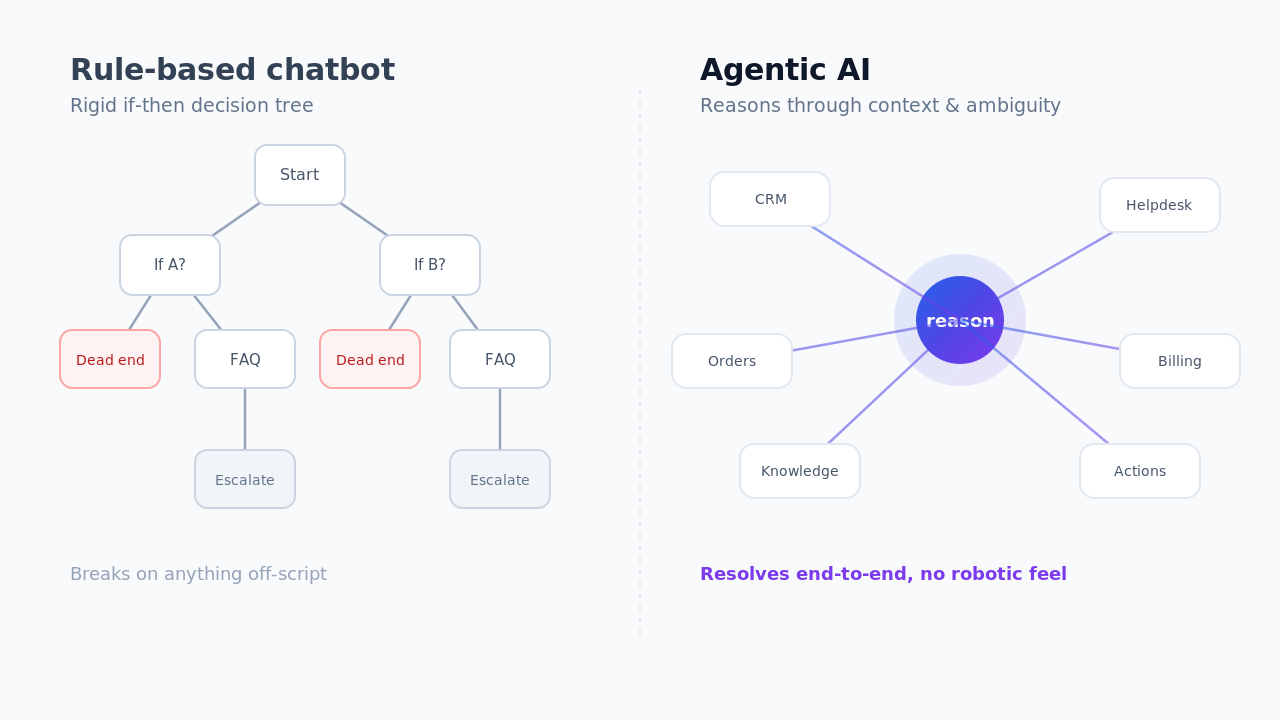
Self-service and AI are one to two orders of magnitude cheaper than assisted text — which is exactly why deflection and automation dominate every 2026 cost-reduction roadmap. But there is a catch that the raw channel numbers hide: deflection is not resolution. A bot that closes a session without solving the problem simply relocates the cost to a reopened ticket, an escalation, or a churned customer. The economics only work when automation actually resolves the issue end-to-end.
Why offshoring is no longer the cheapest lever
For twenty years, the answer to "reduce cost per ticket" was "move it offshore." That lever still works — Philippines and India labor is genuinely 60–80% cheaper than US onshore — but it is hitting three walls.
First, wage inflation. Loaded labor costs are rising 3–7% year over year across every region, and the most experienced offshore CX talent now commands rates that narrow the gap. Second, hidden coordination cost. Every offshore ticket carries management overhead, QA, training, ramp time, and attrition that never show up in the hourly rate. Support attrition is high but varies sharply by market — US contact centres average 21–27% a year (ContactBabel, US Contact Center Decision-Makers' Guide, 2024), while the Philippines has run 43–45% (CCAP attrition survey via Willis Towers Watson, 2022–23 data). There is no single credible global figure. Either way, a meaningful slice of your spend is permanently financing recruiting and onboarding rather than resolving tickets. Third, the quality ceiling. Cheaper labor tends to concentrate on Tier-1 volume; anything complex escalates back to more expensive staff, so the effective cost per resolved ticket is higher than the headline rate.
AI changes the shape of the curve rather than sliding along it. Instead of trading dollars for lower-cost humans, an agentic AI workforce removes the human from the majority of routine text tickets entirely — while the humans you keep focus on the exceptions that genuinely need judgment.
Human vs AI: the real cost gap
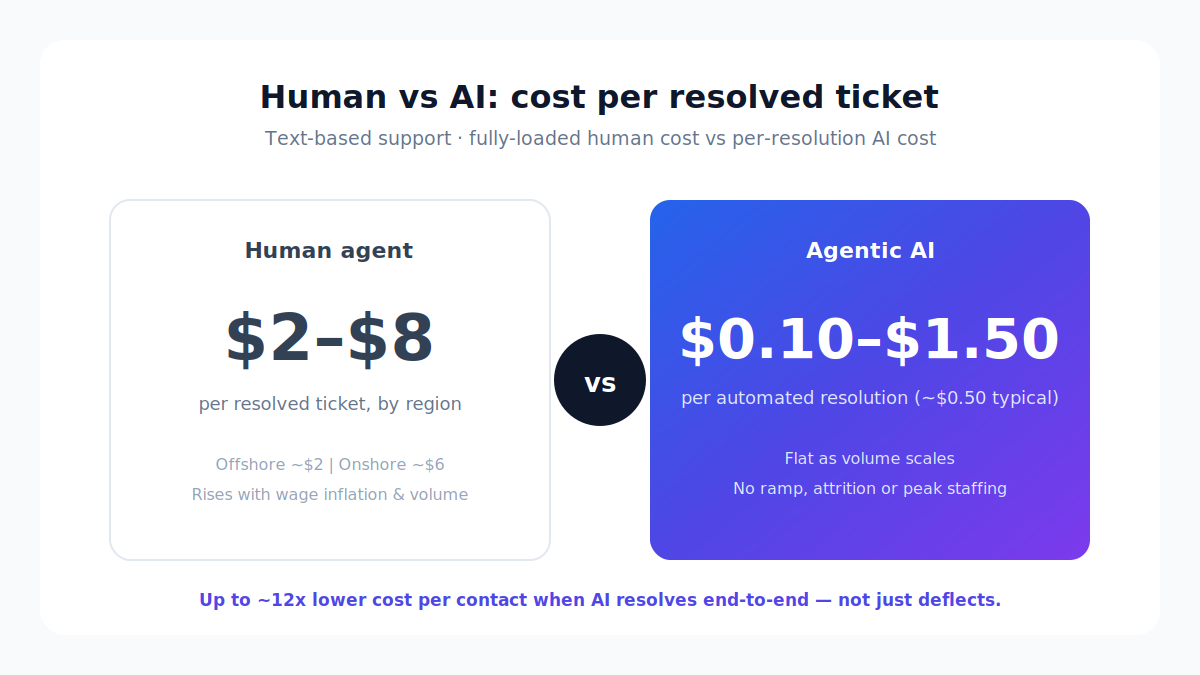
On a per-contact basis, the gap is stark. Industry data puts a human-handled text interaction around $6 and an AI-powered one around $0.50 — roughly a 5–12x difference depending on region and channel. AI pricing itself is a range, not a single number: purpose-built agents are priced per outcome, and what you pay swings with the vendor and the pricing model. Published rates, each read from the vendor's own page in August 2026:
| Vendor | Published rate | Billing unit | Source |
|---|---|---|---|
| Freshdesk (Freddy AI) | $49 per 100 AI Agent sessions (approx. $0.49/session) beyond the bundled 500 | Session | freshworks.com/freshdesk/pricing |
| Gorgias | $0.90 on most plans; $1.00 on Starter; overage to $2.00 | Resolved conversation | gorgias.com/blog/ai-agent-pricing |
| Intercom Fin | $0.99 | Resolution | fin.ai/pricing |
| Zendesk AI | approx. $1.50 committed, $2.00 pay-as-you-go | Automated resolution | Not shown on zendesk.com/pricing; rate confirmed only in a Zendesk product-manager forum post (7 August 2025) |
| Salesforce Agentforce | $2.00, or Flex Credits at $500 per 100,000 | Conversation (charged whether or not it resolves) | salesforce.com/agentforce/pricing |
Our own product, listed separately because we make it: Aissist.io publishes per-resolution rates of $0.20–$0.60, depending on channel — $0.20 for email, forms and social; $0.60 for chat, WhatsApp and SMS — on our pricing page. We have kept it out of the table above rather than rank ourselves inside a list of competitors we compiled.
So "AI cost per ticket" realistically spans $0.10 to ~$1.50 for most resolution-priced tools, with some conversation-priced ones running to $2.00. The floor matters less than two design questions behind it.
The first question is whether you pay per resolution or per conversation — paying for conversations that don't resolve quietly inflates your real cost per solved ticket. The second is how much the AI actually resolves end-to-end versus merely deflecting to a form or a queue. Aissist.io is built around end-to-end resolution rather than deflection, with 83% average resolution and 4.8/5.0 CSAT on automated support — figures we measure across our own deployments and self-report; they are not independently audited — because a low per-resolution price only helps if the resolution rate is high enough to shrink human volume in the first place.
From cost per ticket to true TCO
Here is the trap in optimizing cost per ticket alone: it is the tip of the iceberg. The rate you quote hides most of what a support operation actually costs, and any honest human-vs-AI comparison has to count every layer below the waterline — on both sides.
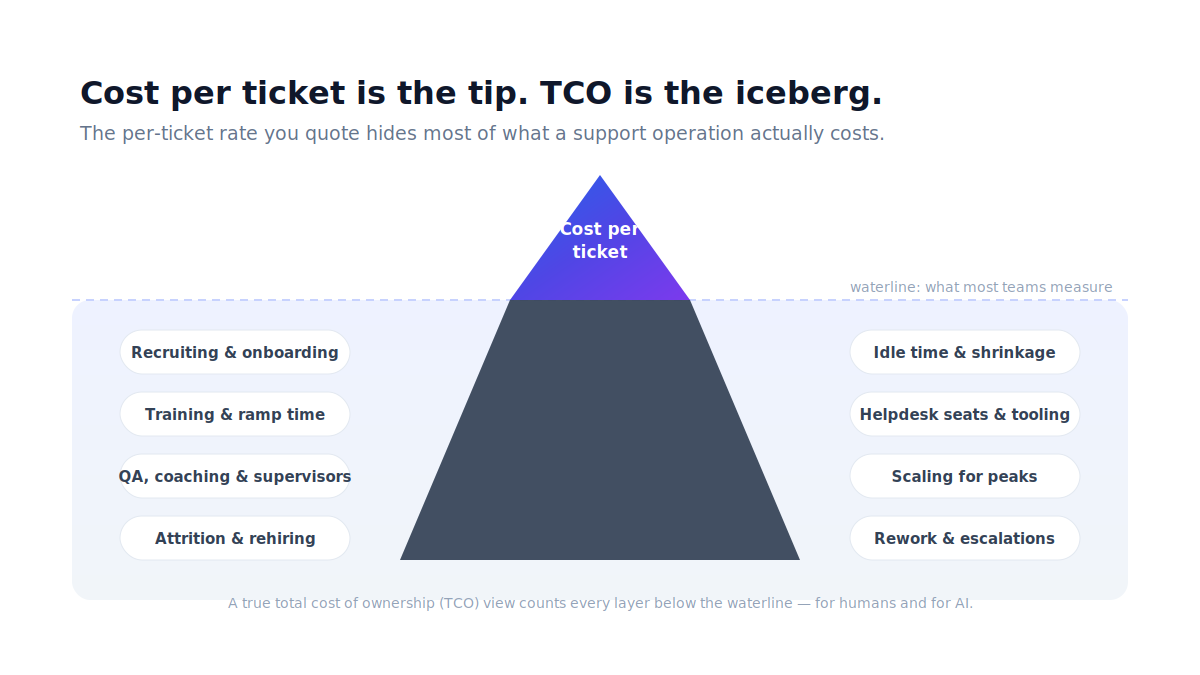
What a human-support TCO includes. Beyond the per-ticket labor rate: recruiting and onboarding, training and ramp time (weeks before an agent is productive), QA and coaching, supervisor and workforce-management overhead, attrition and rehiring, idle time and shrinkage (you pay for scheduled hours, not just handled tickets), helpdesk seats and tooling, rework on reopened tickets, and the cost of over-staffing for peaks you can't perfectly forecast. For scale: the US Bureau of Labor Statistics puts 2025 median base pay for customer service representatives at $44,770, which at a typical 1.25–1.4x loading implies roughly $56,000–$63,000 fully loaded — an estimate derived from base pay, not a published fully-loaded figure. On the spend side, SaaS Capital's benchmark survey puts combined support and customer success at a median 9% of ARR for private B2B SaaS (10% in the $3–5M ARR band) — note that support alone is not broken out.
What an AI operational-layer TCO includes. Platform subscription, per-resolution or usage cost, one-time integration into your existing helpdesk and systems, and a residual pool of humans for genuine escalations and oversight. The structural advantage is that most of these are fixed or flat as volume scales — an AI queue doesn't need peak staffing, doesn't attrite, and doesn't require a six-week ramp for the next hire. That is why the interesting comparison isn't "$6 vs $0.50 per ticket," but total cost to resolve your entire ticket volume, at your resolution rate and CSAT bar, over a year.
That total-cost view is exactly what an AI Operational Layer is designed to change. It sits on top of the stack you already run, resolves the routine majority automatically, and — through insight and continuous optimization from Pulse™ — keeps driving the effective cost per resolved ticket down over time rather than letting it drift up with wages. Teams deploying this way commonly see 40%+ cost savings versus a human-only model — again our own customer data, self-reported. You can model your own numbers against the cost benchmark of AI service.
How to reduce your cost per ticket in 2026
Start by measuring the real number: fully-loaded cost, divided by resolved tickets, split by channel. Then attack it in order of leverage. Shift resolvable volume to self-service and AI before you shift it offshore, because automation cuts the cost floor by an order of magnitude while offshoring only cuts it by half. Route the genuinely complex work to your best (more expensive) humans and stop paying premium rates for Tier-1 volume a machine can resolve. Kill reopens and escalations, which are where "cheap" tickets secretly become expensive. And insist on resolution, not deflection — measure automation on solved tickets and sustained CSAT, not on session closes. Reference points for what "good" looks like by sector live in the AI customer service benchmark.
Key takeaways
Customer service cost per ticket in 2026 spans roughly $1.25 (India, text) to $8 (US, text) for humans, and about $0.10–$1.50 for agentic AI (≈$0.50 typical) — so region changes the number by roughly 3x while AI changes it by 10x or more. But the per-ticket rate is the tip of the iceberg; the decision that matters is total cost of ownership, counting ramp, attrition, QA, shrinkage, and peak staffing on the human side against a largely flat, volume-scalable cost on the AI side. The winning move is not cheaper agents — it is resolving the routine majority automatically and reserving human judgment for the exceptions.
Stop optimizing the wrong number. Aissist.io adds an agentic AI workforce on top of the helpdesk you already run — resolving text tickets end to end for as little as $0.20 per resolution ($0.20–$0.60 by channel), not just deflecting them. See the AI customer service benchmark →
Sources
Every external figure in this guide, with what it is and when it was published. Where we could not verify a number against a citable source, we say so rather than restate it.
- Gartner — Benchmarks to Assess Your Customer Service Costs (1 February 2024) — median cost per contact: $13.50 assisted, $1.84 self-service. Independent analyst; full report is client-gated, figures above are from the public key findings.
- HDI / MetricNet — Metric of the Month: Cost per Ticket (2011, on 2010 data) — $62 average, $27–$490 range, North American desktop support. Cited for historical context only.
- US Bureau of Labor Statistics — Customer Service Representatives (2025 data) — $44,770 median annual base pay.
- SaaS Capital — Spending Benchmarks for Private B2B SaaS Companies — median 9% of ARR on combined support and customer success.
- ContactBabel, US Contact Center Decision-Makers' Guide (2024 edition) — US contact-centre attrition 21–27%. CCAP attrition survey via Willis Towers Watson (reported May 2025) — Philippines 43–45%. Both are subscription reports; figures quoted as reported.
- Vendor pricing pages, all read August 2026: Freshworks, Gorgias, Fin, Zendesk, Salesforce Agentforce.
- Not sourced, and flagged as such: MetricNet's current per-ticket benchmark (member-gated — we removed the $15.56 figure an earlier version of this page carried, because it could not be verified on the public page). Regional per-ticket costs in the table above are our own model, not measured data — see the method note.
Disclosure: this guide is published by Aissist.io, which sells an AI agent in the category it prices. Our own figures are self-reported and labelled; competitor figures are sourced to each vendor's published material. No vendor reviewed this page before publication.
Frequently asked questions
What is a good cost per ticket for customer service?
There is no universal "good" number — it depends on channel, complexity, and region. As a benchmark, Gartner's February 2024 figure puts the median assisted-channel contact at $13.50 and self-service at $1.84, while text channels like chat and email run roughly $3.50–$8 in the US and Europe and $1.25–$3.50 offshore on our own modelling. AI-resolved tickets run ~$0.10–$1.50. A healthy target is a declining fully-loaded cost per resolved ticket at stable or rising CSAT.
How do you calculate cost per ticket?
Divide the total fully-loaded cost of your support operation over a period by the number of tickets it resolved in that period. Fully-loaded cost includes agent wages and benefits, supervisors and QA, technology and licensing, telecom, facilities, and training — not just base pay. For a truer figure, divide by resolved tickets rather than received tickets so reopens and escalations aren't hidden.
What is the difference between cost per ticket and cost per contact?
They're often used interchangeably, but "cost per contact" usually means the cost of a single customer interaction on one channel (a call, a chat, an email), while "cost per ticket" refers to the cost of handling a support case that may span several contacts. Cost per resolution goes one step further and measures the cost of actually solving the issue, which is the most decision-useful of the three.
Which region has the lowest customer service cost per ticket?
For human labor, India typically has the lowest fully-loaded cost per text ticket (~$2), followed closely by the Philippines (~$2.50), then Latin America nearshore (~$3), with Europe (~$5) and the US (~$6) highest. But AI resolution — at roughly $0.10–$1.50 per ticket regardless of geography — is lower than any human region and doesn't carry ramp, attrition, or peak-staffing overhead.
How much does AI reduce customer service cost per ticket?
On a per-contact basis, AI text handling runs around $0.10–$1.50 (≈$0.50 typical) versus roughly $2–$8 for a human, depending on region — about a 5–12x difference. In practice the savings depend on your automation (resolution) rate: at 40–80% automatic resolution, teams commonly report 40%+ reductions in total support cost, because AI absorbs the routine majority and humans handle only the exceptions. The key is measuring resolution, not deflection.
Is offshoring or AI cheaper for customer support?
Both cut cost, but by different magnitudes. Offshoring to the Philippines or India reduces labor cost per ticket by roughly 41–73% versus US onshore. AI reduces the cost floor toward ~$0.10–$1.50 per resolved ticket — an order-of-magnitude cut — and stays flat as volume scales, without the attrition (21–27% a year in US contact centres, higher offshore), ramp time, and management overhead that offshore human teams still carry. Many teams now combine a lean expert human tier with AI handling routine volume.
What is included in a "fully loaded" cost per ticket?
Fully-loaded cost per ticket includes direct agent salaries and benefits, indirect personnel (team leads, supervisors, QA/QC, trainers, workforce planners, managers), technology and software licensing, telecommunications, facilities and utilities, and training and office expense. Because of this overhead, fully-loaded cost is commonly estimated at 1.25–1.4x an agent's base wage, which is why the per-ticket number is always higher than raw hourly pay suggests.
Why is cost per ticket a misleading metric on its own?
Because it ignores total cost of ownership. Two operations with the same $6 cost per ticket can have very different true costs once you account for reopen rates, escalation patterns, attrition, ramp time, shrinkage, and peak over-staffing. It also rewards deflection over resolution — a bot can lower the average by closing sessions without solving problems. Pair cost per ticket with resolution rate, CSAT, and a TCO view to avoid optimizing the wrong number.
Does voice cost more than text-based support?
Yes. Voice consistently runs higher than text channels — often $9–$16+ per contact versus $5–$11 for chat and email — because calls are synchronous, one-to-one, and require more handle time per interaction. Text channels also automate far more readily, which is why cost-reduction and AI strategies concentrate on email, chat, and messaging first. This guide focuses on text-based support for that reason.
How does Aissist.io lower cost per ticket?
Aissist.io is an AI Operational Layer that resolves support and sales tickets end-to-end — 83% average resolution at 4.8/5.0 CSAT and as low as $0.20 per resolution ($0.20–$0.60 by channel), all self-reported from our own deployments — on top of the helpdesk and CRM you already run. Instead of deflecting, its AgentMesh™ workforce resolves the routine majority automatically, Pulse™ surfaces what's driving cost and volume, and Evolve™ keeps optimizing — commonly delivering 40%+ cost savings versus a human-only model.