Deflection Is Not Resolution: Deflection, Handover and Resolution Rate Decoded
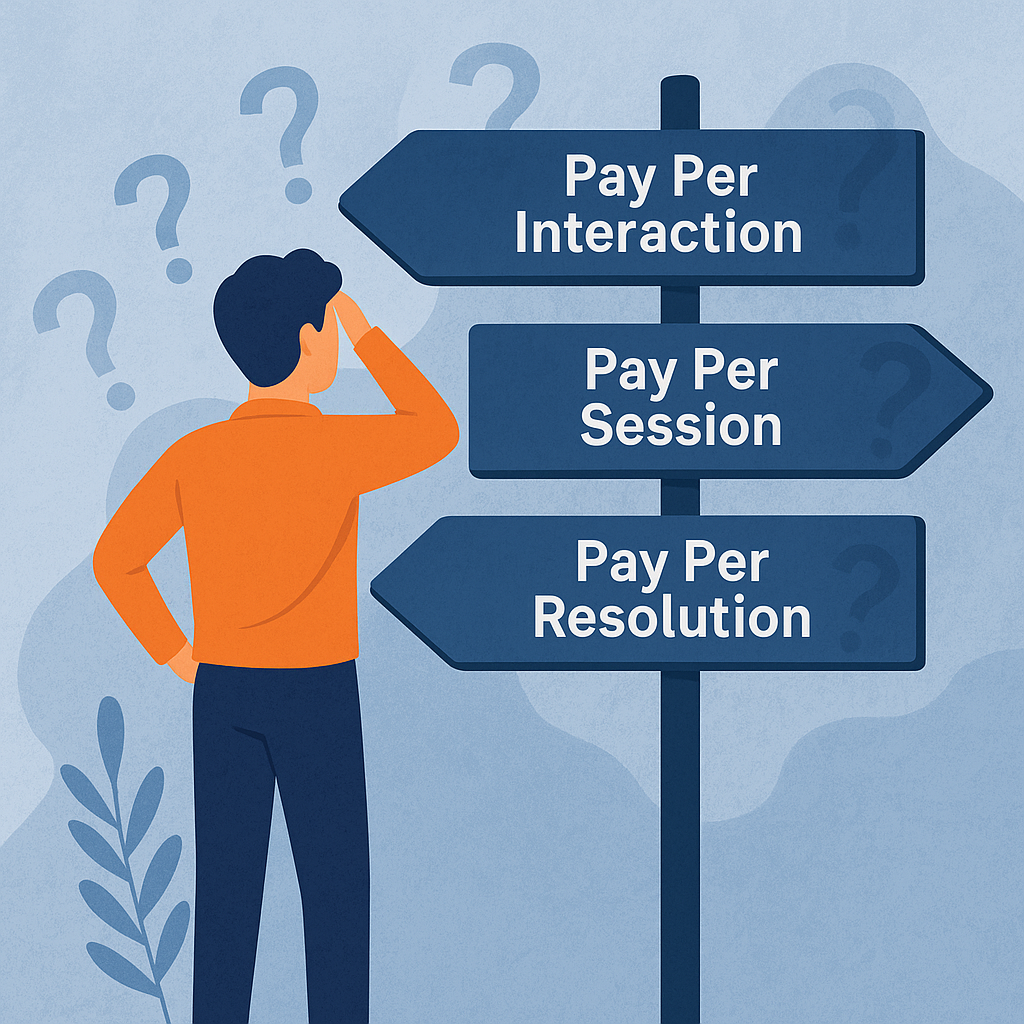
When a vendor quotes outcome-based pricing, the only question that matters is which outcome they are selling: deflection, handover or resolution. Those three words are not synonyms. Resolution is a subset of deflection, handover sits outside deflection entirely, and the deflection vs resolution rate gap runs 20–40 points on the same deployment. No vendor examined here publishes a billing test that requires proof the customer's problem was actually solved.
By Alex Gomez, Sr. Analyst · Published 31 August 2026 · Last updated 31 August 2026
TL;DR:
- "Outcome-based" is not a price until the outcome is defined. The same phrase covers three different billing events, and the cheapest headline rate can attach to the loosest one.
- Deflection rate (also called containment rate) counts conversations no human ever touched. Resolution rate counts the ones where the problem was solved — always a subset of deflection, typically 20–40 points smaller.
- Handover is outside deflection, and is not a solved problem. It means the AI's part is done and a human still has to finish. Intercom bills it anyway when the handoff follows instructions you configured; HubSpot and Zendesk do not.
- Nobody bills on verified resolution. Every published billing trigger in this article reduces to containment, sometimes with a handover clause bolted on.
- Freshworks reported 50% average deflection on 5 August 2026; HubSpot reported 72% resolved without escalation on 6 August 2026. Two metrics, two denominators, not comparable.
What is the difference between deflection and resolution rate?
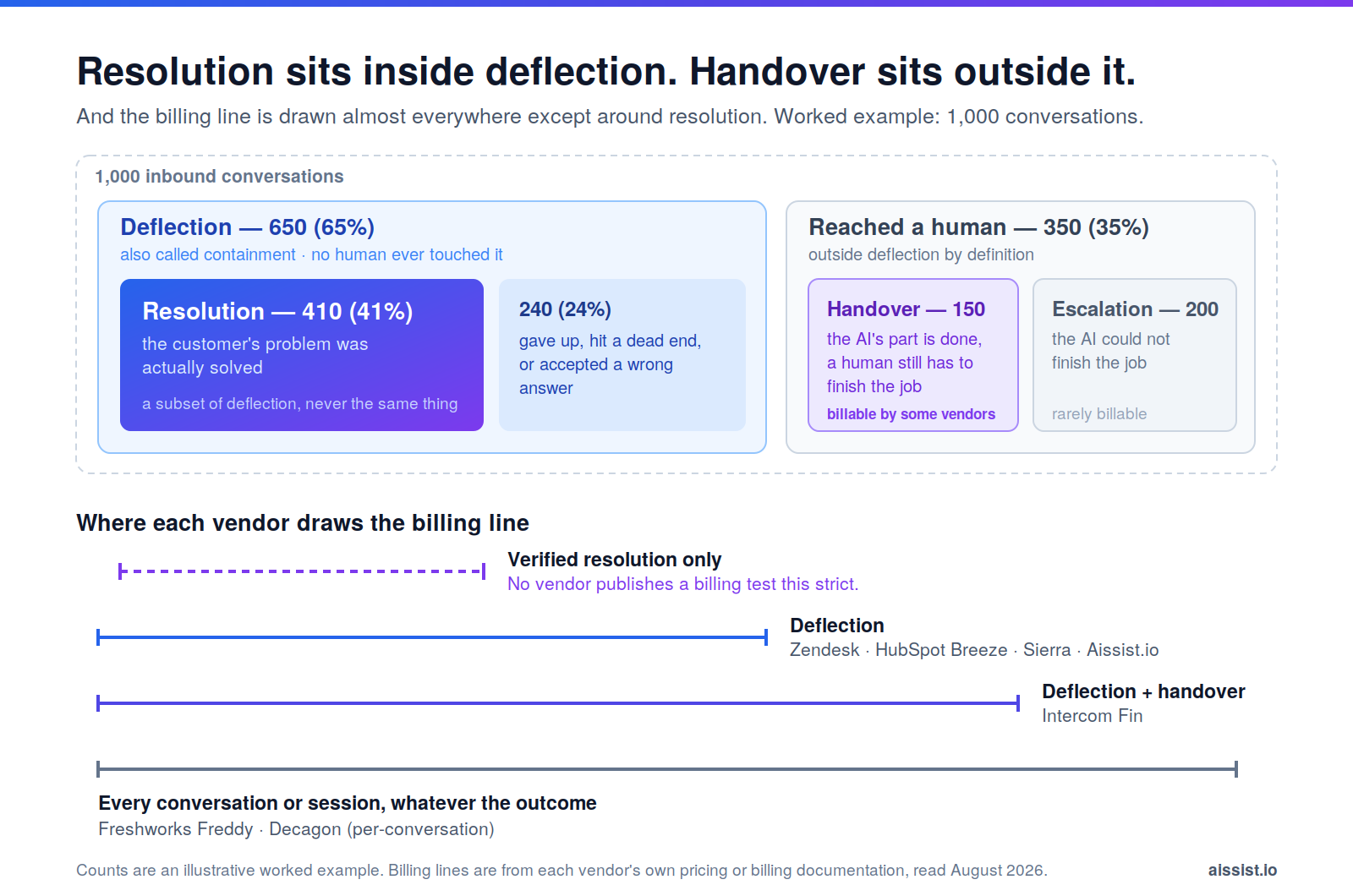
Deflection rate counts conversations that never reached a human; resolution rate counts conversations where the customer's problem was actually solved. Every resolution is a deflection, but most deflections are not resolutions — the gap is filled by customers who gave up, hit a dead end, or accepted an answer that was wrong. A third category, handover, falls outside deflection altogether because a human did get involved.
| Deflection rate (a.k.a. containment) | Resolution rate | Handover rate | |
|---|---|---|---|
| What it counts | Conversations no human ever touched | Conversations where the issue was genuinely fixed | The AI's share of the work is done, then the case routes to a human team by design |
| Did a human touch it? | No | No | Yes |
| Was the problem solved? | Unknown — abandonment counts as success | Yes, that is the test | Not necessarily — a human still has to finish it |
| Relationship | The superset | A subset of deflection | Outside deflection entirely |
| Who bills on it | Zendesk, HubSpot Breeze, Sierra, Aissist.io | Nobody, as a published billing test | Intercom Fin |
Aissist.io defines resolution rate as "the share of conversations where the customer's issue was genuinely solved end-to-end by AI, with no human handoff and no silent abandonment," and deflection rate as "the share of conversations that simply never reached a human — including customers who gave up," in its AI Customer Service Benchmark 2026 (read August 2026). We use those definitions throughout, and we will declare the bias up front: this is our blog, Aissist.io appears in the pricing table below, and we sell against most of the other rows in it. Check every row against the source links rather than taking ours for it.
Is containment rate the same as deflection rate?
In practice, yes — treat containment as another name for deflection. Both count conversations that ended without a human, both reward the customer giving up, and neither says anything about whether the problem was solved. The only real difference is heritage: containment came from IVR and voice, where it means a call handled entirely inside the system, while deflection came from self-service and knowledge bases, where it is sometimes measured against a wider denominator of expected contacts rather than actual conversations.
That denominator difference is worth one question in a vendor call and no more. If a platform quotes containment where another quotes deflection, you are comparing the same idea with two labels. If a platform quotes deflection against "tickets we estimate you avoided," you are comparing a measured number to a modelled one — ask which.
Where the two labels genuinely diverge is scale, not meaning. Deflection measured across a whole help centre can exceed 90% simply because most visitors never intended to open a ticket.
What is a handover, and why do some vendors bill for it?
A handover is a case where the AI has finished its share of the work and the process requires a human to take it from there — a refund above a threshold, a KYC check, a regulated disclosure — and some vendors bill for it precisely because the AI did that work. Critically, a handover does not mean the problem is solved. It means one stage of the work is done and a person still has to finish the job. That also makes it distinct from an escalation, which is the AI failing and calling for help rather than following your rules.
Intercom draws that line explicitly. Per Intercom's Fin outcomes documentation (read August 2026), "if the conversation is still with Fin and that Fin had answered your customer using your available content, a teammate self assigning or manually closing the conversation will still be considered as a resolution if the conversation is not escalated by Fin." Its pricing documentation goes further and names the two cases: a Procedure Handoff, where "Fin handoffs to a human because of instructions you added in Procedure-specific guidance," is a billable outcome, while an escalation driven by "workspace level guidance or escalation rules" is not.
HubSpot and Zendesk take the opposite position. HubSpot requires no handoff to a human for 72 hours before a resolution counts, and Zendesk requires no escalation at all — so at both, a case routed to a person stops the meter regardless of how much work the AI did first.
Neither approach is dishonest. Billing for a handover is defensible when the AI genuinely did the work in front of it. The trap is reading that invoice as a count of solved problems: at the moment the charge lands, the customer is still waiting on a human.
What does each vendor actually charge for?
Five of these eight platforms publish a written test for a billable outcome, and every one of those tests is a containment test — one of them with a handover clause attached. None requires evidence that the customer's problem was solved.
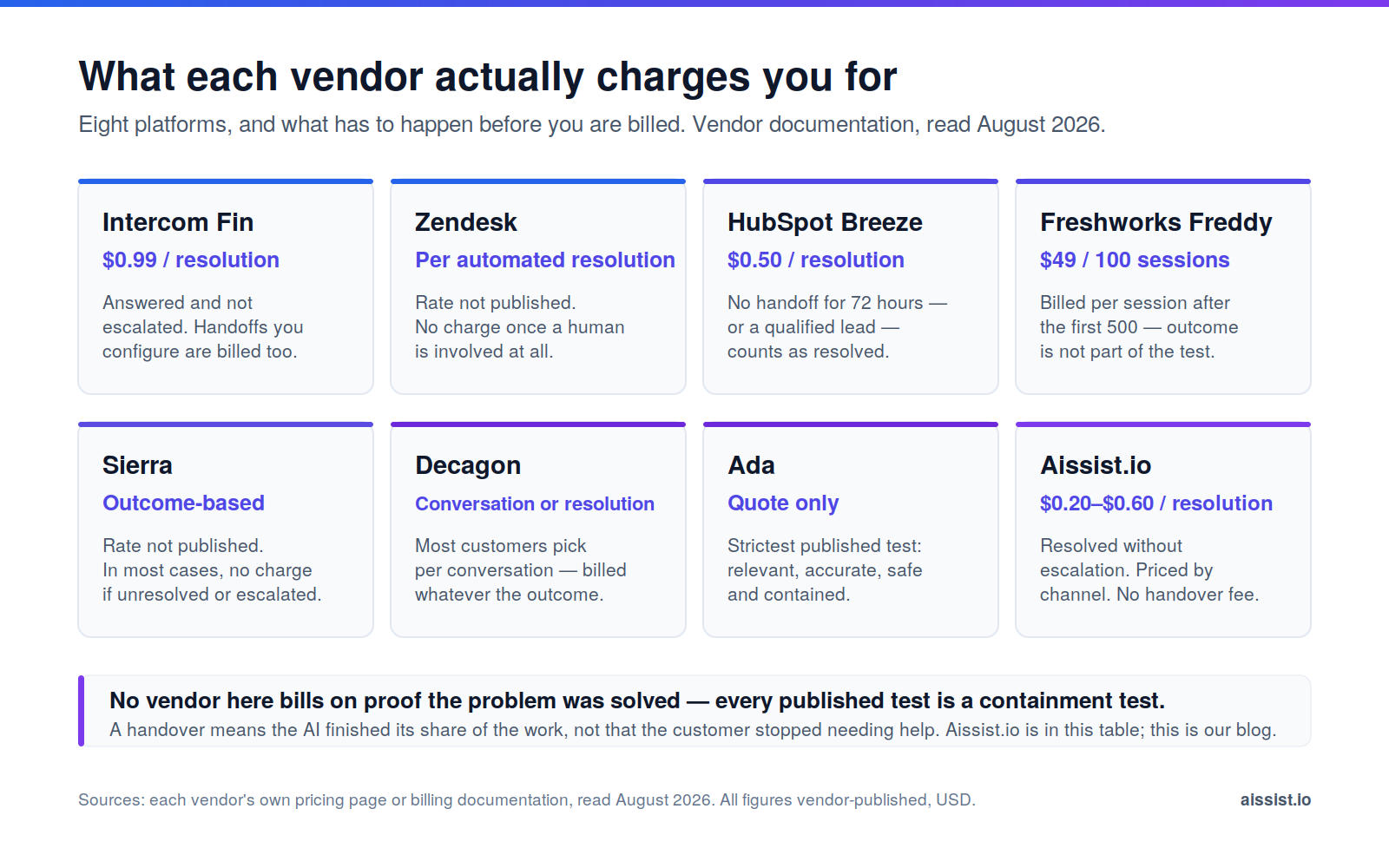
| Vendor | Billing unit and price (USD, read Aug 2026) | What triggers the charge | Handover billed? |
|---|---|---|---|
| Intercom Fin | $0.99 per outcome; standalone needs no seats, or $29–$132 per seat/month (pricing) | Fin answered and did not escalate; refunded if the customer returns to the conversation, even across billing periods | Yes — a Procedure Handoff you configured is billable; a Fin-initiated escalation is not |
| Zendesk | Per automated resolution; rate not published. Suite Professional $115 per agent/month (pricing) | "You pay only for customer requests that were successfully resolved by the AI agent, without any escalation to a human agent" | No |
| HubSpot Breeze | $0.50 per resolution, inside Professional and Enterprise credits (product page) | No handoff to a human for 72 hours — or a qualified lead | No |
| Sierra | Outcome-based; rate not published (Sierra blog, Elliot Greenwald, December 2024) | Criteria agreed per client; "if the conversation is unresolved, in most cases, there's no charge" | No, in most cases |
| Aissist.io | $0.20–$0.60 per resolution by channel; $0.25 email/form/social, $0.60 capped for chat, WhatsApp and SMS (pricing) | The AI resolved the request without escalation, after at least one interaction of genuine inquiry — chitchat does not count | No |
| Ada | Quote only — pricing not published | Measurement test is the strictest published: relevant, accurate, safe and contained; escalation marks it "Not Resolved immediately following the handoff" (Ada docs) | Not published |
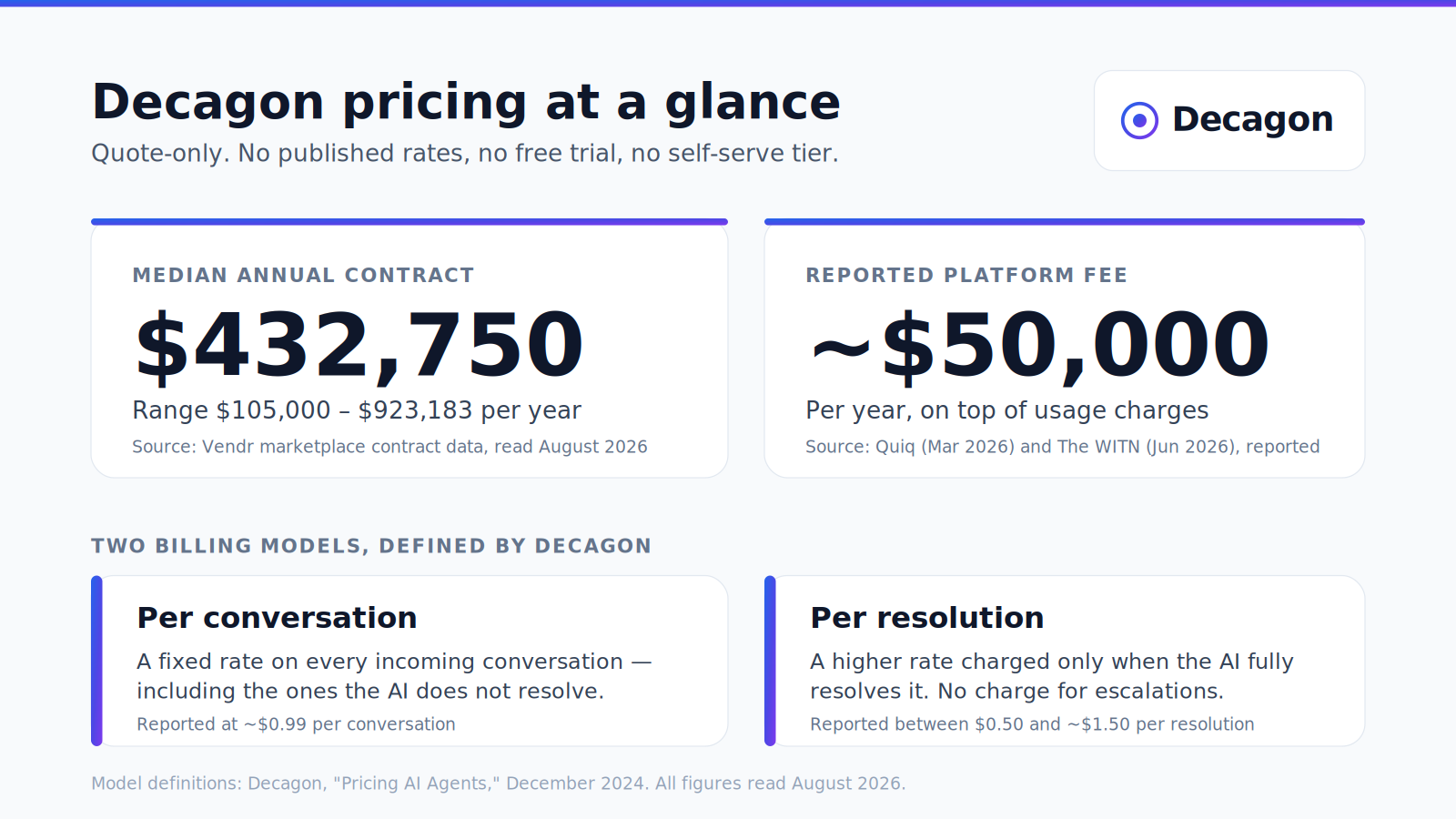
| Decagon | Per conversation, or a higher rate per resolution; rates not published (Decagon blog, Bihan Jiang, Director of Product, December 2024) | Per-conversation, which "the majority" choose, bills on arrival. Decagon itself asks: "If a frustrated customer stops responding, does that count as 'resolved'?" | n/a — everything is billed on the common plan |
| Freshworks Freddy | $49 per 100 sessions after the first 500 included (Freshdesk pricing) | A session starts. Outcome is not part of the test | n/a — everything is billed |
Ada is the one worth singling out. Its published test is the only one that asks whether the answer was correct, not merely whether a human stayed out of it — but Ada does not publish what it charges for, so it cannot be credited with billing on resolution either.
What does "outcome-based pricing" actually mean?
Outcome-based pricing means you are billed on an event rather than a seat — but the event is chosen by the vendor, and across this market it is deflection, handover, or a time window, never verified resolution. Sierra, Zendesk, Intercom, HubSpot and Aissist.io all describe their pricing in outcome language. Each one defines the outcome differently, so the phrase tells you the billing shape and nothing about the standard.
That makes the headline rate close to meaningless on its own. A $0.50 outcome billed on a 72-hour silence window and a $0.99 outcome that is refunded when the customer comes back are not the same purchase, and the cheaper one is not obviously the better deal. The unit price is only comparable once the outcome definition is.
Three questions settle it, in this order:
- Which outcome am I buying — deflection, handover, or resolution?
- Does silence count as success, and is there a window after which it locks in?
- Is the charge reversed if the customer comes back on the same issue?
The closest anyone gets to a resolution test is a proxy for correctness, and Intercom's clawback is the strongest of them: a resolution is "deducted and not charged" if the customer returns to the same conversation, even across billing periods. That turns silence into a falsifiable claim, and it is the feature to ask every other vendor about.
The practical consequence is a reporting gap. If you present a per-resolution invoice as a resolution count, you are reporting deflection plus handover and calling it outcomes. The number is not wrong; the label is.
Why did two vendors report 50% and 72% in the same week?
Freshworks and HubSpot were measuring two different things, and neither said so. On 5 August 2026, Freshworks CEO and President Dennis Woodside said "Freddy AI Agent deflection rates average 50% and reach as high as 80% for mature deployments," reported by CX Today (vendor-claimed). One day later, HubSpot CEO Yamini Rangan said "Customer Agent now resolves 72% of support tickets without human escalation," reported by CX Today on 6 August 2026 (vendor-claimed).
Read quickly, that looks like HubSpot beating Freshworks by 22 points. Read against the definitions above, it is a deflection number next to a deflection number wearing a different word — because HubSpot's own billing definition counts a resolution when there was no handoff for 72 hours, or when the agent qualified a lead.
How do you tell the three apart in your own data?
Pull 200 random AI-handled conversations from last month and sort each into one of three buckets: resolved, deflected but unresolved, or handed over. The first bucket is your real resolution rate. The other two are what most dashboards quietly add to it.
This is not theoretical. In a self-reported audit posted to Intercom's own community forum on 27 May 2025, a customer reviewed 40 tickets, found 16 marked resolved by Fin, and judged only 3 genuinely resolved. That is one team's manual review rather than a study, but it is exactly the exercise below and it took them an afternoon. Four checks do the sorting.
- The repeat-contact check. Count conversations where the same customer opened a new ticket on the same issue within seven days. Every one was counted as a success and was not one.
- The silence check. Separate conversations that ended with a customer confirmation from those that ended in silence. Vendors call the second group assumed resolutions. Count them separately once before deciding to trust them.
- The handover check. Count cases the AI completed and then routed to a team. These are legitimate work and legitimate charges, and they are not resolutions. Report them as their own line.
- The denominator check. Confirm whether your rate is measured against all inbound conversations or only the ones the AI attempted. The second denominator is smaller and flatters the result.
If those numbers are healthy and CSAT is holding, the automation is working. If resolution climbs while CSAT slides, you are on the deflection-driven curve described in the resolution–CSAT tradeoff, where suppressing escalation raises one number by damaging the other. You can also run your own conversations through the Aissist benchmark tool.
Want a number you can defend in a board deck? Aissist.io publishes what it counts and what it charges for, and the benchmark tool sorts your own conversations into resolved, deflected and handed over. Book a consultation →
Key takeaways
Outcome-based pricing is a billing shape, not a standard — the outcome is whatever the vendor defines it to be, and across this market that means deflection, a configured handover, or a silence window. Deflection is the superset, resolution is the subset, and handover sits outside both while still landing on your invoice. So ask three questions before you compare any two numbers or any two prices: which outcome am I buying, does silence count as success, and does a repeat contact claw the charge back. The answers live in the billing documentation rather than the marketing page, which is the most reliable tell in this market — a company will describe its metric loosely and its invoice precisely. The industry has spent a decade proving a bot can end a conversation; the harder claim has always been that it finished the job.
Frequently asked questions
What is the difference between deflection rate and resolution rate?
Deflection rate counts conversations that never reached a human agent, including customers who abandoned. Resolution rate counts only conversations where the problem was genuinely solved, making it a subset of deflection. Aissist.io's 2026 benchmark puts the gap at 20–40 points on the same deployment.
Is containment rate the same as deflection rate?
Effectively yes — treat containment as another name for deflection. Both count conversations that ended without a human and both treat abandonment as success. Containment comes from IVR and voice; deflection comes from self-service, and is sometimes measured against estimated avoided tickets.
What is a handover, and is it a resolution?
No. A handover means the AI finished its share of the work and a human must still complete the case. The problem is not solved at that point, and it is not deflection either, because a person is involved. Some vendors bill it anyway.
Do AI vendors charge for conversations they hand to a human?
Some do. Intercom bills a Procedure Handoff — a handoff following instructions you configured — while not billing escalations Fin initiates itself. HubSpot, Zendesk and Aissist.io do not bill once a human is involved. Ask each vendor which case applies.
What should I ask about outcome-based pricing?
Ask which outcome triggers the bill — deflection, handover or resolution — then whether silence counts as success, and whether the charge reverses if the customer returns on the same issue. Until those are answered, two per-outcome prices are not comparable.
Does any AI vendor charge based on genuine resolution?
No vendor examined here publishes a billing test requiring proof the customer's problem was solved. Every published trigger reduces to containment, sometimes plus a handover clause. Intercom comes closest by deducting a charge if the customer returns to the same conversation.
Does an abandoned chat count as a resolution?
It depends on the vendor. Intercom counts an assumed resolution when no further help is requested, then refunds it if the customer returns. HubSpot counts a resolution after 72 hours with no handoff. Ada marks escalated conversations "Not Resolved" immediately.
Is a 70% deflection rate good?
Not on its own. A 70% deflection rate is consistent with excellent automation and with customers abandoning in bulk, and the metric cannot tell you which. Pair it with resolution rate, CSAT and seven-day repeat-contact rate before treating it as a result.
Changelog
- 31 August 2026 — First published. Verified on this date: all pricing and billing definitions read from each vendor's own pricing page or billing documentation, including Intercom's Fin outcomes and Fin pricing docs, Zendesk pricing, HubSpot's Customer Agent page, Ada's resolution-rate documentation, Sierra's outcome-based pricing post, Decagon's pricing post and glossary, and Freshdesk pricing. Freshworks and HubSpot executive statements dated to CX Today reports of 5 and 6 August 2026.