Containment Rate: The Number Legacy Vendors Report, the Three Outcomes It Hides, and How to Audit It
Containment rate is the share of conversations that enter an AI or bot channel and end there without a handoff to a human agent.
Resolution rate is the share of those same conversations where the customer's request was actually completed and they did not come back about it.
Compiled by Rob Jiang. Published October 8, 2026 · Last updated October 8, 2026.
TL;DR: Containment counts resolved, abandoned and silently failed conversations as the same success; Aissist's 2026 benchmark puts the gap between that kind of number and real resolution at 20–40 points on the same deployment.
Methodology & sources
- Benchmark ranges: Aissist.io's AI Customer Service Benchmark 2026, a synthesis of 40+ published sources dated 2024–2026 (vendor disclosures, independent aggregates, named deployments). It is not a sample of Aissist accounts. Figures read 24 August 2026.
- Denominator for every rate on this page: conversations that entered the automated channel.
- Worked examples use a round, illustrative base of 1,000 conversations. They are arithmetic, not data.
- Third-party sources: Gartner, Ada, ASAPP, Decagon, Wonderchat, LiveChatAI, CX Today. All read October 2026 unless dated otherwise.
- Disclosure: this is Aissist's blog. Aissist sells an AI agent priced per resolution, which gives us an obvious interest in the argument below.
How do you calculate containment rate?
Containment rate equals conversations that ended in the automated channel without a human handoff, divided by all conversations that entered that channel. It is a routing count. Nothing in the numerator asks whether the customer got what they came for.
Containment rate = conversations ended without human handoff
                   ÷ conversations that entered the AI channel
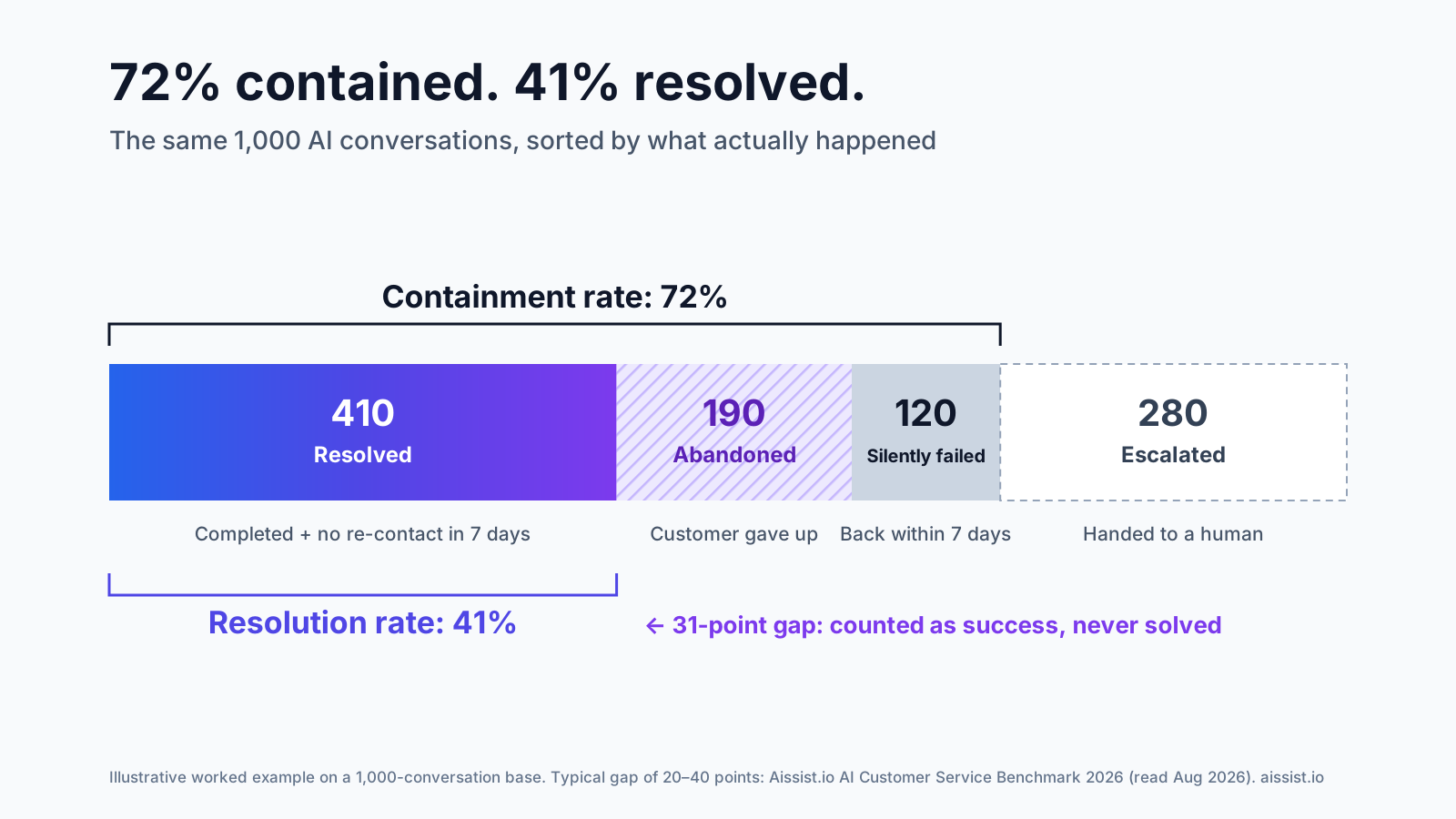
Worked example: 1,000 conversations enter the bot. 280 are handed to an agent. 720 end in the bot. Containment rate = 720 ÷ 1,000 = 72%.
Resolution rate = conversations with a completed request and no re-contact within 7 days
                  ÷ conversations that entered the AI channel
Worked example: of those 720 contained conversations, 410 ended with the refund issued, the order changed or the answer confirmed, and the customer did not return within seven days. Resolution rate = 410 ÷ 1,000 = 41%. Same traffic, same week, a 31-point gap.
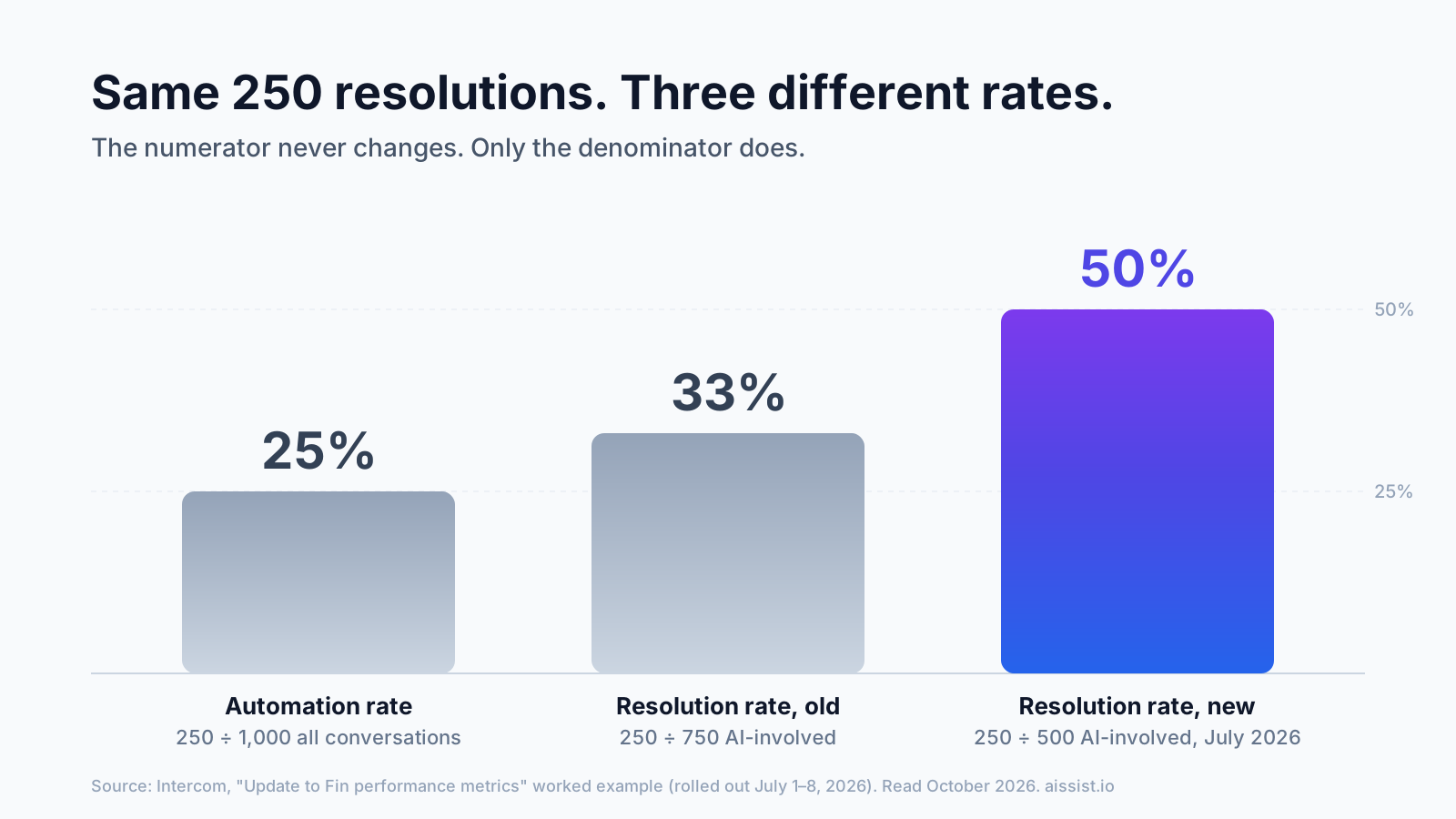
Keep the denominators identical. Some platforms quietly shrink the base to "eligible" or "bot-handled" conversations — Wonderchat's glossary formula, for one, divides by eligible automated conversations. That is a legitimate choice when it's disclosed, but every exclusion lifts the rate without a single extra customer being helped. If a vendor's denominator changes between the deck and the dashboard, ask why.
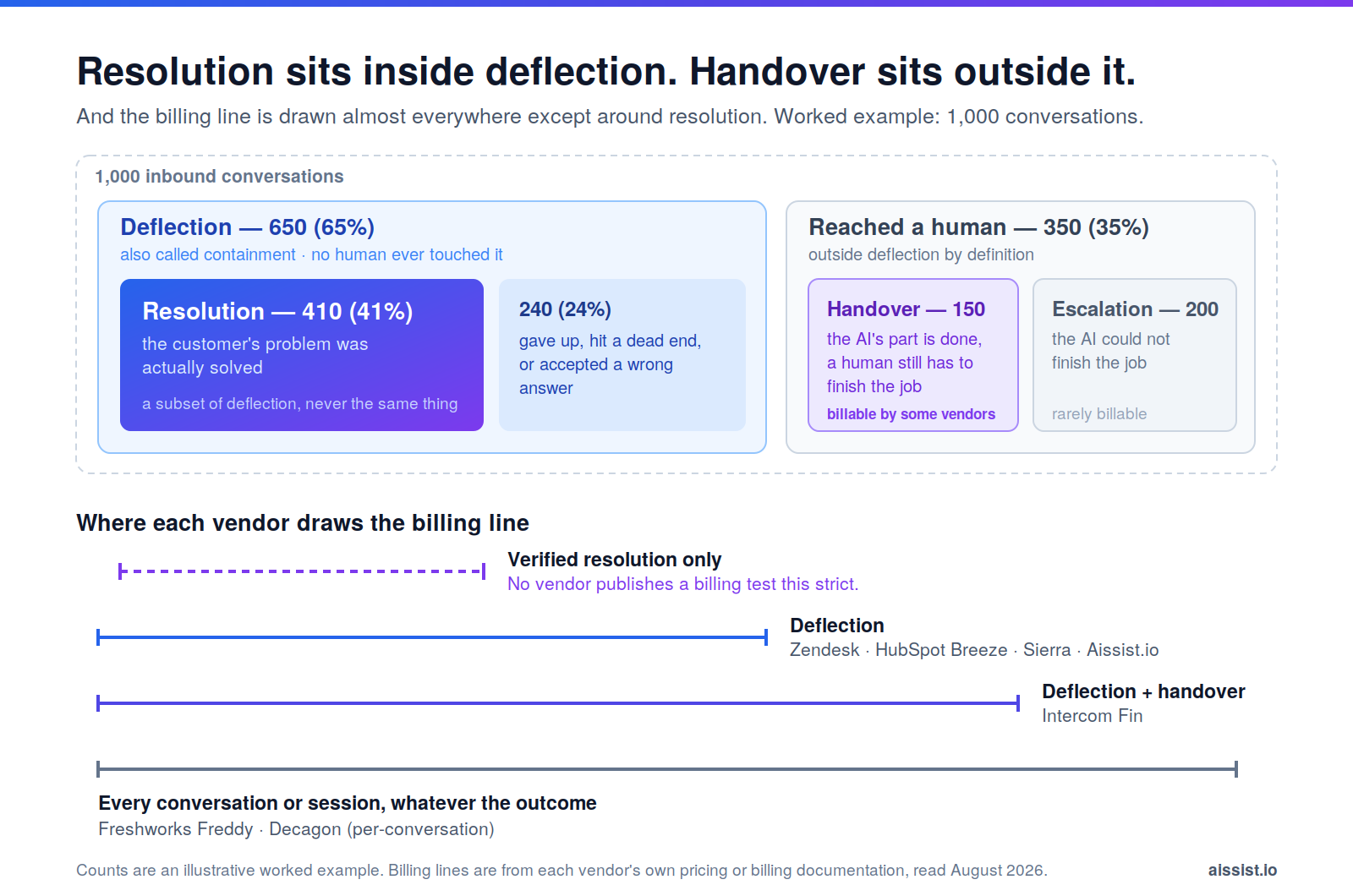
Containment also differs from ticket deflection. Decagon's glossary draws the line well: deflection divides by all inbound demand, containment only by conversations that reached the automated channel. On many vendor dashboards the two collapse into one figure, which is why our deflection vs resolution rate guide treats them together.
What three outcomes does containment hide?
A contained conversation is one of three things: resolved, abandoned, or silently failed — and the containment rate counts all three as wins. Only one of them helped the customer. The other two show up later, as a repeat contact, a refund dispute or a churned account.
| Outcome (of 1,000) | Counted as contained? | What it is | What containment hides | How to detect it |
|---|---|---|---|---|
| Contained and resolved (410) | Yes | Request completed, customer gone for good | Nothing — this is the real win | Action written to the system of record, or explicit confirmation |
| Contained and abandoned (190) | Yes | Customer gave up mid-conversation | A failure logged as a success | Last message is the bot's; customer silent; no action taken |
| Contained and silently failed (120) | Yes | Bot closed the chat; problem still open | Cost moved to the next contact | Same customer, same intent, back within 7 days on any channel |
| Escalated and resolved (280) | No | Human finished the job | Penalised, even when escalating was right | Handoff with full context, solved on first human touch |
The abandoned row is not hypothetical. Simplr told Ada that up to 20% of "contained tickets" in its data were customers who dropped off because the bot was no help, as reported in Ada's analysis of the metric.
"It tells you nothing about how well you're serving them." — Kane Simms, conversational AI and chatbot consultant, quoted by Ada
The last row is the quiet scandal. A good escalation lowers containment. A metric that punishes the right behaviour will, given a quarter or two, get less of it.
Why do legacy vendors report containment instead of resolution?
Vendors report containment because it is the only number a scripted bot can measure about itself. Knowing whether a conversation ended in the bot takes one log line. Knowing whether it resolved takes a completed action in a connected system and a look at the next seven days — which a FAQ-and-retrieval bot never sees.
The two numbers can move in opposite directions. In ASAPP's own analysis of an internet provider's outage flow, simplifying sign-in cut containment 3% while flow success rose 17% (October 2021). Better service, worse-looking dashboard.
Self-service has a long record of flattering itself. Gartner's survey of 5,728 customers found only 14% of service issues fully resolved in self-service (conducted December 2023). And containment-shaped headlines age badly: Klarna said in February 2024 that its assistant handled two-thirds of customer service chats. Its CEO later told Bloomberg:
"We focused too much on cost. The result was lower quality." — Sebastian Siemiatkowski, CEO, Klarna, to Bloomberg, May 2025 (via Voiceflow)
Containment is not useless. It is a capacity number — how much load left the queue. It just isn't an outcome number, and it should never be sold as one.
What is a good containment rate by industry?
A containment rate is only "good" if it sits close to the resolution rate for your industry; anything far above that band is mostly abandonment and repeat contact. Published ranges like LiveChatAI's "20–40% typical, 80–90% top" carry no stated denominator or methodology. The benchmark below states both.
Benchmark block. Denominator: conversations entering the AI channel. Resolution: finished by the AI, no human completing it, no follow-up on the same issue. Source: Aissist AI Customer Service Benchmark 2026, read 24 August 2026.
| Industry | Verified AI resolution band (Aug 2026) | If a vendor claims 80% containment, the not-resolved share is at least |
|---|---|---|
| Ecommerce & Retail | 70–84% | 0 points — claim is plausible |
| Consumer Fintech | 60–75% | 5 points |
| SaaS & Software | 50–70% | 10 points |
| Travel & Hospitality | 45–70% | 10 points |
| Telecom & Utilities | 40–60% | 20 points |
| Healthcare & Insurance | 40–60% | 20 points |
The right-hand column is subtraction from the top of each band, so it is the most generous reading. At the band's midpoint, an 80% containment claim in telecom implies 30 points of conversations that stayed in the bot without being solved.
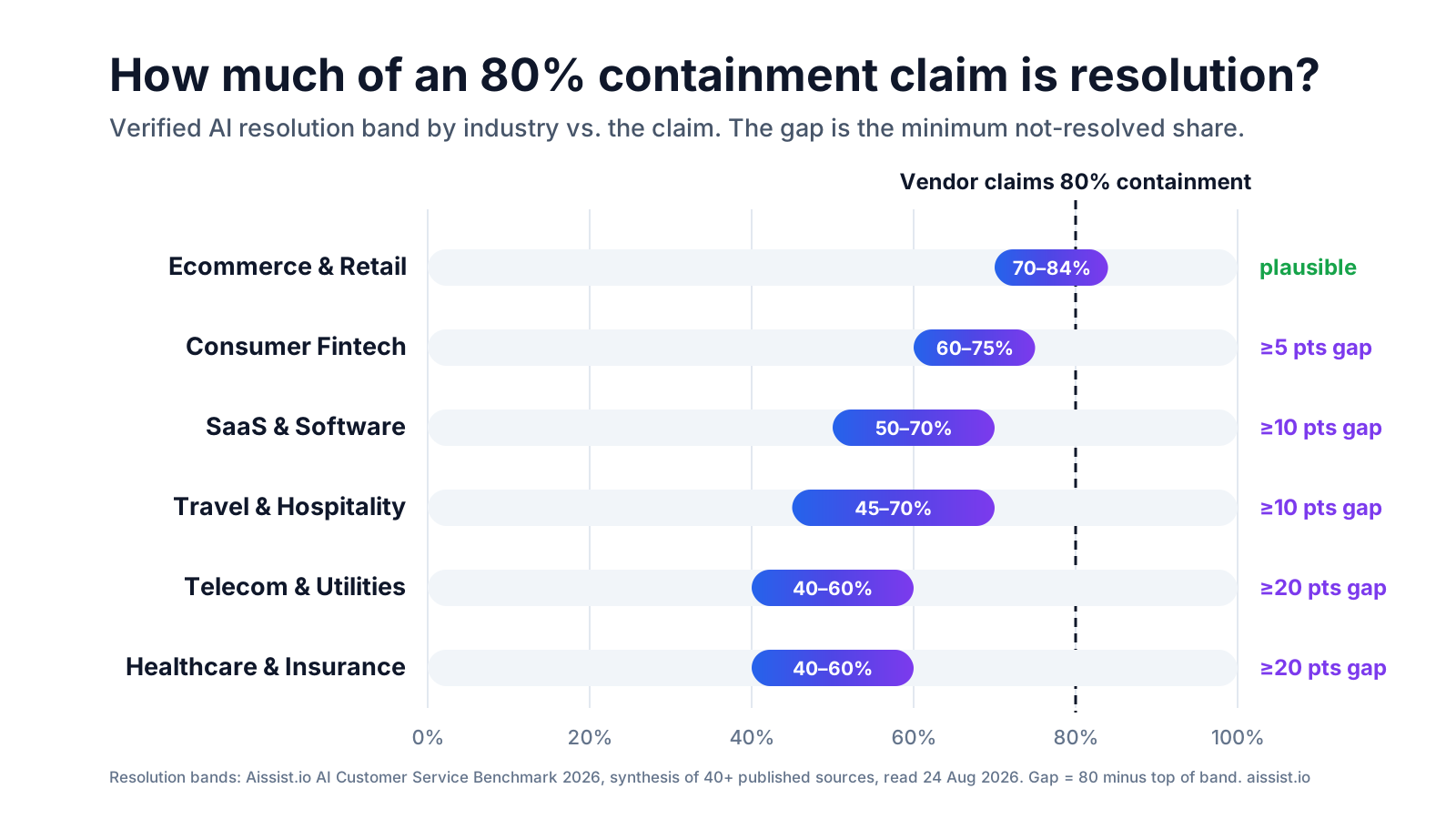
To place your own numbers against these bands, use the AI resolution rate checker. For why pushing resolution past roughly 85% tends to cost CSAT, see the resolution–CSAT tradeoff.
How do you audit a vendor's containment claim in a trial?
Ask for a conversation-level export and run two tests: what share of contained conversations produced a completed action, and what share of contained customers came back within seven days. Containment minus the failures of those two tests is the vendor's real resolution rate.
- Completed-action share. For each contained conversation, check the system of record: was the refund issued, the address changed, the ticket closed with a confirmed answer? Contained conversations with no action and no confirmation go in the abandoned pile.
- Seven-day re-contact rate. Match each contained customer to any new contact on the same intent, on any channel, within seven days. Every match is a silent failure.
- Gaming check. Look for a hidden or missing "talk to a human" option, loops that repeat the same answer, and chats auto-closed on inactivity. Each one raises containment and lowers trust.
A sample of 200 conversations is enough to see the shape. Sort them into the four rows of the outcome table above and the number will speak for itself.
How we run this on ourselves: Aissist audits AI conversation transcripts with an automated reviewer plus human QA sampling, and reports an AI error rate under 1% on its resolution–CSAT tradeoff page — a vendor-reported figure. The same transcript review that catches errors also catches the abandoned chats a containment counter would have scored as wins.
Pair whatever you measure with the wider set of customer service KPIs. Expect first response time to fall and average handle time on the human queue to rise as the AI absorbs easy contacts. That is mix shift — agents now see only the hard cases — not a decline in performance.
Containment is a routing number; resolution is the outcome you pay for
Report containment as capacity, judge the AI on resolution. Containment tells you how much work left the human queue. It cannot tell you whether that work was done, abandoned or pushed into next week. Two checks in a trial — completed actions and seven-day re-contact — turn a flattering percentage into an honest one. For the full definition of the outcome metric, read AI resolution rate; for how vendors blur the terms in billing, read deflection vs resolution rate.
"Resolution is the only number that pays the bill, and it deserves honest measurement." — Lifan, Co-Founder, Aissist.io, benchmark announcement (July 2026)
Frequently asked questions
What is containment rate in customer service?
Containment rate is the percentage of conversations that start in a chatbot or AI agent and end there without being handed to a human agent. It measures routing, not whether the customer's issue was solved.
What is the chatbot containment rate formula?
Divide conversations that ended without a human handoff by all conversations that entered the bot, then multiply by 100. For 720 contained out of 1,000, the chatbot containment rate is 72%.
Is 80% containment good?
Only if resolution is close behind. Verified AI resolution runs 40–84% depending on industry in Aissist's 2026 benchmark, so 80% containment in telecom or healthcare implies at least 20 points of unresolved conversations.
Can containment rate be gamed?
Yes. Hiding the human-handoff option, looping customers through repeated answers, and auto-closing chats on inactivity all raise containment while making service worse. A seven-day re-contact check exposes most of it.
How do I audit the gap between containment and resolution?
Export contained conversations, check each for a completed action or explicit confirmation, then match customers to any same-intent contact within seven days. Containment minus abandoned and re-contacted conversations is the real resolution rate.
Is containment rate the same as ticket deflection?
They are close but not identical. Ticket deflection divides by all inbound demand, including help-center visits; containment divides only by conversations that entered the automated channel. Many dashboards report one number for both.
Why does containment go down when service gets better?
Because good escalations lower containment. An AI that hands complex or sensitive cases to a human with full context improves outcomes but scores worse on a metric that counts every handoff as a failure.
Which metrics should replace containment rate?
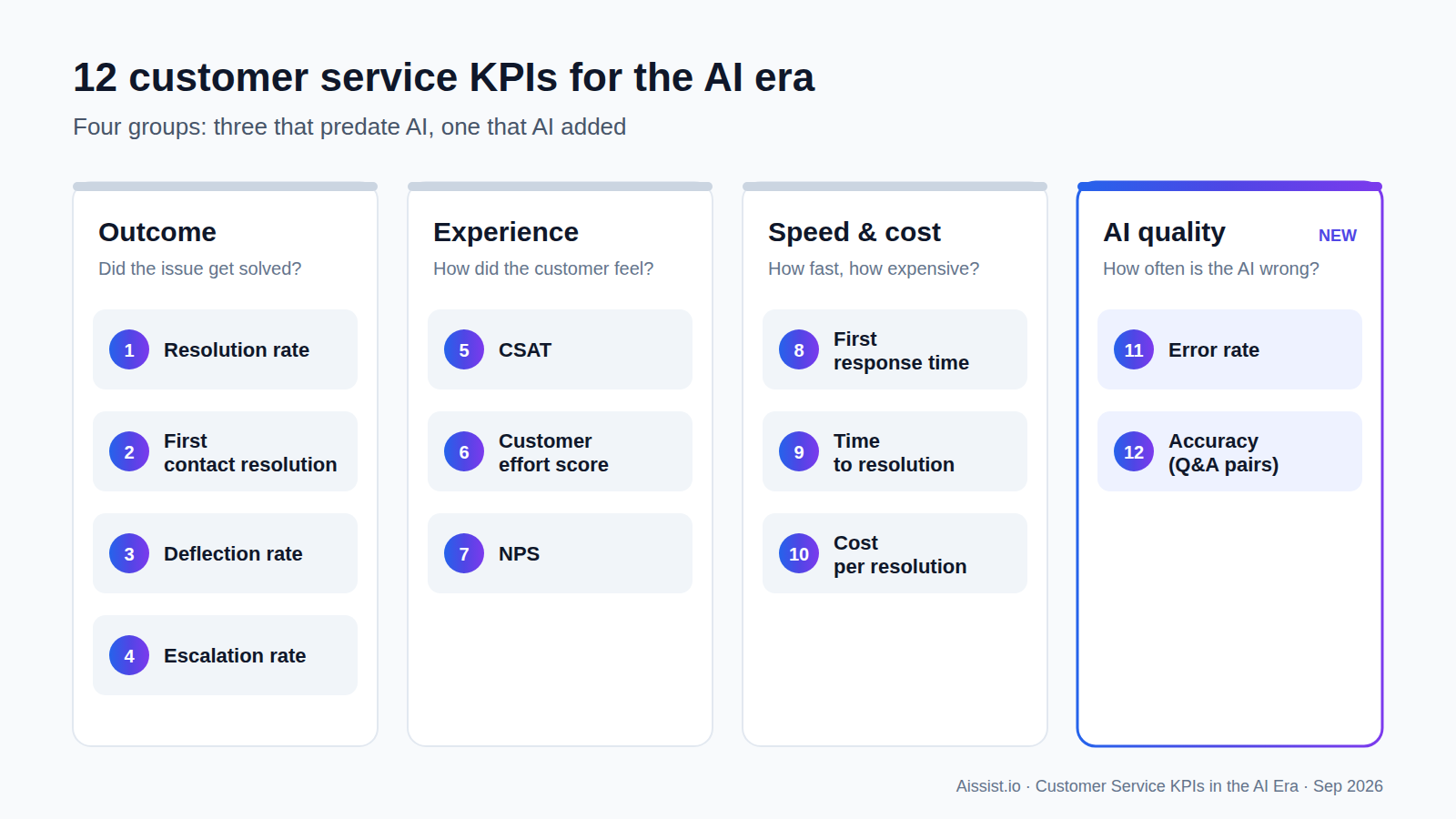
Keep containment as a capacity measure and judge outcomes with AI resolution rate, seven-day re-contact rate and CSAT on AI-handled conversations. Track first response time and average handle time on the human queue separately.