Customer Service KPIs in the AI Era: What Each Metric Means When a Machine Resolves It
Compiled by M.W. Published September 24, 2026 · Last updated September 24, 2026.
Customer service KPIs were designed for human agents working a queue. With AI agents now resolving a large share of tickets, some of those metrics matter more, some matter less, and two new ones have joined the list. Here are the twelve customer service metrics worth tracking in 2026, what each one means now, and how to calculate it.
TL;DR: AI hasn't replaced customer service KPIs, it has reweighted them: resolution rate and error rate now carry the most weight, and the AI Customer Service Benchmark 2026 puts strong AI resolution at 70–75%.
Methodology & sources
- Definitions and formulas follow Aissist.io's guides on deflection vs. resolution, NPS vs. CSAT, cost per ticket and the AI Agent Reliability Benchmark 2026.
- 2026 reference points come from the AI Customer Service Benchmark 2026, a compilation of published vendor and analyst figures. Where no credible benchmark exists, we say so.
- Third-party figures read from Gartner, Verint, Salesforce, CX Today, Anthropic and the τ-bench paper on 24 September 2026.
- Disclosure: this is Aissist's blog, and Aissist sells AI agents for customer service.
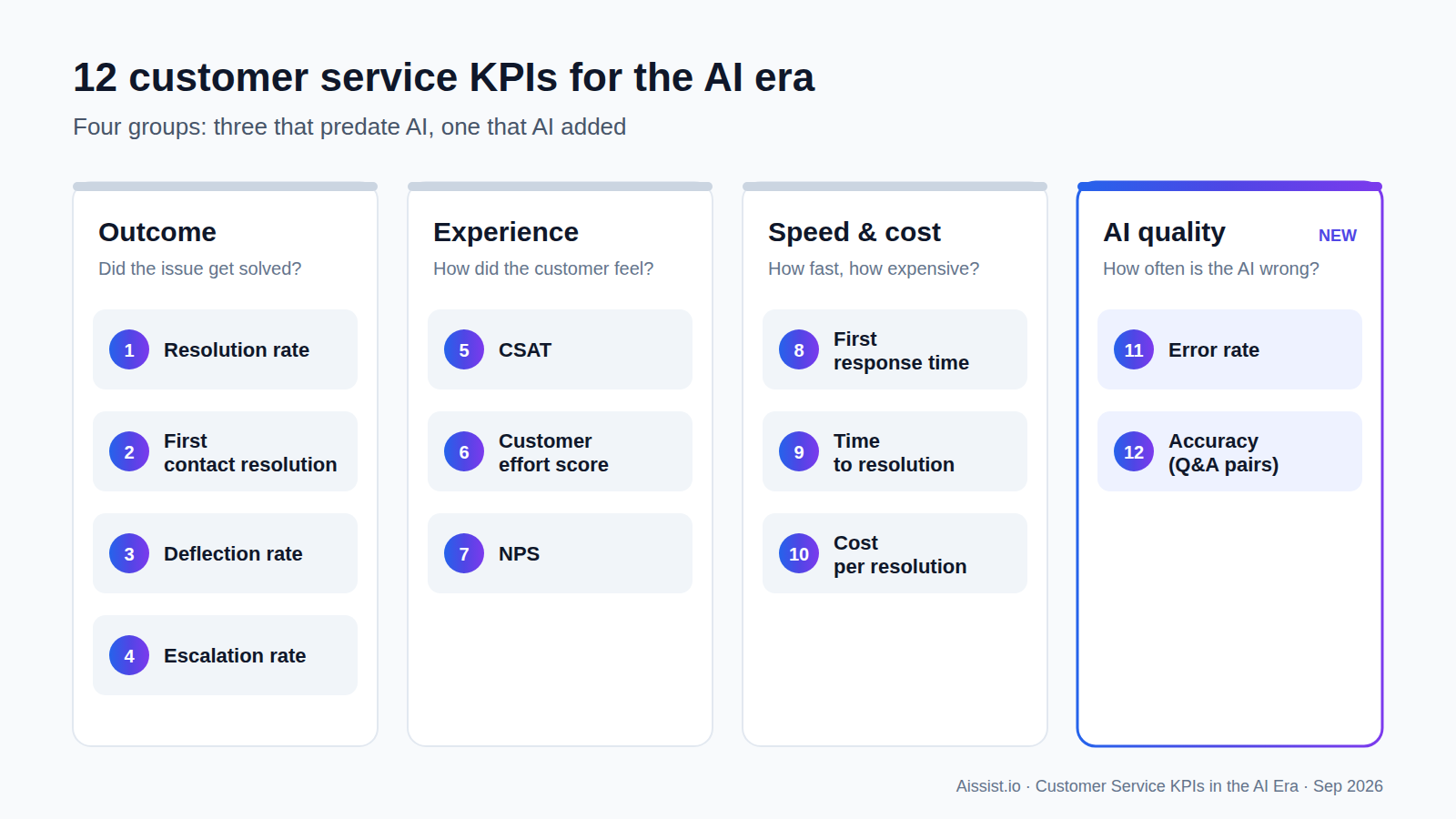
What are the key customer service KPIs in 2026?
The key customer service KPIs in 2026 fall into four groups: outcome (did the issue get solved), experience (how the customer felt), speed and cost, and AI quality (how often the AI gets it wrong). The first three groups existed before AI. The fourth is new, because a machine that answers thousands of customers a day needs its own quality measures.
| # | Metric | What it measures | Formula | 2026 reference point |
|---|---|---|---|---|
| 1 | Resolution rate | Issues the AI finished end to end | Resolved by AI, no human, no repeat contact ÷ AI-handled conversations | 70–75% strong; ~41% median |
| 2 | First contact resolution | Issues solved without the customer returning | Issues with no repeat contact in 72h ÷ all issues | No cross-vendor benchmark |
| 3 | Deflection rate | Conversations that never reached a human | Not handed to a human ÷ all conversations | Runs 20–40 pts above resolution |
| 4 | Escalation rate | Conversations handed to a human | Handed off or flagged ÷ AI-handled conversations | Track against resolution |
| 5 | CSAT | Satisfaction with one interaction | Positive (4–5) responses ÷ all responses × 100 | 80%+ good |
| 6 | Customer effort score | How easy it was to get help | Easy/very easy responses ÷ all responses | No cross-vendor benchmark |
| 7 | NPS | Loyalty to the company | % promoters − % detractors | 30+ good, 50+ excellent |
| 8 | First response time | Wait for the first real reply | Median time to first reply | Seconds for AI |
| 9 | Time to resolution | How long the issue took to solve | Median open-to-resolved time | Track your own trend |
| 10 | Cost per resolution | What each solved issue costs | Fully loaded cost ÷ resolved issues | $0.10–$1.50 AI unit price |
| 11 | Error rate | How often the AI gets it wrong | Conversations with ≥1 error of severity N ÷ AI-handled conversations | Under 1% (S0–S2) as an SLA target |
| 12 | Accuracy | Correct answers on a test set | Correct answers ÷ question-answer pairs tested | Pre-launch gate |
Most existing KPI guides stop at the list. When we read Pylon's guide to 13 support KPIs (July 2025) for this piece, it gave a formula for one of its thirteen metrics and didn't cover AI agents. The sections below cover both.
Which customer service metrics show whether the issue got solved?
Four metrics measure outcome: resolution rate, first contact resolution, deflection rate and escalation rate. Together they show whether customers leave with a solved problem.
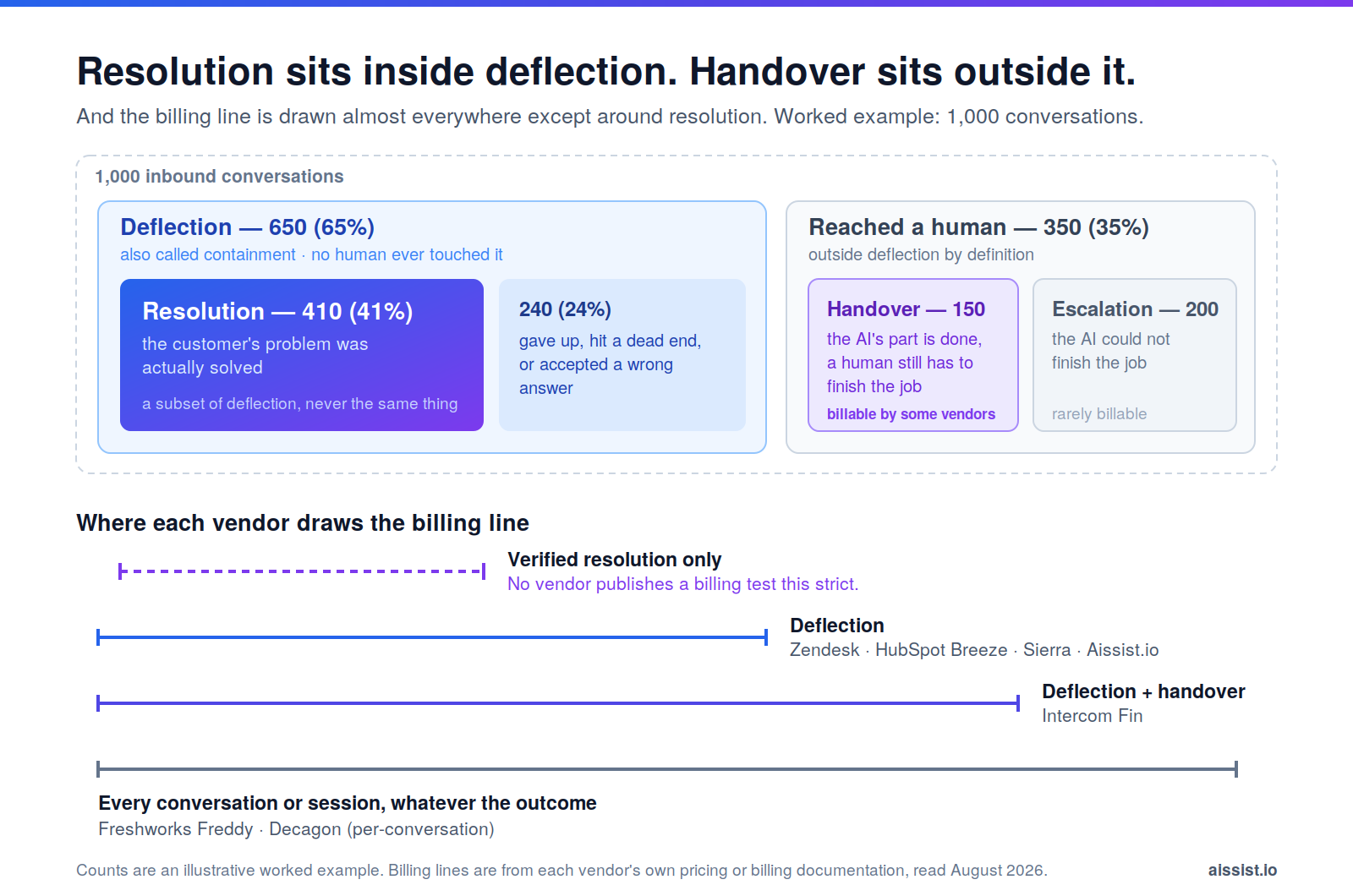
1. Resolution rate. The share of issues an AI finishes end to end, with no human and no follow-up contact on the same issue. It barely existed before AI, because human agents resolved by default. The AI Customer Service Benchmark 2026 puts the tier-1 automation median near 41%, the top quartile near 59% and strong deployments at 70–75%. HubSpot CEO Yamini Rangan said in August that its Customer Agent resolves 72% of support tickets without human escalation, according to CX Today.
2. First contact resolution (FCR). The share of issues solved without the customer having to come back. Before AI, a contact ended when the agent hung up. An AI conversation can run for many turns and still count as one contact, so measure repeat contact on the same issue within 72 hours instead. Measured that way, FCR and resolution rate tell a similar story.
3. Deflection rate. The share of conversations that never reached a human. It was built to measure self-service portals, and it counts customers who gave up as well as those who got an answer. Aissist's deflection vs. resolution guide puts it 20–40 points above resolution on the same deployment. Use it for capacity planning, not quality.
4. Escalation rate. The share of AI conversations handed to a human or flagged for review. Anthropic's definition in its agent oversight metrics is a useful model: "the share of agent activities that are either blocked/redirected or flagged for further review." Salesforce reports that 95% of questions handled by Live Nation's Venue Agent are answered without a handoff, per its 16 September release.
"The outcomes, the quality of outcomes is what will enable more small, medium businesses to adopt AI." — Yamini Rangan, CEO, HubSpot, via CX Today
Which customer service metrics show how customers felt?
CSAT, customer effort score and NPS measure the customer's side of the experience, at three distances: one interaction, one issue, and the whole relationship.
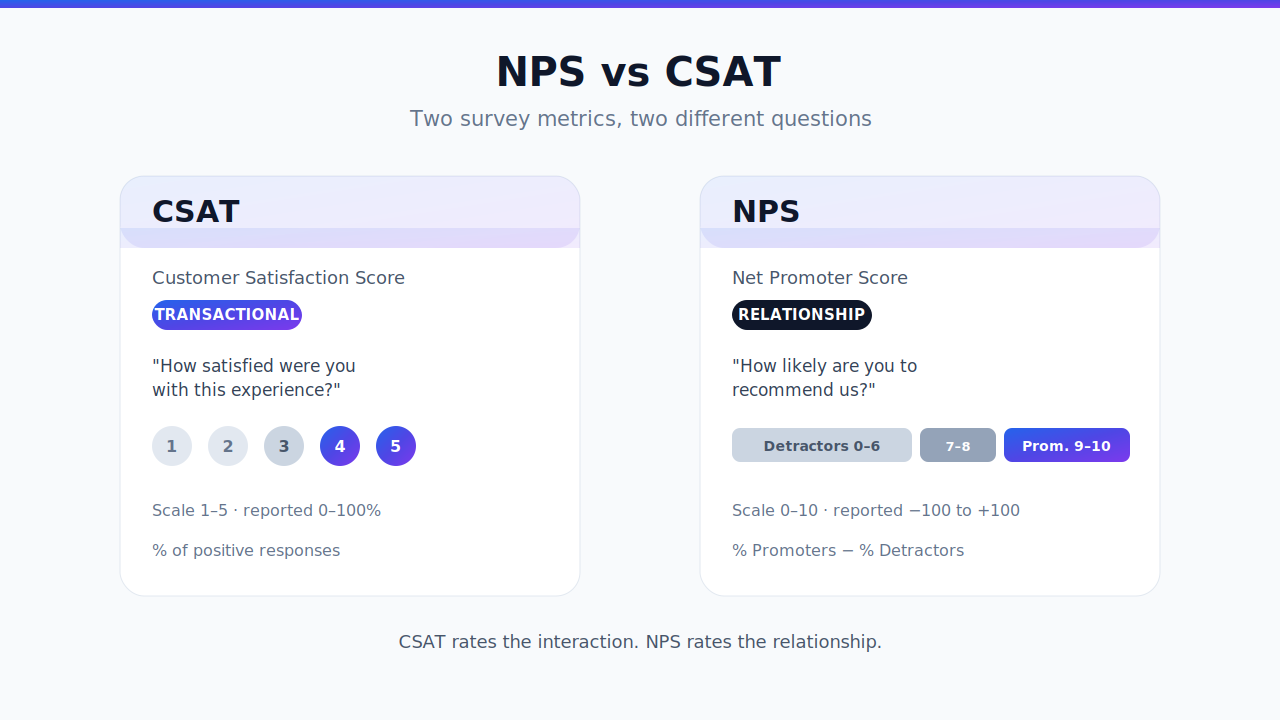
5. CSAT. The share of survey responses that rate an interaction positively, usually 4 or 5 on a 1–5 scale. Aissist's NPS vs. CSAT guide treats 80%+ as good. With AI in the mix, report it separately for AI-handled and human-handled conversations: the benchmark finds AI-handled CSAT typically runs 5–10 points below the same team's human-handled score.
6. Customer effort score (CES). How easy customers say it was to get their issue resolved. Before AI, effort meant transfers and hold music. Now it can also mean looping with a bot before reaching a person, so split CES by AI-only and AI-then-human paths. Gartner finds service interactions are nearly four times more likely to lead to disloyalty than loyalty, which is why effort earns its place. No cross-vendor 2026 benchmark exists; track your own trend.
7. Net Promoter Score (NPS). A relationship score: the percentage of promoters (9–10) minus the percentage of detractors (0–6). AI moves it slowly, so don't expect a same-quarter jump from an agent launch. The NPS vs. CSAT guide treats above 30 as good and above 50 as excellent.
"Customers don't avoid AI; they avoid AI that doesn't work. They want fast, end-to-end resolution, with a human available when needed." — Anna Convery, Chief Marketing Officer, Verint
Verint's survey of 5,000 US consumers found 69% would accept automated service if it fully resolved their issue.
Which customer service metrics track speed and cost?
First response time, time to resolution and cost per resolution cover speed and money, and AI changes all three more than any other group.
8. First response time (FRT). The time until a customer gets a first meaningful reply. An AI replies in seconds, so an average across all conversations drops close to zero and stops telling you much. Keep tracking it on the human path, where customers still wait.
9. Time to resolution. The time from opening an issue to solving it, on the customer's clock. Average handle time measured how long an agent spent working; with AI, that effort no longer drives cost. Time to resolution is the speed metric that still reflects the customer's experience.
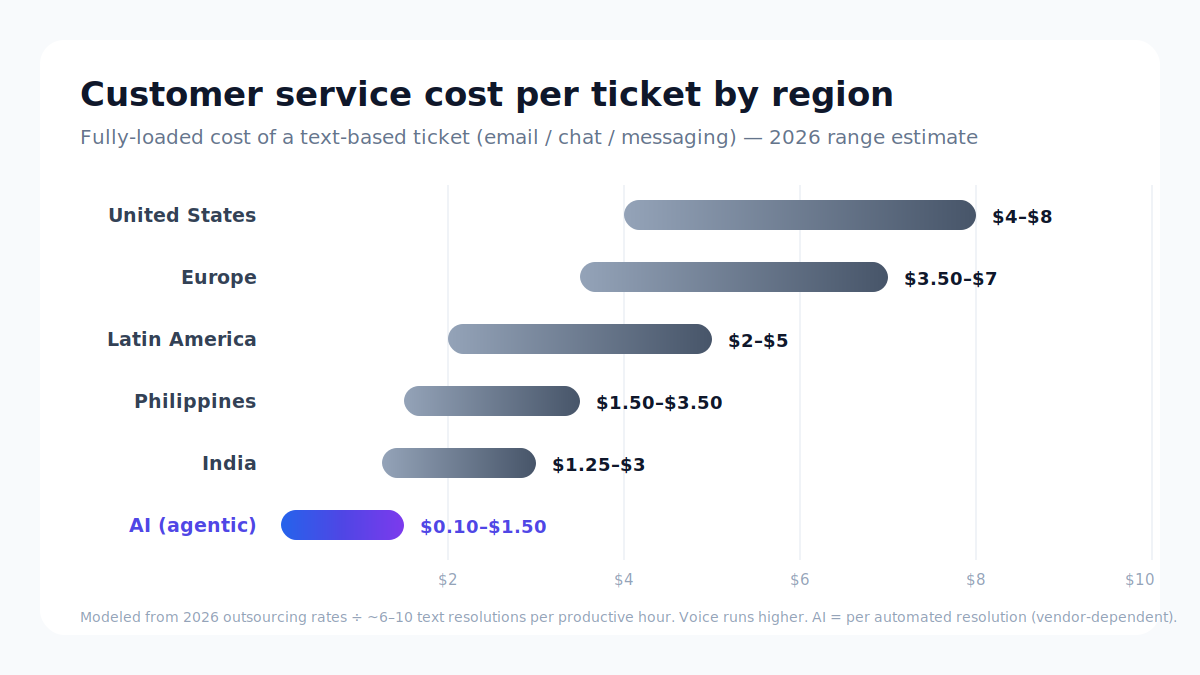
10. Cost per resolution. Fully loaded support cost divided by resolved issues. Aissist's cost-per-ticket guide models a US text ticket at $4–$8 when handled by humans, against $0.10–$1.50 per AI resolution in vendor unit pricing. The benchmark estimates about $5 per resolution all-in once integration work is spread across volume.
Which metrics measure AI quality?
Error rate and accuracy measure how often the AI gets things right, and they answer different questions: accuracy is tested before launch, error rate is tracked in production.
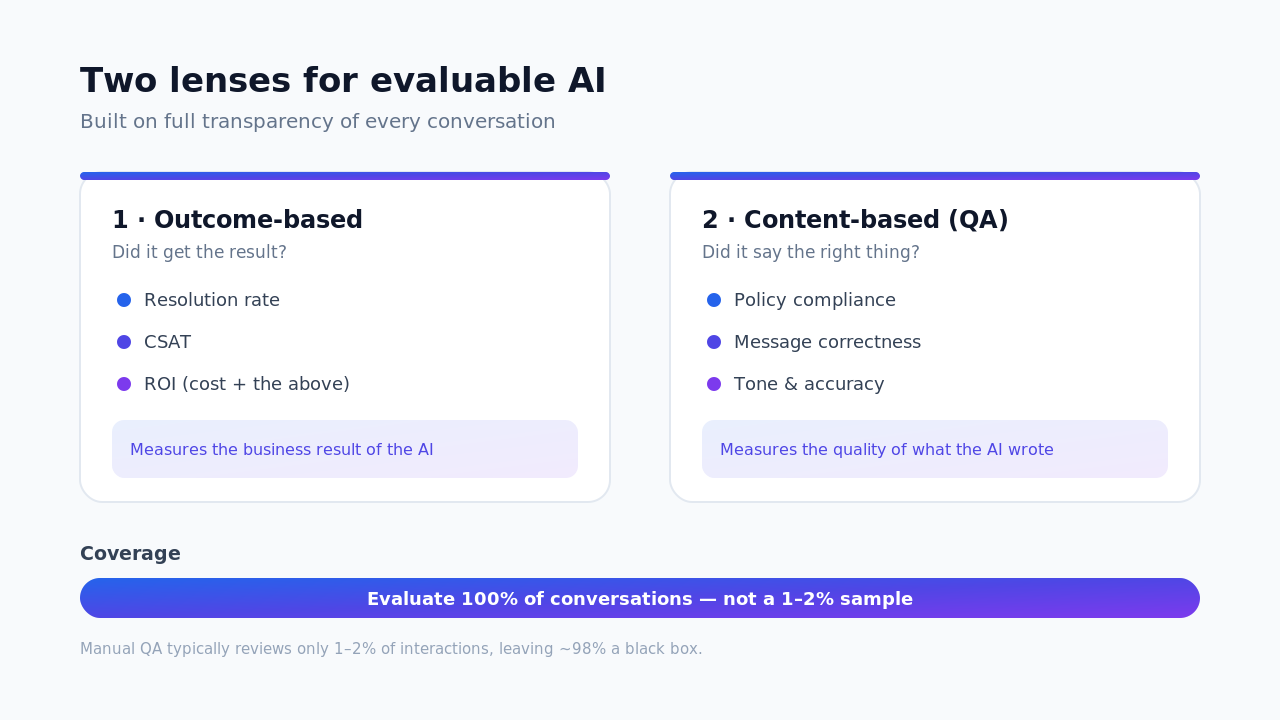
11. Error rate. The share of AI-handled conversations containing at least one error of a given severity. Aissist's error rate definition grades errors from S0 (a business outcome the company can't take back, such as an unauthorized refund) to S3 (cosmetic wording or formatting), and counts conversations rather than messages. Before AI, QA teams graded a sample of human tickets; an AI can be graded on every conversation. No major vendor publishes a production error rate yet. Aissist's contractual SLA targets are under 1% for S0–S2 combined, under 0.1% for S1 and under 0.01% for S0; those are targets, not observed averages.
12. Accuracy. The share of question-answer pairs in an evaluation set that the AI answers correctly. It's the quality number vendors quote most. It is only as good as the test set, so check how many pairs were used, whether they came from real tickets, and when the test ran. Aissist's reliability benchmark describes accuracy as "a success metric measured once." The τ-bench study shows the gap that leaves: state-of-the-art function-calling agents succeeded on under 50% of tasks, and under 25% when they had to succeed on all eight attempts in the retail domain.
"Our experiments show that even state-of-the-art function calling agents (like gpt-4o) succeed on <50% of the tasks, and are quite inconsistent (pass^8 <25% in retail)." — Shunyu Yao, Noah Shinn, Pedram Razavi and Karthik Narasimhan, τ-bench
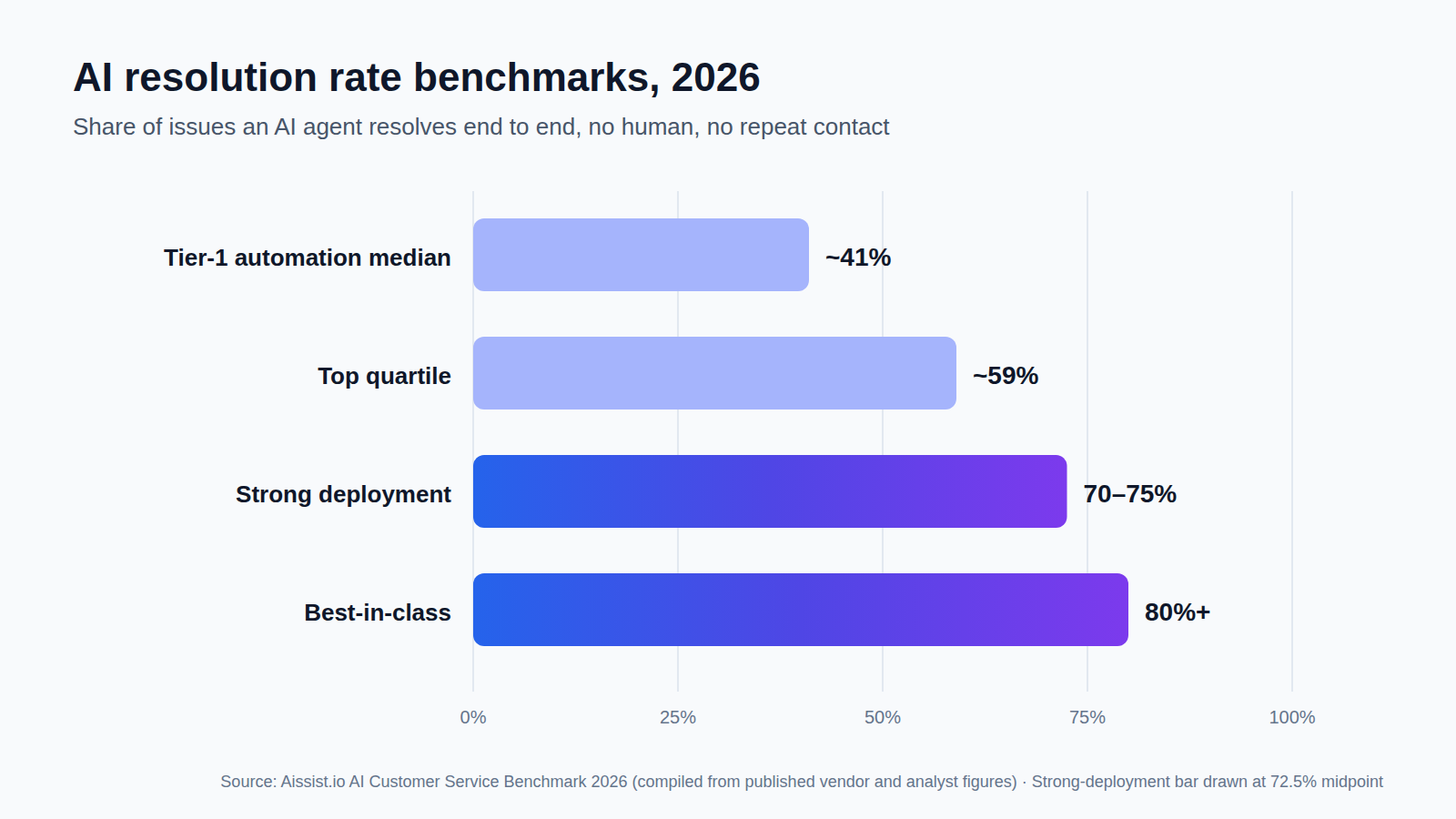
Resolution and error rate are the new core customer service KPIs
Every familiar customer service KPI still has a job, but the center of gravity has moved. Resolution rate tells you whether the AI finishes the work; error rate tells you what it costs when it doesn't. CSAT and effort keep the customer's view honest, cost per resolution keeps the finance view honest, and first response time and handle time drop to supporting roles.
If you're setting up a dashboard this quarter, start with those four core metrics, then add the rest as you need them. For how resolution and satisfaction pull against each other, see the resolution–CSAT tradeoff analysis.
See how Aissist measures resolution and error rate in production. Book a demo →
Frequently asked questions
What are the most important customer service KPIs for AI support?
Resolution rate, CSAT, error rate and cost per resolution. Together they show whether the AI finishes the work, whether customers are happy with it, how often it gets things wrong, and what each solved issue costs.
How do you calculate first contact resolution with an AI agent?
Divide the issues with no repeat contact on the same issue within a set window, such as 72 hours, by all issues. Counting sessions doesn't work well, because an AI conversation can run for many turns without ending.
What is a good customer effort score?
There's no cross-vendor 2026 benchmark, so track your own trend over time. Report CES separately for AI-only and AI-then-human conversations, since effort usually rises on the handoff path.
What is an AI agent error rate in customer service?
The share of AI-handled conversations containing at least one error of a given severity. Count conversations rather than messages, and report each severity level separately so a wrong refund is never averaged together with a typo.
How is AI accuracy measured with question-answer pairs?
Run the AI against a set of question-answer pairs with known correct answers, then divide correct responses by total pairs. Sample the pairs from real tickets, state how many you used, and re-run the test after every change to the AI.
What is the difference between CSAT, CES and NPS?
CSAT rates satisfaction with one interaction, CES rates how easy it was to get an issue resolved, and NPS rates how likely a customer is to recommend the company. CSAT and CES are transactional; NPS is a relationship metric.
Which customer service metrics matter less once AI answers first?
First response time and average handle time. An AI replies in seconds and its handling time isn't labor cost, so both averages stop reflecting the customer's experience. Keep tracking them on the human-handled path.