NPS vs CSAT: The Difference, and Why Both Matter to Customer Service
The short version of NPS vs CSAT: CSAT measures how satisfied a customer was with a single interaction, while NPS measures how loyal a customer feels toward your company overall. Both come from short surveys, both use numeric scales, and both get quoted in the same QBR — which is exactly why they get confused. They answer different questions, and using one where you need the other quietly misleads a support team. This guide breaks down what each metric means, where to use it, whether the two correlate, and what each one actually tells you about your service operation. For the trade-off view on one of these metrics, see our resolution rate vs. CSAT analysis.
What Is CSAT?
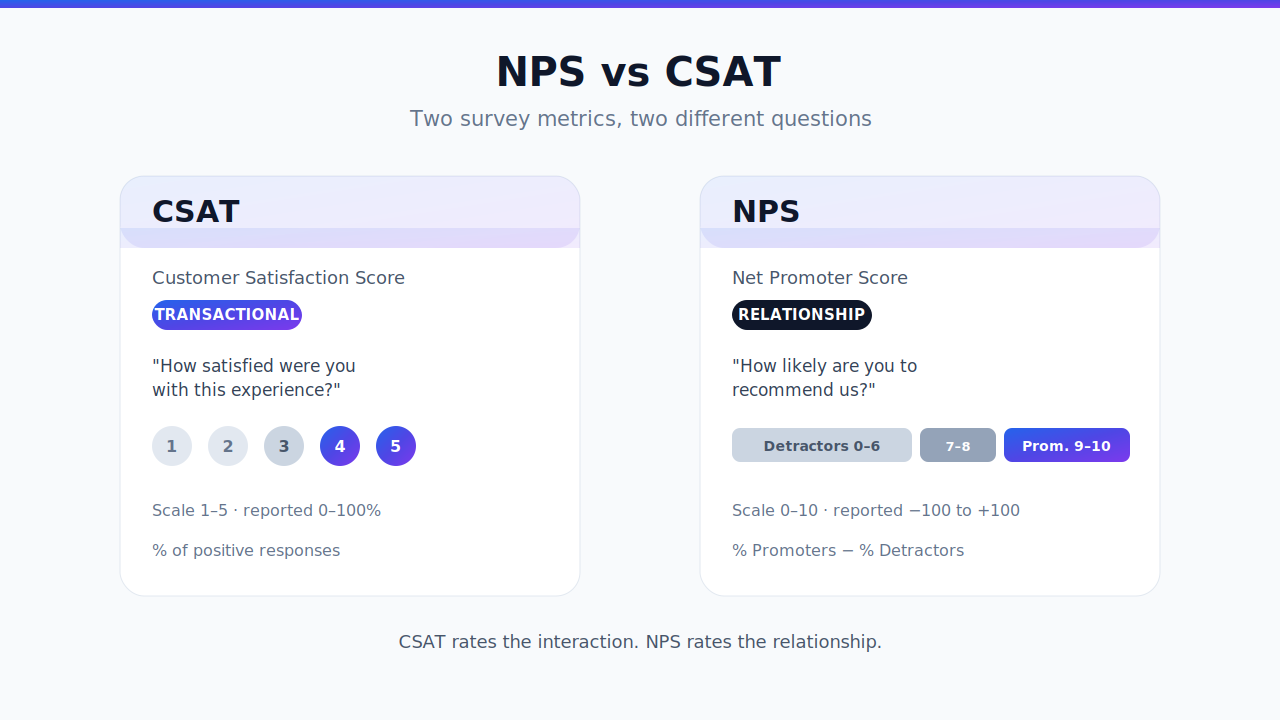
CSAT, or Customer Satisfaction Score, is a transactional metric. It asks a customer to rate a specific, recent experience — usually right after a support ticket closes, a purchase completes, or a chat ends. The question is some version of "How satisfied were you with this support experience?" and the customer answers on a scale, most often 1–5 (sometimes 1–7 or 1–10).
To calculate CSAT, you take the number of positive responses — typically the top two boxes, such as the 4s and 5s on a 1–5 scale — divide by the total number of responses, and multiply by 100. The result is a percentage from 0 to 100%. A CSAT of 85% means 85% of respondents rated the interaction favorably.
CSAT is the everyday workhorse of customer service. It's granular, so you can slice it by agent, channel, queue, or topic. It has relatively high response rates because you're asking about something fresh and specific. And it produces a fast feedback loop: a dip in CSAT on a particular ticket type this week is something a support manager can act on immediately.
What Is NPS?
NPS, or Net Promoter Score, is a relationship metric. Instead of one interaction, it captures how a customer feels about your company as a whole. The classic question is "How likely are you to recommend this company to a friend or colleague?" answered on a 0–10 scale.
Calculating NPS works differently from CSAT. Respondents are grouped by their score: Promoters (9–10), Passives (7–8), and Detractors (0–6). NPS equals the percentage of Promoters minus the percentage of Detractors. The result is a whole number from −100 to +100 — not a percentage, which is a distinction that trips people up constantly.
Because NPS reflects a considered judgment about the overall relationship, it's the metric that connects to retention, referrals, and revenue. It's strategic — often a board-level number — and it's typically sampled periodically rather than fired after every touchpoint. Response rates tend to be lower than CSAT because you're asking for a bigger, more reflective assessment.
NPS vs CSAT at a Glance
| Dimension | CSAT | NPS |
|---|---|---|
| What it measures | Satisfaction with one interaction | Loyalty to the company overall |
| Type | Transactional | Relationship |
| Question | "How satisfied were you with this experience?" | "How likely are you to recommend us?" |
| Scale | 1–5 (sometimes 1–7 / 1–10) | 0–10 |
| Reported as | Percentage, 0–100% | Index, −100 to +100 |
| Calculation | % of positive (top-box) responses | % Promoters − % Detractors |
| Best for | Agent, channel, and process monitoring | Retention, referral, and board reporting |
| Cadence | After each interaction | Sampled periodically |
Where to Use Each
The cleanest way to keep NPS vs CSAT straight is to match the metric to the question you're actually asking.
Reach for CSAT when you want to know whether a specific thing worked: Did this resolution land? Is this agent handling refunds well? Did the new chatbot flow leave people satisfied? CSAT is operational and diagnostic — it's how you monitor quality, coach agents, and catch a broken process early.
Reach for NPS when you want to know whether the cumulative experience is building or eroding loyalty. Are customers becoming advocates or churn risks? Is the relationship healthy enough that they'd stake their reputation on recommending you? NPS is strategic and directional — it tells you where the relationship is heading, not which ticket went sideways.
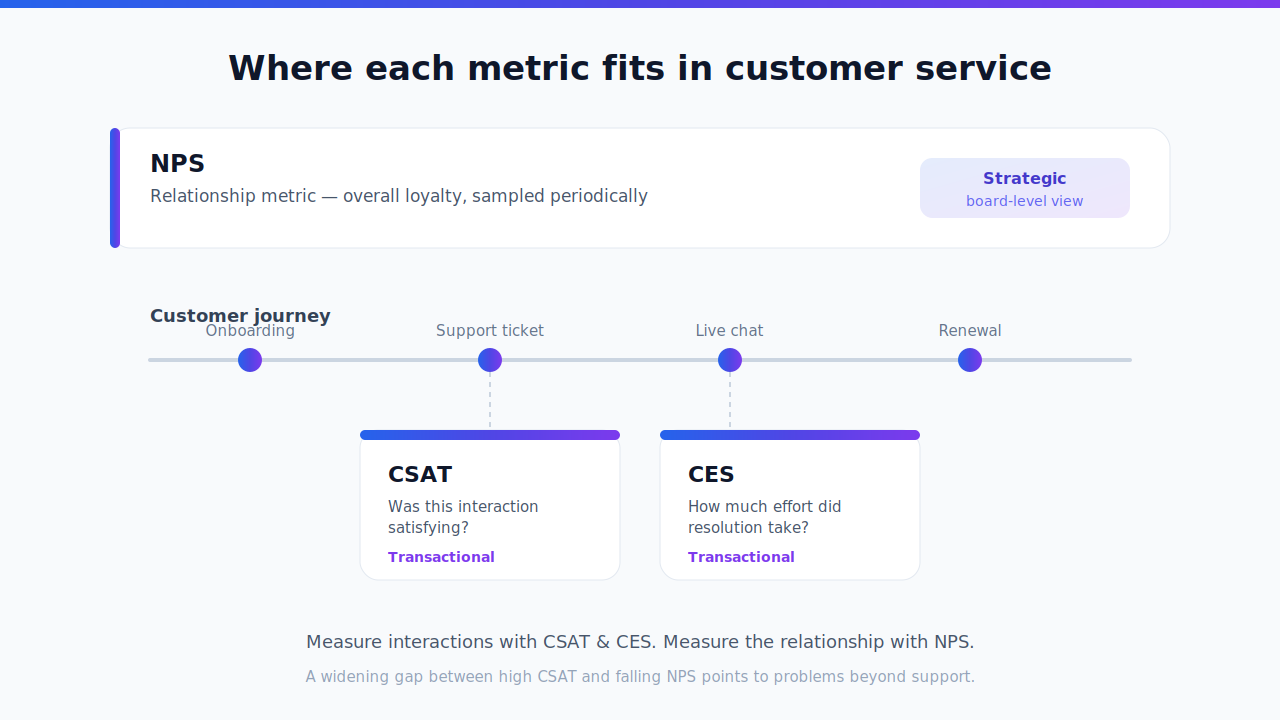
Many teams also weigh a third metric here, which is where NPS vs CSAT vs CES comes in. CES, the Customer Effort Score, asks "How easy was it to get your issue resolved?" It's another transactional metric, sibling to CSAT, and it's especially predictive of loyalty in support contexts because effort is what customers remember. A common, healthy setup: CSAT and CES at the interaction level, NPS at the relationship level.
Do NPS and CSAT Correlate?
They're related, but there's no fixed mathematical correlation, and treating them as interchangeable is a mistake. Good individual experiences (high CSAT) tend to build toward loyalty (higher NPS) over time — strong CSAT is roughly necessary for strong NPS, but it isn't sufficient.
The two can and do diverge. A customer might rate a support interaction 5/5 because the agent was friendly and fixed the immediate problem, yet still be a Detractor because the product keeps breaking or the pricing changed. Conversely, a loyal Promoter might rate one frustrating ticket low without it denting their overall relationship. That divergence is a feature, not noise: when CSAT is high but NPS is sliding, it's a signal that something outside the support conversation — product, price, onboarding — is doing the damage. This is exactly the kind of pattern an insight layer like Pulse is built to surface, because it reads across every ticket and metric rather than looking at one score in isolation.
How NPS and CSAT Get Confused
The confusion is understandable. Both metrics come from short post-interaction surveys, both use numeric scales that look similar at a glance, and both get labeled loosely as "satisfaction." The most common mistakes are worth naming so you can avoid them.
The first is comparing the raw scores directly. A CSAT of 85% and an NPS of 40 are not on the same scale — one is a 0–100% percentage, the other a −100 to +100 index — so "our CSAT is higher than our NPS" is a meaningless statement. The second is using one metric's benchmark to judge the other. The third is collecting transactional NPS after every ticket and then treating it as a relationship metric; firing the recommend-question after a single chat blurs the very line that makes NPS useful. And the fourth is asking support to own NPS outright — support influences it heavily, but so do product, sales, and pricing.
What Each Means for Customer Service
For a support organization, CSAT is the metric you live in day to day. It's fast, specific, and coachable, and it's the fairest way to measure whether resolutions — human or automated — are actually satisfying customers. It's worth noting that well-built agentic AI can sustain high CSAT on automated resolutions; across its deployments, Aissist.io averages 4.8/5.0 CSAT on the conversations it resolves. If you're setting targets, our AI customer service benchmark shows what good looks like across resolution rate, CSAT, and cost.
NPS is the metric that keeps support honest about the bigger picture. A team can post excellent CSAT and still watch loyalty erode if resolutions are slow, effortful, or repetitive. Read together — CSAT and CES telling you whether each interaction worked, NPS telling you whether the relationship is compounding in your favor — the two give a support leader both the microscope and the map.
Measure what your AI actually resolves. Deflection inflates numbers; resolution earns loyalty. Aissist.io resolves support and sales end to end on the stack you already run — and reports the CSAT to prove it. See the customer service benchmark →
Key Takeaways
CSAT and NPS are not competitors; they're complementary. CSAT (and its sibling CES) measures the health of individual interactions and belongs to the support team's daily workflow. NPS measures the health of the overall relationship and belongs to the business. Don't compare their scores directly, don't ask one to do the other's job, and watch the gap between them — when transactional satisfaction is high but loyalty is falling, the answer usually lives outside the support conversation.
Frequently Asked Questions
What is the difference between CSAT and NPS?
CSAT measures satisfaction with a single, recent interaction (like a support ticket) on a 1–5 scale, reported as the percentage of positive responses. NPS measures overall loyalty to a company by asking how likely someone is to recommend it on a 0–10 scale, reported as an index from −100 to +100. CSAT is transactional and operational; NPS is relationship-level and strategic.
Should I use NPS or CSAT for customer service?
Use CSAT as your primary day-to-day customer service metric, because it's specific, coachable, and fast to act on. Use NPS in parallel to track whether the overall relationship is strengthening or weakening. Most mature support teams run CSAT (often with CES) at the interaction level and NPS at the relationship level rather than choosing one.
How is CSAT calculated?
Divide the number of positive responses (typically the top two boxes, such as 4s and 5s on a 1–5 scale) by the total number of responses, then multiply by 100. For example, 170 positive responses out of 200 total gives a CSAT score of 85%. The result is always a percentage between 0 and 100%.
How do you calculate NPS?
Group survey responses into Promoters (9–10), Passives (7–8), and Detractors (0–6). Subtract the percentage of Detractors from the percentage of Promoters. If 60% are Promoters and 20% are Detractors, your NPS is 40. Passives count toward the total but not the score, and the final number ranges from −100 to +100.
Do NPS and CSAT correlate?
Loosely, but not reliably. Strong CSAT tends to support a healthy NPS over time, yet the two can diverge — high interaction satisfaction can coexist with low loyalty if product, price, or reliability problems persist. A widening gap between high CSAT and falling NPS is a useful warning that the issue lives outside the support conversation.
What is a good CSAT score?
A CSAT score of 80% or above is generally considered good for customer service, and top-performing teams often exceed 90%. Benchmarks vary by industry and channel, so trend and segment context matter more than a single global number. Track CSAT over time and by ticket type rather than judging it against one universal target.
What is a good NPS score?
Any positive NPS (above 0) means you have more Promoters than Detractors. Scores above 30 are typically viewed as good and above 50 as excellent, though benchmarks vary widely by industry. Because NPS ranges from −100 to +100, compare against peers in your sector rather than to CSAT or other percentage-based metrics.
What is the difference between NPS, CSAT, and CES?
CSAT measures satisfaction with an interaction, CES (Customer Effort Score) measures how easy it was to get an issue resolved, and NPS measures overall likelihood to recommend. CSAT and CES are transactional and best for operational support monitoring; NPS is a relationship metric for strategic, loyalty-focused decisions. Many teams use all three together.
Can one survey measure both NPS and CSAT?
You can include both questions in a single survey, but keep their purposes distinct. Ask the CSAT (or CES) question about the specific interaction and the NPS question about the overall company, and analyze them separately. Bundling them is fine; treating the two resulting scores as interchangeable is not.