AI Disclosure in Customer Service: Does Telling Customers It's AI Change Their Behavior?
Yes—telling customers up front that they're talking to a bot changes how they behave, and the effect is large. In the most-cited field experiment on the subject, AI disclosure in customer service cut conversions by nearly 80% when the disclosure came before the conversation.
One thing has changed since that research, and it changes what you can do about it. Since 2 August 2026, Article 50 of the EU AI Act has been in force, and it requires that people be told they are interacting with an AI system at the latest at the time of the first interaction. Breaches carry fines of up to €15 million or 3% of worldwide annual turnover, whichever is higher (Cooley, 3 August 2026). The single most effective tactic in the research literature—delaying disclosure until after the conversation—is the one tactic that is no longer available to you if you serve EU customers.
So the question is no longer whether to disclose, and it is no longer when. It is how to make disclosure at the very first turn cost you nothing—which the same research says is a competence problem, not a wording problem.
What the research says about AI disclosure
The sharpest evidence comes from a 2019 Marketing Science study by Luo, Tong, Fang, and Qu, "Machines vs. Humans." Researchers ran a field experiment with 6,255 customers of a financial-services firm making outbound calls about loan renewals, randomizing when—or whether—the chatbot revealed it was AI.
Undisclosed, the chatbot closed deals at a 23.7% rate, statistically on par with proficient human agents (25.1%) and roughly four times more effective than inexperienced staff (4.9%). The moment the bot disclosed it was AI before the conversation, the purchase rate collapsed to 4.8%—a 79.7% drop. Call length told the same story: disclosed-first calls lasted about 10 seconds versus nearly 64 for human agents. Customers heard "AI" and hung up.
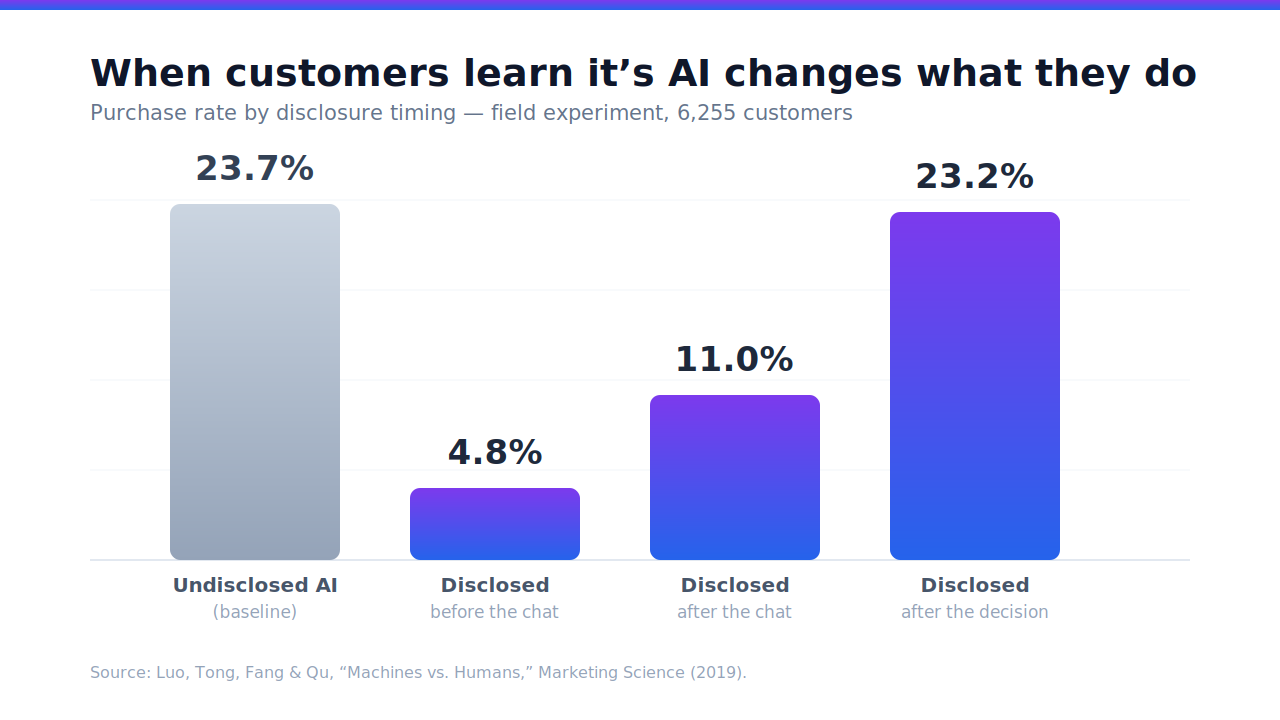
The important nuance is timing. When disclosure came after the conversation, conversions recovered to 11.0%; disclosed only after the customer had decided, the rate returned to 23.2%—no meaningful gap from human agents. Same bot, same competence, wildly different outcomes based on one thing: when the customer found out.
Read that chart carefully, though, because three of its four bars are now off the table in the EU. Article 50 requires notice at the latest at the first interaction, so "disclosed before chat"—the 4.8% bar, the worst one—is the only compliant column left for an EU-facing deployment. This is the uncomfortable part of the evidence, and it is worth stating plainly rather than burying: the law mandates the timing that tested worst. Everything below is about why that bar is not your destiny.
Why disclosure changes behavior
The mechanism matters because it tells you what to fix. A voice-mining analysis in the study found the disclosed and undisclosed bots were equally competent in knowledge and empathy. What changed was customer perception: once told they were dealing with a machine, people rated the same agent as less knowledgeable and less empathetic. This is textbook algorithm aversion—a subjective bias against machines that persists even when the machine objectively performs.
That bias isn't fixed, though. Customers with prior AI experience showed a significantly smaller disclosure penalty. As agentic AI becomes the norm in customer service, the aversion softens—and the cost of honesty falls with it.
AI disclosure and resolution rate
For support teams the relevant metric isn't conversion, it's resolution—and disclosure affects it indirectly. The risk is abandonment. Surveys consistently find a meaningful share of customers will disengage on hearing "AI": one CX analysis reported that roughly a third would end the interaction, pushing abandonment on disclosed-AI calls toward 25–30% versus 3–5% for human-fronted ones. A customer who bails is a case that never gets resolved, so clumsy disclosure can quietly drag first-contact resolution down.
But resolution rate is ultimately a capability problem, not a labeling problem. A genuinely capable system resolves the issue regardless of the badge on it. Top agentic implementations already resolve 70–90% of incoming queries end-to-end, and Aissist.io's own benchmarks show 83% average resolution with AgentMesh. When the AI actually solves the problem, disclosure doesn't stop it from solving the problem—it just sets the customer's expectations before it does.
AI disclosure, CSAT, and NPS
Here the picture flips in disclosure's favor. CSAT tracks whether the issue got solved, not who solved it: about 74% of users report higher satisfaction when a chatbot fully resolves their problem without a human handoff, and 87% report positive experiences with AI chatbots overall. Transparency actually helps CSAT, because customers who know they're talking to a bot calibrate their expectations and judge the interaction more fairly. What tanks CSAT is a bot that lacks context or can't escalate—not the disclosure itself. (This is the same resolution–CSAT trade-off that separates real automation from deflection.)
NPS and long-term trust are where hiding AI backfires hardest. Around 75–85% of consumers say they want to know when they're interacting with AI, and 81% consider it an ethical problem for AI to pass as human. Concealing it doesn't protect loyalty; it defers the damage. Discovery-after-the-fact reads as deception, and Salesforce research found 44% of consumers are more likely to use an AI agent when its logic is explained and 45% when there's a clear escalation path. Disclosure done well is an NPS asset, not a liability—the Pulse insight layer exists precisely to catch where trust and satisfaction move so you can prove which effect you're getting.
How to disclose AI without paying the penalty
Older versions of this advice—including an earlier version of this page—told you to let competence lead and disclose a little later. Since 2 August 2026 that is not a legal option for EU customers, so the playbook has to change. What survives is everything that was doing the real work anyway.
Disclose at the first turn, in the same breath as something useful. Article 50 sets when (no later than the first interaction); it does not dictate that the disclosure be the only thing in that message. "I'm an AI assistant—I can see order #4471 shipped Tuesday, and I can reroute it now" is compliant and does not read as a disclaimer. A bare "You are chatting with a bot" as a standalone opener is compliant too, and wastes the turn.
Make human escalation obvious and instant. The option to reach a person is what converts "I'm stuck with a bot" into "I'm in control," and Salesforce research puts a number on it: 45% of consumers are more likely to use an AI agent when there is a clear escalation path.
Invest in actual resolution. Every satisfaction and trust gain in the data is downstream of the problem getting solved. The disclosure penalty in the study was measured on a bot doing outbound loan-renewal sales; a bot that immediately does something the customer wanted is not in the same position.
Measure your own penalty rather than inheriting ours. The 79.7% figure comes from one 2019 outbound-sales experiment in Chinese financial services. Your channel, intent mix and brand are different. Evolve exists to test disclosure wording against real resolution and CSAT data—within the timing the law now fixes for you.
Know which obligations bind you. Article 50(1)—telling people they are talking to an AI—applies now, to providers, with no transition. The separate Article 50(2) obligation to mark AI-generated content in a machine-readable format gives systems already on the market before 2 August 2026 until 2 December 2026. The exemption for interactions that are "obvious" to a reasonably well-informed person exists but is, in the Commission's own words, to be "interpreted in a restrictive manner" (European Commission FAQ). Do not build a compliance position on it.
Key takeaways
AI disclosure in customer service does change behavior, and since 2 August 2026 the EU AI Act removes your discretion over the timing: notice at the latest at the first interaction, with fines up to €15M or 3% of worldwide turnover behind it. The research says that is the worst-testing moment to disclose (~80% conversion loss in one outbound-sales experiment), which makes the rest of the design load-bearing rather than optional. The damage in that study was concentrated in low-competence interactions and perception, not in honesty itself—CSAT rises when the issue actually gets resolved, and long-term trust and NPS favor transparency. Build a system that resolves end-to-end, disclose plainly at the first turn alongside something useful, and offer an instant path to a human. You no longer get to choose when to disclose; you still get to choose whether it costs you anything.
Disclose with confidence—because the AI actually resolves. See how an AI Operational Layer resolves support and sales end-to-end while keeping customers in control. Get a free demo →
FAQs
Should you disclose AI to customers in customer service?
Yes, and if you serve EU customers it is a legal obligation rather than a choice. Article 50 of the EU AI Act has applied since 2 August 2026 and requires that people be informed they are interacting with an AI system at the latest at the time of the first interaction, with fines up to €15 million or 3% of worldwide annual turnover. Independently of the law, a large majority of consumers—around 75–85% in recent surveys—say they want to know when they're dealing with AI, and 81% view AI posing as human as unethical. The practical goal is to disclose clearly at the first turn while designing the interaction—competent resolution plus easy human escalation—so disclosure doesn't cost you conversions or satisfaction.
Does telling customers they're talking to AI reduce sales?
It can, sharply, if the disclosure comes first. A field experiment published in Marketing Science found that revealing the chatbot was AI before the conversation cut purchases by 79.7% (from 23.7% to 4.8%), while disclosing after the conversation or after the customer decided recovered results to near human parity. Timing, not disclosure itself, drove most of the loss. Note that the late-disclosure options in that study are no longer lawful for EU-facing deployments: since 2 August 2026 Article 50 of the EU AI Act requires notice at the latest at the first interaction. Treat the finding as an explanation of where the risk sits, not as a tactic you can still use.
Does AI disclosure hurt CSAT?
Generally no. CSAT is driven by whether the customer's problem is solved, not by whether a human or AI solved it. Roughly 74% of users report higher satisfaction when a bot fully resolves their issue without a handoff. Transparency helps customers set realistic expectations, so a disclosed, capable AI with a clear escalation path typically maintains or improves CSAT.
How does AI disclosure affect resolution rate?
Indirectly. Disclosure can raise abandonment—some customers disengage on hearing "AI," pushing abandonment toward 25–30% in some contexts—and an abandoned contact is an unresolved one. But resolution is fundamentally a capability question. A system that resolves 70–90%+ of queries end-to-end keeps first-contact resolution high whether or not it discloses; weak automation is what lowers it.
When is the best time to disclose that a customer is talking to AI?
Disclose clearly and early enough to be honest and compliant, but lead with value rather than a disclaimer that primes bias. The research shows front-loading "I'm a bot" before any helpful exchange triggers the steepest drop-off, while disclosure paired with visible competence and an easy path to a human preserves outcomes. Where regulations apply, follow their timing requirements first.
Is disclosing AI in customer service legally required?
In the EU, yes — it is now a live obligation rather than a trend. The EU AI Act's Article 50 transparency rules, which require informing people when they interact with an AI system, have applied since 2 August 2026, with fines of up to €15 million or 3% of worldwide annual turnover behind them. Other jurisdictions are moving in the same direction. Even where it is not yet mandatory, disclosure is a baseline expectation, so building it in now avoids both compliance and trust problems later.
Why do customers react negatively to AI disclosure even when the AI performs well?
It's algorithm aversion—a subjective bias against machines. In the Marketing Science study, disclosed and undisclosed bots were objectively equal in knowledge and empathy, yet customers rated the disclosed bot as less capable purely because they knew it was AI. Notably, customers with prior AI experience showed a much smaller penalty, which suggests the aversion fades as agentic AI becomes familiar.
Can you get the benefits of AI automation without losing customer trust?
Yes—by making disclosure and resolution work together. Trust erodes when AI is hidden and later discovered, not when it's disclosed and effective. An AI Operational Layer that resolves issues end-to-end, states plainly that it's AI, and escalates to a human on request captures the cost and speed gains of automation while protecting CSAT, NPS, and trust.
Sources
- Luo, X., Tong, S., Fang, Z., & Qu, Z. (2019). Machines vs. Humans: The Impact of Artificial Intelligence Chatbot Disclosure on Customer Purchases. Marketing Science, 38(6), 937–947. INFORMS
- Salesforce, New Research Shows How AI Agents Can Step In as Consumer Trust Slips. salesforce.com
- CX Today, Why AI Disclosure Could Make or Break Customer Trust. cxtoday.com
- Contentstack, Will AI chatbots hurt my customer satisfaction score (CSAT)? contentstack.com
- EU AI Act, Article 50 transparency obligations (effective 2 August 2026). artificialintelligenceact.eu
Does the EU AI Act require disclosing AI chatbots in customer service?
Yes. Article 50(1) of the EU AI Act has applied since 2 August 2026. It requires providers of AI systems that interact directly with people to design them so that the person is informed they are interacting with an AI system, at the latest at the time of the first interaction, unless that is obvious to a reasonably well-informed, observant and circumspect person. The European Commission states that this "obvious" exemption should be "interpreted in a restrictive manner," so it is a weak basis for a compliance position. Non-compliance can draw fines of up to €15 million or 3% of worldwide annual turnover, whichever is higher, enforced by national market surveillance authorities. A separate obligation in Article 50(2), to mark AI-generated content in a machine-readable format, gives systems already on the market before 2 August 2026 until 2 December 2026 to comply.
Changelog
- 28 August 2026 — Updated for the EU AI Act's Article 50 transparency obligations, which became applicable on 2 August 2026. The page previously described the law in the future tense and recommended delaying disclosure to reduce the conversion penalty; that timing is no longer lawful for EU-facing deployments, so the playbook and takeaways were rewritten around disclosure at the first interaction. Added the €15M/3% penalty, the Article 50(2) marking runway to 2 December 2026, and the restrictive reading of the "obvious" exemption. Sources read 28 August 2026.
- 31 July 2026 — First published.