
AI Customer Service · Transparency & evaluation
Evaluable AI: you can't deploy what you can't measure
The hardest part of deploying AI isn't getting it to answer — it's proving it works. In our own review of the vendors in this category, roughly 90% offered no real evaluation, or only a coarse label like “success.” That is our count of our own competitors, not an independent study: we have not published the vendor list or the criteria, so treat it as a claim we are making rather than a finding you can check.
7 min read · Updated July 2026
Compiled by Rob Jiang, Chief AI Engineer. Figures read from their sources on 24 August 2026. Published by Aissist.io, which sells a product in the category measured here — our own deployments appear among the figures and are labelled as ours.
- →The hardest part of deploying AI isn't getting it to answer — it's proving it works. Evaluable AI is AI you can see into, measure, and improve.
- →In our own review of AI support vendors — our count, not a published study — roughly 90% offered no real evaluation, or only a coarse single-metric label like "success", so buyers can't tell a genuine fix from a guess.
- →Measure with two lenses across every conversation: outcome-based (resolution, CSAT, ROI) and content-based QA (policy compliance, correct messaging).
- →"Intent gap" scoring isn't real content evaluation — it measures your taxonomy, not your AI. And because AI is now part of the team, hold it to your human agents' yardstick.
Most AI buying conversations focus on what the AI can do. The harder, more important question is how you'll know it's doing it well. This is what evaluable AI is about — AI you can see into, measure, and improve — and it's quickly becoming the deciding factor in whether an AI deployment survives contact with the real world.
It matters because AI failures are quiet. A broken integration throws an error; a subtly wrong or off-policy AI response just goes out the door, and you find out weeks later from a churned customer or a compliance incident. Without continuous measurement, you're flying blind between the moment you launch and the moment something goes wrong.
The headline figure is from Aissist's own review of AI support vendors; manual-QA figures are from Solidroad. The bar evaluable AI has to clear is 100% coverage — measuring everything the AI does, continuously.
The Real Challenge
Transparency and evaluation, not capability
The central challenge of modern AI deployment is transparency and evaluation, and it breaks down into four questions every operator needs answered. If you can't answer them, you don't have a deployment — you have a liability running in production.
How do you measure it?
Define the metrics up front — resolution, CSAT, ROI, policy compliance — and make them computable on every conversation, not just a sample.
How do you know it's working well?
Confirm the numbers against inspectable evidence. If you can't open the transcript behind a "resolved," the metric is a claim, not a fact.
Where are the gaps?
Surface the failure modes continuously — off-policy answers, wrong messages, missed escalations — so they're caught in hours, not weeks.
How do you improve it?
Close the loop: feed the gaps back into the system and re-measure, so quality compounds instead of drifting.
Yet a surprising number of solutions make this impossible by design. In our own review of the market, roughly nine in ten vendors either offer no evaluation at all or expose only a single coarse metric — a headline “success” or “resolved” count with no way to inspect what was said, to whom, or why. That's not a product; it's a leap of faith. And the market has stopped accepting it: “proprietary algorithm, trust us” no longer clears enterprise procurement, where teams increasingly require transparency documentation — reproducibility, audit trails, and human oversight — before a contract is signed (Hrizn).
The stakes are amplified by how little visibility teams had even before AI: traditional QA manually reviews just 1–2% of interactions, leaving roughly 98% a black box (Solidroad). Evaluable AI has to beat the status quo, not inherit its blind spots — which means scoring 100% of what the AI does. That is exactly the job of an insight layer like Pulse™.
Two Lenses
The two ways to measure AI
Outcome-based asks “did it get the result?”; content-based asks “did it say the right thing?” A serious deployment uses both — each is blind to what the other sees. An AI can close a case (good outcome) while quoting the wrong refund policy along the way (bad content).
Did it get the result?
Resolution rate (did the AI actually solve the issue, not just respond) and CSAT (were customers satisfied), with ROI layered on top — resolution and satisfaction weighed against cost. Outcome metrics are the bottom line: they tell you whether the AI is producing business value.
- Resolution rate
- CSAT
- ROI (cost × resolution × satisfaction)
Did it say the right thing?
Classic QA on the substance of each response — did it comply with policy, generate the correct message, stay accurate and on-brand, and avoid saying anything it shouldn't. It catches what outcomes miss: an AI can close a case while quoting the wrong refund policy along the way.
- Policy compliance
- Message correctness
- Accuracy & tone
The key is that both should run across every conversation, not a sample. Full-coverage evaluation is the difference between managing by evidence and managing by guesswork. For a deeper treatment, see how to measure the true ROI of agentic AI and the resolution-versus-CSAT trade-off.
A Common Trap
Why “intent gap” scoring isn't real content evaluation
Here's where a lot of solutions go wrong. Many measure an intent gap — how often the system failed to match an utterance to a known intent — and position that as content-based evaluation. It isn't, or at least it's a weak proxy for it.
The problem is that intent-gap scoring only means something relative to the structure of your intents. If your taxonomy is coarse, the AI looks great; if it's granular, the same AI looks worse — you're measuring the map, not the territory. Worse, intent is itself an over-simplification of customer service. Real cases are intertwined, ambiguous, and multi-part: a single conversation can span a defect, a warranty question, and a refund policy at once, none of which collapse neatly into one “intent.”
True content evaluation looks at the response on its own terms — accuracy, policy compliance, completeness, tone — against the real situation, not against whether a classifier found the right label. That's a fundamentally different and more honest measurement, and it's why leaning on intent-gap metrics gives false confidence.
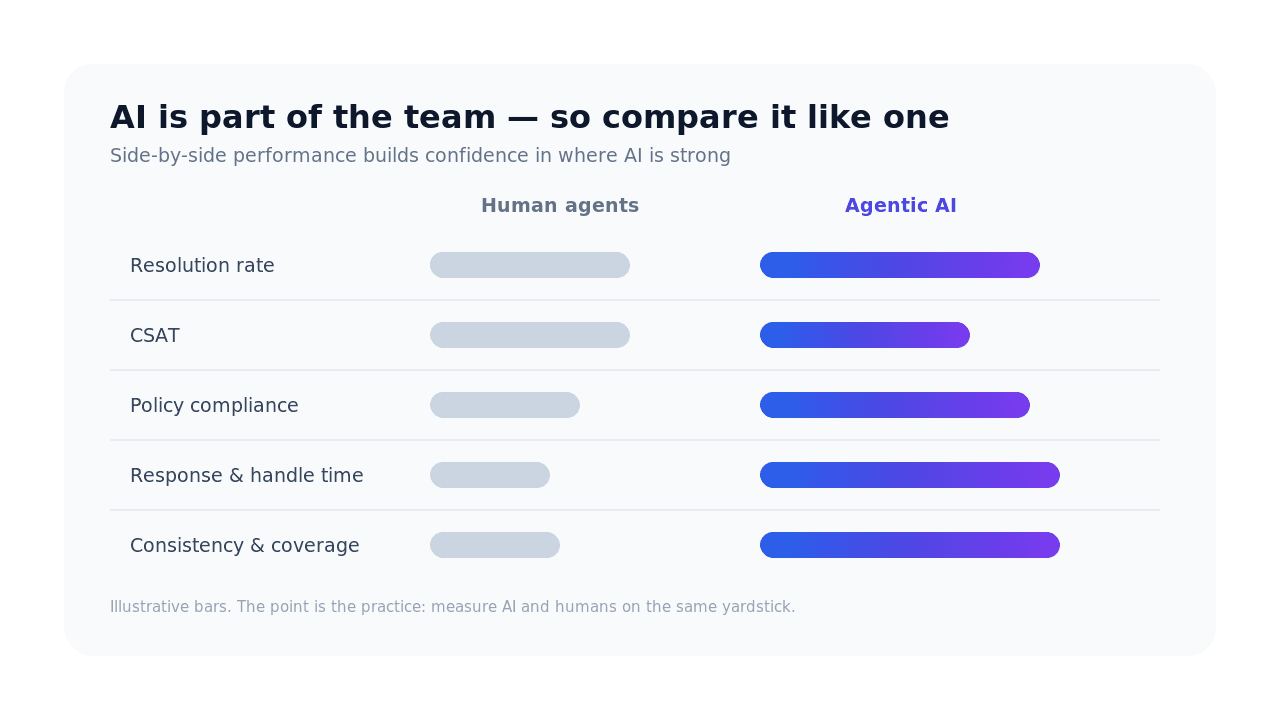
Put AI and human agents on the same scorecard and the picture clarifies fast — where the AI matches or beats your reps, and where a human should still own the case.
The Human Yardstick
Compare your AI against your human agents
There's one more evaluation that changes how leaders think about AI: comparing it head-to-head with your human agents. Put AI and human agents on the same scorecard — resolution rate, CSAT, policy compliance, handle time, consistency — and you see precisely where the AI matches or beats your reps and where it still needs a human. That replaces anxiety and hype with evidence, so you can route the work accordingly: let the AI own what it's demonstrably good at, and reserve human judgment for the rest.
This framing also defuses the internal politics of AI adoption. When AI is measured on the same yardstick as everyone else, it stops being a mysterious black box bolted onto the org and becomes a teammate with a known, inspectable track record. Continuous comparison — and continuous improvement on the gaps it reveals — is the loop that a system like Evolve™ is built to close, and it only works on a reliable, transparent AI foundation.
Due Diligence
What to ask your vendor
Before you trust any AI performance number, get these answered in writing:
Can we see the actual AI conversations — every one, not a curated sample?
Is "resolution" verified, or is it a self-reported label with no transcript behind it?
Do you evaluate content, not just outcome — policy compliance and message correctness on each response?
Is your "content" score really intent-gap scoring, which measures our taxonomy rather than your AI?
What share of interactions do you score — 100%, or a sample like legacy manual QA?
Can we compare the AI to our human agents on the same scorecard and the same metrics?
FAQ
Frequently asked questions
What is evaluable AI?+
Evaluable AI is AI you can see into, measure, and improve — where every conversation is visible to the business, performance is quantified with clear metrics, gaps are surfaced continuously, and there's a defined path to make it better. It's the opposite of a black-box deployment that reports a headline number without letting you inspect what the AI actually did.
Why is AI transparency important in customer service?+
Because AI failures are silent — an off-policy or wrong response just ships, and you learn about it later from a lost customer or a compliance issue. Transparency lets you inspect what the AI said and why, catch problems early, and satisfy procurement and regulators. In today's market, "trust us, it's proprietary" no longer clears enterprise review, which increasingly requires audit trails and human oversight.
How do you measure whether an AI is working well?+
Use two complementary lenses across every conversation. Outcome-based metrics — resolution rate, CSAT, and ROI (which factors cost with resolution and satisfaction) — tell you if the AI produces business value. Content-based QA — policy compliance, message correctness, accuracy, and tone — tells you if it's saying the right things. An AI can hit a good outcome while getting the content wrong, so you need both.
What is the difference between outcome-based and content-based AI evaluation?+
Outcome-based evaluation asks "did it get the result?" and measures resolution rate, CSAT, and ROI. Content-based evaluation asks "did it say the right thing?" and inspects each response for policy compliance, accuracy, and correctness — closer to traditional QA. Outcome metrics show business impact; content metrics catch quality problems the outcome numbers can hide. Serious deployments use both.
Is intent-gap scoring a good way to evaluate AI?+
Not on its own. Intent-gap scoring measures how often the system failed to match a message to a known intent, but the result depends entirely on how your intents are structured — coarse taxonomies flatter the AI, granular ones penalize it. Intent also oversimplifies customer service, where real cases are intertwined and multi-part. It measures your taxonomy, not whether the AI actually served the customer.
Why do only 1–2% of interactions get reviewed in traditional QA?+
Manual quality assurance is human-limited: analysts can only listen to or read a tiny fraction of conversations, so most programs sample just 1–2% of interactions and leave roughly 98% unreviewed. That sampling creates blind spots and forces decisions based on guesswork. Evaluable AI addresses this by automatically scoring 100% of interactions against consistent criteria.
How should I compare AI performance to my human agents?+
Put them on the same scorecard and measure identically — resolution rate, CSAT, policy compliance, handle time, and consistency. Because AI is now part of the team, evaluating it on the team's yardstick shows exactly where it matches or beats your reps and where humans are still needed. That evidence lets you route work confidently and improve the specific gaps the comparison reveals.
Can you evaluate AI without seeing its conversations?+
No — that's the definition of a black box. If a solution won't show the business the actual AI conversations, you can't verify resolution claims, run content QA, catch policy violations, or improve anything. Full visibility into every interaction is the foundation of evaluable AI; any metric offered without it should be treated as unverified.
See, measure, and improve every AI conversation.
Aissist.io is built to be evaluable: every interaction visible, scored on outcome and content, and compared against your human agents on one honest yardstick — with Pulse for insight and Evolve for continuous improvement.
Why automating more can make customers unhappier — and how honest measurement breaks it.
Resolution rate, CSAT & cost across 6 industries — with claimed vs. verified figures.
Per interaction, per session, per resolution — normalized to cost per resolved issue.
The ~90% figure is from Aissist's own review of AI support vendors — our competitors — and we have not published the vendor list, the sample size or the scoring criteria. It reflects how few expose real, inspectable evaluation, and it is a claim we are making about our own market, not an audited finding. Manual-QA figures (1–2% reviewed / ~98% unreviewed) are from Solidroad. Product figures are Aissist's own; individual results vary by channel mix, intent complexity, and how each team defines a resolution.
Rob Jiang
Chief AI EngineerRob is chief AI engineer at Aissist.io, with two decades of experience building conversational and agentic AI systems.