
Pulse · Agent Insight
QA and insights on AI and human agents, on standards that you define.
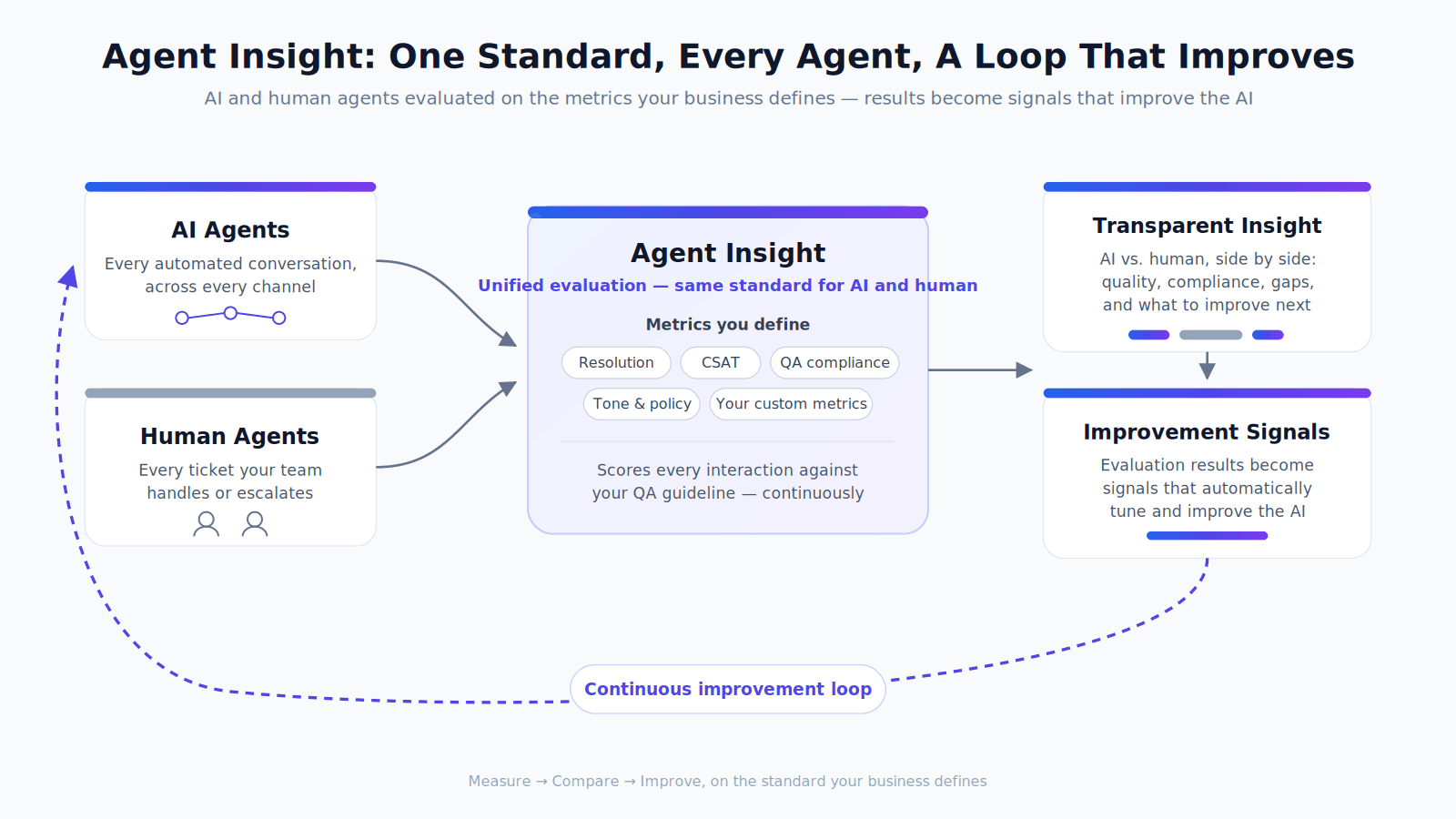
Agent Insight measures and tracks the performance of every agent in your operation — AI and human — against the same standard, using metrics your business defines. It turns AI agent evaluation from a black box into a transparent scorecard: how good is the AI, how does it compare with your team, does it comply with your QA guideline, and what should improve next.
Then it goes one step further: evaluation results become signals that drive continuous, automatic improvement of the AI itself — closing the biggest gap between “the AI is running” and “we trust what the AI is doing.”
Why It Matters
Why AI agent evaluation matters now.
Every operator who deploys AI for customer support or sales runs into the same three questions within weeks:
How good is the AI, really?
Resolution counts tell you volume, not quality. A conversation can close a ticket and still miss the policy, the tone, or the actual customer need.
How does it compare with my human agents?
Most teams evaluate AI with one set of tools and humans with another — or evaluate the AI not at all. That makes “is the AI better or worse than my team on this case type?” unanswerable, and every staffing and automation decision becomes a guess.
Does it comply with my QA guideline?
You already have a quality standard. Your call center quality assurance program spent years encoding it. If the AI isn’t scored against that same guideline, you don’t have QA coverage — you have QA coverage for the shrinking human half of your operation.
This is not a minor annoyance. Transparency of AI performance consistently ranks among the top three obstacles businesses cite when applying AI to real operations. Teams don’t stall on AI adoption because the technology can’t resolve cases — it can — they stall because they can’t see, prove, or govern the quality of what it resolves. Agent Insight exists to remove that obstacle.
One Standard
One standard for AI and human agents.
The core design decision behind Agent Insight is that AI and human agents are evaluated on the same standard, in the same system, at the same time. Every interaction — an AI-resolved conversation, a human-handled ticket, an escalation that passed through both — is scored against the same rubric.
- Quality, side by side. See resolution quality, CSAT, accuracy, and guideline compliance for AI and human agents on one dashboard, segmented by case type, channel, and language.
- QA compliance as a first-class metric. Your existing customer service QA guideline becomes the rubric. The AI is held to it on 100% of conversations — not the 1–2% sample rate typical of manual QA review.
- Grounded decisions. When AI outperforms humans on a case type, automate more of it. When humans outperform AI, route accordingly and feed the gap back into improvement. Either way, the decision rests on evidence rather than anecdotes.

Metrics You Define
Metrics you define, because there is no one-size-fits-all.
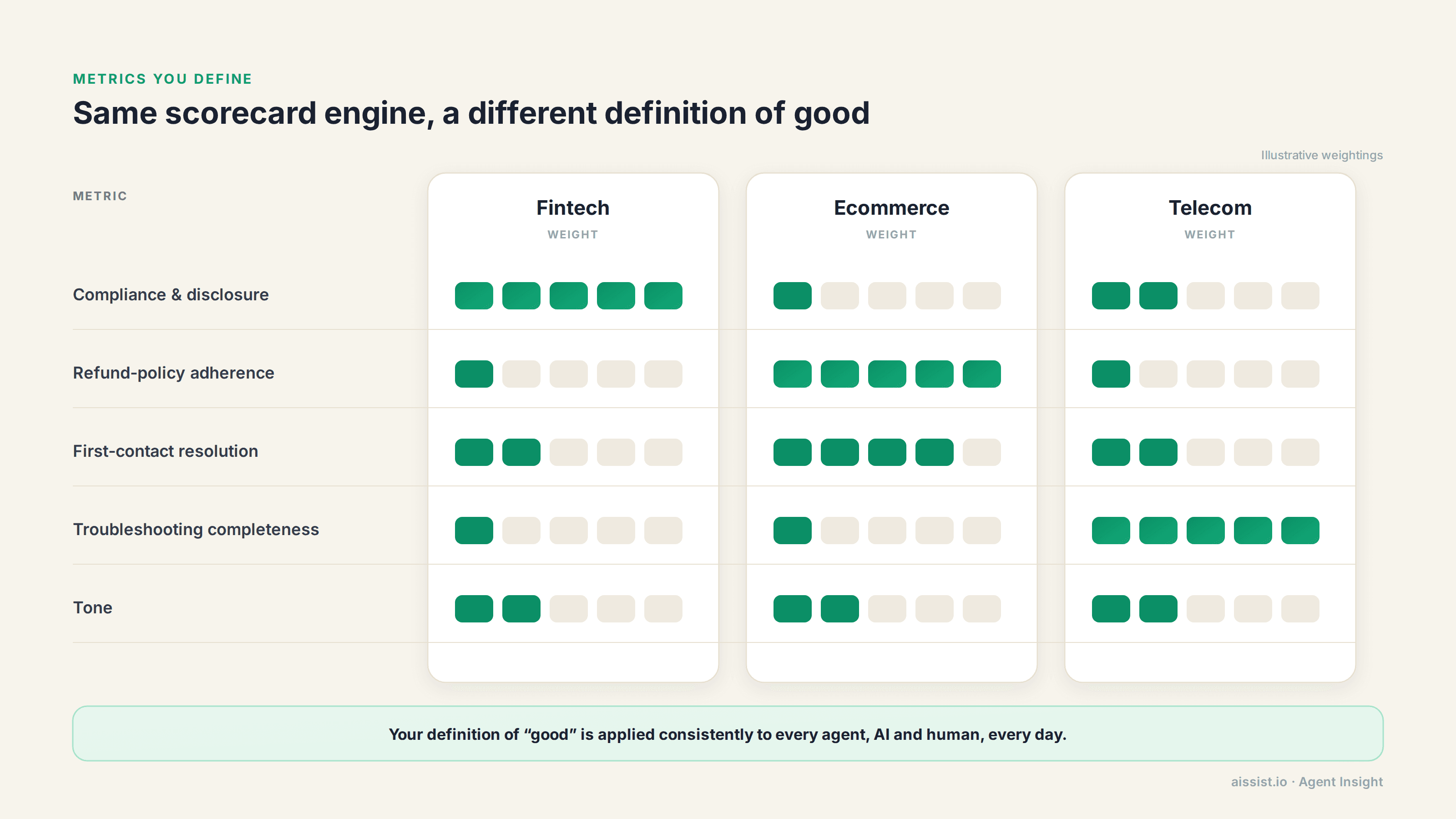
Most evaluation tools ship a fixed scorecard and ask your business to fit it. Agent Insight inverts that: you define the metrics, because quality means something different in every operation.
A fintech company weights compliance language and disclosure accuracy. An ecommerce brand weights refund-policy adherence and first-contact resolution. A telecom operator weights troubleshooting completeness across 65+ languages. Agent Insight lets each business express its own definition of “good” — resolution criteria, tone requirements, policy checks, escalation discipline, custom dimensions — and then applies that definition consistently to every agent, every day.
This is what makes the evaluation trustworthy. A generic AI quality-assurance score tells you how the vendor defines quality. A score on your own metrics tells you whether the AI is doing <em>your</em> job to <em>your</em> standard.
Delve Into Any Agent
Go deep on a single agent — trends, daily breakdown, and what to fix next.
Open any AI or human agent to see a weighted overall score trend, a day-by-day breakdown across every metric, and the metric comments captured behind each score.
From there, Agent Insight generates an assessment of what went well, what did not, and where improvement is needed — with concrete recommendations you can act on.

Delve Into Any Session
Open any session and see exactly how it was scored.
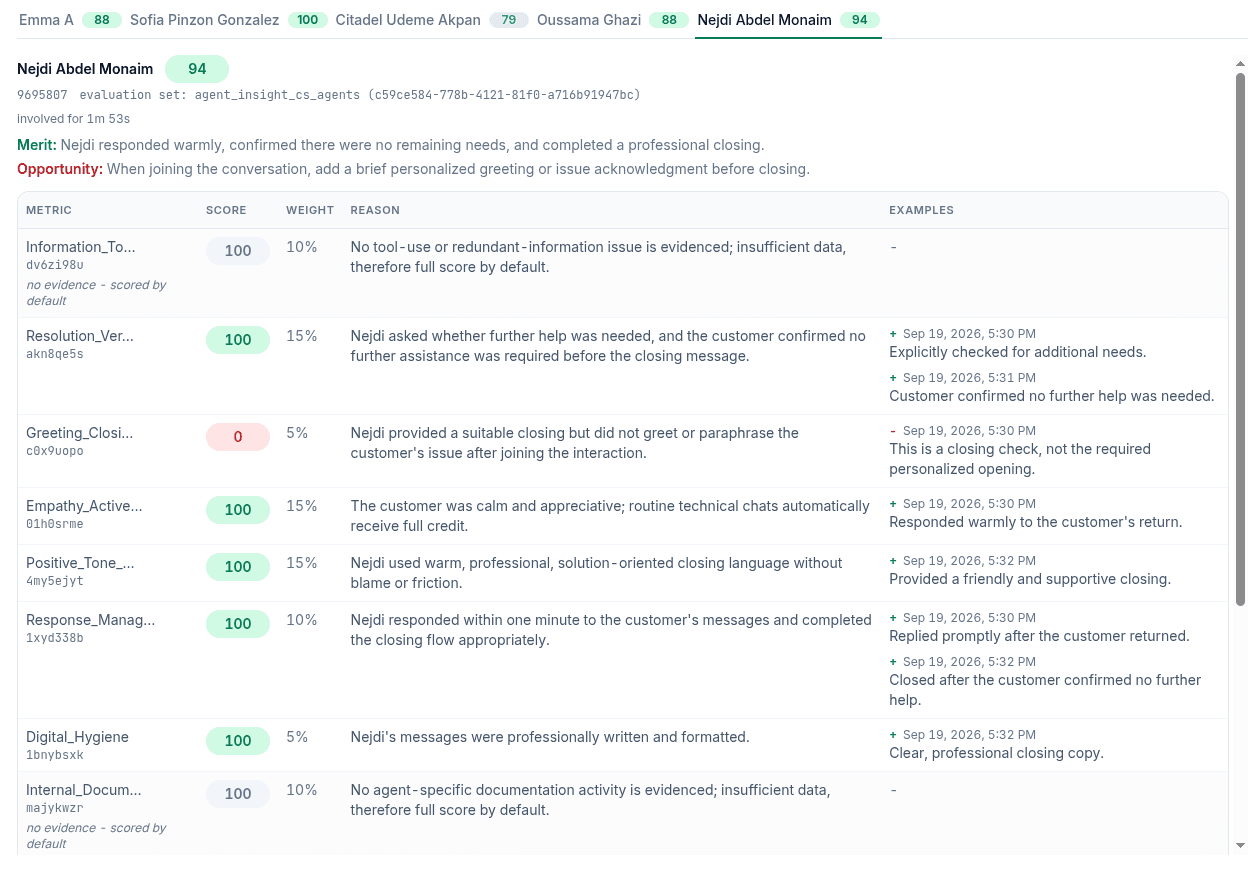
Scores tell you where to look; a session tells you what happened. Open any conversation and Agent Insight shows the whole evaluation behind its score, judged against the standard you defined rather than a generic rubric.
It opens with the two lines a coach would write — the merit and the opportunity. One session reads “clearly explained the Fair Usage Policy and possible speed reduction, then transferred the case for individualized review” against “use available account data before requesting identifiers, and begin with a personalized paraphrase of the issue.”
Below that sits every metric in your evaluation set, with its score, its weight in the total, and the reason it was given: why information gathering failed when the order data was already on file, why a generic greeting scored zero, why technical accuracy held at 100.
Each judgment links to examples from the conversation, timestamped and marked as a positive or a negative, so any score can be checked in seconds against what was actually said. Evaluation stops being an opinion and becomes something you can audit — and a disputed score is settled by evidence, not by seniority.
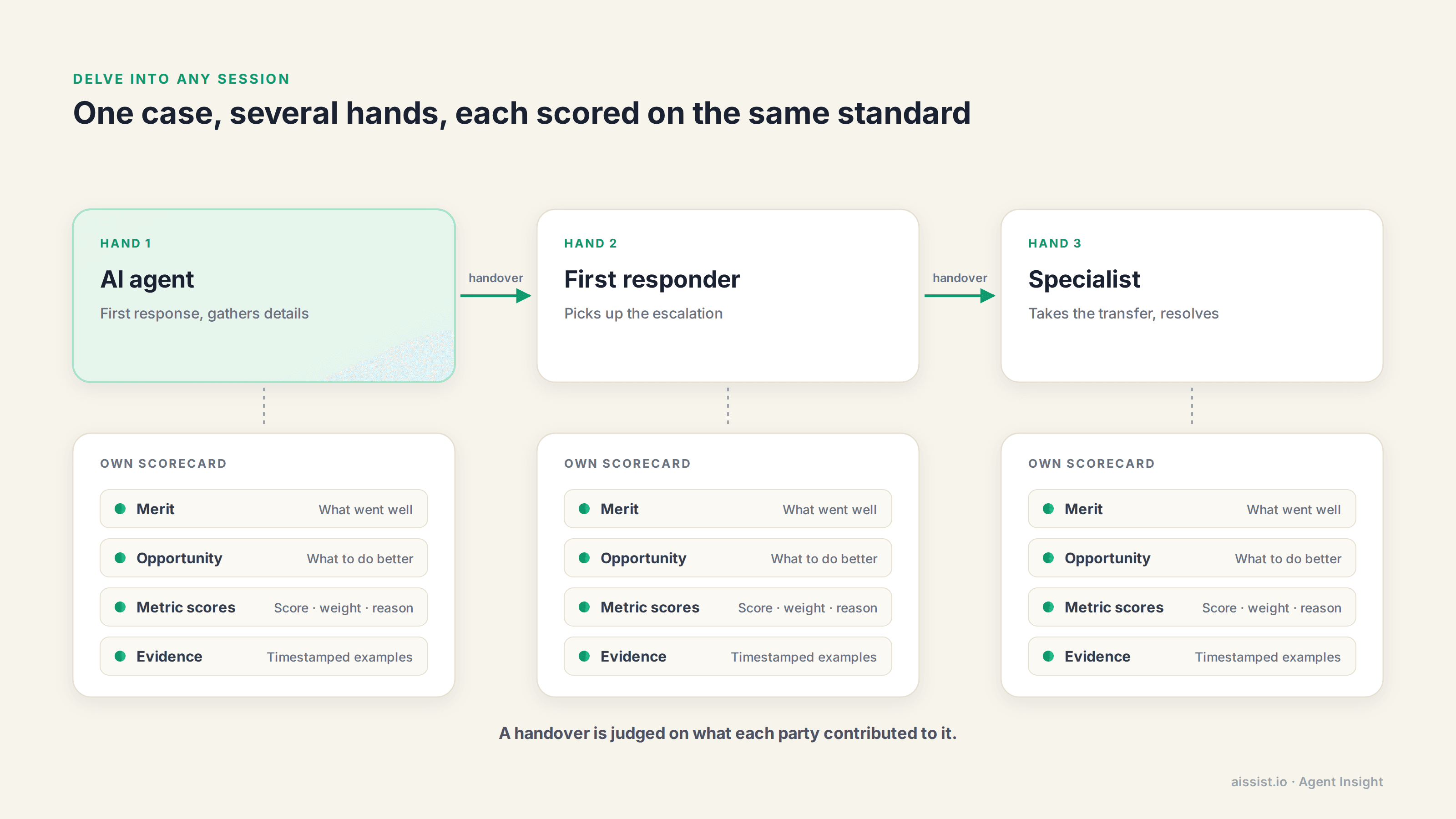
When a case passes through several hands, every agent involved is scored separately on the same standard — the AI, the first responder, the specialist who took the transfer — so a handover is judged on what each party contributed to it.
From Evaluation to Signals
Improvement that runs itself.
Measurement that ends in a dashboard is a report. Measurement that changes behavior is an operating system.
Agent Insight turns evaluation results into signals — structured findings about where quality falls short of the standard and why. Those signals feed directly into Evolve™, Aissist’s continuous optimization layer, which converts them into concrete improvements to the AI: refined guidance, corrected knowledge, sharpened escalation rules. The loop runs continuously:
- 1
Every interaction is evaluated against your metrics.
- 2
Shortfalls and drifts surface as signals, with root cause attached.
- 3
Signals drive automatic improvement of the AI’s behavior.
- 4
The next cycle of evaluation verifies the fix.
Human agents benefit from the same visibility — coaching priorities come from the same scorecard — but the defining property is that for AI agents, the loop closes automatically. Quality doesn’t depend on someone reading a report and filing a ticket. This is the difference between AI you monitor and AI that improves itself under your standard, through the platform’s AI loop.
Key Takeaways
Agent Insight makes AI agent evaluation transparent, comparable, and self-correcting. One standard covers AI and human agents; the metrics are yours, not a vendor’s template; QA compliance is checked on every conversation instead of a sample; and evaluation results become signals that continuously improve the AI through Evolve. For operators, it answers the question that blocks most AI adoption — “can I see and trust the quality of my AI?” — with evidence instead of assurances.
FAQ
Frequently asked questions.
What is AI agent evaluation?
AI agent evaluation is the practice of measuring the quality of an AI agent's work — resolution accuracy, policy compliance, tone, customer satisfaction — against a defined standard. Done well, it covers every interaction (not a sample), uses the business's own quality rubric, and produces comparable scores across AI and human agents so operators can make automation and routing decisions on evidence.
How does Agent Insight compare AI and human agents fairly?
Both are scored against the same rubric, on the same case types, using the same metrics. Because the standard is identical, differences in scores reflect real differences in performance rather than differences in how each group was measured. Results can be segmented by case type, channel, and language to keep comparisons apples-to-apples.
Can I use my existing QA guideline to evaluate AI agents?
Yes. Agent Insight is built around business-defined metrics, so your existing call center quality assurance rubric — policy checks, tone requirements, resolution criteria, compliance language — becomes the evaluation standard. The AI is then scored against it on every conversation, extending your QA program to the automated side of your operation without rewriting it.
What agent performance metrics can I track?
Any metric your business defines. Common dimensions include resolution quality, first-contact resolution, CSAT, QA guideline compliance, policy and disclosure accuracy, tone, escalation discipline, and handle efficiency — plus fully custom metrics specific to your industry. There is deliberately no fixed scorecard, because no single set of metrics fits every operation.
How is this different from traditional call center quality assurance?
Traditional QA reviews a small manual sample — often 1–2% of interactions — covers only human agents, and produces reports that someone must act on. Agent Insight evaluates 100% of interactions, covers AI and human agents on one standard, and converts findings into signals that automatically improve the AI, closing the loop without manual follow-through.
How do evaluation results actually improve the AI?
Evaluation findings become structured signals — what fell short, on which cases, and why. Those signals feed Evolve, Aissist's continuous optimization layer, which translates them into concrete changes: refined guidance, corrected knowledge, better escalation rules. The next evaluation cycle then verifies whether the fix worked, so quality compounds over time.
Why is transparency of AI performance such a barrier to adoption?
Because businesses can't govern what they can't see. Without transparent evaluation, operators can't prove the AI meets their quality bar, can't compare it with their team, and can't identify what to fix — so adoption stalls regardless of how capable the AI is. Transparency of AI performance consistently ranks among the top three obstacles to applying AI in business operations, which is the gap Agent Insight is designed to close.
See how every agent performs — on your standard.
Agent Insight is part of Pulse in the AI Operational Layer. Book a working session and we will map it onto your real traffic and QA standards.