
Which Reliable AI Automation Tools Are People Using Daily?
There is no shortage of AI automation tools in customer support right now. New products launch constantly, but once you look past demos and feature lists, a more practical question shows up: which AI tools are teams actually using every day, and what kind of work are those tools really handling?
Not all AI automation tools operate the same way. Some help agents handle tickets faster. Others automate structured workflows. A smaller group is moving toward AI that can complete tasks end to end instead of only suggesting replies or giving preset answers.
This article breaks down the tools teams are actively using, what kind of automation each one supports in practice, and where human involvement still shows up. For a deeper look at the adoption problem itself, see Reliable AI.
Zendesk AI: An Added Layer for Efficient Customer Support
Many support teams already work inside Zendesk, so Zendesk AI often becomes part of daily operations quickly.
In practice, teams use Zendesk AI to:
- read incoming tickets
- suggest responses based on the knowledge base
- categorize and route requests more efficiently
This helps agents spend less time drafting replies and deciding where tickets belong. Over time, that consistency can improve resolution speed and make common issues more predictable to manage.
1. Aissist.io
Where It Excels
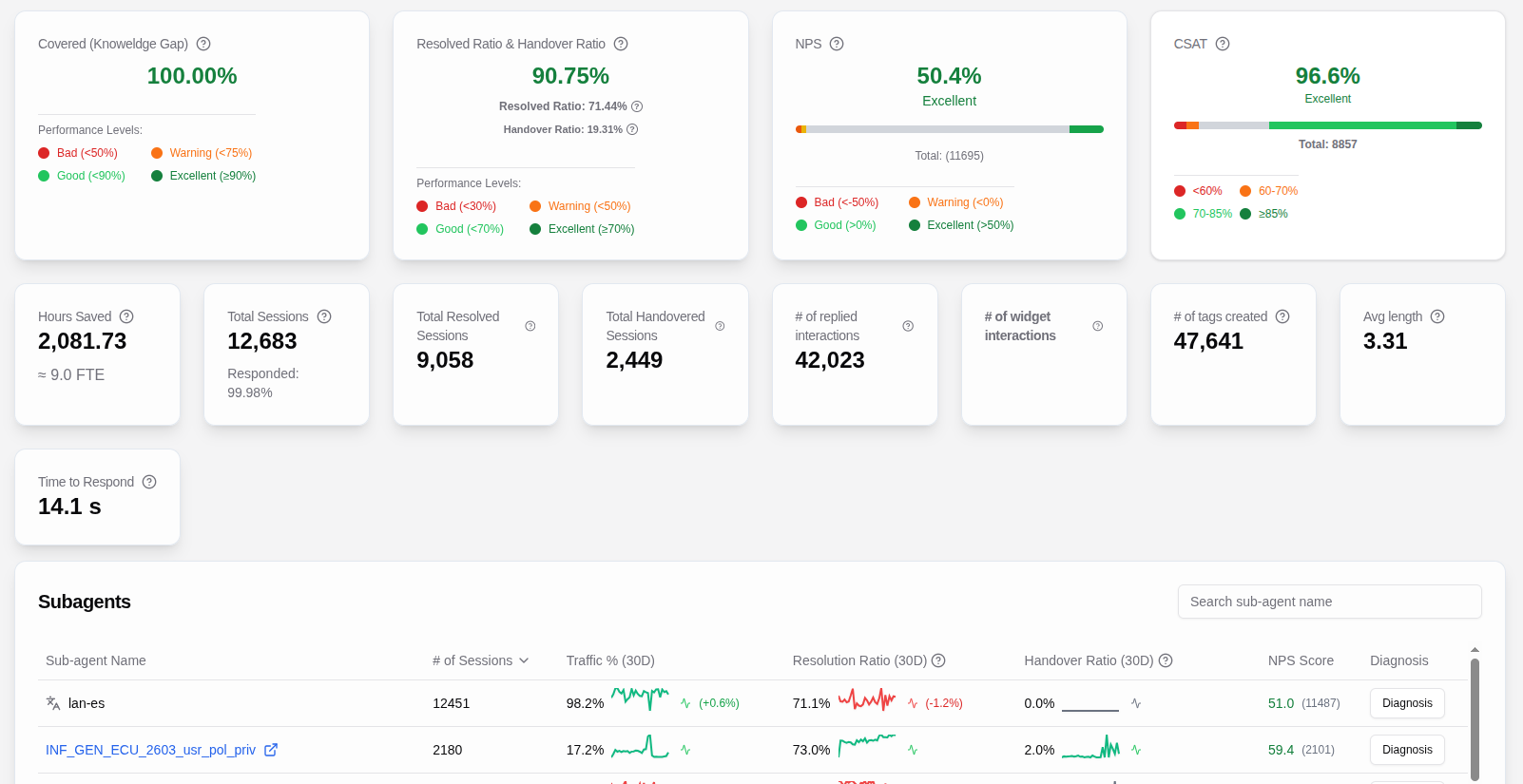
Aissist.io is built to handle complex, multi-step scenarios across systems and teams, including refunds, account changes, escalations, and other operational workflows. By executing end-to-end workflows with fewer handoffs, it can reduce manual effort, shorten resolution time, increase conversion, and improve CSAT.
It is also designed to stay relatively easy to operate, so teams can deploy sophisticated automation without adding major operational overhead.
What to Know
This type of execution-focused AI is still relatively new. It usually requires clearer workflow design than traditional chatbot tools. That said, Aissist.io is positioned around reliability in real-world scenarios, especially when the work spans multiple steps and systems.
2. Zendesk AI

Where It Works Best
Zendesk AI works well in structured environments where support requests follow repeatable patterns. If a team already has a well-maintained help center and organized support workflows, Zendesk AI can improve efficiency without requiring large process changes.
Limitations to Keep in Mind
Zendesk AI still depends on human agents for complex execution. It improves decision support, response speed, and routing, but edge cases and workflow completion still usually require a person. In that sense, it remains more assistive than autonomous.
Intercom Fin: Handling Repetitive Conversations at Scale
Teams handling high volumes of repetitive support conversations often use Intercom Fin. It is designed for frontline customer conversations where large volumes of common questions show up every day.
On a typical day, Fin:
- answers customer questions using help center content
- handles simple and repetitive queries
- resolves straightforward issues before they reach an agent
For teams dealing with high volumes of repetitive requests, that can noticeably reduce ticket volume.
Where It Works Best
Fin is most effective in environments with strong documentation and predictable customer questions. Companies with detailed help centers usually get the most value, especially when speed and containment are top priorities.
Limitations to Keep in Mind
Fin starts to show limits when a request goes beyond conversation. If an issue requires backend action, account changes, or an unusual workflow, the task usually has to be handed to a human.
3. Ada: Reliable Automation for Clearly Defined Processes
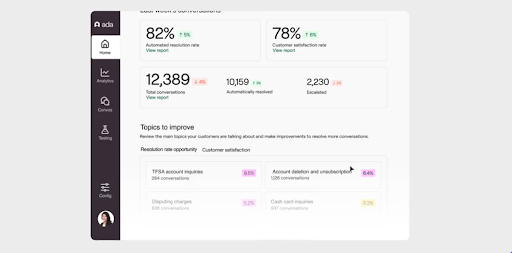
Ada takes a more structured approach to customer support automation. Instead of relying heavily on open-ended AI responses, it lets teams build guided workflows for specific use cases.
That makes it useful for repeatable processes such as:
- order tracking
- password resets
- basic subscription changes
When customers interact with Ada, they are usually guided through predefined flows designed to resolve common issues without involving an agent.
Where It Works Best
Ada performs best in teams with predictable, clearly defined workflows. In those environments, it can consistently reduce the burden on human representatives handling routine requests.
Limitations to Keep in Mind
When a request falls outside predefined paths, Ada becomes less effective. It does not adapt as well to unexpected or more complex issues, so escalation remains an important part of the process.
4. Forethought: Making Large Support Queues More Manageable
Forethought is often used by teams dealing with large support volumes. Its value is less about replacing support work and more about helping teams manage that work better.
It commonly helps with:
- triaging incoming tickets
- prioritizing requests
- surfacing relevant information for agents
In daily use, it acts more like an AI support layer that improves organization and response speed.
Where It Works Best
Forethought is useful for teams with high ticket volume where prioritization and organization are major challenges. It adds structure without requiring a full operational redesign.
Limitations to Keep in Mind
Like Zendesk AI, Forethought does not take ownership of the task itself. It improves how decisions are made, but actual execution still stays with human agents.
What These Tools Are Actually Used For
One pattern is clear: these tools are not interchangeable. They are being used for different layers of work.
Some tools are mostly used for:
- speeding up agent responses
- reducing repetitive conversations
- organizing tickets and requests
Others are used for:
- handling multi-step workflows
- interacting with backend systems
- completing requests without human handoffs
That difference is what really matters when evaluating the best AI tools for customer service automation. The key question is not which platform is best in the abstract. It is what kind of work you need automated, and how reliably the tool handles that work every day.
What Most Teams Are Moving Toward Next
Choosing an AI tool for customer support is less about adding AI for its own sake and more about understanding where your team is in its automation maturity.
Most teams do not stay at one automation layer forever. They gradually move toward systems that reduce the actual workload handled by human agents. If you are exploring that shift, execution-focused platforms such as Aissist.io represent the next step beyond response drafting and simple containment.
Final Takeaway
The AI tools teams use most often tend to map to specific types of work:
- Zendesk AI and Forethought improve support operations and agent efficiency
- Intercom Fin helps contain repetitive conversations
- Ada handles structured, repeatable workflows
- Aissist.io focuses on end-to-end workflow execution
If the goal is only to answer more tickets faster, assistive AI tools may be enough. If the goal is to reduce operational workload directly, teams are increasingly moving toward AI systems that can complete the work itself.