
How End-to-End AI Automation Resolves Real-World Business Challenges
When businesses start exploring AI tools, the conversation often begins with polished demos and idealized workflows. Teams that are focused on outcomes ask a tougher question: how does AI handle real work when that work is messy, unpredictable, and high-stakes?
That is where end-to-end AI automation becomes practical. Instead of only suggesting responses, these systems combine reasoning, data retrieval, and action execution to resolve business needs across different systems, teams, and customer contexts.
This article breaks down where end-to-end AI automation helps most, the business challenges it addresses, and where human oversight still matters.

Why End-to-End AI Automation Matters
AI started as an assistive layer for repetitive work, but the demand has shifted beyond suggestions.
Operations and support teams now deal with:
- increasing ticket volume
- inconsistent responses across languages or regions
- cross-system workflows that require coordination
- rising customer expectations for immediate and accurate outcomes
As a result, organizations are moving toward systems that do not just assist human agents, but can complete meaningful parts of the work themselves.
How End-to-End AI Automation Works in Practice
The core difference is that end-to-end systems can combine understanding, logic, and execution. They do not stop at the response layer.
Handling Complex Support Scenarios
Early automation worked best in predictable cases such as password resets, order status checks, and simple FAQs. Real business environments are more complicated.
Many customer inquiries require a system to:
- pull data from multiple backend systems
- apply conditional logic
- take actions across several tools
- record outcomes for compliance or auditing
That is where end-to-end automation becomes valuable. Instead of telling a customer that a refund was initiated, the system can verify the order, process the refund, update records, and send confirmation in one connected flow.
Making Multilingual Support More Reliable
For digital businesses serving customers in multiple languages, consistency is difficult to maintain.
Traditional automation often struggles with language quality as complexity grows. End-to-end systems can do better when they combine structured data with language understanding, helping preserve clarity and consistency across regions.
Teams using this model often see:
- fewer translation errors
- faster responses in non-English channels
- more consistent tone and execution across regions

Reducing Organizational Friction and Manual Handoffs
One of the biggest hidden costs in operations is the amount of work that gets passed from one person or team to another.
In support, a single ticket may require billing verification, policy interpretation, fulfillment action, and follow-up communication. Each handoff introduces delay, context loss, and coordination overhead.
End-to-end automation reduces that friction by packaging those steps into one workflow. In practice, that often means:
- fewer repeated handoffs
- fewer waiting periods between teams
- less multi-party coordination for routine operations
Even when headcount stays the same, teams often see operational gains because the workflow itself becomes simpler.
Where Human Oversight Still Matters
Advanced automation does not remove the need for people in every case. Reliable systems still depend on human involvement where ambiguity, risk, or judgment is high.
Human escalation is especially important for:
- complex or ambiguous customer intent
- compliance-sensitive decisions
- low-confidence scenarios with incomplete data
The goal is not to force AI to answer everything. The goal is to route uncertain cases safely while letting automation handle the rest.
What Changes in Practice
When end-to-end automation is deployed well, teams usually see:
- fewer manual touchpoints
- faster resolution cycles
- lower error rates
- more consistent execution across teams and regions
The biggest benefit is not just speed. It is reliability. Work that once depended on coordination becomes more structured, repeatable, and easier to manage.
Final Takeaway
If your current systems assist but do not execute, end-to-end AI automation is the next practical step.
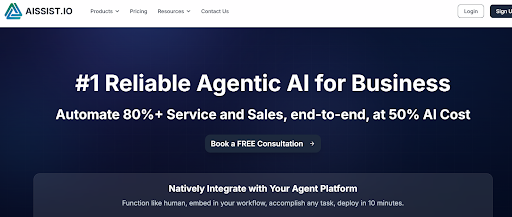
Execution-focused platforms such as Aissist.io are built around this shift. They connect response generation, workflow logic, and system actions so teams can handle more complex operations without adding the same amount of overhead.
FAQs
What is end-to-end AI automation?
It is automation that combines reasoning, decision-making, and system actions in one connected flow so tasks can be completed, not just answered.
Can end-to-end AI automation handle complex business processes?
Yes. When workflows are clearly defined and integrated with the right systems, it can manage multi-step and cross-functional tasks.
Is it safe for critical operations?
Yes, if escalation rules, validation steps, and human oversight are built in at the right points.