
AI Customer Service · Buyer's guide
How to choose a customer service AI vendor: 3 things that matter most
Choosing a customer service AI vendor is one of the higher-stakes software decisions a support or CX leader will make this year — the wrong pick quietly taxes every ticket, every agent, and every customer for years. Get three things right and the rest of the evaluation falls into place.
By Lucía Martínez Díaz, Director of AI Success · 8 min read · Updated July 2026
- →Define your own success metrics and priorities — a fixed reference for reconciling the different ways vendors define resolution, CSAT, and cost, so you can compare them objectively.
- →Trial on real traffic, at meaningful scale, before you commit — production behaves nothing like a scripted demo, and most pilots die on the way to production.
- →Aim for operational excellence, not just automation — the bigger prize is quality, efficiency, better decisions, and customer outcomes, not deflection alone.
Before you make a long-term commitment, focus on three things: define your own success metrics, test the solution on real traffic at meaningful scale, and set the bar at operational excellence rather than automation alone. Get those three right and the rest of the evaluation — features, integrations, pricing — falls into place around outcomes that actually matter to your business.
These are the same principles we recommend to both prospective and existing customers evaluating agentic AI for support. The rest of this article unpacks each one, with the data and the practical questions to put in front of every vendor.
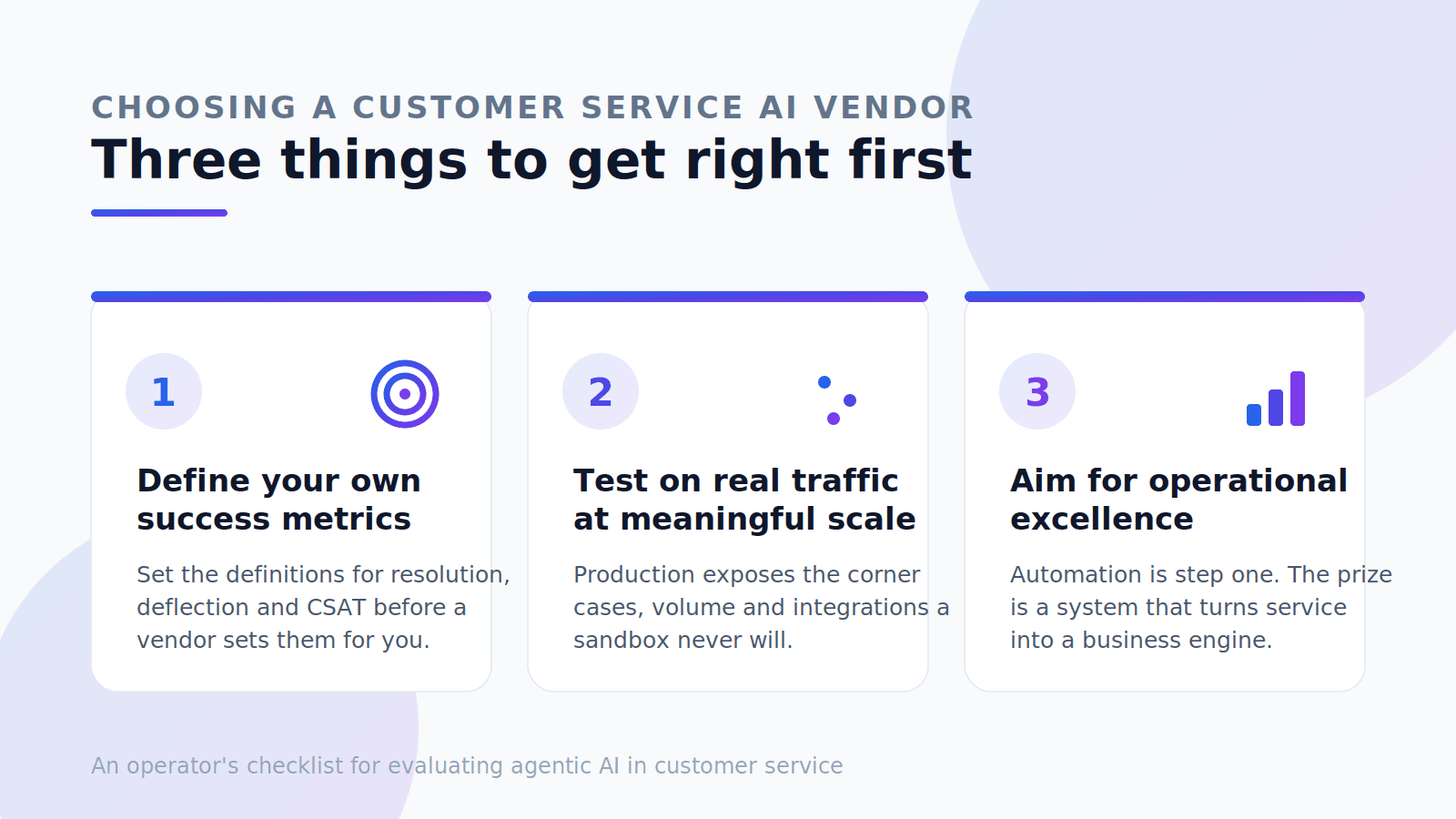
Three things to get right when choosing a customer service AI vendor — define your own metrics, trial on real traffic, aim for operational excellence.
Principle 01
Define your own success metrics before a vendor defines them for you
The single most common evaluation mistake is letting the vendor supply the scorecard. Every customer service AI vendor arrives with a favorite headline number, and those numbers are rarely computed the same way twice. If you don't walk in with your own definitions, you end up comparing one vendor's best-case metric against another's — and choosing on marketing, not merit.
The point of owning your metrics is to give yourself a fixed reference point for navigating the tangle of vendor-defined metrics. Every vendor reports on its own definitions of resolution, deflection, and CSAT; your job is to see through those differences rather than take each at face value. When you have a clear internal definition of what “resolution” or “cost per resolution” actually means to you, translating each vendor's number onto that common yardstick — and comparing them apples-to-apples — becomes straightforward instead of a guessing game.
Start by naming the outcomes that matter most to your business. For most support and sales teams that means some combination of end-to-end resolution rate, customer satisfaction (CSAT), cost per resolution, first-contact resolution, handle time, and escalation rate. Then decide how each should be measured reliably, consistently, and objectively — so you can hold every vendor's figure up against the same standard, on the same terms.
The most important distinction to pin down is resolution versus deflection, because vendors blur the two constantly. Deflection counts a conversation the bot handled without a human — which includes the frustrated customer who gave up and left. Resolution means the customer's issue was actually solved end-to-end. A 70% “deflection” rate and a 70% “resolution” rate describe completely different realities for your customers and your costs. Write your own definition down, and hold every vendor to it. For a deeper treatment of the difference, see our note on deflection vs. resolution.
Do the same for CSAT (survey method, timing, response scale, and whether AI-handled conversations are measured separately), for cost (does “cost per resolution” include the human review, integration, and escalation overhead, or only the model call?), and for quality (who audits transcripts, and against what rubric?). Ambiguity here is not harmless — it is where inflated claims hide.
A quick, self-contained test you can apply to any vendor: ask them to compute your top three metrics using your definitions, on a sample of your own tickets, and to show the raw transcripts behind the numbers. A vendor confident in real outcomes will do this readily. One that resists, or insists on its own definitions, is telling you something.
Objective, transcript-level evidence — not slideware — is what a reliable evaluation rests on. Published, methodology-transparent figures help too; our own AI customer service benchmarks exist precisely so buyers can see how resolution, CSAT, and cost are defined and measured rather than taking a single headline number on faith. With that shared yardstick in hand, everything downstream gets easier: vendor claims reconcile against a single standard, RFP scoring becomes objective, pilots produce comparable results, and the eventual business case rests on numbers you trust because you defined them.
Principle 02
Trial on real traffic, at meaningful scale, before you commit
A controlled pilot tells you whether a system can work. Real production traffic tells you whether it does. Those are different questions, and the gap between them is where most customer service AI projects quietly fail.
The data on this is sobering. MIT's State of AI in Business 2025 report found that roughly 95% of enterprise AI pilots delivered zero measurable return, with only about 5% making it into production with demonstrable value — and the researchers attributed the failures largely to non-technical factors like poor integration with existing systems and misalignment with real workflows, not model quality. Independent industry data tells the same story: Prosigns' State of Enterprise AI 2026 reports that 82% of enterprise AI initiatives launched in 2024 had still not reached production by early 2026, and 47% of pilots were killed before ever reaching production. McKinsey's 2025 State of AI survey rounds it out — around 88% of organizations now use AI in at least one function, but nearly two-thirds have not begun scaling it, and only about 6% qualify as high performers. Adoption is easy; scaling to real value is rare.
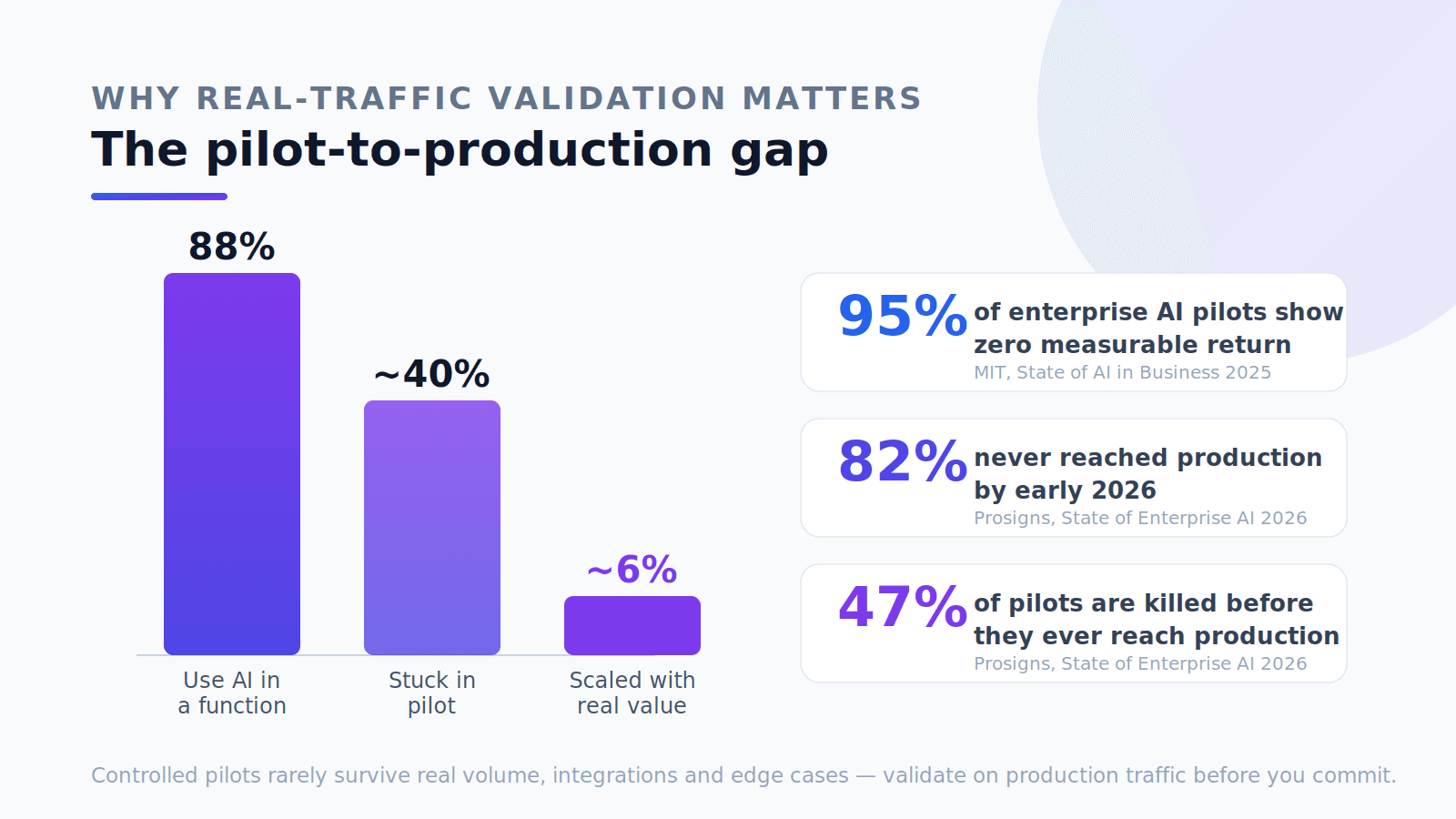
The pilot-to-production gap: most AI pilots deliver no measurable return, and most initiatives never reach production. Live traffic is what separates the ones that do. Sources: MIT, Prosigns, McKinsey.
The Sandbox Problem
Why a solution that aced the pilot falls apart in production
Because the sandbox systematically hides the things that break AI in the real world:
- 1
Corner cases. Real customers ask questions no test script anticipated — mixed intents, missing account context, angry escalations, edge-case policy exceptions. Volume surfaces the long tail a curated pilot never will.
- 2
Scale. Behavior under ten test conversations is not behavior under ten thousand concurrent ones. Latency, rate limits, queueing, and cost per resolution only show their true shape at load.
- 3
Integration reality. Live systems have stale CRM records, half-configured helpdesk fields, flaky third-party APIs, and permission quirks. Whether the AI can act reliably through your actual stack is invisible in a clean demo environment.
- 4
Consistency over time. A model that answers well on Monday must answer the same way on Friday, across channels, without drift. Only sustained real traffic reveals consistency.
The value of real traffic is precisely that it gives you the corner cases, the scalability, and the consistency you can never reproduce in a sandbox. So structure your evaluation around it. Run the vendor on a meaningful slice of live traffic — a real channel, a real queue, real customers — for long enough to see the long tail, with human oversight in place. Watch how it fails as closely as how it succeeds: graceful escalation, honest “I don't know,” and no fabricated answers matter more than a high score on easy tickets.
This is also where enterprise fundamentals get stress-tested — governance, reliable AI without hallucination, data handling, and clean handoff to humans. A vendor that deploys quickly and integrates natively with the helpdesk stack you already run makes this kind of real-world test practical rather than a six-month project.
The takeaway is simple: never sign a long-term agreement on the strength of a demo or a scripted pilot alone. Insist on production validation, at scale, on your traffic. It is the single most reliable predictor of whether the tool will actually deliver once the contract is signed.
Principle 03
Aim for operational excellence, not just automation
The third principle is the one that separates a good three-year outcome from a mediocre one. Automation is usually only the first step — and often not the most difficult one. Deflecting or auto-answering a slice of tickets is table stakes. The far greater opportunity is to use AI to improve the entire operation and, ultimately, the broader business. If you evaluate a vendor purely on “how much can it automate,” you will almost certainly miss the bigger opportunities that show up later.
Operational excellence means the system does more than close tickets. It generates actionable insight, surfaces issues with minimal effort, and continuously optimizes performance with limited human intervention. A strong customer service AI vendor should improve four things at once: quality (better, more consistent answers), efficiency (lower cost per resolution, less manual triage), decision-making (clear signal on what is changing in your customer base and why), and customer outcomes (higher satisfaction and fewer repeat contacts).
Concretely, that looks like a platform with three capabilities working together rather than a single automation bot:
An automation layer
Resolves support and sales cases end-to-end across your channels — reasoning through complex cases, not just matching FAQs.
AgentMesh™An insight layer
Reads every ticket, agent, and operation in real time to tell you what is changing and why — turning your support queue into a live sensor for the business.
Pulse™A continuous-optimization layer
Catches change early and recommends or executes the next operational move, so performance improves week over week instead of decaying.
Evolve™The buying question follows directly. Instead of asking only “how much can you automate?”, ask the vendor: What insight will this generate that we don't have today? How will it help us make better operational decisions? And how does it keep improving after go-live without a team of engineers babysitting it? Those questions expose whether you are buying a point tool or an operational layer that compounds in value.
At its best, AI transforms customer service from a cost center into a genuine business engine — a source of insight, efficiency, and customer loyalty rather than a line item to minimize. That is the outcome worth optimizing your vendor choice around.
In Short
Key takeaways
Choosing a customer service AI vendor comes down to three disciplines that reinforce each other:
Define your own metrics.
Especially the resolution-versus-deflection distinction — so you compare vendors on outcomes you trust rather than on their marketing.
Validate on real traffic.
At meaningful scale. The data is unambiguous that most pilots die before production, and only live traffic exposes corner cases, scale, and consistency.
Set the bar at operational excellence.
Not automation — so the system generates insight and compounds in value instead of plateauing after go-live.
Do those three, and you will choose a partner that turns support into a business engine — not just another chatbot.
FAQ
Frequently asked questions
What should I look for when choosing a customer service AI vendor?+
Focus on three things before features or price. First, define your own success metrics — resolution rate, CSAT, cost per resolution — and how you'll measure them, so you compare vendors objectively. Second, insist on testing the solution on your real production traffic at meaningful scale, not just a scripted demo. Third, evaluate whether it drives operational excellence — insight and continuous improvement — rather than automation alone.
What is the difference between resolution and deflection in AI customer service?+
Deflection counts any conversation handled without a human agent, which includes customers who gave up and abandoned the chat. Resolution means the customer's issue was actually solved end-to-end. They can produce very different numbers from identical traffic, so a high deflection rate does not mean happy customers. Always ask a vendor to report true end-to-end resolution, defined your way, with transcripts to back it up.
Why do so many AI customer service pilots fail to reach production?+
MIT's State of AI in Business 2025 found about 95% of enterprise AI pilots delivered zero measurable return, and Prosigns' 2026 data shows 82% of initiatives never reached production. The failures are usually non-technical: weak integration with existing systems, misalignment with real workflows, poor data quality, and governance gaps. Controlled pilots hide the volume, edge cases, and integration realities that only appear in live production traffic.
How long should I run a customer service AI pilot before committing?+
Run it long enough on real traffic to see the long tail of edge cases, not just easy tickets — typically several weeks of live volume on a real channel or queue with human oversight, rather than a fixed number of days. The goal is meaningful scale and variety: enough conversations to expose corner cases, load behavior, integration issues, and consistency over time. Duration matters less than exposure to genuine production complexity.
Which metrics matter most when evaluating a customer service AI vendor?+
The core set is end-to-end resolution rate, CSAT on AI-handled conversations, cost per resolution (including review and escalation overhead), escalation and containment rates, and answer quality audited against a transcript-level rubric. Define each precisely and apply the same definition to every vendor. Reliability metrics — hallucination rate, correct escalation, data governance — matter just as much as headline automation numbers for any enterprise deployment.
What questions should I ask a customer service AI vendor in an RFP?+
Ask them to compute your top three metrics on a sample of your own tickets, using your definitions, and to show the raw transcripts. Ask how they handle edge cases, escalation, and hallucination. Ask what insight the platform generates beyond closing tickets, how it integrates with your existing helpdesk and CRM, how fast it deploys, and how it keeps improving after go-live without heavy engineering effort.
Is automation enough, or should I expect more from customer service AI?+
Automation is the starting point, not the destination. The larger value is operational excellence — a system that also surfaces real-time insight, improves quality and efficiency, informs decisions, and continuously optimizes with minimal human intervention. Evaluating on automation alone leaves that value on the table. The best platforms turn customer service from a cost center into a business engine that compounds in value over time.
How is agentic AI different from a traditional customer service chatbot?+
Traditional chatbots match questions to scripted answers or FAQ content and tend to break on complexity. Agentic AI uses multiple reasoning agents that can understand intent, pull context from your systems, take actions across your stack, and resolve cases end-to-end — then escalate cleanly when needed. That difference is why agentic systems can target genuine resolution and operational improvement rather than simple deflection.
Your metrics, your traffic, operational excellence.
Aissist.io is built to be evaluated on your definitions and your live traffic — genuine resolution, not deflection — with automation, insight, and continuous optimization working as one operational layer.
Resolution rate, CSAT & cost across 6 industries — with claimed vs. verified figures.
Why automating more can make customers unhappier — and how to break it.
Thirteen platforms audited on published resolution rate, definition of resolved and billing unit.
Statistics cited from MIT's State of AI in Business 2025, Prosigns' State of Enterprise AI 2026, and McKinsey's State of AI in 2025. Product figures are Aissist's own. Individual results vary by channel mix, intent complexity, and how each team defines a resolution.
Lucía Martínez Díaz
Director of AI SuccessLucía is director of AI success at Aissist.io, leading the work of turning AI deployments into measured business impact. She has over 8 years of industry experience building AI systems, particularly in the customer service domain.