Aissist vs Decagon: Multi-Agent vs Single-Agent AI
Most AI support platforms promise the same things — faster responses, lower ticket volume, better customer experiences. But many buyers focus on features and overlook the architecture underneath. That hidden layer is what decides whether an AI system holds up on complex tasks.
The Aissist vs Decagon comparison captures a real fork in customer-support technology: some platforms use a single primary AI agent to handle everything, while others use specialized agents that coordinate across workflows. As support environments grow more connected and ticket volumes rise, the choice between a multi-agent platform and a single-agent system matters more than any feature list.
For a full, dimension-by-dimension breakdown, see our Aissist vs Decagon head-to-head — and for where both land among the field, the Top Agentic AI for Customer Service guide.
Understanding the Architectural Difference
These are two different frameworks, and the most important difference isn't in the user interface — it's in the behind-the-scenes decision-making. One approach puts a central agent in charge of every duty. The other distributes tasks among agents that specialize and collaborate to complete the work.
Single Primary Agent
In a single-agent architecture, most responsibilities are delegated to one AI system. That agent takes the request, gathers context, decides, and responds. It's worth understanding why many organizations still choose this model before evaluating it:
- One central agent coordinates conversations, decisions, and workflows in a single reasoning process.
- Fewer moving parts make implementation simpler and deployment faster.
- Data access and workflow management stay inside one primary decision-making engine.
- For smaller support operations, maintenance requirements can stay fairly consistent.
- In simpler settings, a leaner architecture with fewer administrative layers can be an advantage.
Multi-Agent System
A multi-agent framework breaks work into specialized AI agents. Each has a defined role, but they also collaborate to accomplish larger tasks. As support environments become more connected, many organizations hit a bottleneck with a single reasoning engine — which has driven interest in architectures built on collaboration, delegation, and specialized execution:
- Specialized agents handle triage, routing, research, and resolution independently.
- Workloads are distributed rather than concentrated in one central reasoning process.
- Agents interact and share information across operational areas.
- Complex workflows are broken into specialized tasks with coordinated execution paths.
- Distributing responsibilities across several intelligent agents leads to scalability.
What Decagon's Single-Agent AI Offers
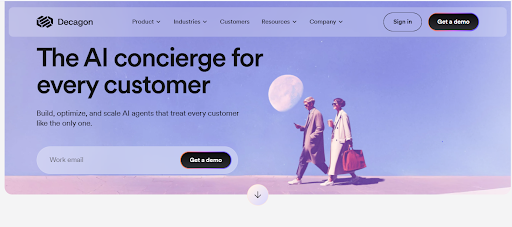
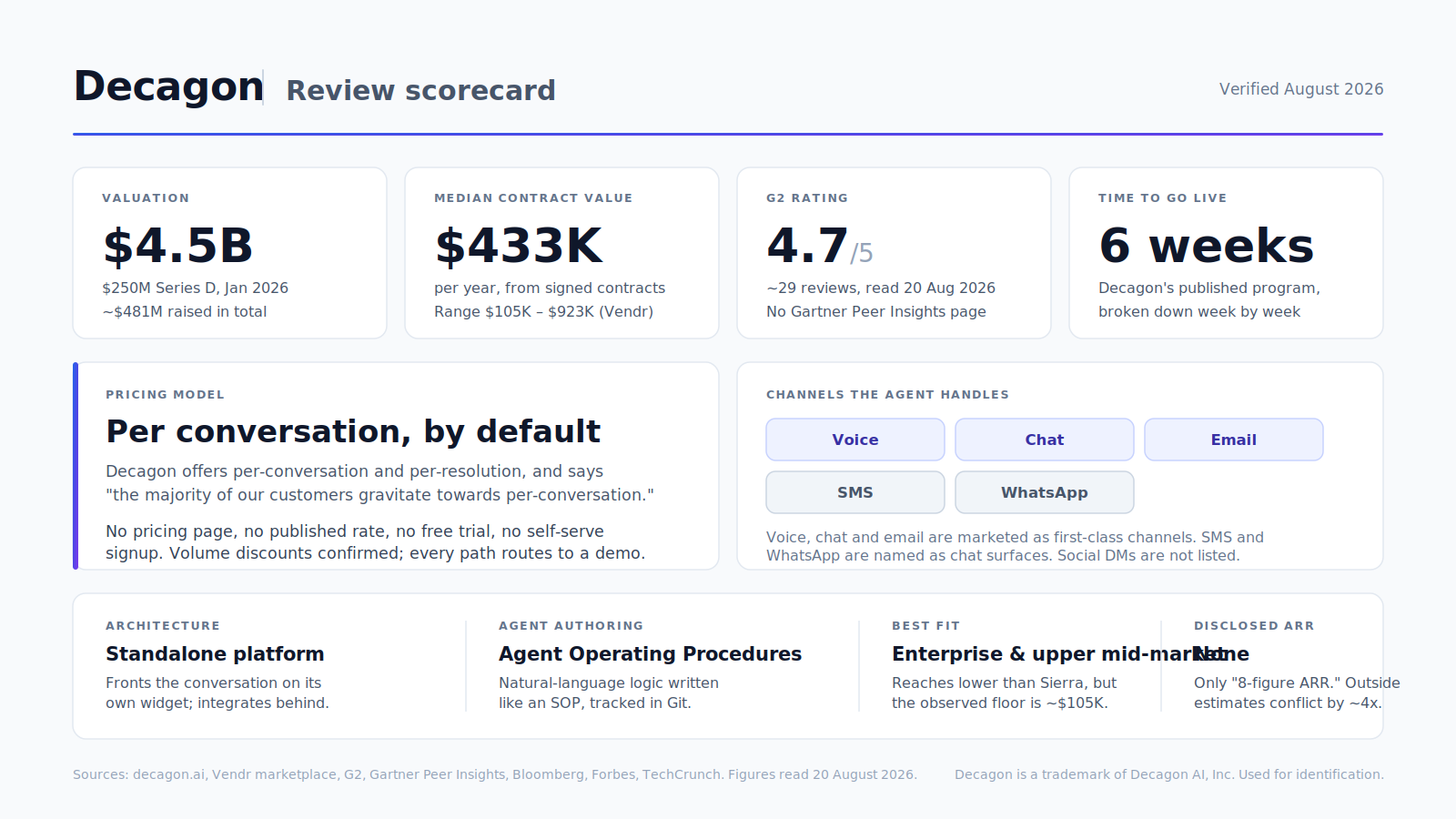
Decagon is recognized for a polished AI support experience built on a unified agent model. It's designed to manage customer conversations and connect with business systems that add context, keeping a single thread consistent throughout an interaction. That makes it an attractive choice for organizations that value streamlined deployment and centralized management.
How it works. Decagon's business-logic layer is a single, unified decision layer that pulls data from integrated systems, interprets customer needs, and coordinates resolution. This keeps interactions consistent and operations relatively simple.
Pros. The centralized architecture makes administration easier and deployment faster, and helps teams build governance without managing multiple agents or coordination layers.
Best for. Organizations with moderate workflow complexity that want a strong customer experience without added orchestration overhead.
Why Aissist's Multi-Agent AI Is a Popular Choice
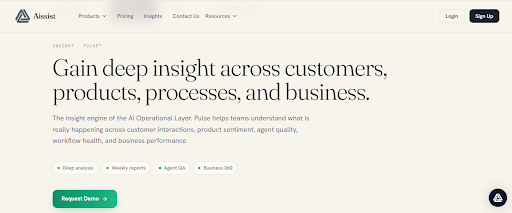
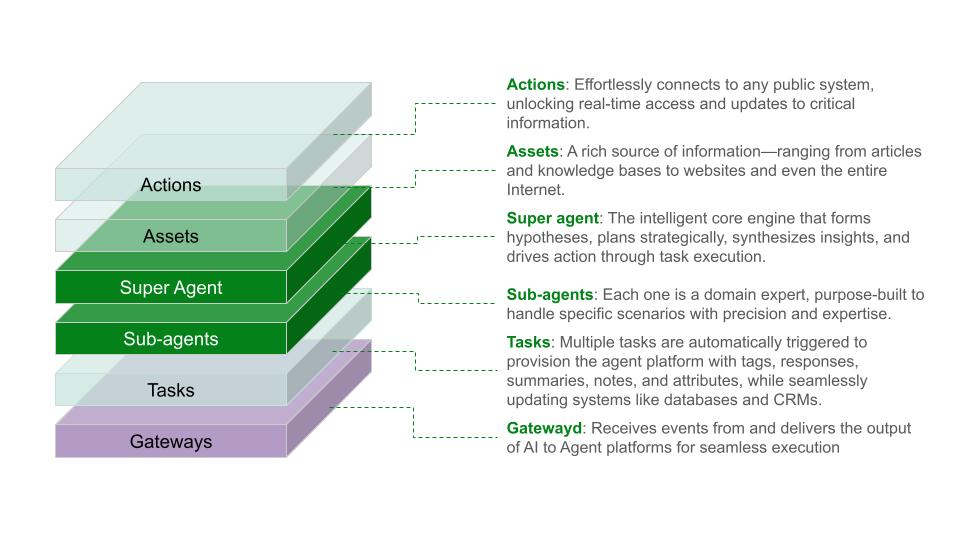
Aissist takes a different approach. Rather than relying on one AI system for every task, it uses a team of specialized agents that collaborate to resolve customer problems — an architecture purpose-built for complexity. This is especially useful when a single conversation touches billing, CRM records, product databases, internal documentation, and operational workflows at once.
How it works. Aissist's AgentMesh distributes tasks to specialized agents: one determines intent, another retrieves knowledge, another executes workflow actions, and another validates the result before it reaches the customer.
Pros. The distributed model is more operationally flexible — deeper workflow processing, better cross-platform coordination, and stronger scalability for large support environments.
Best for. Businesses running multiple systems, where each agent can focus on a specific task instead of forcing one model to do everything.
Strategic Alignment: Who Suits Which Framework?

The right architecture is about what's practical, not what's marketed. Evaluate platforms against your workflow complexity, integration needs, governance expectations, and future scalability goals — those factors decide which framework delivers better outcomes.
- Single-agent use cases. Organizations with simpler support, minimal integrations, and smaller teams benefit from centralized architectures that streamline deployment and governance while keeping the conversational experience consistent.
- Multi-agent use cases. Distributed architectures with specialized agents that coordinate actions, fetch information, and execute across multiple systems tend to perform better on complex, cross-system workflows.
Head-to-Head: Multi-Agent vs Single-Agent AI
This comparison focuses on how architecture influences performance, scalability, and operational flexibility — beyond feature lists.
| Category | Aissist (Multi-Agent) | Decagon (Single-Agent) |
|---|---|---|
| Core architecture | Multiple specialized agents collaborate | Single primary agent manages workflows |
| Decision making | Distributed across specialized agents | Centralized within one reasoning engine |
| Workflow complexity | Strong support for multi-step processes | Best suited for simpler execution paths |
| Cross-system coordination | Designed for extensive orchestration | Managed through central agent logic |
| Scalability approach | Workload distributed across agents | Workload concentrated in one agent |
| Operational flexibility | High adaptability across departments | More streamlined and predictable |
| Support automation depth | Extensive workflow execution potential | Strong conversational automation |
| Governance requirements | Requires broader coordination oversight | Simpler governance structure |
| Enterprise suitability | Large and complex environments | Mid-sized and focused operations |
| Future expansion | Easier specialization via additional agents | Relies on central agent capabilities |
Architecture ultimately shows up in the numbers that matter — genuine resolution, CSAT, and cost per resolution. See how the field compares in the AI Customer Service Benchmark 2026.
Final Thoughts
The Aissist vs Decagon question is ultimately about architecture, not features alone. Both platforms automate customer support, but they approach it differently. Organizations with simpler workflows may find value in single-agent systems that offer centralized management and quick deployment. Companies operating across multiple platforms and business functions often gain more flexibility from multi-agent platforms that coordinate specialized agents throughout the customer journey.
Want the specifics? Compare pricing, deployment, and performance in the full Aissist vs Decagon breakdown, then accelerate end-to-end automation with coordinated AI agents that deliver deeper resolutions across every interaction.
FAQs
What is the difference between multi-agent and single-agent AI?
A single-agent system relies on one primary AI engine. A multi-agent system distributes responsibilities across specialized agents that collaborate to complete complex tasks.
Which architecture scales better for enterprise support?
Multi-agent architectures generally handle growing workflow complexity more effectively, because tasks can be distributed across specialized agents rather than concentrated within one system.
Is Decagon a good choice for customer support?
Decagon can be a strong option for organizations seeking centralized AI management and conversational automation without extensive workflow-orchestration requirements.
Why are companies adopting multi-agent architectures?
Many organizations need AI to work across numerous platforms. Multi-agent architectures help coordinate information, automate actions, and manage more sophisticated support processes.
Does multi-agent AI replace human agents?
No. Multi-agent AI reduces repetitive work and speeds up resolutions, but human agents remain important for sensitive situations, policy decisions, and complex interactions.