How to Create Good Instructions for Generative AI
Good instructions tell a generative AI system what you are trying to achieve and give it room to get there, rather than scripting every keystroke. The single most useful shift most teams can make is to write instructions that are more descriptive than prescriptive — describe the intent and the principles, and let the model reason about the specifics. Descriptive instructions consistently give a capable AI more space to perform well, especially on the messy, real-world cases a rigid script never anticipated.
Prescriptive vs. Descriptive Instructions
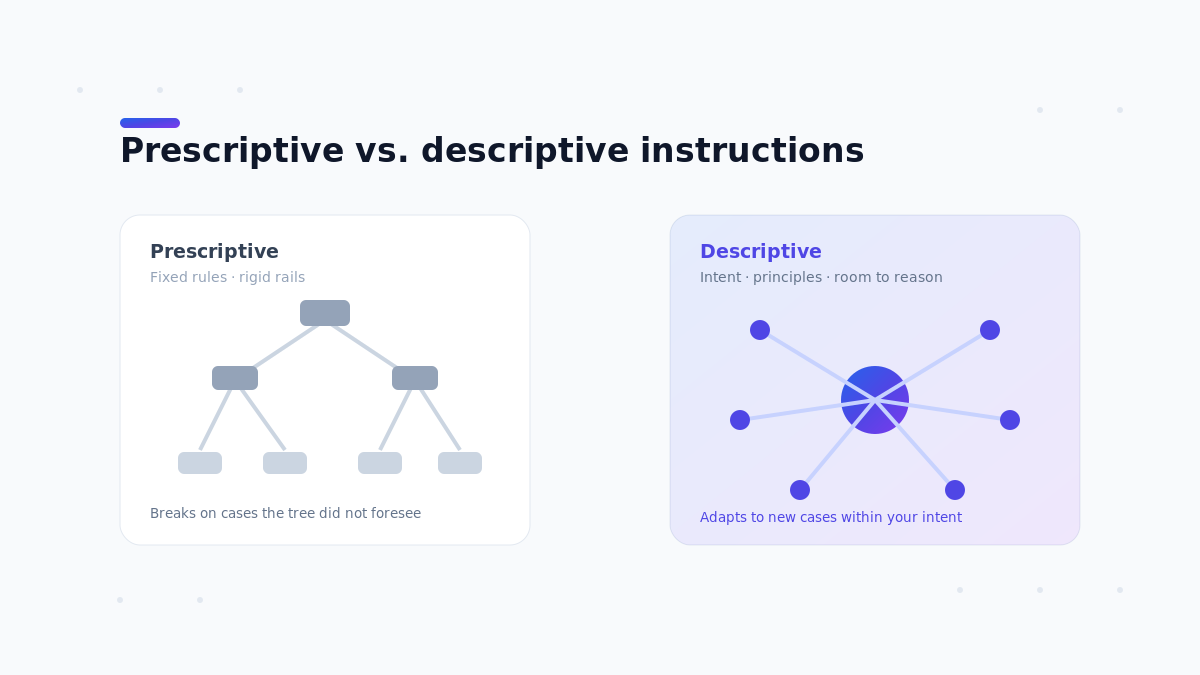
A prescriptive instruction dictates the exact output or the exact steps. It leaves little to interpretation: do this, in this order, in this shape. A descriptive instruction states the goal, the qualities that matter, and the boundaries — then trusts the agent to choose how to satisfy them.
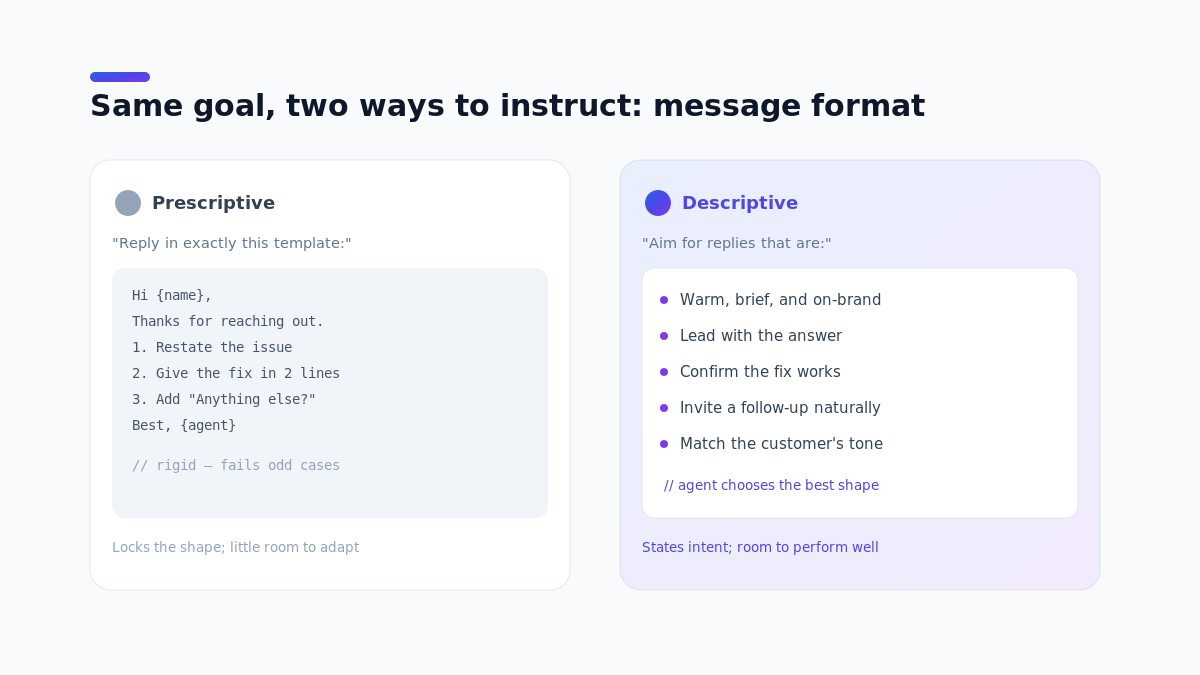
The clearest tell is a format example. Handing the agent a fixed reply template to fill in is prescriptive. Telling it what a good reply should feel like — and letting it compose one — is descriptive.
- Prescriptive: "Reply using exactly this template: greeting line, restate the issue, numbered fix in two lines, then 'Anything else?', then sign-off."
- Descriptive: "Aim for replies that are warm and brief, lead with the answer, confirm the fix, and invite a natural follow-up — matching the customer's tone."
Both target the same outcome. The prescriptive version locks the shape; the descriptive version communicates intent and lets the agent adapt.
Why Descriptive Usually Wins for AI
Modern models have strong reasoning and theory of mind. When you over-specify, you actively suppress that capability and force the agent down a path that may not fit the situation in front of it.
Descriptive instructions win for three reasons. First, coverage: a template only handles the cases you imagined, while intent generalizes to the ones you did not. Second, quality: given the "why" behind a rule, a good model makes better local decisions than a rule could encode. Third, durability: descriptive instructions age well because they are not pinned to a specific layout, product name, or edge case that will change next quarter.
There is also a subtle failure mode with prescriptive rules. The more rigid the script, the more brittle the result — the agent either breaks awkwardly on an unforeseen case or follows the letter of the instruction into a nonsensical answer. Describing intent lets it stay sensible when reality does not match the template.
Prescriptive vs. Descriptive: Side-by-Side Examples
| Goal | Prescriptive (rigid) | Descriptive (room to perform) |
|---|---|---|
| Message format | "Use this exact reply template." | "Give guidance on what a good reply looks like." |
| Length | "Write exactly 100 words." | "Keep it concise — as short as it can be while still clear." |
| Tone | "Start every reply with 'Happy to help!'" | "Sound warm, calm, and on-brand." |
| Steps | "Do step 1, then 2, then 3, always." | "Here is the outcome and the constraints; sequence the work sensibly." |
| Escalation | "Escalate only if the ticket contains the word 'refund'." | "Escalate when a case is risky, unclear, or beyond your confidence." |
| Edge cases | A branch for every scenario you could list. | The principle that should govern any scenario. |
Read down the right-hand column and you will notice the descriptive versions are usually shorter, and yet they cover more ground.
When Prescriptive Instructions Are Still Right
Descriptive is the default, not an absolute. Be prescriptive where variation is a defect, not a feature: legal disclaimers and regulatory language that must appear verbatim, data formats another system will parse (dates, JSON, IDs), safety and compliance guardrails, and hard business rules like refund thresholds. The skill is knowing which parts of a task genuinely require an exact shape and constraining only those, while leaving everything else described rather than dictated. Constrain the non-negotiables; describe the rest.
How to Write Good Descriptive Instructions
Start with the goal and the audience — what a great outcome accomplishes and for whom. Then give the principles that separate good from bad, and explain the why behind each; a model that understands the reason applies it far better than one memorizing a rule. Prefer examples over templates: show one or two strong cases to convey the target without freezing the format. Add constraints only where they matter, and phrase things positively — say what to do, not just what to avoid. Finally, test for stability: run the same instruction several times, and if the outputs swing wildly, the instruction is too vague in the places that count — tighten those, and only those.
Aissist.io Is Instruction-Driven, Not Flows and Trees
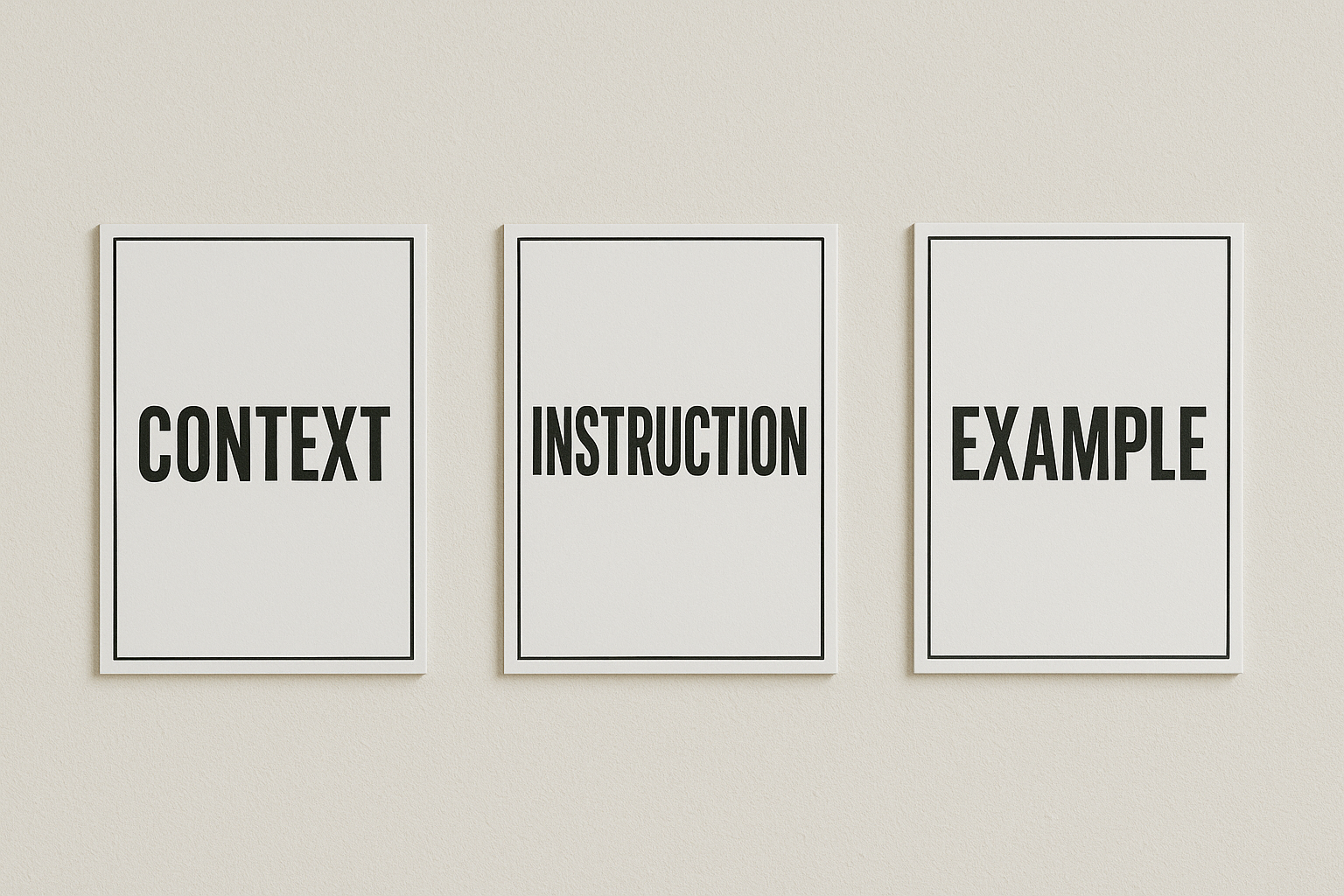
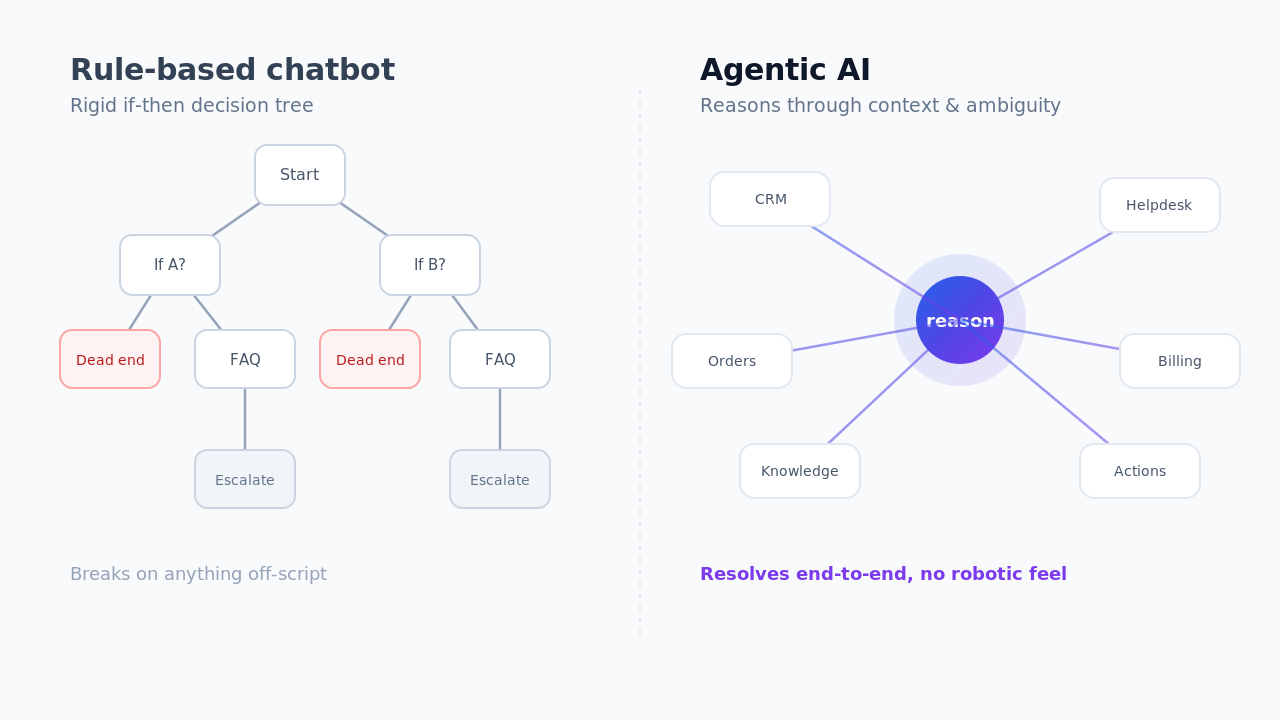
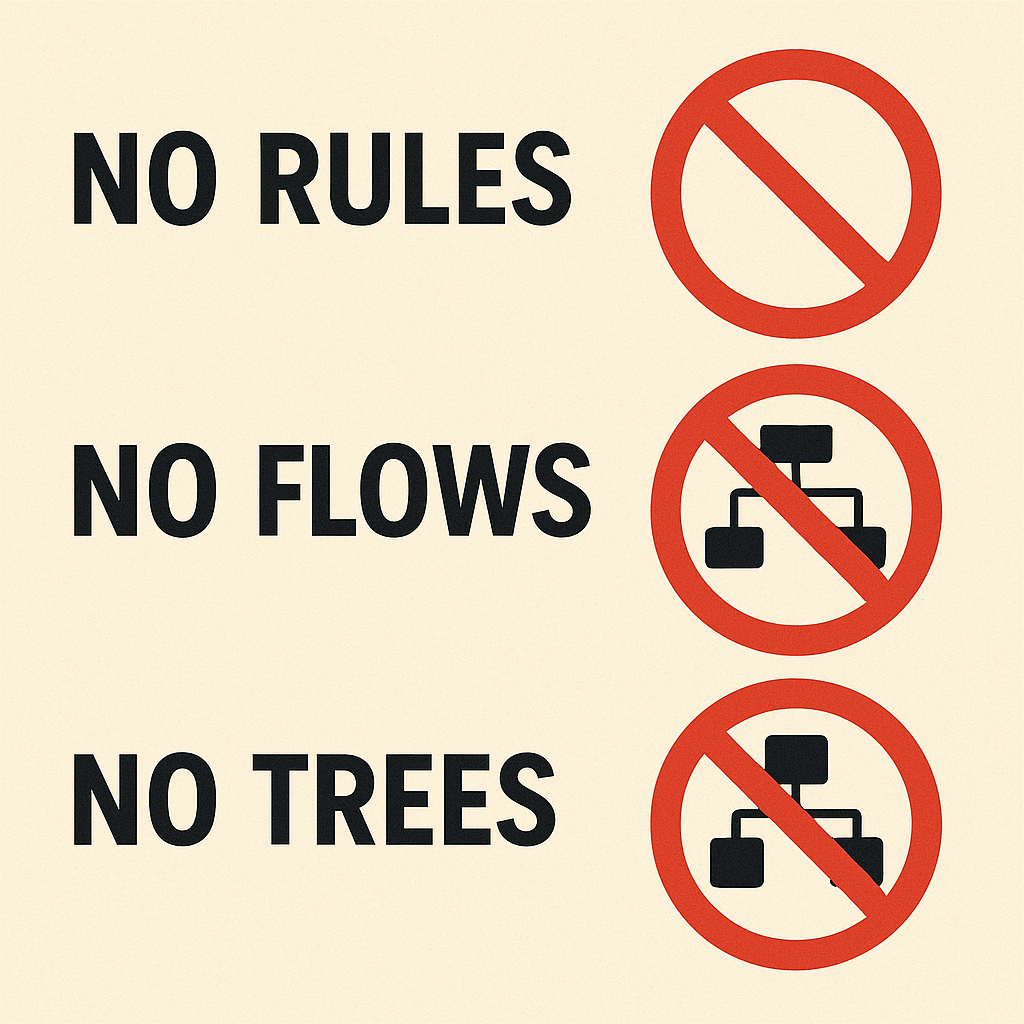
This is exactly why Aissist.io is built to be instruction-driven rather than flow-, tree-, or rule-based. Traditional chatbots make you hand-build decision trees and rigid flows — the most prescriptive setup imaginable — and they break the moment a customer goes off-script. Aissist's AgentMesh takes your intent, SOPs, and business context as instructions, then reasons over them to resolve real cases end to end, escalating when it should. You describe how your business works; the agent figures out how to apply it. That is the practical payoff of good, descriptive instructions at platform scale — see no flows, no trees, no rules, no code and a concrete context and instruction example for how it looks in practice.
Key Takeaways
Good instructions describe intent and give a capable agent room to reason; they only prescribe exact shapes where variation would be a genuine defect. Favor descriptive over prescriptive because it covers unforeseen cases, produces better judgment, and ages well. Give the goal, the principles, the "why," and a couple of examples — then test for stability and constrain only what truly must be fixed. It is the same philosophy that makes an instruction-driven platform outperform a maze of flows and trees. For related reading, see no flows, no trees, no rules, no code and agentic AI vs. chatbots.
Frequently Asked Questions
What makes an instruction "good" for a generative AI?
A good instruction makes the goal, the audience, and the qualities of a great result unmistakable, while leaving the AI room to decide how to get there. It explains the reasoning behind key rules, uses positive phrasing (what to do rather than only what to avoid), and constrains the exact format only where a specific shape genuinely matters. The test is whether a capable model, running it several times, produces consistently strong results.
What is the difference between descriptive and prescriptive instructions?
Prescriptive instructions dictate the exact output or steps — a fixed template, a required word count, a mandated sequence. Descriptive instructions state the intent and the qualities that matter and let the AI choose how to satisfy them. Giving a strict reply template is prescriptive; describing what a good reply should look like is descriptive. Descriptive instructions generally give generative AI more room to perform well.
Why are descriptive instructions usually better for AI?
Because modern models reason well, and over-specifying suppresses that ability. Descriptive instructions cover cases you never anticipated, let the model make better local decisions when it understands the "why," and stay durable as products and edge cases change. Rigid scripts, by contrast, break or produce nonsensical answers the moment reality does not match the template.
When should I still use prescriptive instructions?
Use prescriptive instructions where variation is a defect: verbatim legal or compliance language, data formats another system must parse, safety guardrails, and hard business rules like refund limits. The goal is to constrain only the true non-negotiables and describe everything else, rather than scripting the whole task.
How can I tell if my instructions are too vague?
Run the same instruction several times on realistic inputs. If the outputs vary wildly in the ways that matter, the instruction is under-specified in those spots — tighten them with clearer principles or a constraint. If results are already stable and good, adding more rules usually hurts by boxing the AI in. Tune the specific places that wobble, not the whole prompt.
How does an instruction-driven AI platform differ from a chatbot with flows?
A flow- or tree-based chatbot requires you to hand-build every branch — a fully prescriptive setup that breaks when customers go off-script. An instruction-driven platform like Aissist.io takes your intent, SOPs, and business context as guidance and reasons over them to resolve cases end to end, adapting to situations no one scripted while escalating when appropriate.