

Business Impact
- Client: A global telecom service provider (anonymized)
- Industry: Telecommunications
- Use Cases: AI customer service at peak load, incident detection, root-cause analysis, real-time insight
- Impact: 20x traffic absorbed, root cause found in ~25 minutes, three independent confirmations
On the evening of 30 October 2026, a carrier-side outage cut mobile data for subscribers of one of our telecom customers. Phones showed full signal. Nothing loaded. Within an hour, support traffic was running about 20x normal.
TL;DR: Aissist.io's AI agents absorbed a 20x support surge, found the root cause within about 25 minutes, and even spotted a working fix in the conversations, but because that insight was not yet wired to our self-evolve engine, the AI agents could not change their strategy to use it.
Methodology & sources
- Data: Aissist.io platform telemetry, Ask Engine responses and automated alert records, 29–30 October 2026.
- Times are Pacific (server time). Multipliers compare 30 October with the same hours on 29 October.
- Disclosure: this is Aissist's blog, and the company affected is an Aissist customer. We have kept it anonymous.
What happened when the carrier went down?
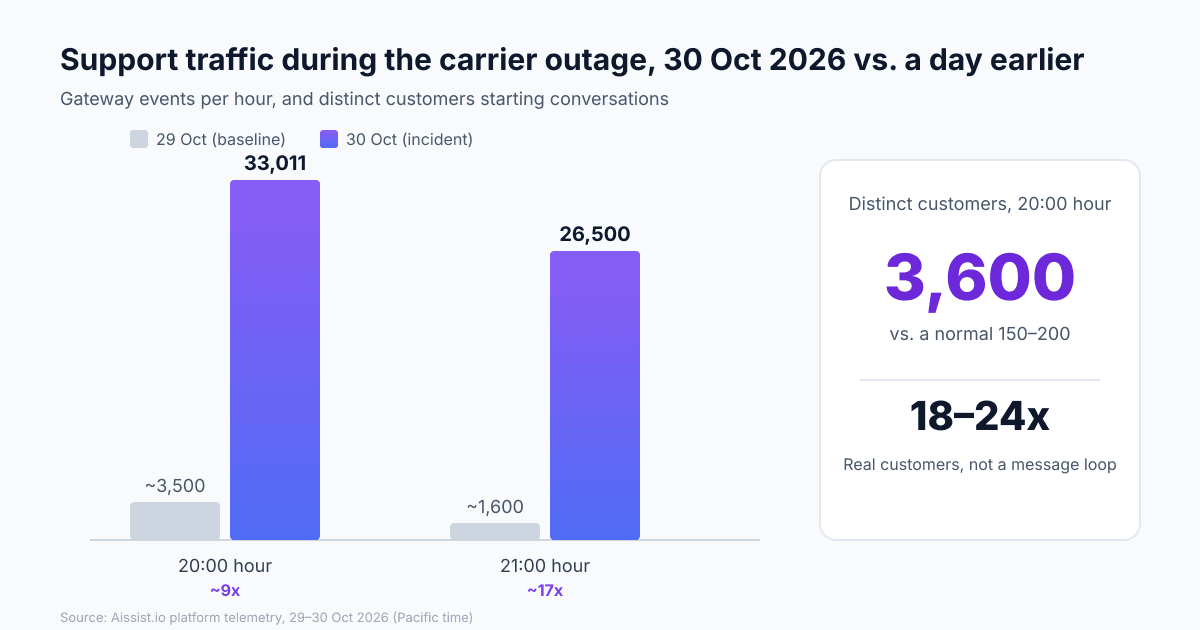
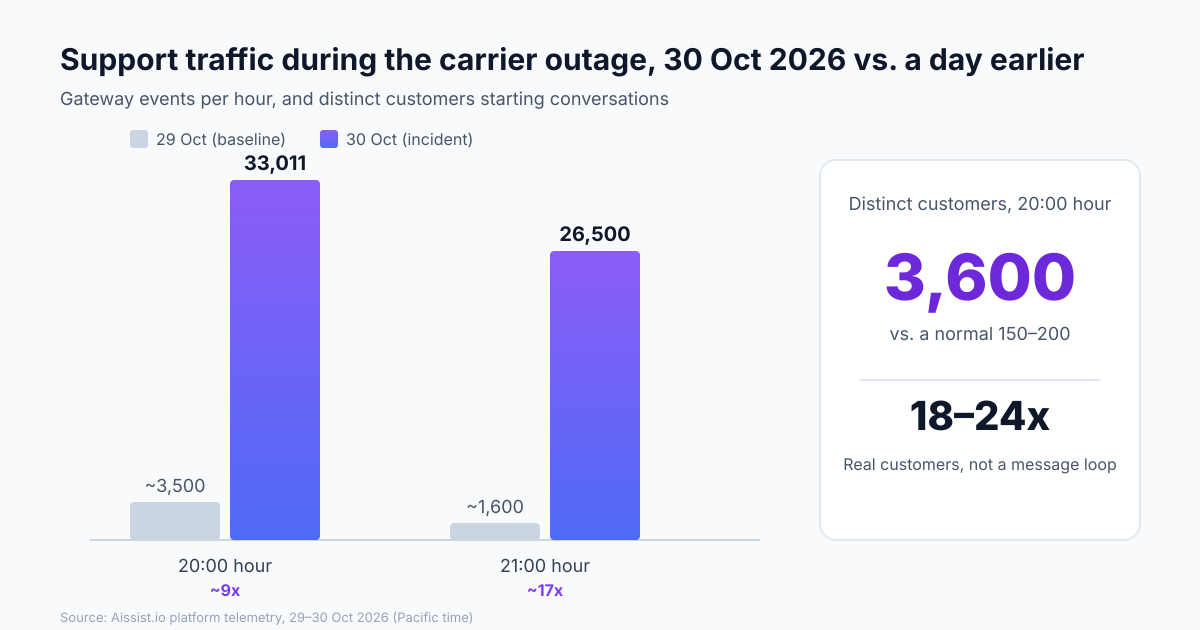
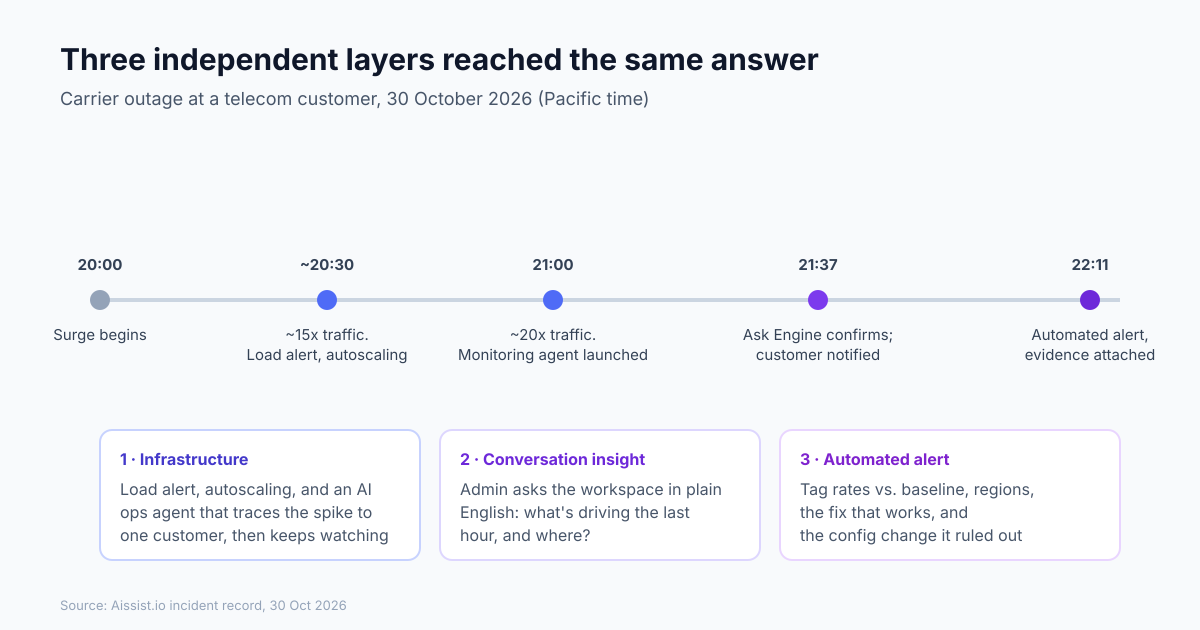
Starting at 20:00, conversation volume rose about 15x by 20:30 and about 20x by 21:00. Gateway events hit 33,011 in the 20:00 hour against roughly 3,500 at the same time the day before, and 26,500 in the 21:00 hour against roughly 1,600.
The number that mattered most was people, not events. About 3,600 distinct customers started conversations in the 20:00 hour, against a normal 150–200. That ruled out the usual suspect in any spike, a message loop or a misbehaving integration. These were real subscribers in several countries across Asia, all describing the same thing: signal, but no data.
A telecom outage doesn't produce a polite trickle of tickets. It produces everyone at once. A team staffed for 150 conversations an hour does not absorb 3,600. That is not a staffing failure. It is arithmetic.
The platform held. Autoscaling grew the affected zone's service cluster several times over within the hour, from 4 to 19 session and gateway tasks and from 3 to 13 reasoning-graph tasks, and average reply time moved only from 14.7 to 16.7 seconds. Keeping up was the easy part.
How fast did the system find the cause?
About 25 minutes after the outage began, our AI agents had traced the spike to one customer, one symptom and one cause, with no one asking it to. The first signal was server load, roughly 20 minutes in. An AI operations agent then analysed the system and concluded that almost all the traffic came from a single customer's workspace, that it was thousands of distinct people, and that the cause was a connectivity outage on the carrier's side, not anything in our code.

At 21:00 a second agent was launched to monitor the situation continuously: volume, escalations and the shape of the conversations as the evening went on. Incidents change. Somebody has to keep watching, and it doesn't have to be a person.
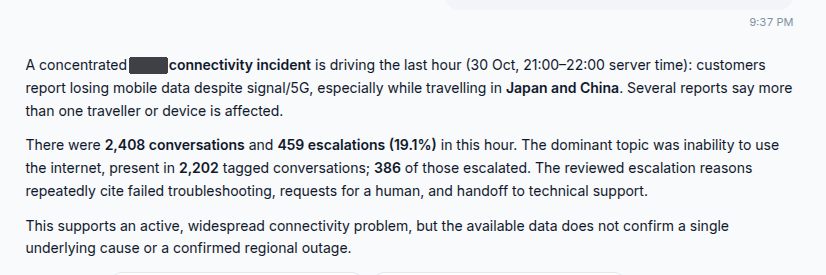
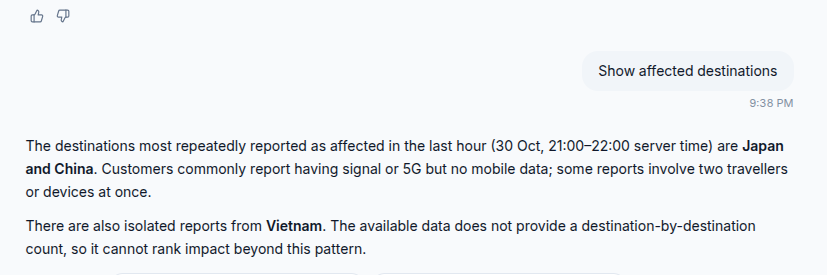
Two more layers then confirmed the diagnosis independently. At 21:37 an Aissist admin asked the customer's workspace a plain-English question through the Ask Engine: what is driving the last hour? It answered from the conversations themselves: 2,408 conversations, 2,202 of them about losing internet access, concentrated in a handful of destinations. It also said what it could not confirm, such as an official regional outage. An insight tool that invents certainty during an incident is worse than no tool at all.
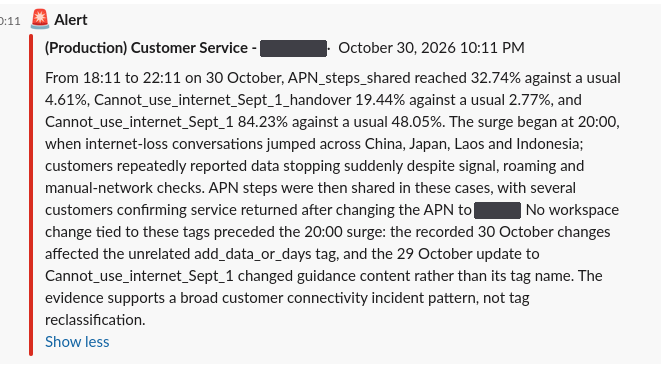
At 22:11 an automated alert, measuring against the customer's long-term baseline, made it three for three:
| Signal (18:11–22:11) | Usual | 30 October |
|---|---|---|
| Conversations about no internet access | 48.05% | 84.23% |
| Those handed over to a human | 2.77% | 19.44% |
| Conversations where network (APN) setup steps were shared | 4.61% | 32.74% |
It also checked whether the spike was self-inflicted, such as a renamed tag, and ruled it out.
The AI found a fix. Why couldn't it use it?
Our AI agents found a potential solution in the conversations, but the agents talking to customers kept following their standard troubleshooting routine anyway. Several customers confirmed that their data came back after changing one network setting, the APN. The alert surfaced exactly that.
But look at the order things happened in each conversation. Customers reported going through signal checks, roaming settings and manual network selection first. Only then were the APN steps shared. The agents were doing what they were designed to do on a normal day: work through the troubleshooting tree, step by step. On this particular evening, most of those steps could not help, and the handover rate rose from about 3% to 19% as frustrated customers asked for a human.
The insight existed. The strategy didn't change. That gap is the most important lesson of the night.
It happened because the diagnosis was not yet wired to our self-evolve engine, part of Evolve™, which we have already built for exactly this situation. Wired in, it would have changed the agents' approach as soon as the cause and the fix were known: tell customers up front that there is a carrier issue, lead with the APN change, skip the steps that cannot help, and return to the standard routine once the outage clears. Customers would have reached the right answer in far fewer steps, and far fewer would have needed a human.
What are we changing for the next incident?
We are working on four things, and the first is the one that matters most.
| What we're building | What it changes |
|---|---|
| Self-evolve engine wired into incident handling | Once a cause and fix are found, the AI changes its strategy within minutes |
| Faster automated notification | The customer is alerted at about the same time as the server-load signal, not two hours later |
| Faster monitoring-agent kickoff | Continuous watching starts at detection, not 30 minutes in |
| Shared memory across agents | What one agent learns, every agent knows, so the next incident starts from experience |
On 30 October, the infrastructure agent, the Ask Engine and the alert each reached the same conclusion on their own, and the agents talking to customers never heard about it. With shared memory and self-evolve wired together, the conclusion becomes the strategy. Humans call that experience. Our agents are about to have it too.
AI agents should adapt, not just answer
This incident shows what the next generation of support AI is for. Answering 3,600 people an hour is the minimum. The real job is to read every conversation as a signal, connect it to what is happening in the systems, find the cause and the fix, and change how the AI behaves while the incident is still unfolding. That is how we build it at Aissist, as an AI operational layer: AgentMesh™ answering, Pulse™ explaining, and Evolve turning what it learns into the next move. On 30 October we did the first two in minutes. The third is what we are wiring in now.
Frequently asked questions
What can AI agents do during a support traffic surge?
Beyond answering every customer, AI agents can trace the cause of a surge, monitor it continuously, find a working fix in the conversations and, when wired to a self-evolve engine, change their strategy to lead with that fix.
How can AI detect a carrier outage from support conversations?
By comparing topic and escalation rates with a normal baseline. During this incident, conversations about no internet access rose from 48% to 84% of volume, and handovers on that topic rose from about 3% to 19%.
What is a self-evolving AI agent?
A self-evolving AI agent changes its own strategy when conditions change, for example leading with a known fix during an outage instead of working through its standard troubleshooting steps, then returning to normal once the issue clears.
Did the traffic surge slow down AI replies?
Only slightly. Average reply time rose from 14.7 to 16.7 seconds at the peak, while autoscaling grew the service cluster several times over.
What is the Aissist Ask Engine?
The Ask Engine lets a team ask questions about its support conversations in plain English, such as "what is driving the last hour?", and get an answer from live conversation data, including what the data cannot confirm.
M.W.
Co-founderM.W. is a serial entrepreneur and co-founder of Aissist.io, with over 12 years of hands-on experience in machine learning and advanced AI. He has built and led the development of three generations of AI systems, from early ML automation to modern agentic AI platforms powering enterprise-scale operations