Why AI Hallucinations in Customer Service Are a Governance Problem
AI hallucinations in customer service are the top complaint about AI chatbots, according to G2's July 2026 analysis of 2,950+ verified reviews. Better models don't close that gap. Governance does.
TL;DR: Reliability comes from the system around the model: the best model alone still errs on 1.8% of grounded summaries in Vectara's benchmark, while Aissist.io's four-layer governance framework keeps factual and policy errors under 1%.
Methodology & sources
- G2 research: 2,950+ verified AI Chatbots reviews (Jan 1–Jul 17, 2026) plus a vendor survey, published Jul 31, 2026.
- Industry surveys: World Quality Report 2025 (2,000+ executives, Nov 2025); Gong/Censuswide (2,056 leaders, Jan 6–9, 2026); Gartner (poll of 3,412 webinar attendees, Jan 2025).
- Model benchmark: Vectara Hallucination Leaderboard, grounded document summarization, updated May 11, 2026.
- Aissist data: the under-1% error rate is vendor-claimed: any factual or policy error in an AI reply or action, measured by automated LLM audit of transcripts plus human QA sampling. See how errors are graded by severity for what counts as an error.
- All figures verified September 2026. Disclosure: this is Aissist's blog, and the governance framework below is ours.
This article covers why AI hallucinations happen in production and the governance layer that catches them. For the controls most enterprises are missing, see the AI agent governance gap. For everyday prompt-level fixes, see 7 tips for hallucination prevention.
What is the biggest pain point in deploying AI chatbots?
Accuracy is the biggest pain point in AI chatbot deployment. G2's analysis found verified reviewers mention accuracy and hallucinations 13.7% of the time when describing what they dislike, making it the number one complaint.
The complaint is not a niche worry. The World Quality Report 2025 found hallucination and reliability concerns block enterprise-scale AI for 60% of organisations. Gong's April 2026 survey found 58% of companies have stalled AI projects. And Gartner predicts over 40% of agentic AI projects will be canceled by the end of 2027, citing escalating costs, unclear business value or inadequate risk controls.
What makes hallucinations dangerous is not that they happen. It is that they sound right.
"It hallucinates with confidence. I've had it generate DAX formulas and SQL joins that looked perfectly fine but were logically wrong." — Sandeep J, verified AI Chatbots reviewer, G2
In customer service, a confident wrong answer is a promise. In Moffatt v. Air Canada (Feb 2024), the airline's chatbot invented a bereavement-fare refund policy. Air Canada argued the chatbot was responsible for its own actions. British Columbia's Civil Resolution Tribunal was not persuaded and ordered the airline to pay $812.02.
"It should be obvious to Air Canada that it is responsible for all the information on its website." — Christopher Rivers, Tribunal Member, BC Civil Resolution Tribunal, Moffatt v. Air Canada, as reported by McCarthy Tétrault
The fine was small. The precedent was not: your AI's answers are your company's answers.
Why won't a better model fix AI hallucinations in customer service?
A better model lowers the error rate per answer, but customer service multiplies answers. On Vectara's Hallucination Leaderboard, even the best model introduces false information in 1.8% of grounded summaries, and widely used flagships such as Gemini 2.5 Pro, GPT-4o and Claude Sonnet 4.5 score between 7.0% and 12.0%.
That benchmark is the easy case: summarise a document you were handed. A support conversation is harder. The agent reads the ticket, looks up the order, checks the policy, decides on an action, calls an API and writes the reply. On Aissist's reliable AI page, a single execution spins out 12 to 20 tasks, each with its own chance to go wrong.
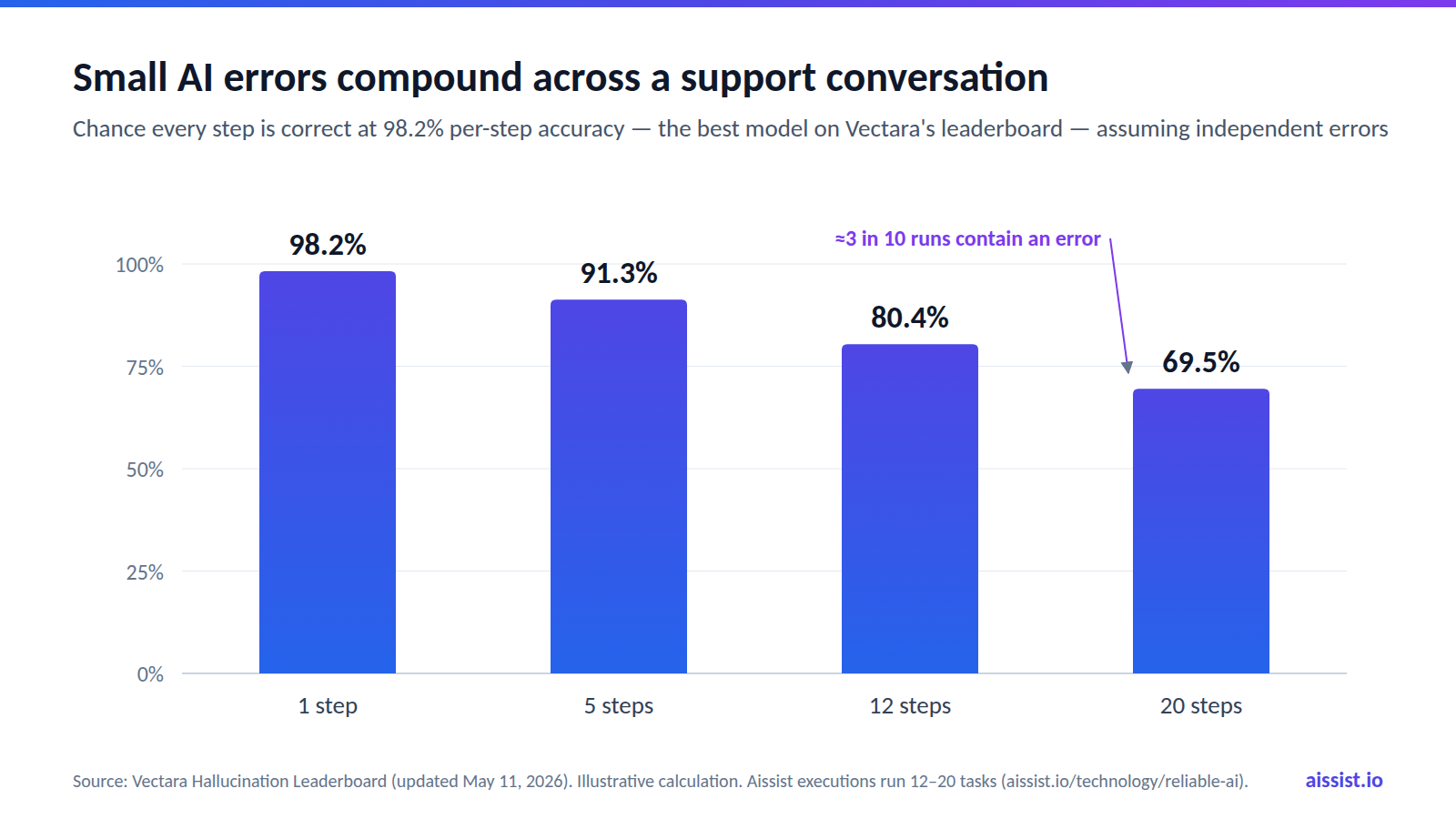
Small error rates compound. If every step were as accurate as the best model on Vectara's benchmark (98.2%) and errors were independent, the odds of a clean run fall fast:
| Steps in one execution | Chance every step is correct |
|---|---|
| 1 | 98.2% |
| 5 | 91.3% |
| 12 | 80.4% |
| 20 | 69.5% |
Illustrative calculation from Vectara's lowest published rate; real step accuracy varies.
A 98% model sounds excellent until you notice a support conversation is not one question. At 20 steps, roughly three executions in ten contain at least one mistake. Swapping in next quarter's model trims that number. It does not change the shape of the curve.
"The narrative undersells how much of agent quality is plumbing rather than intelligence." — Becca Xu, AI Agent Product Manager, Assembled, in G2's research
G2 found the same pattern from the other side. Vendors building on the same foundation models its reviewers complain about report failure rates as low as 1%. The difference is not the model. It is what catches the model's mistakes before a customer reads them.
What is an AI governance framework for customer service?
An AI governance framework for customer service is a set of checks that sits around the model and decides whether each output is reliable enough to send, needs another attempt, or goes to a human. It turns "the model said so" into "the system verified it."
Aissist.io's reliable AI framework uses four layers. No single layer is enough on its own; they trade cost for certainty, so each is applied where the risk justifies it.
| Layer | What it does | What it catches | Cost | Best used for |
|---|---|---|---|---|
| Prompt engineering | Gives every agent a clear reliability posture and shared guardrails before work begins | Off-policy behaviour by design | Low | Every agent, always |
| Booster | Runs the same task an odd number of times, compares results, and proceeds with the strongest agreement | One-off, random errors | High | Critical or high-risk steps, such as refunds |
| Self inspect | Asks, before release, whether the answer is reliable given the context and information available | Unsupported or ungrounded answers | Medium | Pre-output checks on customer-facing replies |
| Stacked system | A separate governor — an AI police layer — monitors every agent's behaviour and outputs against policy | Policy violations across multi-agent workflows | High | System-wide policy control and escalation |
Think of it as the difference between a talented new hire and a well-run team. The hire is the model. The team adds a checklist (prompt engineering), a second opinion on the risky calls (booster), a self-review before hitting send (self inspect), and a supervisor who knows the policy manual (stacked system).
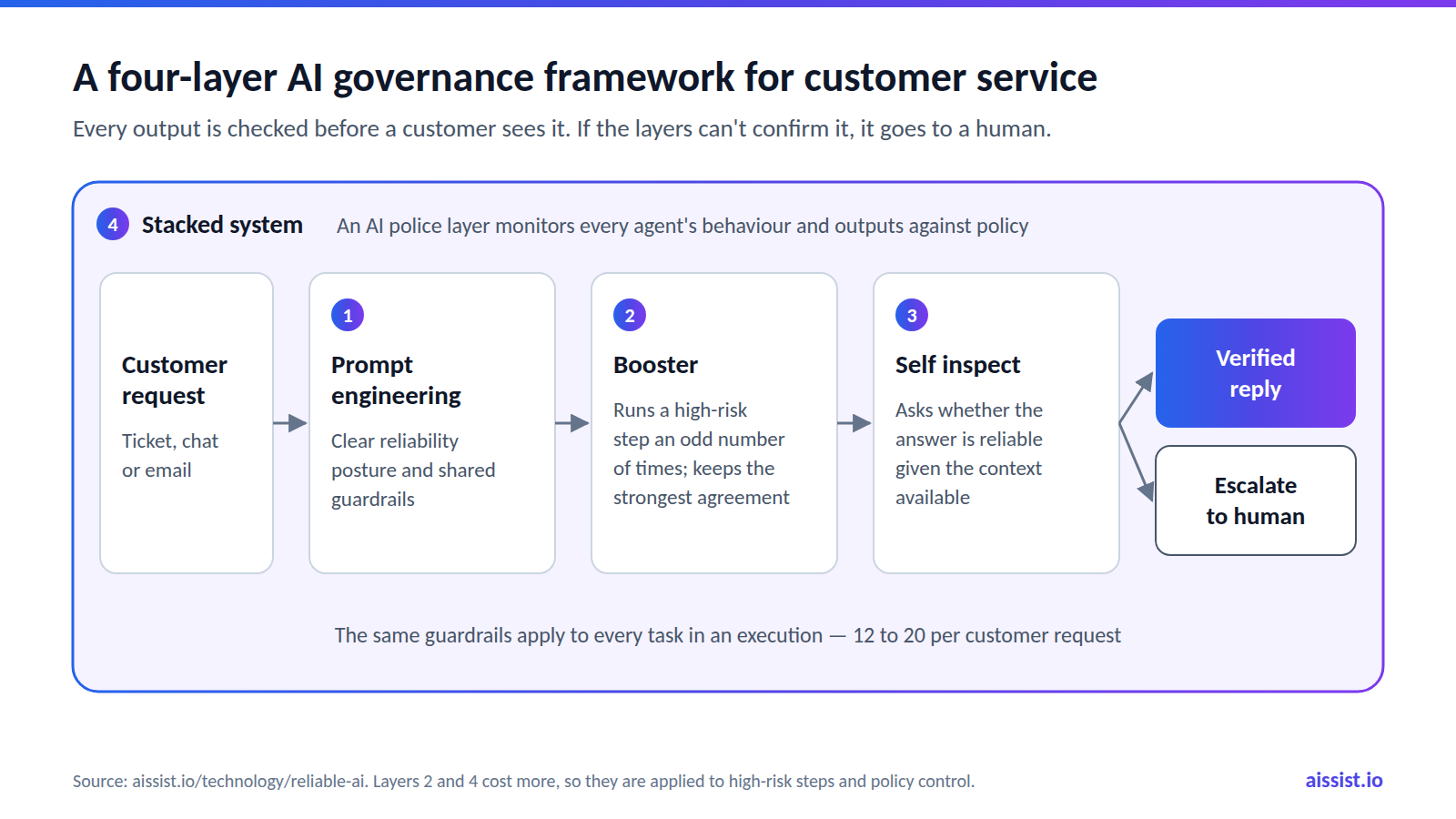
The last step matters most. When the layers can't agree an answer is reliable, the right output is a handoff, not a guess.
"Autonomy without trustworthy fallback logic isn't a feature; it's a liability." — Abby Schervish, Maven AGI, in G2's research
Governance also covers what surrounds the answer. Aissist's security framework adds automatic PII masking and audit logs that record access and changes, so every decision can be traced after the fact.
How low can the AI error rate go with governance?
With all four layers in place, Aissist.io's agents keep factual and policy errors under 1% of AI replies and actions, a vendor-claimed figure measured by automated LLM audit of transcripts plus human QA sampling. That sits at the low end of what G2's vendor survey reported.
An error rate is only meaningful next to what it doesn't count. A low error rate says nothing about how many conversations the agent finished — an agent that escalates everything has an excellent error rate and resolves nothing. Governance does not make an agent answer everything. It makes the agent stop when it shouldn't answer.
That is the trade a governed system makes on purpose: fewer confident answers, far fewer wrong ones. For a support leader, an honest "let me get a colleague" is recoverable. An invented refund policy is a tribunal decision.
"A customer can forgive an AI that says 'I'm not sure, let me get a person.' They don't forgive one that invents a refund policy. We built governance so our agents know the difference." — M.W., Co-founder, Aissist.io
We hold our own numbers to the same standard, which means stating plainly that our under-1% error rate is vendor-measured and not independently audited. Treat it the way you should treat any vendor's: as a claim to test on your own tickets.
How do you evaluate an AI vendor's governance?
Ask vendors how errors are defined, measured and caught — not just how good their model is. Every vendor has a hallucination rate. Some publish it, fewer define it, and fewer still tell you how it was measured.
| Question to ask | A strong answer | A red flag |
|---|---|---|
| What counts as an error? | Factual and policy errors, per reply or action | "Hallucinations" only, undefined |
| How is it measured? | Automated audit of transcripts plus human QA sampling, with sample size and window | Vendor benchmark or demo set |
| What happens when the AI is unsure? | Structured escalation to a human with context attached | The AI always answers |
| Which steps get extra checks? | Named high-risk actions (refunds, cancellations, account changes) with voting or inspection | One guardrail prompt for everything |
| Can you audit a decision later? | Full audit logs of replies, actions and policy checks | Chat transcripts only |
Then apply simple rules:
- If your AI takes actions (refunds, order changes), require step-level checks such as voting or inspection on those actions, because one wrong API call costs more than one wrong sentence.
- If you're in a regulated or high-liability industry, require a policy-monitoring layer and audit logs, because you will need to show what the AI did and why.
- If a vendor quotes an error rate without a definition and a denominator, run a pilot on your own tickets before signing, because the number was not built to be checked.
Reliability is a system property, not a model property
Hallucination is the number one complaint in G2's data because most buyers meet AI as a raw model: ask a question, trust the answer. Vendors reporting low failure rates run the same models inside systems that check, vote, inspect and escalate.
Customer service raises the stakes. Answers are multi-step, customers act on them, and courts treat them as company statements. The fix is not waiting for a model that never hallucinates. It is a governance framework that catches mistakes before customers see them and hands off when certainty runs out.
Test the error rate on your own tickets. Aissist.io's AgentMesh™ runs all four governance layers on the helpdesk you already use. Get a free demo →
Frequently asked questions
What is an AI hallucination in customer service?
An AI hallucination in customer service is a confident but false response from an AI agent, such as an invented policy, a wrong order status or a made-up refund rule. It is dangerous because customers act on it, and companies can be held responsible for it.
What causes AI chatbots to hallucinate?
AI chatbots hallucinate because language models generate the most plausible response, not a verified one. Missing or conflicting knowledge, ambiguous questions and long multi-step tasks all raise the chance of an error slipping through.
Can retrieval-augmented generation (RAG) eliminate hallucinations?
No. RAG grounds answers in your documents, which helps, but it doesn't eliminate hallucinations. Vectara's leaderboard measures exactly that grounded setting, and even the best model still adds false information to 1.8% of summaries, so output checks are still needed.
What is an acceptable AI error rate for customer support?
There is no industry standard, so compare rates only when they share a definition (factual, policy or both), a unit (per reply or per conversation) and a method. Otherwise the lower number may simply be the narrower definition.
Is a company liable for what its AI chatbot says?
Often, yes. In Moffatt v. Air Canada (2024), a Canadian tribunal held the airline responsible for its chatbot's incorrect refund advice. Liability varies by jurisdiction, so check with legal counsel; this is not legal advice.
How do you measure an AI agent's error rate?
Audit transcripts automatically with an LLM grader for factual and policy errors, then confirm with human QA sampling. Report errors per reply or action, with the sample size and time window, so the rate can be checked.
Does AI governance make responses slower or more expensive?
Some layers do. Booster and stacked-system checks add compute cost, so they are applied to high-risk steps rather than every sentence. Prompt engineering and self inspection are lighter and run everywhere.
Sources
- G2, AI Chatbot Capabilities & Limitations: What 2000+ G2 Users Say — 2,950+ verified reviews, Jan 1–Jul 17, 2026, plus vendor survey; published Jul 31, 2026. Read 15 September 2026.
- OpenText, Capgemini and Sogeti, World Quality Report 2025 — 2,000+ senior executives, published 13 November 2025. Read 15 September 2026.
- Gong, Unlocking the "Trust Barrier" for Enterprise AI — 2,056 business leaders, fielded by Censuswide Jan 6–9, 2026. Read 15 September 2026.
- Gartner, Gartner Predicts Over 40% of Agentic AI Projects Will Be Canceled by End of 2027, 25 June 2025. Read 15 September 2026.
- Vectara, Hallucination Leaderboard, updated 11 May 2026. Read 15 September 2026.
- McCarthy Tétrault, Moffatt v. Air Canada: A Misrepresentation by an AI Chatbot; CX Today, Court Orders Air Canada to Pay Out for Chatbot's Bad Advice. Read 15 September 2026.
- Aissist.io, Reliable AI, AI Agent Reliability Benchmark 2026, Security & Compliance. Read 15 September 2026.
Changelog
- 15 September 2026 — Published. All figures verified against primary sources on this date.