AI Leadership: From People Managers to AI Strategists
AI leadership is no longer about managing headcount and directing tasks — it is about setting direction for intelligent systems and defining the boundaries they operate within. As AI becomes embedded in day-to-day operations, the manager's job is shifting from supervising people to orchestrating a workforce of humans and AI agents together. The leaders who thrive won't be the most technical; they'll be the ones who pair human judgment with AI fluency.

That shift is the throughline of a recent USA Today feature on Lifan Xu, co-founder of Aissist.io, on how leadership is evolving in the age of intelligent systems. His core argument reframes AI adoption as a leadership discipline, not a technology race: "AI projects rarely fail because the models are incapable. They fail because organizations start without defining what success actually looks like." In other words, the decisive work happens in the leader's head — and on the whiteboard — before any model is deployed.
The role is changing: from directing work to designing systems
For a century, management meant being the person with the answers — assigning tasks, reviewing output, and optimizing throughput. Intelligent systems break that model. When AI agents can read, reason, and act across the tools a business already runs, the leader's value moves upstream: to setting objectives, encoding judgment into guardrails, and deciding what the system should and shouldn't do.
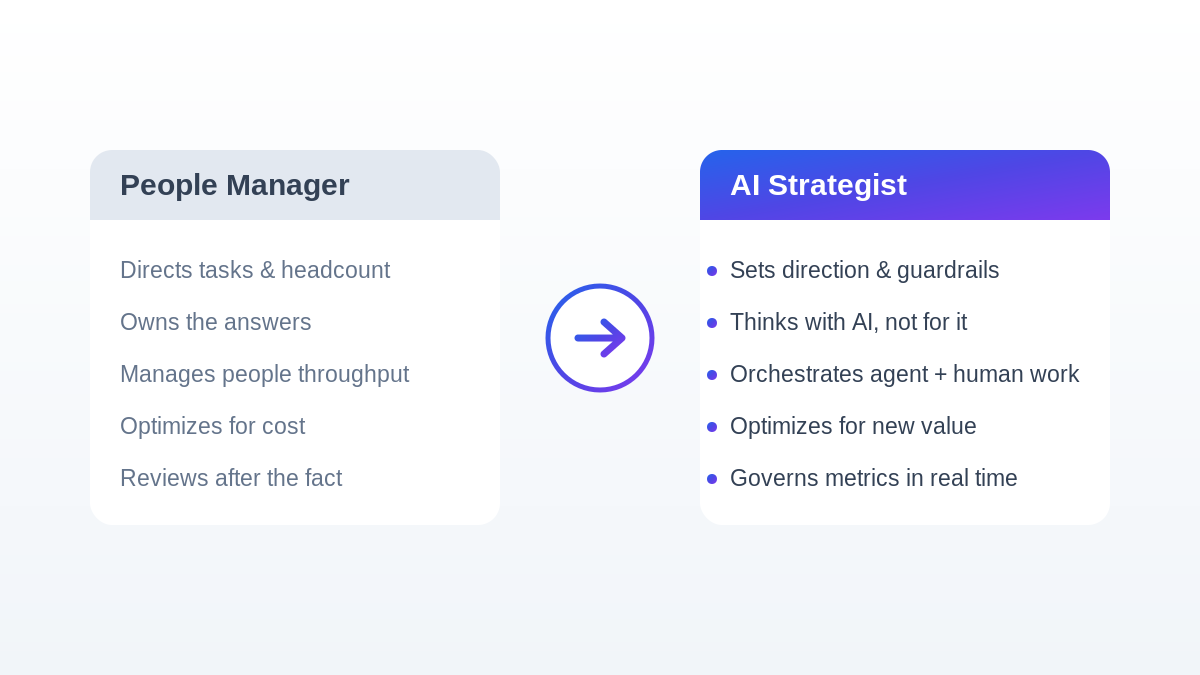
This is the move from people manager to AI strategist. The strategist still leads people — but they also lead machines, which requires a different posture. Instead of owning every decision, they define the decision space. Instead of reviewing work after the fact, they govern performance in real time. The skill isn't writing prompts; it's designing the operating conditions in which humans and agents produce reliable outcomes.
The new leadership skill set: AI fluency without losing human depth
AI fluency is becoming a core leadership competency — not the ability to build models, but the ability to reason about what AI can do, where it fails, and how to direct it. Xu's framing is that the best leaders use AI to think with them, not for them. They bring AI into the strategic conversation as a co-thinker while keeping accountability, ethics, and context firmly human.
Three capabilities separate AI strategists from the managers they used to be. First, fluency in interpreting data and AI output well enough to challenge it rather than rubber-stamp it. Second, the discipline to translate ambiguous business goals into measurable targets an intelligent system can be held to. Third, the judgment to manage ethics and risk — deciding where automation is appropriate, where a human must stay in the loop, and how to keep the system trustworthy. These are leadership skills, not engineering ones.
Managing AI agents is a management problem, not a technical one
As teams start managing AI agents alongside people, familiar management questions return in new form. What is this agent responsible for? How do we measure whether it's doing a good job? When does it escalate to a human? Who's accountable when it's wrong? Treating agents as teammates with defined roles, metrics, and escalation paths — rather than as a black box — is what turns AI from a science project into dependable operational capacity.
This is also where the failure mode Xu describes shows up. Leaders who deploy AI without defining success, without monitoring, and without clear human-in-the-loop boundaries end up with systems no one trusts. Leaders who define the metric first, wire in reliable oversight, and keep humans on the complex, high-empathy work build something that compounds.
What AI strategists should do differently
The practical shift is straightforward to state and hard to master. Lead the system, not just the people: define the objective, the boundaries, and the measure of success before deployment. Build AI fluency across the leadership team so decisions about automation are informed, not outsourced. Keep humans where humans matter — judgment, ethics, relationships, and the edge cases machines handle poorly. And treat every agent like a team member with a job description and a scorecard.
Leadership in the age of AI rewards a specific blend: the strategic clarity to point intelligent systems at the right problems, and the human depth to keep them accountable. That's the difference between a manager who supervises work and a strategist who designs how work gets done.
Ready to lead a hybrid workforce, not just manage one? Aissist.io gives leaders an AI operational layer — Digital Agents, an AI Manager, and continuous optimization — with the metrics and governance to stay in control. Get a free demo →
Key takeaways
AI leadership is shifting from directing people to orchestrating intelligent systems. The manager becomes an AI strategist: setting direction, encoding judgment into guardrails, and governing performance in real time. The essential skills are AI fluency, translating goals into measurable targets, and managing ethics and risk — while keeping humans on the work that needs them. Define success before you deploy, and manage agents like accountable teammates.
Frequently asked questions
How is AI changing the role of leaders and managers?
AI is moving leaders from directing tasks to designing systems. As AI agents handle execution, the leader's value shifts upstream to setting objectives, defining guardrails, and governing outcomes. Managers increasingly orchestrate a hybrid workforce of people and AI agents, which requires strategic clarity and AI fluency more than day-to-day task supervision.
What is an AI strategist?
An AI strategist is a leader who directs intelligent systems toward business goals rather than simply managing human throughput. They define what success looks like, set the boundaries AI operates within, interpret and challenge AI output, and keep humans accountable for judgment, ethics, and complex cases. It's a leadership role focused on designing how humans and AI produce results together.
What is AI fluency and why do leaders need it?
AI fluency is the ability to reason about what AI can do, where it fails, and how to direct it — not the ability to build models. Leaders need it to make informed decisions about automation, to challenge AI output instead of rubber-stamping it, and to use AI as a strategic co-thinker while retaining human accountability for outcomes.
Will AI replace managers?
AI is unlikely to replace managers, but it is changing what management means. Routine coordination and after-the-fact review are increasingly automated, while distinctly human work — judgment, ethics, relationships, and handling ambiguity — becomes more valuable. Managers who evolve into AI strategists, orchestrating people and agents together, become more essential, not less.
How do you manage AI agents in a team?
Manage AI agents much like human teammates: give each a clear responsibility, define how its performance is measured, set escalation paths for when it should hand off to a human, and assign accountability for errors. Pair this with real-time monitoring and governance so leaders retain oversight instead of treating the agent as a black box.
Why do AI initiatives fail under weak leadership?
AI initiatives most often fail because leaders deploy them without defining success, monitoring, or human-in-the-loop boundaries. As Lifan Xu notes, models are rarely the problem — the missing element is a clear, measurable definition of what the AI is supposed to achieve. Strong AI leadership sets that target before deployment and governs against it.
What skills will leaders need in the age of AI?
Leaders will need AI fluency, the ability to translate ambiguous goals into measurable targets, and strong ethics and risk judgment. Just as important are durable human skills — strategic direction, emotional intelligence, and accountability. The winning combination blends digital fluency with human depth, using AI to think with leaders rather than for them.
Based on Lifan Xu's commentary in a USA Today contributor feature, "From People Managers to AI Strategists: How Leadership Is Evolving in the Age of Intelligent Systems." Read the original at usatoday.com.