Why AI Projects Fail to Deliver ROI — and What Leaders Must Rethink
Most AI projects fail not because the models are weak, but because they were never tied to a measurable business outcome. Industry research puts the AI ROI gap starkly: by some estimates up to 95% of AI pilots never reach production. Understanding why AI projects fail — undefined metrics, underestimated maintenance, and lost momentum — is the first step to being in the small group that actually captures returns.

The pattern is familiar across industries. A promising pilot, an impressive demo, months of engineering effort — and then quiet abandonment before anything ships. According to Lifan Xu, co-founder of Aissist.io, the cause is rarely the technology. "AI isn't failing because the technology is weak. It's failing because organizations approach it with narrow goals." The fix isn't a better model; it's a better setup.
The root cause: no measurable objective
The most common reason AI projects fail shows up before deployment even begins: there is no clear objective tied to measurable impact. AI gets introduced as an experiment rather than a strategic program aligned to defined performance indicators. Without a target, "success" is undefined — and anything you can't measure, you can't defend when budgets tighten.
From there the sequence is predictable. Performance metrics are left undefined, integration complexity surfaces once the system meets real data, internal confidence erodes, and executive patience runs out. The discipline that prevents this is deliberately strict. As Xu puts it: "We focus on aligning AI to business metrics before deployment begins. If we cannot define how performance will be measured, we do not proceed." Naming the metric first is the single highest-leverage move in any AI implementation.
The "we can build it ourselves" trap
The second major driver of the enterprise AI failure rate is quieter and more expensive: internal teams assume they can replicate advanced AI systems with limited resources. They underestimate the ongoing maintenance, monitoring, and optimization these systems demand. AI is not a one-time build — it is a living system that drifts as data, edge cases, and processes change.
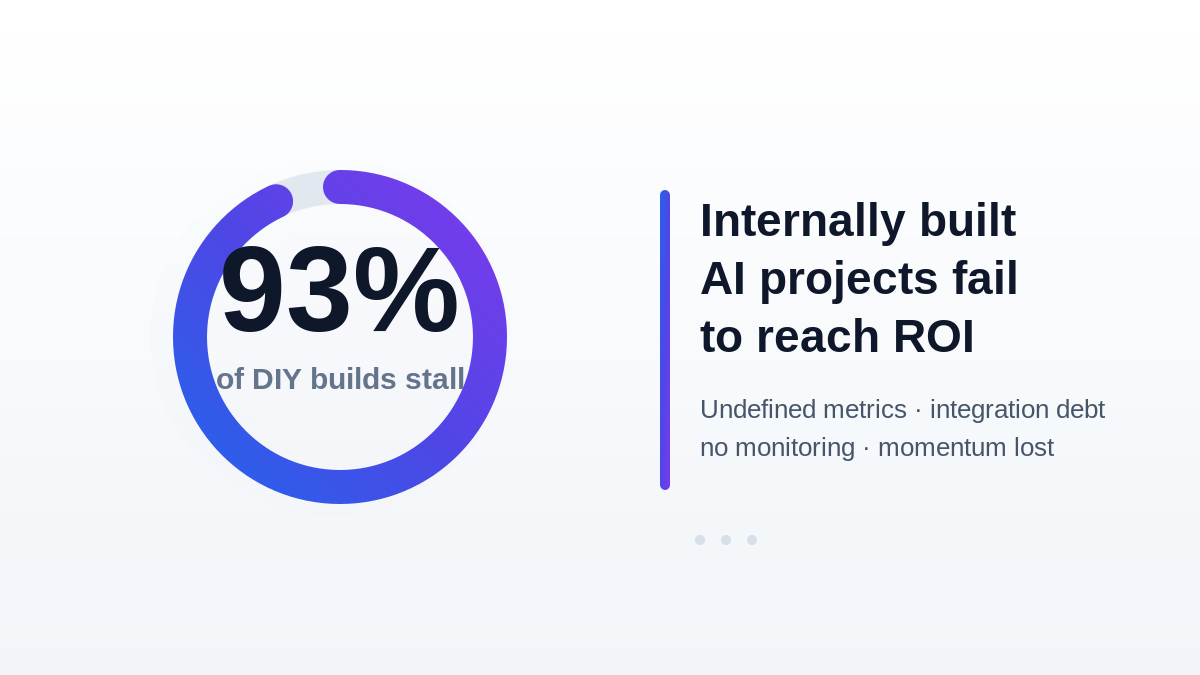
Over time, projects treated as one-off builds accumulate technical debt and stall under operational pressure. The proof of concept that looked cheap quietly consumes a team's capacity without ever scaling. This is why reliable, governed AI with monitoring built in — not bolted on — outlasts the DIY approach that dominates the failure statistics.
Speed is a strategic variable, not a nice-to-have
Momentum is the most underrated factor in AI ROI. When initiatives take years to show tangible results, executive sponsorship fades long before the technology can prove itself. Time-to-value determines whether a program survives long enough to matter. This is where deployment model matters: an AI operational layer that connects to the stack you already run — helpdesk and CRM — can show measurable results in weeks rather than the multi-year timelines that kill internal builds.
The winners aren't the teams with the most advanced models. They're the ones who demonstrate a measurable result early and compound from there.
The bigger miss: treating AI as a cost-cutting tool
The deepest error is one of ambition. When AI is treated purely as a way to cut costs, organizations miss the larger opportunity: unlocking new revenue streams, greater scalability, and new business models. Narrow framing produces narrow returns. Leaders who only ask "what can we automate to save money?" rarely reach the more valuable question — "what can we now do that we couldn't do before?"
In customer operations, that shift looks like moving from deflection to genuine end-to-end resolution: not just closing tickets faster, but converting service interactions into retention and revenue. That's the difference between an AI experiment and a strategic program.
How to be in the group that captures ROI
Before the next deployment, four questions separate the programs that scale from the ones that stall. Can you state, in one sentence, the business metric this AI is meant to move and how you'll measure it? Have you planned for ongoing monitoring and optimization rather than a one-time build? Will it show measurable value in months, not years? And are you aiming beyond cost savings toward new capability and growth?
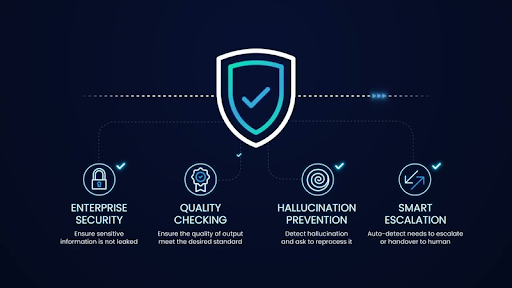
Systems built this way — aligned to business metrics from the outset, with governance and guardrails designed in — are how AI moves out of pilot purgatory and into production.
Want to see a metric-first deployment on your stack? Aissist.io defines the target metric before go-live, connects to the tools you already run, and shows measurable results in weeks. Get a free demo →
Key takeaways
AI projects fail on setup, not on model quality. The fixable causes are consistent: no measurable objective, underestimating maintenance, ignoring time-to-value, and framing AI as pure cost-cutting. Define the metric before you deploy, plan for continuous optimization, prioritize fast time-to-value, and aim for growth — and you move from the 95% that stall to the minority that capture real AI ROI.
Frequently asked questions
Why do most AI projects fail?
Most AI projects fail because they begin without a clear objective tied to a measurable business metric. When AI is launched as an experiment rather than a strategic program with defined KPIs, performance can't be measured, integration issues surface, confidence erodes, and executive support fades. The technology is rarely the problem — the setup is.
What percentage of AI projects fail to deliver ROI?
By widely cited industry estimates, up to 95% of AI pilots never reach production or deliver measurable ROI. The exact figure varies by study and definition, but the consistent finding is that the large majority of AI initiatives stall before generating a return, usually for organizational rather than technical reasons.
Why do enterprise AI pilots stall before production?
Enterprise AI pilots stall because they perform well in demos but break on real-world complexity, lack transparency and oversight for leaders, and are hard to integrate with existing systems. Combined with undefined success metrics and accumulating technical debt, these gaps erode trust and momentum before the pilot can scale.
How do you measure AI ROI?
Measure AI ROI by defining the target business metric before deployment — resolution rate, cost per resolution, CSAT, revenue influenced, or hours saved — and establishing a baseline. Track the change against that baseline over a fixed window. If you cannot define how performance will be measured up front, the project isn't ready to deploy.
Should we build AI in-house or buy a platform?
Building in-house often underestimates the ongoing maintenance, monitoring, and optimization advanced AI requires, which is why many internal builds accumulate technical debt and stall. A governed platform that integrates with your existing helpdesk and CRM typically reaches measurable value faster, though the right choice depends on your team's capacity and time-to-value needs.
How long should an AI project take to show ROI?
It should show measurable value in months, not years. When AI initiatives take years to deliver, executive patience runs out and sponsorship disappears. Prioritizing fast time-to-value — starting with a well-scoped, metric-aligned use case — keeps the program funded and lets results compound over time.
Is AI only useful for cutting costs?
No. Treating AI purely as a cost-cutting tool is one of the biggest missed opportunities. Beyond efficiency, AI can unlock new revenue streams, greater scalability, and new business models. In customer operations, that means moving from deflection to end-to-end resolution that also drives retention and revenue growth.
Based on Lifan Xu's commentary in International Business Times: Why So Many AI Projects Fail to Deliver ROI and What Strategic Leaders Must Rethink Before Their Next Deployment.