CX Org Design After AI: The Four Roles That Own Resolution in 2027
Gartner predicts that by 2027, 50% of companies that attributed headcount reduction to AI will rehire staff — to do similar work, under different job titles. That clause is the whole story of CX org design after AI: the headcount was never the variable, the org chart was.
TL;DR: Half of companies that cut service headcount for AI will rehire by 2027 "under different job titles," per Gartner — because AI moves the work to instruction design, escalation judgment and evaluation, not out of the building.
Methodology & sources
- Gartner press releases and survey data: 321 customer service and support leaders surveyed October 2025; 199 service and support leaders surveyed April–May 2026; workforce predictions published September 2026.
- Analyst commentary from Gartner and Forrester, quoted from primary press releases and from Customer Experience Dive reporting.
- Competing role definitions read directly from vendor pages at Decagon, Sierra, MavenAGI, Intercom's Fin and Ada on 17 September 2026.
- Deployment ramp figures from Aissist.io's AI customer service benchmark, a synthesis of published sources rather than a study — no sample of deployments, no N.
- All figures verified September 2026. Disclosure: this is Aissist.io's blog, and Aissist.io sells the AI operational layer described in the reporting-line section below.
This article defines the roles and reporting lines. For the case for keeping humans in the loop at all, see build a hybrid team and how to build a hybrid team with Aissist. For training the people who stay, see upskilling agents with agentic AI.
Why are companies that cut customer service staff for AI already rehiring?
Companies are rehiring because they removed the people and kept the work. Gartner's prediction is specific: by 2027, 50% of companies that attributed headcount reduction to AI will rehire staff to perform similar functions, but under different job titles — published in Gartner's February 2026 press release on a survey of 321 customer service and support leaders. The rehiring is not a retreat from AI. It is a correction of a filing error.
The dated numbers, in one place:
By 2027, 50% of companies that attributed headcount reduction to AI will rehire staff to perform similar functions, but under different job titles. Only 20% of customer service leaders had actually reduced agent staffing because of AI at the time of the survey. — Gartner, 3 February 2026 (321 leaders, October 2025)
By 2029, 30% of employees laid off due to replacement by AI will need to be rehired, "often at a significantly higher cost." — Gartner, "Four Shifts Shaping the Future of Work", 9 September 2026
The 20% figure is the one that reframes the debate. Most service organisations never made the cut in the first place — and the ones that did are now writing job descriptions for the same work. Gartner's Kathy Ross, Senior Director Analyst in the Customer Service & Support practice, attributes much of what did happen to the economy rather than the technology: "Most recent workforce reductions were influenced by broader economic conditions rather than automation alone."
What makes the rehiring expensive is that the returning role is not the role that left. Emily Potosky, Senior Director Analyst at Gartner, put the mechanism plainly to Customer Experience Dive in September 2026:
"I would say that paints a picture where you are going to have to rehire people to do the same work that you attempted to eliminate." — Emily Potosky, Senior Director Analyst, Gartner
So the question buyers are asking has changed. It is no longer how many people AI lets them remove. It is what the remaining people are for, and where they sit.
What changes in CX org design when AI resolves end to end?
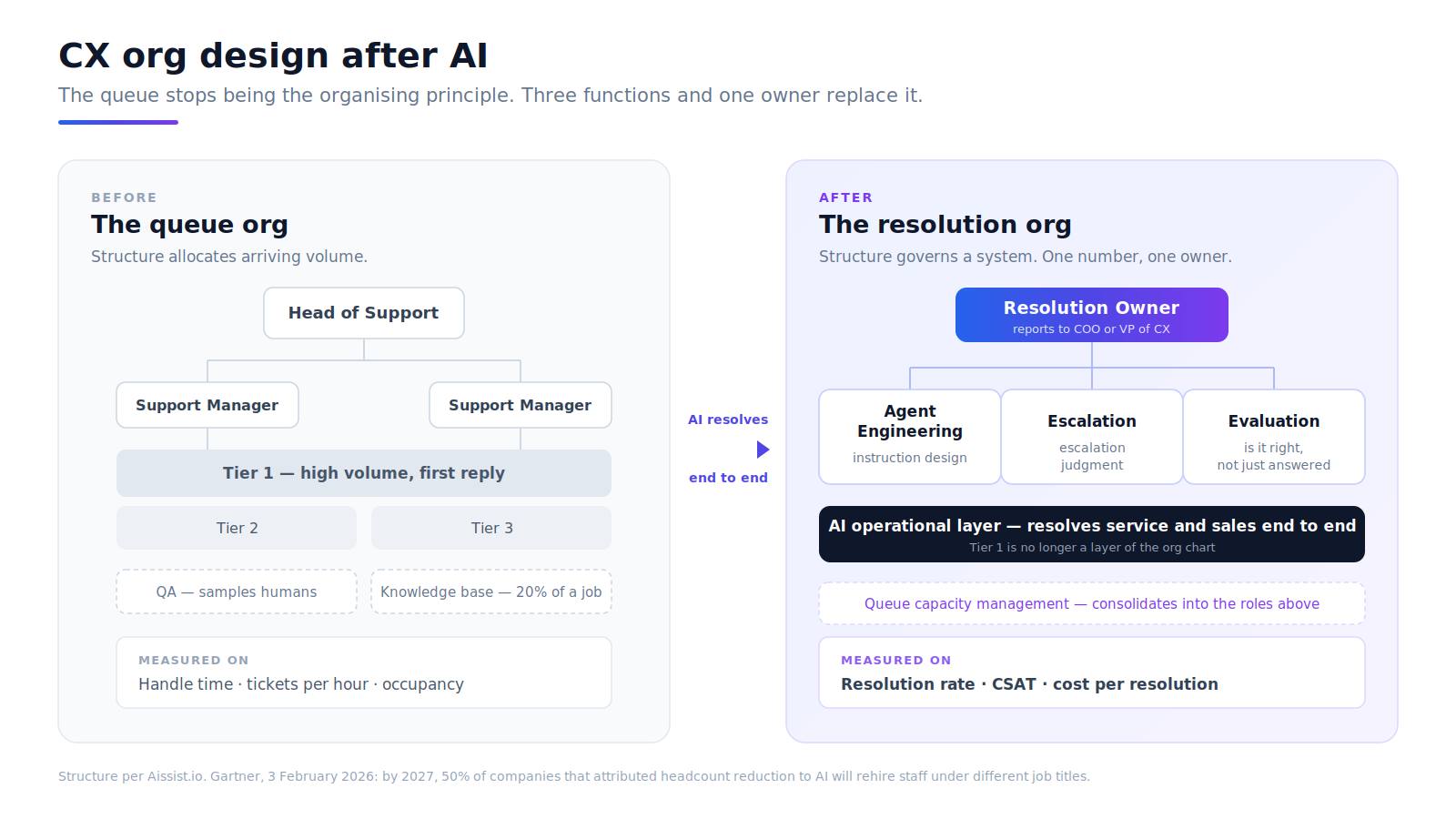
CX org design changes at the root: the work moves from handling contacts to governing a system, and that breaks the queue-shaped org chart. A traditional support org is built around throughput: tickets arrive, tiers absorb them, team leads manage capacity, and every role is measured on volume it personally touched. When an AI operational layer resolves cases end to end, nobody personally touches the volume — so the structure that allocated it has nothing left to allocate.
Here is the before-and-after, in words rather than boxes.
Before — the queue org. A Head of Support sits above two or three Support Managers. Each manager owns a queue and a team of eight to fifteen agents split into Tier 1, Tier 2 and Tier 3. QA sits to one side, sampling a few conversations per agent per month, and knowledge base upkeep is somebody's twenty percent. Every solid reporting line follows volume, and every metric — handle time, tickets per hour, occupancy — measures a human's personal throughput.
After — the resolution org. One Resolution Owner sits above three functions that did not previously exist as jobs: Agent Engineering, which writes and integrates the instructions the AI acts on; Escalation, a small senior bench that takes what the AI hands over and defines the handover rule; and Evaluation, which decides whether the AI was right, not merely whether it replied. Tier 1 stops being a layer. QA stops being a side function sampling humans and becomes Evaluation, auditing a system. The reporting lines now follow the resolution rate, and that rate is one number owned by one person.
Leaders already sense it coming. Gartner's February 2026 survey of 321 service and support leaders found 91% under executive pressure to implement AI, 80% planning to move at least some agents into new roles, 84% planning to add skills to the agent role and adjust hiring profiles, and 58% aiming to upskill agents into knowledge management specialists. Plans to reshape roles are nearly universal. Published structures for the reshaped org are not.
"Service organizations are entering a period where AI and human expertise must work in tandem. Leaders are not just deploying AI—they are redesigning service models to ensure that technology enhances the customer experience while humans provide context, empathy, and judgment." — Kim Hedlin, Director, Research, Gartner Customer Service & Support practice, Gartner
Aissist.io's position here is not neutral, and it follows from the product: an AI operational layer that resolves service and sales end to end removes the queue as the organising principle. What is left to organise is instruction quality, escalation judgment and measurement. Three things, three functions, one owner.
Which four roles own resolution in an AI-first CX org?
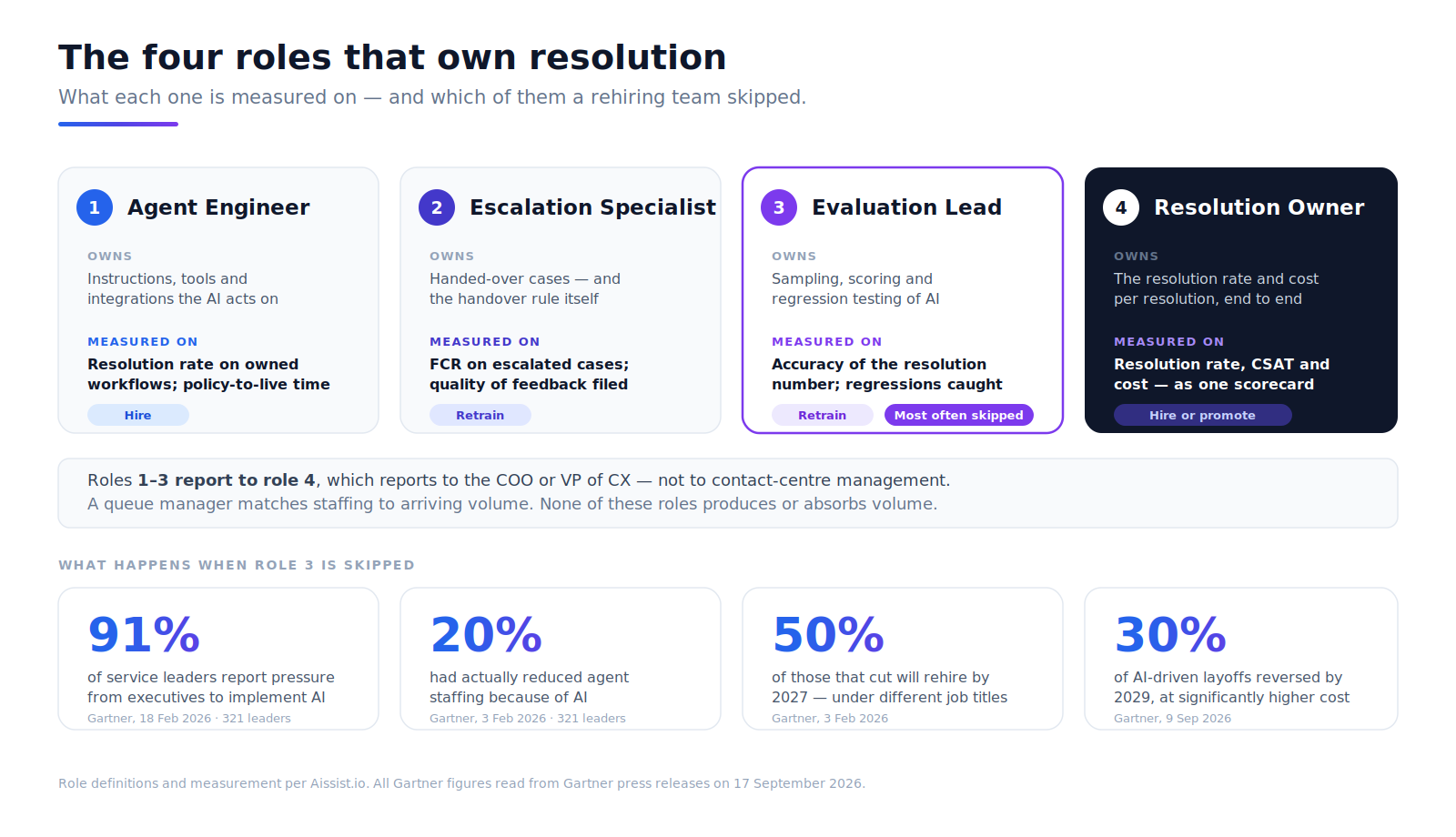
Four roles carry the work that survives end-to-end automation: the Agent Engineer, the Escalation Specialist, the Evaluation Lead and the Resolution Owner. Each is defined below as a standalone job, not a vendor's product persona.
-
Agent Engineer. The Agent Engineer designs, builds and ships the instructions, tools and integrations an AI agent uses to resolve a case end to end. The job is translation: taking a policy a human held in their head and rendering it as something a system executes reliably, then wiring up the CRM, order system and payment APIs the agent needs to act. It is the one role the market has already named — Sierra and Decagon both hire for it under this exact title.
-
Escalation Specialist. The Escalation Specialist resolves the cases the AI hands over and owns the rule that decides what gets handed over. This is the senior end of the old Tier 2 and Tier 3 bench, retrained: fewer people, harder cases, and a second duty — writing down why a case escalated in a form the Agent Engineer can act on. Forrester's Max Ball calls the frontline version "bot unblockers" and the senior version "judges" and "experts."
"That is a job that I think a fair number of frontline reps will transition into." — Max Ball, Principal Analyst, Forrester, on bot unblockers, in Customer Experience Dive
-
Evaluation Lead. The Evaluation Lead decides whether the AI's resolutions were correct, and runs the sampling, scoring and regression testing that proves it. This is not legacy QA with a new label. Legacy QA graded a human's tone on five conversations a month; evaluation grades a system's judgment across every conversation, catches regressions when a prompt or model changes, and produces the evidence that lets a business trust an automated refund. It is the role most often skipped and the one whose absence shows up in the rehiring statistic.
-
Resolution Owner. The Resolution Owner is accountable for the resolution rate across AI and humans together, as a single number with a cost attached. Elsewhere this role gets called the Agent PM or AI Programs Lead; the name matters less than the accountability, which is end-to-end rather than per-channel. They set what the AI is allowed to do, fund the evaluation function, and answer for CSAT and cost per resolution in the same sentence.
The fourth role makes the other three coherent. Without it, Agent Engineering reports to Engineering and optimises for shipped workflows, Escalation reports to Support and optimises for queue clearance, and Evaluation reports to nobody and gets cut in the first budget review — which is roughly how a team ends up rehiring in 2027.
Who do these roles report to, and why not the contact centre?
They report to the Resolution Owner, who reports into operations or the CX executive — not into contact-centre management, because contact-centre management is organised around capacity and these roles are not. A queue manager's job is to match staffing to arriving volume. None of the four roles above produces or absorbs volume, so measuring them inside that structure produces the wrong incentives within a quarter.
| Role (Sep 2026) | What they own | Measured on | Reports to | Hire or retrain |
|---|---|---|---|---|
| Agent Engineer | Instructions, tools, integrations the AI acts on | Resolution rate on owned workflows; time from new policy to live behaviour | Resolution Owner, dotted line to Engineering | Hire — or retrain a technical support engineer |
| Escalation Specialist | Handed-over cases and the handover rule itself | First-contact resolution on escalated cases; quality of escalation feedback filed | Resolution Owner | Retrain — senior Tier 2/Tier 3 agents |
| Evaluation Lead | Sampling, scoring, regression testing of AI resolutions | Accuracy of the resolution number; regressions caught before customers find them | Resolution Owner, dotted line to Risk or Compliance | Retrain — QA lead, with new tooling |
| Resolution Owner | The resolution rate and cost per resolution, across AI and humans | Resolution rate, CSAT, cost per resolution, as one scorecard | COO or VP of CX | Hire or promote — often the Head of Support |
| Support Manager (legacy) | Queue capacity and agent throughput | Handle time, occupancy, tickets per hour | — | Role consolidates into Resolution Owner or Escalation |
Two dotted lines matter. The Agent Engineer needs Engineering's code review and release discipline without inheriting Engineering's roadmap, or agent work becomes a backlog item behind the product. The Evaluation Lead needs a line to Risk or Compliance, because the moment an AI issues refunds or changes account details, "was it right" stops being a CX question and becomes an AI governance question.
One rule explains why the Evaluation Lead cannot report to the Agent Engineer's manager: if the person who builds the agent also owns the score that grades it, the score stops being information. Every other quality function in a serious business is separated from the thing it measures. Automated customer service has been the odd exception, mostly because the score used to be a containment percentage nobody believed anyway.
What independence buys, concretely: an evaluation function scores every conversation on a fixed rubric, applied uniformly rather than to a sample, and reports to someone who does not own the automation target. The test of whether you have one is simple — an evaluation function that never contradicts the marketing is not an evaluation function.
One first-hand note. On 17 September 2026 we read the six vendor pages that currently define these roles — Decagon's CX org design and agent engineer posts, Sierra's agent engineer page, MavenAGI's support-leader-as-PM piece, Intercom Fin's org blueprint and Ada's AI org chart. Ada's is the only one that assigns reporting lines. Not one of the six cites an external source for a single figure, and five carry no statistics at all — which is fine as a starting point and thin as the basis for an org chart you will defend in a budget review.
Which teams end up in the rehiring statistic?
The teams that cut headcount before the evaluation function existed — and the teams that sized the cut off a marketing number. A substantial share of contacts still reaches a person on any honest measure, because every escalation and transfer counts as unresolved. Cut the escalation bench on the assumption that the AI takes everything, and the remainder has nowhere to land. Size the bench off your own measured escalation rate, not a vendor's resolution claim.
The spread between deployments is the real planning problem. End-to-end resolution varies enormously across accounts running identical technology, driven mostly by workload composition rather than vendor choice. There is no headcount ratio to copy from a case study, only the number your own traffic produces.
Aissist.io's AI customer service benchmark adds the trajectory: new deployments typically launch at 40–50% resolution and improve by roughly a point per month as workflows and documentation mature. That improvement is not a property of the model. It is somebody's job, and removing the somebody flattens the curve at launch performance.
The money is already moving, which is what makes the sequencing error expensive. Gartner's August 2026 survey of 199 service and support leaders found AI spending up 38% while overall service and support budgets rose just 2% — the AI line item is being funded by the rest of the function.
"To fund ambitious AI initiatives, leaders are increasingly redirecting spending away from labor and overhead and instead toward technology." — Kim Hedlin, Director Analyst, Gartner Customer Service & Support practice, Gartner
Redirecting labour budget into technology is the right move if the technology absorbs the work. It is a trap if the roles that make the technology work were in the labour budget you just cut. Gartner's September 2026 future-of-work predictions sharpen the cost of getting the order wrong: by 2027, 75% of organisations that prioritise AI productivity gains as cost savings will be surpassed by competitors who reinvest those gains into innovation, modernisation and upskilling.
The safe sequence is unglamorous. Stand up evaluation first, because it is the only function that tells you what the AI can safely be given next. Name a Resolution Owner second, so the number has an address. Hire or retrain agent engineering third, against workflows evaluation has shown are ready. Reduce headcount last, if the resolution rate justifies it — and never by deleting the escalation bench, because the cases the AI hands over are, by construction, the hard ones. Aissist.io's Pulse™ evaluates human and AI agents on metrics the business defines rather than on containment, but the sequence holds whatever tooling a team uses.
Resolution is an org design problem, not a headcount problem
Gartner's rehiring predictions are not evidence that AI underdelivers. They are evidence that the work AI creates was never budgeted. Instruction design, escalation judgment and evaluation are real jobs with real outputs, and they do not fit a structure built to allocate arriving tickets — which is why the staff come back "under different job titles."
The practical test for next year's CX org design is one question: who is accountable for the resolution rate, across AI and humans, as a single number with a cost attached? If the answer is a name, the four roles above have somewhere to report. If the answer is a committee, the rehiring forecast is about you. Aissist.io covers the human side in build a hybrid team, how to build a hybrid team with Aissist and upskilling agents with agentic AI — though a consultation pressure-tests a structure faster than a blog post will.
Name the owner before you size the team. Aissist.io's Pulse™ gives the evaluation function a resolution number it can defend, on the helpdesk you already run. Book a consultation →
Frequently asked questions
What does an AI agent engineer actually do?
An AI agent engineer designs, builds and ships the instructions, tools and integrations an AI agent uses to resolve customer cases end to end. The job combines prompt and behaviour design with API integration work, then iterating on live performance. Sierra and Decagon both hire for the role under that title.
Who should own the resolution rate in an AI-first support org?
One Resolution Owner should own resolution rate, CSAT and cost per resolution as a single scorecard covering AI and humans together, reporting to the COO or VP of CX. Splitting the number between an AI program and a human queue is how accountability disappears. Gartner's data shows 80% of organisations already plan to move agents into new roles.
Is an AI agent product manager a real job or a vendor invention?
It is real work with an unsettled title. Decagon calls it the agent product manager, MavenAGI frames it as support leaders becoming product managers, and Ada calls it the AI Programs Lead or ACX Director. The accountability — owning what the AI is allowed to do and what it is measured on — is consistent across all three.
Can existing support agents be retrained into these roles?
Yes, for three of the four. Escalation specialists come from senior Tier 2 and Tier 3 agents, evaluation leads from QA leads with new tooling, and knowledge work from existing content owners — Gartner found 58% of leaders aim to upskill agents into knowledge management specialists. Agent engineering is usually a hire or a move from technical support engineering.
Should we cut support headcount before or after deploying AI?
After, and only once an evaluation function can show which workflows the AI resolves reliably. Gartner predicts 50% of companies that attributed headcount reduction to AI will rehire by 2027, and 30% of AI-driven layoffs will need reversing by 2029, "often at a significantly higher cost."
What happens to QA when AI handles most conversations?
QA becomes an evaluation function: instead of scoring a sample of human conversations for tone, it scores a system's judgment at volume, catches regressions when prompts or models change, and produces the audit evidence a business needs before letting AI issue refunds. It also stops reporting to the team that builds the agent.
How many people do these four roles need?
Fewer than the queue org they replace, but not zero, and the ratio depends on your own resolution rate rather than a vendor's benchmark. End-to-end resolution varies widely between deployments on the same technology, so size the escalation bench against the volume your AI actually hands over rather than against a published rate.