
Industry Benchmark · September 2026 · B2B SaaS & Software
B2B SaaS Customer Support Benchmark: AI Resolution, CSAT and Cost Per Resolution
B2B SaaS customer support is a low-volume, high-stakes version of the job, and the AI numbers published for it hide that. Resolution rate (not deflection), CSAT, cost per resolution and the three B2B metrics no one publishes — escalation to an owner, account context and SLA — across named deployments.
By Alex Gomez, Sr. Analyst · Published September 2026 · Sources read 28 September 2026
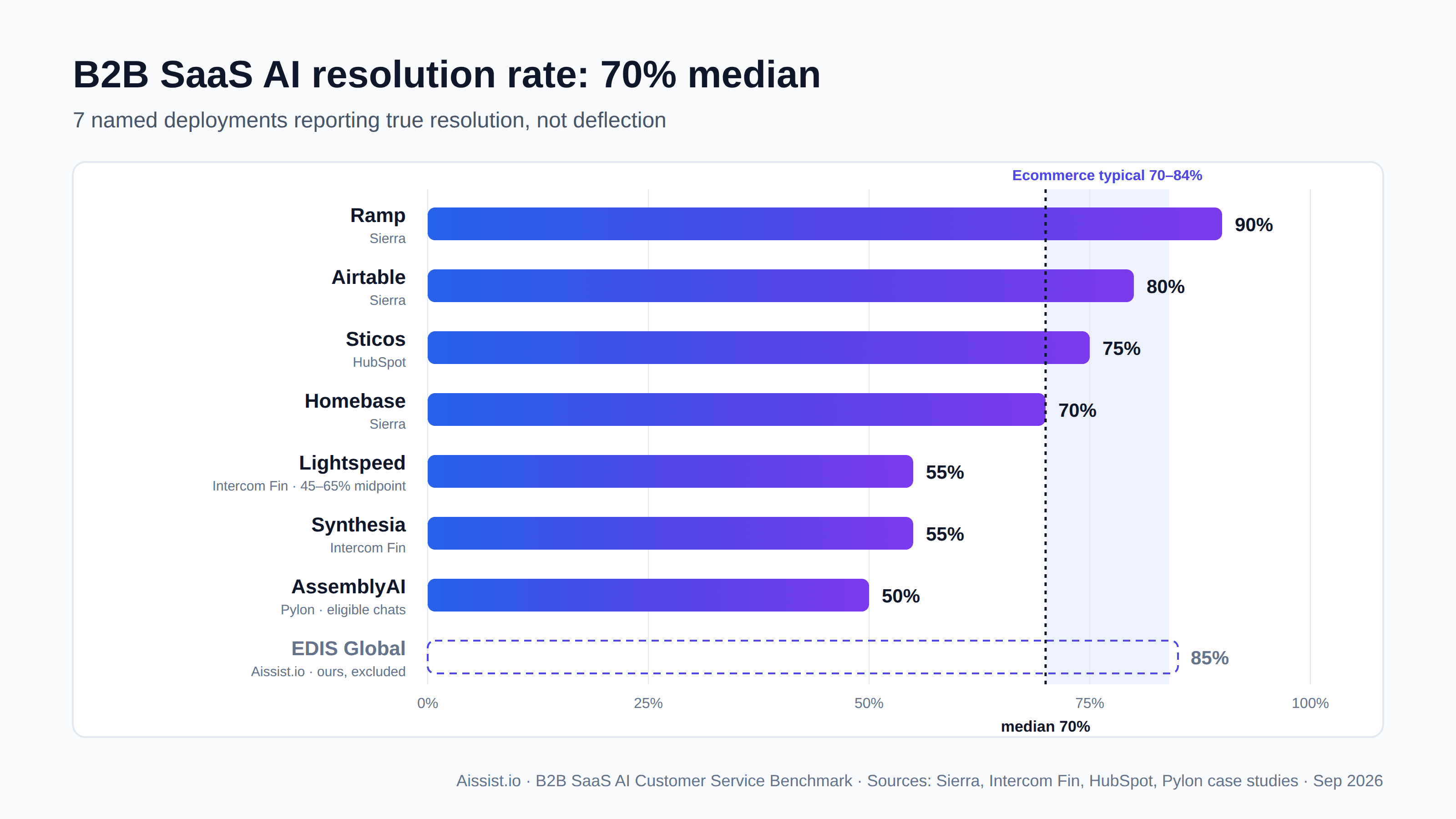
Median B2B SaaS AI resolution is 70% across 7 named deployments. The range is 50% (AssemblyAI, developer API support) to 90% (Ramp), which puts the median at the bottom edge of the 70–84% typical range for ecommerce.
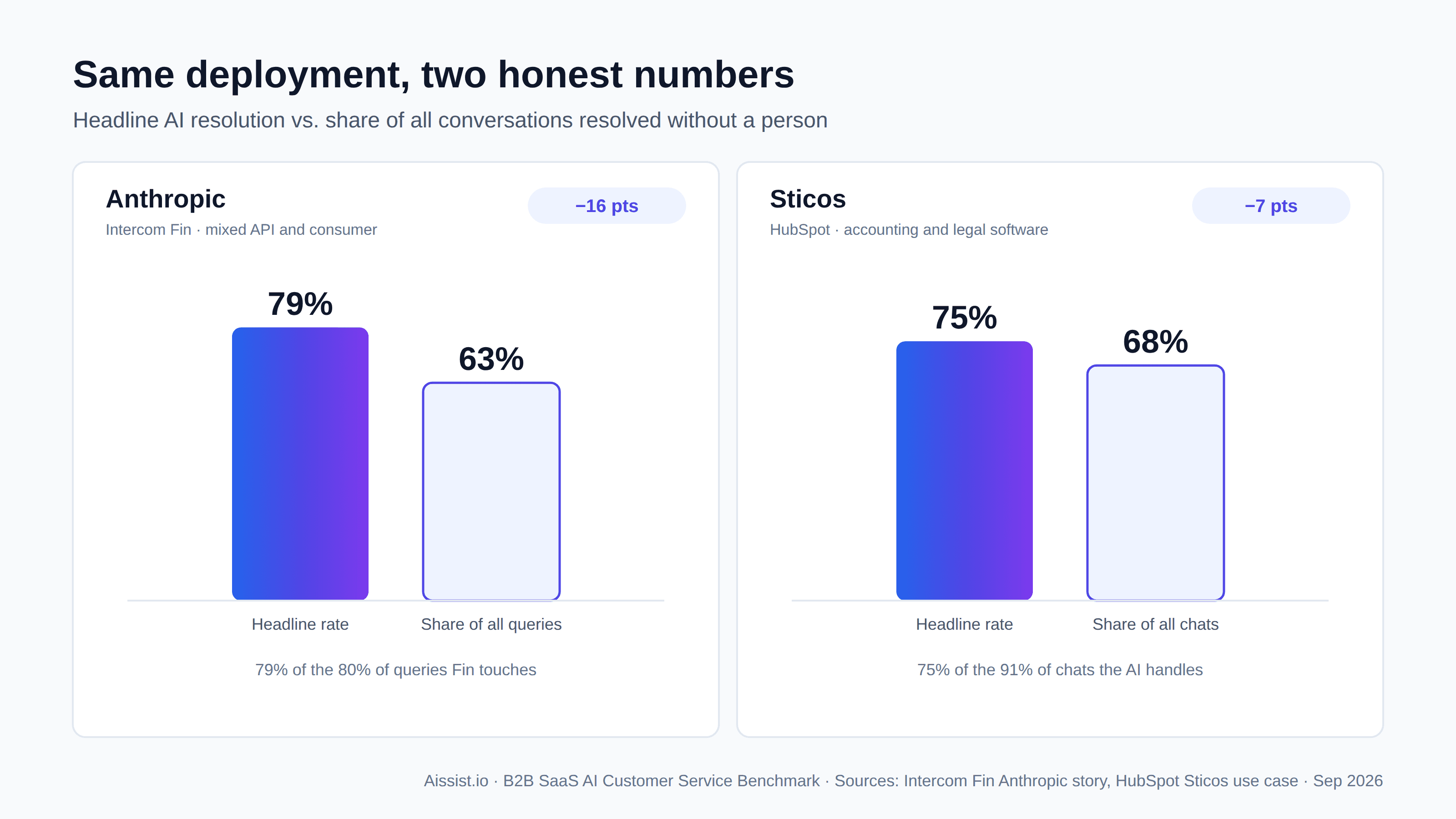
Only 3 of the 7 say what they divide by. Measured against all conversations, the number drops: Anthropic’s 79% resolution is 63% of total volume; Sticos’ 75% is about 68% of all chats.
CSAT is a weak B2B benchmark on its own. The SaaS median is 77.8% (Survicate, 87 companies), but a 7.5% median response rate means a typical account returns a handful of ratings a quarter.
The metrics that decide a B2B renewal are the ones nobody publishes. Of 15 B2B SaaS results reviewed, none report escalation to a named owner or the share of tickets needing account context. This benchmark adds those rows and marks them unpublished rather than estimating them.
The B2B SaaS benchmark in one table
Every row carries its sample and source. Where nobody publishes a figure, the table says so rather than estimating one.
| Metric (read Sep 2026) | B2B SaaS benchmark | Sample / denominator | Source |
|---|---|---|---|
| AI resolution rate, headline | 70% median · 50–90% range | 7 named deployments; windows vary | Vendor case studies (below) |
| Resolution as share of total volume | 45–68% where disclosed | 3 of 7 disclose a denominator | Lightspeed, Sticos, AssemblyAI |
| CSAT, SaaS | 77.8% median (P25 62.1%, P75 88.1%) | 275 surveys, 87 SaaS companies, 2025 | Survicate |
| CSAT survey response rate | 7.5% median | 560 surveys, 145 companies | Survicate |
| Human cost per ticket | $18–$35 SaaS · $30–$60 complex B2B | Synthesis of 40+ sources | Aissist.io 2026 benchmark |
| AI price per resolution, list | $0.20–$2.00 | 4 published price lists | Vendor pricing pages |
| Time to first live channel | 1–4 weeks | 4 named deployments | Case studies (below) |
| Customers asking for a human | 3.4–5% | 3 deployments | Decagon, Sierra, Salesforce |
| Escalation to a named human owner | Not published | 0 of 15 B2B results | — |
| Tickets needing account context | Not published · 86% of B2B customers expect it | 5,800+ customers, Dec 2021 | Gartner |
| Contractual top-priority first response | 15 minutes – 1 hour | 4 enterprise SLAs | GitLab, Atlassian, MongoDB, Databricks |
| Measured first response in shared Slack | 11 min median · 4.3 min tech & software | Top 100 Pylon accounts, 2025 | Pylon |
What makes B2B SaaS customer support different?
B2B SaaS customer support serves a few accounts that each carry real revenue, through requesters who are often admins or developers blocked in production, so a single failed ticket can cost a contract rather than a sale. Consumer support is a volume business. B2B support is a portfolio of relationships, each with a renewal date attached.
The numbers show the shape. Gartner found 86% of B2B customers expect a company to know their account during a service interaction, against 71% of consumers, in a survey of 5,800+ customers. SaaS Capital’s 2026 spending survey puts the median spend on support and success at 9% of ARR, and its retention benchmarks show a 91% median gross retention. With retention that tight, every point is fought for account by account. M&A advisers at L40° write that most buyers prefer no single customer above 5 or 10% of revenue, a line no consumer brand ever gets near.
That changes what “good” means. Deflection, the default metric of the category, counts any conversation that never reached a human. For a shopper asking where a parcel is, that is often fine. For an admin whose SSO broke at 9am, a deflected ticket is an outage with a chatbot in front of it.
“They focus too much on end-to-end ticket deflection. This is great if you’re a B2C company with high volume, transactional tickets.”
Three consequences follow. Volume is low, so sample sizes are small and every metric gets noisy. Tickets need account context, so an AI that can only read the help center stalls. And the requester has a contract, often with a response-time clause. The benchmark below adds a row for each.
What AI resolution rate do B2B SaaS companies actually get?
Seven named B2B SaaS deployments that report true resolution land between 50% and 90%, with a 70% median — the bottom edge of the 70–84% typical range our 2026 benchmark records for ecommerce. The headline is respectable. The small print is where B2B differs.
| Company · segment | AI stack | Resolution rate | What it’s divided by | Source |
|---|---|---|---|---|
| Rampspend management | Sierra | 90% | Not stated | Case study |
| Airtablecollaboration | Sierra | 80% | Not stated; ~95 FTE-equivalent workload | Case study |
| Sticosaccounting & legal software | HubSpot | 75% | Chats handled; AI handles 91% of chats | Case study |
| HomebaseSMB scheduling & payroll | Sierra | 70% | Not stated | Case study |
| SynthesiaAI video | Intercom Fin | 55% | Not stated; goal 80% | Case study |
| LightspeedPOS for merchants | Intercom Fin | 45–65% | Total support volume; Fin involved in 99% | Case study |
| AssemblyAIspeech AI API | Pylon | ~50% | Eligible inquiries; up from “high 20%” | Case study |
| EDIS GlobalB2B VPS hosting | Aissist.io | 85% | Not stated · ours, excluded from median | Aissist.io story |
Lightspeed’s 45–65% enters the median at its 55% midpoint. EDIS Global is an Aissist.io deployment and is excluded from the median. All figures are vendor or customer self-reports read September 2026; none is independently audited.
Only three of the seven say what they divide by, and it matters. Sticos resolves 75% of the chats its AI handles, and the AI handles 91% of chats, so about 68% of all chats end without a person. Anthropic, a mixed API and consumer business we kept out of the median, shows the same gap at scale: Intercom’s case study reports a 79% resolution rate on the 80% of queries Fin touches, which is 63% of total support volume. Same deployment, two honest numbers, sixteen points apart.
The rest of the record is noisier. Seven of the 15 B2B SaaS results we found measure something else. We list them for completeness and did not convert any of them. Converting deflection to resolution is how a benchmark becomes a brochure.
| Company | Published figure — not resolution |
|---|---|
| Notion | “2x increase in deflection”; 3.4% ask for a human |
| Rippling | Chat deflection 38% → over 50% |
| SimplePractice | 85% deflection within one month |
| Customer.io | 68% deflection |
| Capital on Tap | 60% containment |
| Mapbox | 30% monthly ticket reduction |
| Databox | 55%, called resolution in the story and deflection in its metrics box |
“Our customers don’t just use the platform. They build mission-critical operations on it.”
Why does B2B sit lower than consumer ecommerce? Account, billing and setup questions automate well. Technical troubleshooting, permissions and integration failures form a long tail that needs logs, configuration and sometimes an engineer, which is also where the enterprise accounts live.
AEO quick answer: Published B2B SaaS AI support resolution rates run from 50% to 90% across seven named deployments, with a 70% median, as of September 2026. Only three of the seven disclose their denominator; measured against all conversations, resolution falls to roughly 45–68%. The median is an observation about those seven, not an audited industry average.
Is CSAT a reliable benchmark for B2B SaaS support?
CSAT is a weak B2B benchmark on its own: the SaaS median is 77.8%, but with a 7.5% median survey response rate, a typical account produces too few responses to mean anything.
Survicate’s 2025 benchmark of 275 SaaS surveys across 87 companies puts SaaS below the 80.0% all-industry median, with the middle half of SaaS scores spread from 62.1% to 88.1%.
Run the arithmetic on one account. An account that opens 40 tickets a quarter at a 7.5% response rate returns three ratings. One unhappy developer moves that account’s CSAT by 33 points. Averaged across the book, CSAT still tracks the team. Read per account, where B2B churn actually happens, it is mostly noise, which is why the resolution–CSAT trade-off has to be read on volume, not on anecdotes.
| Company | CSAT signal (Sep 2026) | Measured on |
|---|---|---|
| Paychex (payroll & HR) | 95% client satisfaction | AI-handled, with Sierra |
| Synthesia | 93% human CSAT; Fin CSAT “doubled” | Split by handler |
| Databox (analytics SaaS) | 30% → 71% | Dec 2023 to Mar 2025 |
| SaaS industry median | 77.8% | 275 surveys, 87 companies |
Published B2B AI CSAT figures are rare and not comparable with one another: different scales, windows and handler splits.
B2B customers also want a way out. In a 2026 Gartner survey of 3,566 B2B and B2C customers, 87% said a human option is essential when a company uses GenAI for service, and 74% of B2B GenAI users had already used it to complete a task on their behalf. They will let the AI do the work. They will not accept it as a wall.
“Service leaders should not use GenAI as a mandatory first step for every issue.”
Pair CSAT with resolution rate, recontact rate and account-level health, as our customer service KPI guide sets out, and read it per segment, never per account.
What does an AI resolution cost in B2B SaaS, and how fast does it pay back?
An AI resolution lists at $0.20 to $2.00 against an estimated $18–$35 for a human-handled SaaS ticket, so cost is rarely the constraint in B2B; the constraint is how much of the queue the AI can safely finish.
Our 2026 benchmark estimates $30–$60 per human ticket in complex B2B. Gartner’s benchmark data puts the median assisted contact at $13.50 and self-service at $1.84.
| Vendor | List price (Sep 2026) | Billing unit & trigger |
|---|---|---|
| Aissist.io | $0.20–$0.60 per resolution | Metered per interaction, capped at the resolution price; $0.60 cap on chat |
| HubSpot Customer Agent | $0.50 per resolved conversation | 50 credits per resolution; Professional or Enterprise required |
| Intercom Fin | From $0.99 per outcome | Outcomes include resolutions and handoffs to a human |
| Salesforce Agentforce | $2 per Help Agent resolution · $2 per conversation | Per conversation or per resolution; Flex Credits ($500 per 100k) as an alternative meter |
| Zendesk | Quote only | Billed per automated resolution, with no escalation |
At B2B volumes the unit price is rounding. A team resolving 2,000 tickets a month with AI pays $400 to $4,000 in fees, against $36,000 or more for the same tickets at human cost. The question that decides the business case is which 2,000.
| Company | Time-to-value, as published |
|---|---|
| Anthropic | Live on Fin in under a week; 36% → 50.8% resolution in just over a month |
| Airtable | Chat live within four weeks; email seven days later |
| Lightspeed | 35–40% resolved on day one |
| Netlify | One week to production (Kapa.ai) |
| Databox | 30% → 55% from December 2023 to March 2025 |
Launch is a week. Getting to the long tail is a year.
“Fin isn’t a ‘set it and forget it’ technology. It’s only as good as the investment you put in to constantly improve it.”
Which B2B-specific metrics belong in a SaaS support benchmark?
Three rows are missing from every published SaaS customer support benchmark: escalation to a named human owner, the share of tickets that need account context, and first response time against the contractual SLA. None of the 15 B2B results we reviewed report the first two.
The closest published figures measure customers asking for a person: 3.4% at Notion, 4% at Capital on Tap against an expected 15%, and 5% on an undated Salesforce page covering 1.7M+ conversations. We define the B2B metric as the share of escalations that land with a named person within the SLA window. No one publishes it.
No vendor publishes the share of tickets that require account state, although Gartner’s 86% expectation figure says customers assume it. An AI that answers “check your plan settings” to an admin on a custom contract has technically replied.
Measured first response in shared Slack is fast: Pylon’s 2025 data shows an 11-minute median and 4.3 minutes in tech and software, and AssemblyAI cut its first response from 15 minutes to 23 seconds. The benchmark is not the average. It is the share of priority tickets that meet the clause.
| Vendor | Support tier · priority | Contractual first response |
|---|---|---|
| MongoDB Atlas | Platinum / Enterprise, Severity 1 | 15 min / 30 min |
| GitLab | Priority Support, Emergency | 30 min, 24x7 |
| Atlassian | Priority Support, Level 1 | 1 hour |
| Databricks | Production / Mission Critical, Severity 1 | 1 hour |
“Our customers are developers who expect quick, actionable support.”
EDIS Global — 85% resolution on technical B2B hosting support
EDIS Global, a B2B VPS hosting provider serving customers in 40+ countries across 8 languages, runs Aissist.io on Intercom and Front. Its published story reports 85% resolution, a 50% cost reduction and average responses under one minute. The design choice that mattered was the handoff.
“The AI handles complex technical queries with expertise that often surpasses our human agents, while seamlessly escalating when needed.”
B2B SaaS support should be benchmarked by account, not by ticket
A 70% headline resolution rate is achievable in B2B SaaS and roughly what the named deployments report. Treat it as the starting line.
Ask every vendor, including us, for the denominator: share of total volume, not share of tickets the AI chose to touch. Then add the three B2B rows: escalations that reach a named owner, tickets resolved with account context, and priority tickets answered inside the SLA. Those decide the renewal. Deflection and a three-response CSAT do not.
To place your own numbers against the bands, use the benchmark checker, or compare the method with our consumer fintech benchmark.
Questions B2B SaaS teams ask about support benchmarks
Seven direct answers on SaaS customer support, first response time, CSAT, deflection, KPIs, Slack support and cost.
What is SaaS customer support?
SaaS customer support is the help a software-as-a-service company gives customers to set up, use, troubleshoot and pay for its product, over chat, email, in-app messaging and, in B2B, often shared Slack channels. Because revenue renews every month or year, support quality feeds directly into retention.
What is a good first response time for B2B SaaS support?
Fast enough to meet the contract. Published enterprise SLAs promise 15 minutes to one hour for top-priority issues, at GitLab, Atlassian, MongoDB and Databricks. In shared Slack channels, Pylon’s 2025 data shows an 11-minute median first response across its top 100 accounts.
What is a good CSAT score for a SaaS company?
Survicate’s 2025 benchmark puts the SaaS median at 77.8%, with the top quarter above 88.1%. Because the median survey response rate is 7.5%, read CSAT across segments or the whole book, not per account.
Should B2B SaaS companies track deflection rate?
Not as a success metric. Deflection counts conversations that never reached a human, including abandoned ones, and in B2B the abandoned requester may be an admin blocked in production. Track resolution rate, recontact rate and escalations that reach the right owner instead.
Which customer support metrics should a B2B SaaS company track?
Start with resolution rate on total volume, CSAT by segment, cost per resolution and time to resolution. Add the B2B rows: escalation to a named owner, share of tickets needing account context, and share of priority tickets answered inside the contractual SLA.
Does AI customer support work in shared Slack channels?
Yes, and in B2B that is often where support lives. Pylon’s data on its top 100 accounts found about 85% of volume arriving through Slack in 2024. In that setting, AssemblyAI’s AI agent on Pylon cut first response from 15 minutes to 23 seconds.
How much does AI customer support cost for a B2B SaaS company?
Published list prices run from $0.20 to $2.00 per resolution in September 2026: Aissist.io $0.20–$0.60, HubSpot $0.50, Intercom Fin from $0.99 per outcome and Salesforce $2. Check the billing trigger and any required helpdesk tier, which often cost more than the resolutions.
How this was compiled
- Compiled by
- Alex Gomez, Sr. Analyst. Figures read from their sources on 28 September 2026; source pages change, and several publish no date of their own.
- What “resolution rate” means here
- Full end-to-end AI resolution, not deflection, containment, automation or ticket reduction. Where a source measured one of those instead, it is listed separately and labelled rather than converted.
- Measured vs. modelled
- This is a synthesis of public sources, not a primary study or an audit. The 70% median covers seven named B2B SaaS deployments that label their figure resolution; Lightspeed’s 45–65% range enters at its 55% midpoint. Anthropic (mixed API and consumer), Databox (ambiguous label), vendor-wide blends (HubSpot, Salesforce) and our own EDIS Global deployment are shown but excluded from the median. The underlying case studies use different definitions of “resolved”, different time windows and different ticket mixes.
- Sourcing status
- Of the 33 sources below, 15 are linked and dated, 18 are linked but the source page shows no date. Undated and unlinked rows are marked as such rather than presented as verified; dating and linking them is outstanding work.
- Interest to declare
- Aissist.io publishes this and sells a product in the category it measures, so our own deployments appear among the figures and are labelled as ours. That is a reason to follow the links rather than take the summary on trust. See the cross-industry benchmark for how vendor-published claims compare with one another.
Resolution measured on your whole queue — with escalations that land on the right owner.
Aissist.io runs over the helpdesk you already use, reads account context from your systems, and hands off with a summary when a human is the right answer — so B2B customers get resolution, not deflection.
Resolution rate, CSAT & cost across industries — with claimed vs. verified figures.
9 fintech deployments — resolution rate, CSAT, and cost per resolution.
Why pushing AI resolution higher can lower CSAT, and how to break it.