Within four days in October 2026, a US bank regulator did not say who refunds an AI agent's mistake, American Express restated that it is building a warranty for one, and Meta's proposed contract terms put the risk of its AI features on its customers. This is the AI agent liability question a head of CX gets asked before signing.
TL;DR: Liability for an AI agent's mistake follows the record of who authorised it: Amex's planned protection pays only against authenticated intent, while Meta's proposed terms, now due to take effect on 20 November according to CIO, assign customers "any and all risks" of its AI features.
Methodology & sources
- Primary documents: Amex's agentic commerce terms page and April 2026 press release, US Regulation E (12 CFR 1005.2), and Fox Business's report of the Moffatt v. Air Canada tribunal decision.
- Reporting: American Banker (22 Oct), AIM Media House (26 Oct), CIO (19 Oct, updated 26 Oct), The Texan (23 Oct) and Fox Business (19 Feb 2024). Meta's contract wording is quoted as reported by CIO.
- All sources first read 26 October 2026; every claim about a named company re-checked 31 October 2026. This is general analysis, not legal advice.
- Disclosure: this is Aissist's blog. Aissist sells an AI operational layer that resolves service and sales on top of existing helpdesks, and we sign these contracts too.
What happened in October that put AI agent liability on the table?
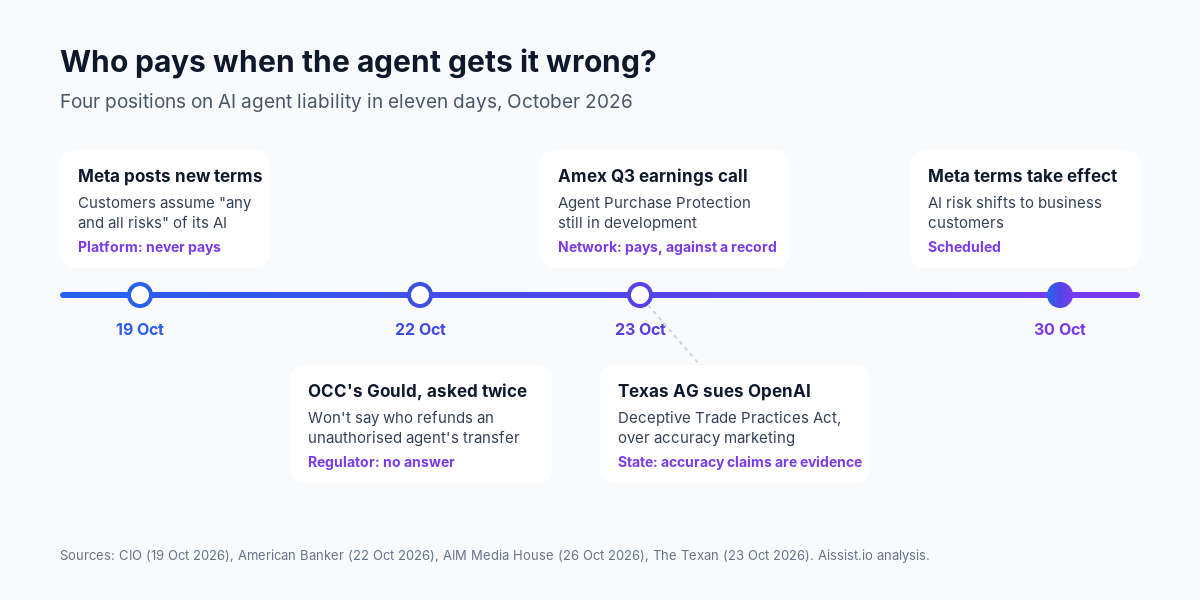
Three parties answered the same question three different ways in one week: a regulator didn't answer, a card network offered to pay, and a platform's proposed terms put the risk on its customers.
On 22 October, Fox Business host Stuart Varney asked Comptroller of the Currency Jonathan Gould twice whether customers get their money back when an unauthorised AI agent moves funds out of an account. American Banker reports (22 Oct 2026; checked 31 Oct 2026) that Gould gave no details on how such cases would be resolved, and instead stressed that banks can stop the activity.
"Banks are some of the most fortified parts of our system." — Jonathan Gould, Comptroller of the Currency, via American Banker
On 23 October, Amex CEO Steve Squeri told analysts the company had launched its first conversational AI voice agents and that Agent Purchase Protection is still in development, with no launch date and agent access limited to agents approved via API or MCP, according to AIM Media House (26 Oct 2026; checked 31 Oct 2026).
"We're just not going to let assistants run rogue through our systems." — Steve Squeri, CEO, American Express, Q3 2026 earnings call via AIM Media House
Meanwhile, CIO reports (19 Oct 2026, updated 26 Oct; checked 31 Oct 2026) that Meta's proposed commercial terms, posted 19 October, say customers are "solely responsible for and assume any and all risks associated with such AI features" — and for whatever content those features produce. The terms were due to take effect on 30 October; CIO's update says Meta moved that date to 20 November.
Of the three, only Amex told you where the line sits. When we went to check Meta's wording for this piece, its preview terms page refused our automated fetch, so the quote above comes via CIO. The same terms, CIO notes, let Meta use crawlers and other automated software to collect content; Meta told CIO afterwards that this applies only to its ads and business products and does not change how it uses crawlers.
Who is liable when an AI agent makes a mistake today?
It depends on who acted and on whose authority: you own your own agent's errors, your customer largely owns their agent's errors, and nobody has settled who owns a rogue agent's.
The clearest precedent is old by AI standards. In Moffatt v. Air Canada (2024), a British Columbia tribunal rejected the airline's argument that it could not be held liable for information provided by its chatbot, found it "did not take reasonable care to ensure its chatbot was accurate", and ordered it to pay about C$812 in damages, interest and fees, Fox Business reported (19 Feb 2024; checked 31 Oct 2026). Small number, large principle.
For a customer's own agent, US banking rules already lean one way. Under Regulation E, a transfer by "a person who was furnished the access device" by the consumer is not an unauthorised transfer until the consumer tells the bank to stop it. Hand an agent your credentials and its mistakes start to look like yours.
| Scenario | Who acted | Who is contractually liable today (Oct 2026) | What the contract would have to say instead |
|---|---|---|---|
| Your vendor's AI answers or acts in your support channel | Your agent, on your authority | You, to the customer (Moffatt). Recovery from the vendor depends on your contract; terms that assign "any and all risks" of AI features to you, as Meta's proposed terms do, limit what you can recover | Vendor bears losses from actions taken outside the limits you configured, and gives you the action log to prove it |
| A customer's personal agent orders, cancels or requests a refund | The customer's agent, on the customer's grant | Largely the customer: Reg E treats credential-holders as authorised; Amex's protection, once live, covers only registered agents sending authenticated intent | Your terms define what an agent-initiated action is, which grants you accept, and that you record the intent you acted on |
| An unauthorised third-party agent moves funds or changes an account | Nobody with authority | Unsettled. The Comptroller gave no answer when asked on 22 October; outcomes turn on whether access was ever granted | Who blocks, who refunds first, what evidence settles the dispute, and within what window |
Why does liability follow the escalation path?
Because every working answer above depends on one fact: a record of which action the agent took and who authorised it. Where that record exists, the loss has an owner; where it doesn't, the loss lands on whoever can't prove otherwise.
Amex's design proves it. Its terms page (checked 31 Oct 2026) says the protection requires a registered agent, Card Member-authenticated purchase intent sent to Amex, and a return attempt with the merchant first. A covered error is a purchase that "deviates from the Card Member-authenticated purchase intent." Requests too vague to verify, such as "best", are excluded. Amex will pay — but only against a record.
"As commerce becomes more agent-powered, trust becomes the defining factor." — Luke Gebb, EVP and Head of Global Innovation, American Express, April 2026 press release
The same logic runs through a support desk. If your AI issued a refund, someone in finance will ask whether it was within policy, who set the policy, and whether a human approved the exception. If the answer is "the model decided", nobody can say who decided — and nobody can say who pays. The decision record is not a compliance nicety. It is the evidence that decides who absorbs the loss.
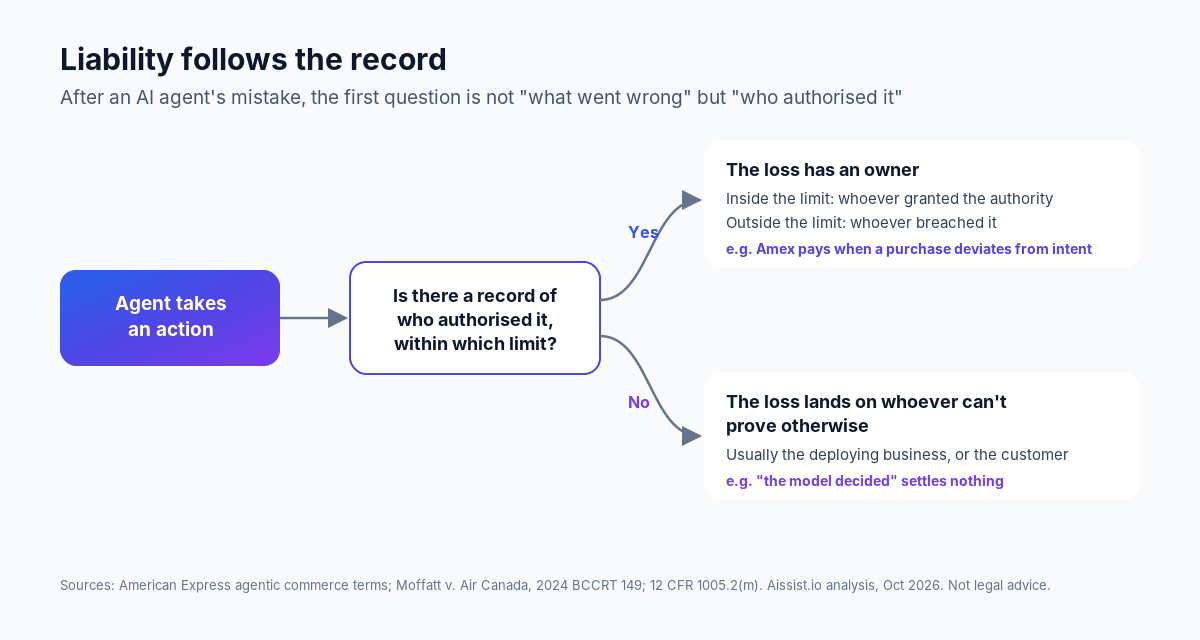
This is why escalation design matters commercially. Aissist's reliable AI architecture separates the model, which proposes an action, from a governance layer that checks it against limits the business sets and escalates anything outside them. That separation is what makes a deviation provable — the same property Amex is underwriting.
Which clauses should you read in an AI vendor agreement?
Read the clauses that decide who holds the record and who holds the risk; the rest is standard boilerplate.
- The AI disclaimer. Does it say outputs "may make mistakes" and stop there, or does it assign "any and all risks" to you, as Meta's proposed terms do, per CIO?
- Limitation of liability. Is AI output carved out of the vendor's cap, excluded entirely, or treated like any other service failure?
- Indemnity direction. Who indemnifies whom when an AI action harms a third party, such as your customer?
- Action scope. Does the contract name which actions the agent may take (refunds, cancellations, account changes) and the limits you can set on each?
- Out-of-policy actions. Who bears the loss when the agent acts outside limits you configured? This is the clause that matters most and the one most often missing.
- Logs and evidence. Do you get every action, the authority it ran under, and any human approval, exportable and retained long enough to cover your dispute window? Ours are on our security page.
- Third-party and customer agents. Does the vendor let you require scoped grants from customers' agents and reject unregistered ones?
"The new AI provisions shift substantial responsibility for inaccurate or unsuitable outputs onto customers." — Mike Wilkes, enterprise CISO, Aikido Security, via CIO
Process for reporting an incident after the fact is a separate negotiation; our AI incident reporting guide covers notification windows and telemetry rights.
What does the Texas lawsuit mean for vendor accuracy claims?
It means an accuracy claim in a sales deck can become evidence under ordinary consumer-protection law, not just a promise to argue about later.
On 23 October, The Texan reports (23 Oct 2026; checked 31 Oct 2026), Texas Attorney General Ken Paxton sued OpenAI and Sam Altman personally under the Texas Deceptive Trade Practices Act, alleging deceptive marketing of ChatGPT's "safety, accuracy, and reliability." These are allegations; OpenAI had yet to respond when The Texan published.
For buyers, the point is practical. If a vendor sells on accuracy and its contract disclaims accuracy, the marketing and the contract now point in opposite directions, and a regulator has shown interest in that gap. Ask vendors to put headline numbers in the order form, with their definition. Telling customers they are talking to AI is the other half; see our AI disclosure guide.
That applies to us. Aissist reports an 83% average resolution rate and 4.8/5.0 CSAT on its AI customer service benchmark; those are vendor-reported figures, and a buyer should ask how we define "resolved" before relying on them. We'd rather be asked in a vendor call than in a deposition.
Whoever can't show the record pays
Where someone can show who authorised an agent's action — Amex's intent record, Reg E's access grant, a governance log of limits and approvals — liability has a clear owner. Where nobody can, the regulator has no answer and the loss falls on whoever is left holding the transaction. Take the matrix above into your next vendor call, ask for clause 5 and clause 6 in writing, and treat the action log as part of the commercial terms. For how to keep that log and control what agents do, see our piece on the AI agent governance control gap.
Want to see the action log a vendor call should ask for? Our governance layer records every agent action, the limit it ran under and who approved exceptions. Get a free demo →
Frequently asked questions
Who is liable when an AI customer service agent gives wrong information?
The business that deployed it, in the leading case. A BC tribunal in Moffatt v. Air Canada (2024) held the airline responsible for its chatbot's answer and rejected its argument that it could not be liable for information from the chatbot.
Does Meta's new contract make businesses liable for its AI's mistakes?
Yes, as reported by CIO. Meta's proposed commercial terms say customers assume any and all risks of its AI features and resulting content. CIO reported on 26 October 2026 that Meta moved the effective date from 30 October to 20 November; the wording could change before then.
What is American Express Agent Purchase Protection?
A planned Amex protection for purchases made by registered AI agents that deviate from the Card Member's authenticated purchase intent. Amex announced it in April 2026 and said on 23 October that it is still in development, with no launch date.
Do customers get their money back if an unauthorised AI agent moves funds?
There is no clear regulatory answer yet. When asked twice on 22 October 2026, Comptroller Jonathan Gould did not say, and Regulation E's definition of unauthorised transfers turns on whether the consumer ever furnished access.
How do I handle an AI agent transaction dispute with a customer?
Start from the action record: what the agent did, under which policy limit, and with whose approval. Without that record, you cannot show whether the agent stayed in policy, which makes the dispute hard to win or recover from a vendor.
Does a customer's personal AI agent change who is liable?
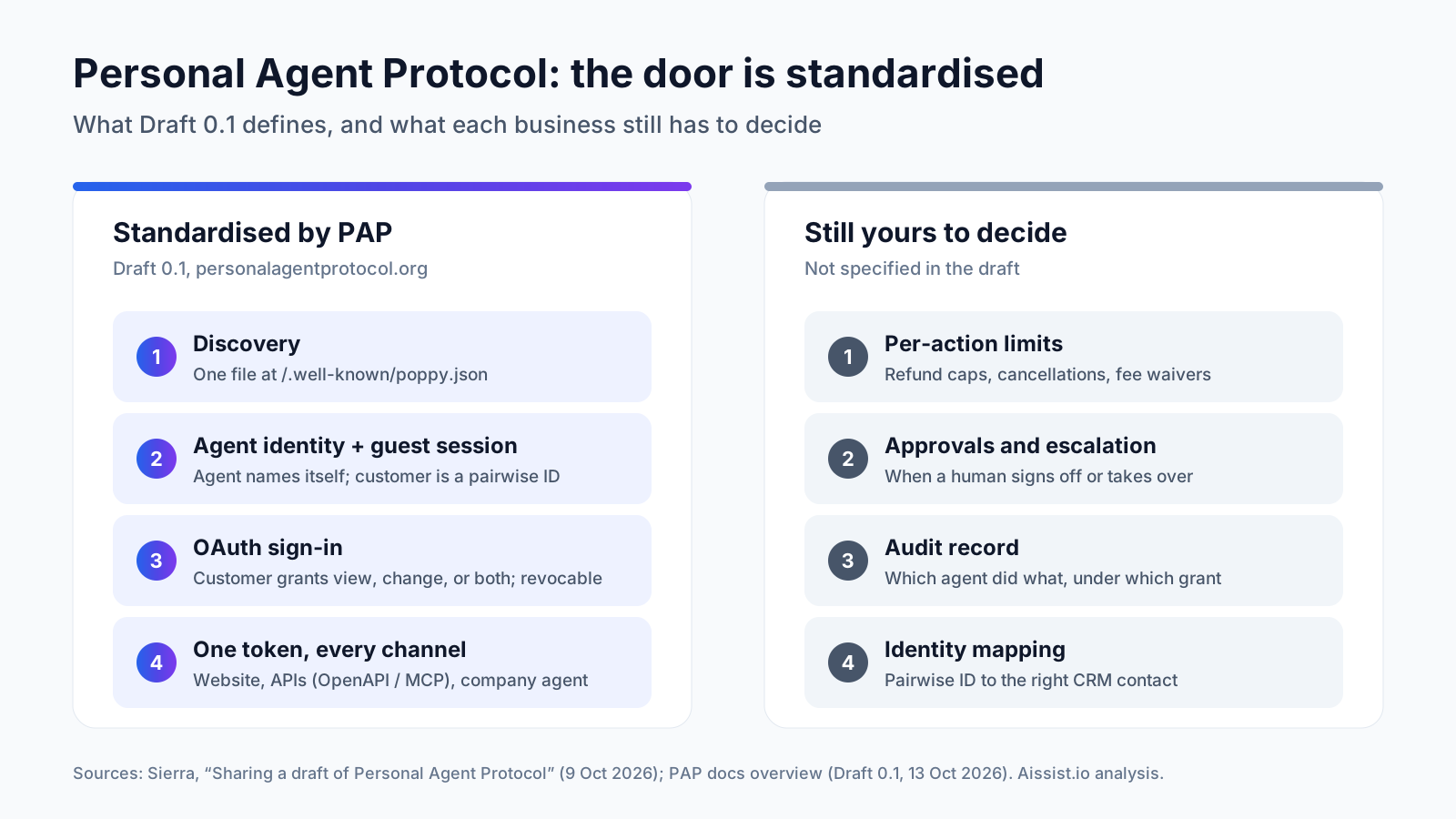
Often, yes. When a customer grants an agent credentials, Regulation E treats it as authorised until the customer revokes it. Our guide to the Personal Agent Protocol covers how those grants reach a support stack.
Changelog
| Date | Event |
|---|---|
| 14 Apr 2026 | Amex announces Agent Purchase Protection for registered agents |
| 19 Oct 2026 | Meta posts new commercial terms assigning AI risk to customers |
| 22 Oct 2026 | OCC's Gould, asked twice, gives no details on who refunds an unauthorised agent's transfer |
| 23 Oct 2026 | Amex says the protection is still in development; Texas AG sues OpenAI and Altman |
| 26 Oct 2026 | Article published; CIO reports Meta moved the effective date of its new terms to 20 November |
| 31 Oct 2026 | Adverse vendor claims sourced or removed; Meta effective date corrected |
| 20 Nov 2026 | Meta's new terms scheduled to take effect |