AI Agents for Banking and Fintech Support: KYC, Disputes and the Actions an Agent Should Never Take Alone
Compiled by Lifan Xu. Published October 5, 2026.
AI agents for banking now resolve most routine fintech tickets: the median across seven disclosed fintech deployments is 75% end-to-end resolution, per Aissist's fintech AI support benchmark. The harder question is which of the remaining actions an agent should never fire alone.
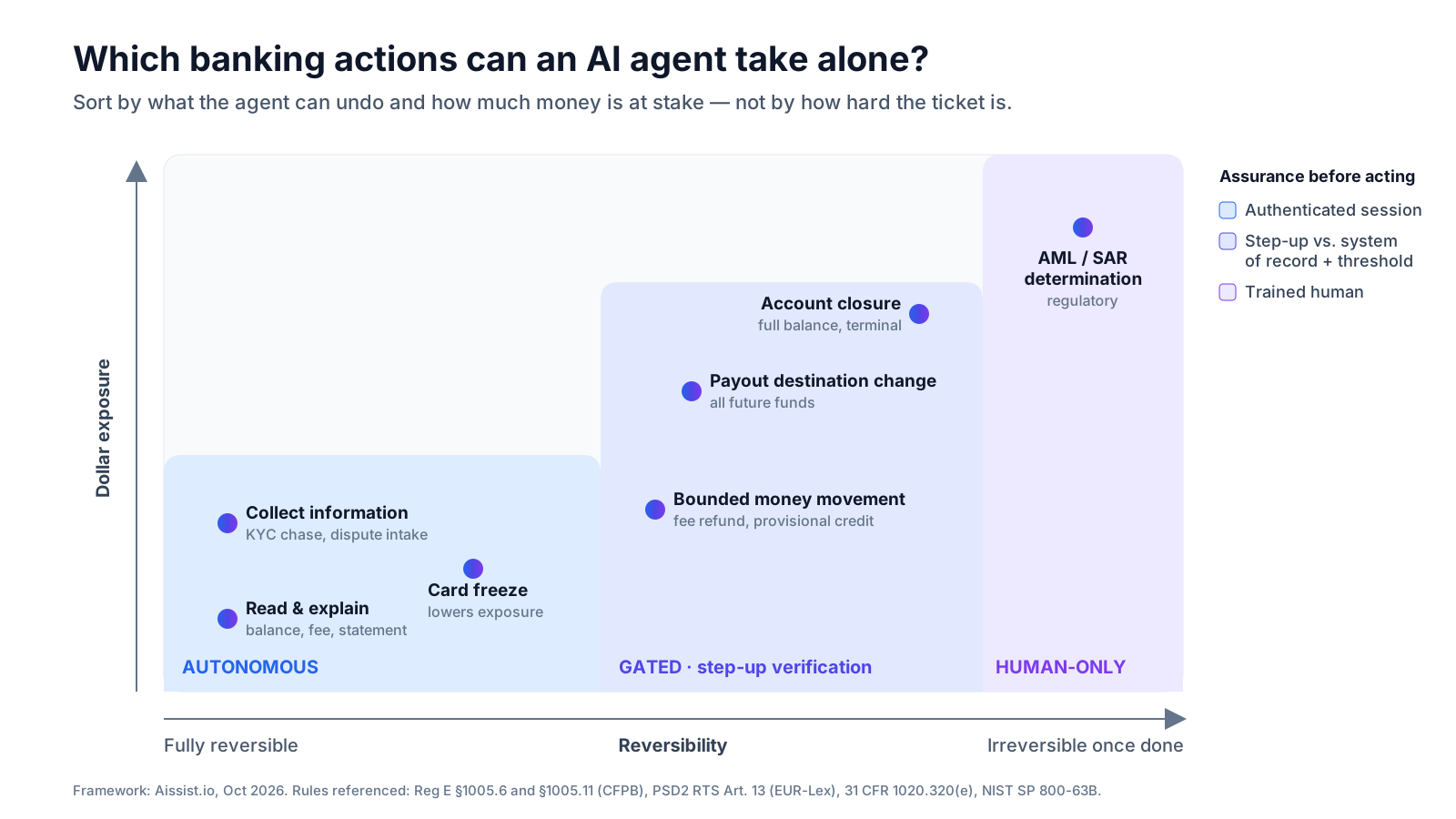
TL;DR: Sort a banking queue by reversibility and dollar exposure, not difficulty: an agent can read, explain, chase KYC documents and triage disputes alone, but moving money, changing a payout destination or closing an account needs step-up verification first.
Methodology & sources
- Aissist fintech benchmark: 9 deployments, 7 with disclosed resolution rates, figures read 24 August 2026 by the compiling analyst. Payphone and Weltrade figures are Aissist's own and vendor-reported.
- Regulations read at their primary sources: CFPB (Regulation E), eCFR (31 CFR 1020, 16 CFR 314), EUR-Lex (PSD2 RTS 2018/389), NIST SP 800-63B, PCI SSC.
- Vendor capabilities read from each vendor's own banking page. No vendor reviewed this article.
- All figures verified October 2026. Disclosure: this is Aissist's blog, and Aissist sells AI agents to fintech teams.
What does an AI agent do in a banking support queue?
An AI agent in a regulated support queue is software that authenticates the customer, reads their records in the bank's systems, explains what happened, and takes approved actions on their behalf — within limits set by the institution's risk policy, with every step logged. A chatbot answers questions about the account. An agent touches the account.
That difference is why banking is different. The CFPB's chatbot issue spotlight found that roughly 37% of the US population used a bank chatbot in 2022 and that all ten of the largest US commercial banks run one. Those were mostly read-only. Write access is the new part.
"A poorly deployed chatbot can lead to customer frustration, reduced trust, and even violations of the law." — Rohit Chopra, then Director, Consumer Financial Protection Bureau
The clearest recent signal came from a brokerage, not a bank. At its HOOD Summit on 29 September 2026, Robinhood announced AI agents that can trade for retail customers — but only inside a dedicated agentic account, with per-trade approval on by default. PYMNTS reports the models on offer include OpenAI's and Anthropic's.
"By default, we have trade approvals." — Vlad Tenev, CEO, Robinhood, via BeInCrypto on Yahoo Finance
Read that design closely. The separate account caps the dollar exposure; the default approval gates the write. That is the whole framework, shipped by a retail broker.
Which banking and fintech tickets should an AI agent handle alone?
Most of them: an AI agent should handle every ticket whose actions are read-only, information-gathering or protective, and hand off only the actions that move money, redirect it or end the relationship. Here are ten common use cases, tagged by who should act.
- KYC document chase — autonomous. Request the missing document, check it is legible and complete, chase on schedule. KYC automation covers collection; the identity decision stays with the Customer Identification Program.
- Onboarding status — autonomous. Read the application state and say what is blocking it.
- Transaction disputes — triage autonomous, outcome gated. Collect the Regulation E details and open the case; the credit decision is gated.
- Card freeze — autonomous. Fully reversible, and speed protects the customer. Unfreezing is gated.
- Fee explanation — autonomous. A fee refund is money movement and goes under a threshold.
- Loan servicing questions — autonomous. Payoff amounts, due dates, statements. Hardship changes go to a human.
- Statement retrieval — autonomous, after authentication.
- Payout investigation — autonomous; destination change gated. Trace the payout freely. Changing where it goes is the classic account-takeover move.
- AML follow-up — human-only. The agent can deliver a compliance-scripted document request and nothing more.
- Account closure — gated. Irreversible, and it disburses the full balance.
Six of ten run with no person at all, and two more hand off only their final write. Notice that "hard" never decided a tag. A multi-step dispute intake is complex and harmless; a one-field payout change is simple and dangerous.
How do you decide which actions need a second gate?
Gate an action when it cannot be cleanly undone or when its dollar exposure exceeds a set threshold, and match the required assurance to that exposure — session authentication for reads, step-up verification for writes, a human for determinations. Step-up verification means re-proving identity at the moment of the action, checked against the system of record, not against what the customer typed in chat.
| Action class | Example | Reversible? | Dollar exposure | Required assurance | Rule that bites |
|---|---|---|---|---|---|
| Read and explain | Balance, fee, statement | No state change | None | Authenticated session | GLBA Safeguards Rule: access only to needed data |
| Protective toggle | Card freeze | Instantly | Lowers it | Session; act on any doubt | Reg E §1005.6: $50 vs $500 liability |
| Collect information | KYC chase, dispute intake | Yes | None directly | Session | Reg E §1005.11: 10-business-day clock |
| Bounded money movement | Fee refund, provisional credit | Partly | Capped by policy | Step-up plus threshold | Reg E §1005.11 provisional credit |
| Destination change | Payout account, beneficiary | Not once funds leave | Future balance | Step-up (two factors) plus system-of-record check | PSD2 RTS Art. 13: SCA on trusted beneficiaries |
| Terminal action | Account closure | No | Full balance | Step-up plus human review | Consumer-law risk flagged in the CFPB chatbot spotlight |
| Determination | AML, SAR, EDD decision | No | Regulatory | Human only | 31 CFR 1020.320(e): SAR confidentiality |
The card freeze is autonomous because of regulation: Regulation E caps a consumer's loss at $50 if they report within two business days, and up to $500 after. The SAR rule forbids any "director, officer, employee, or agent" from revealing a SAR exists — a word choice that has aged interestingly.
"Two factors" follows NIST SP 800-63B, where AAL2 requires two distinct authentication factors. And PII redaction applies to every row: PCI SSC guidance forbids storing card security codes after authorization, even encrypted, so they must be masked before reaching a transcript.
Which vendors build AI agents for banking?
The vendors that publish banking-specific AI agent pages include NiCE Cognigy, Kasisto, Kore.ai, Parloa and Lorikeet, plus Aissist.io — and the useful comparison is what each publishes about controls, not the length of its use-case list. The table is unranked; Aissist sits last because it is our product.
| Vendor | What it is | Banking actions it lists | Controls it publishes (Oct 2026) | Proof it publishes |
|---|---|---|---|---|
| NiCE Cognigy | Conversational AI agents, voice and digital | KYC ID&V, payments, lost card, open/close account | PCI DSS, SOC 2 Type II, ISO 27001 | Humm Group: over 50% resolution (customer quote) |
| Kasisto | Banking-specific agent, KAI | Card block and replace, transaction search | Live-agent handoff | 200+ intents out of the box; 16 countries |
| Kore.ai | Enterprise agent platform | Balances, internal transfers, fraud claims | Okta, Entra ID, Google Workspace for authentication and approvals | No named bank on page |
| Parloa | AI agent management platform | Fund moves, KYC, disputes, identity recovery | Role-based permissions for transfers, credits, freezes | No named bank on page |
| Lorikeet | AI concierge for regulated support | KYC document collection, transaction status | Dollar and risk thresholds; read-first | Breeze: 40% of complex volume in 30 days (customer quote) |
| Aissist.io | AI Operational Layer, AgentMesh™ | Transaction status, KYC guidance, dispute intake | PII masking, audit logs, ISO 27001, GDPR | Payphone 75%, Weltrade 72% resolution (vendor-reported) |
Lorikeet deserves credit for candour: its KYC article says objective-driven case ownership is "not what Lorikeet ships today." Most banking pages list actions an agent can take. Few say which ones it won't.
What does this look like in a live fintech deployment?
In Weltrade's published deployment, gating didn't block automation — missing APIs did: of every 100 inquiries, 65 were fully resolved by AI and 25 were handed to backend teams as structured tickets. The forex broker's customer story (March 2026) says many backend workflows weren't yet exposed through APIs; the remaining 10 of 100 aren't broken out.
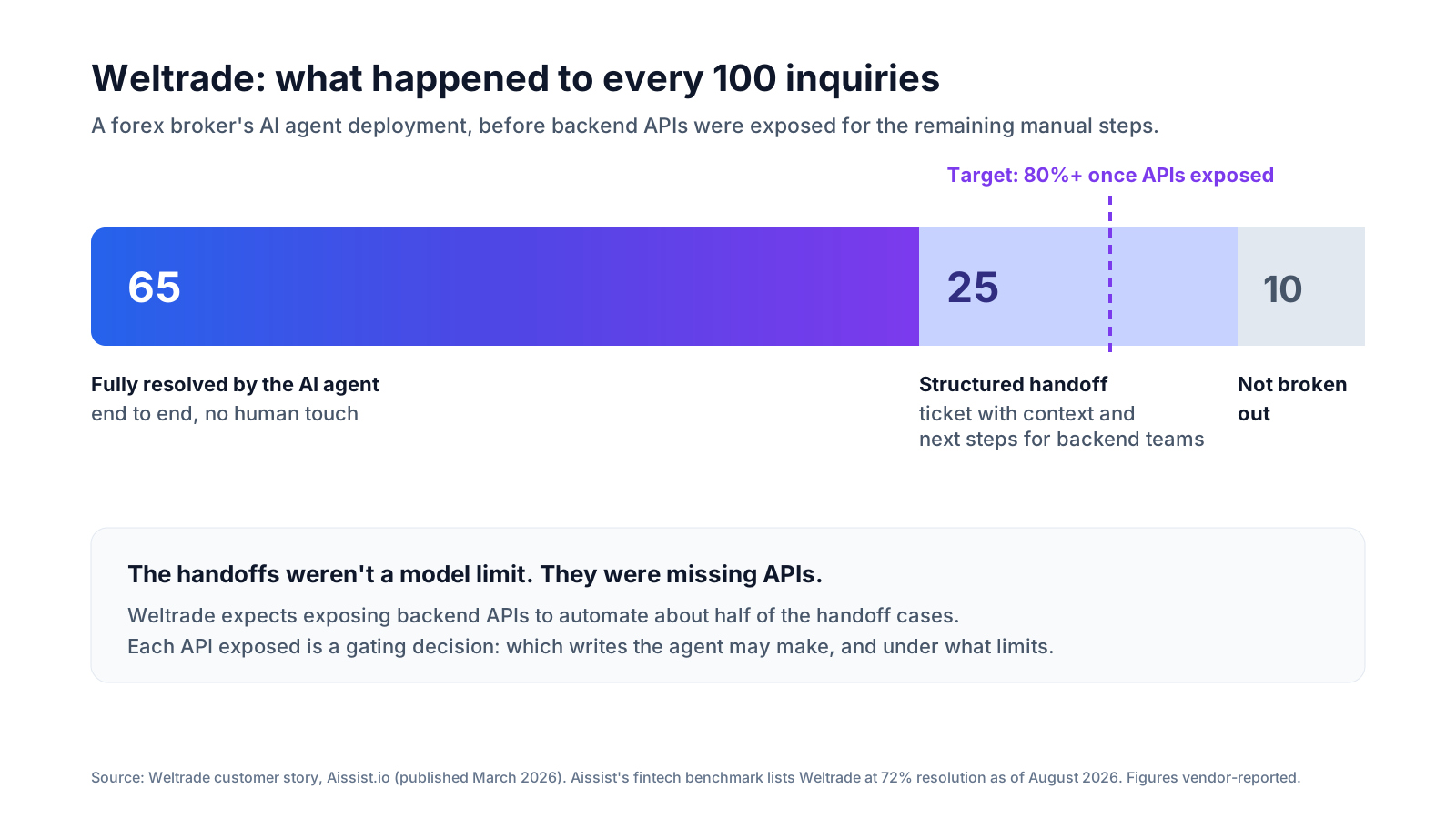
Weltrade expects exposing those APIs to automate roughly half the handoffs and lift resolution above 80%. Aissist's benchmark already lists Weltrade at 72% as of August 2026. Every API exposed is a gating decision made in advance: which writes, under which limits.
"The best of Aissist.io is its strong performance, very human-like interaction, and how controllable and customizable it is through sub-agents." — Olga Kuharskaya, AI Lead, Weltrade
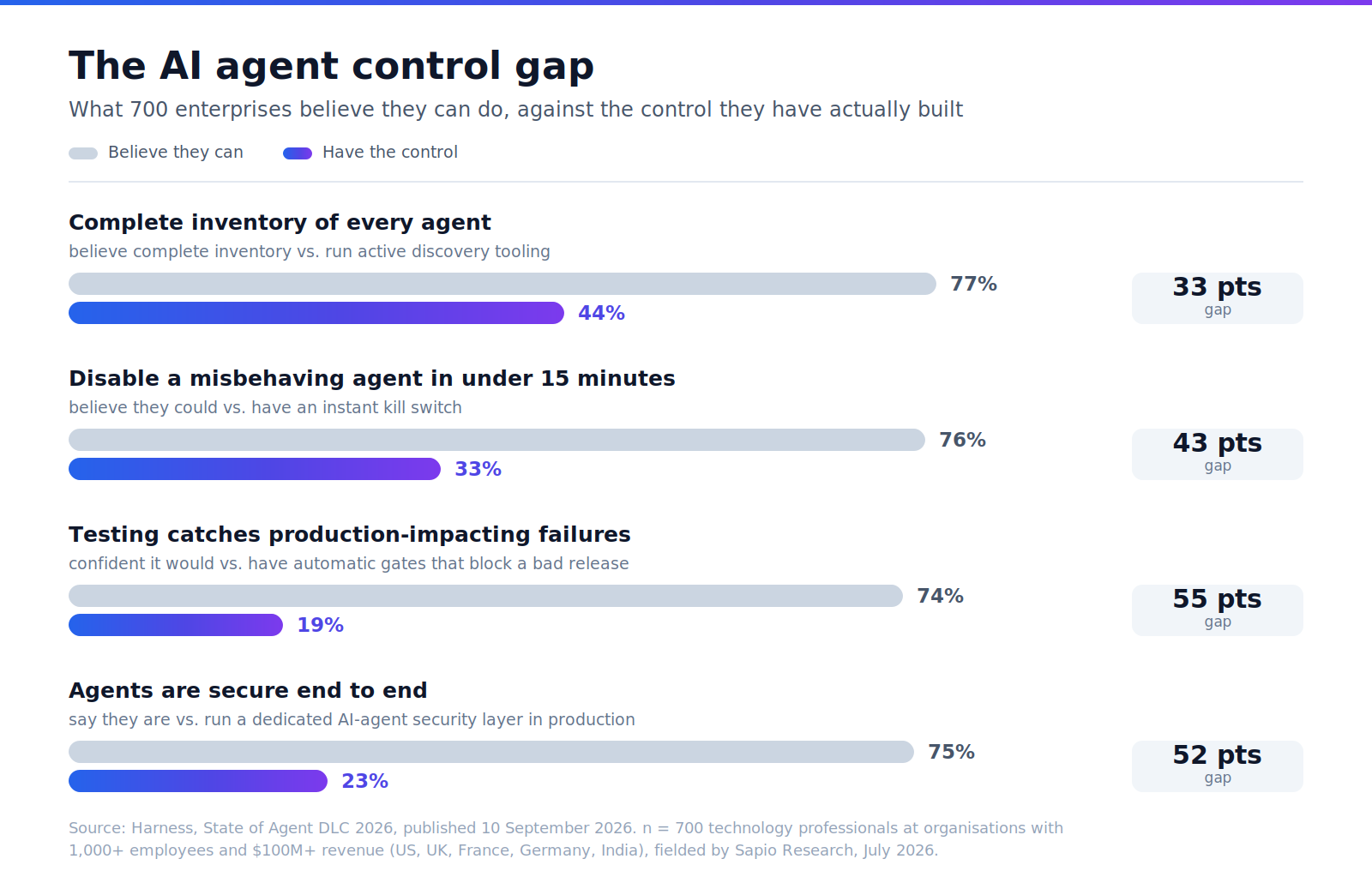
Aissist grades agent errors on the same axis. Its internal severity scale ranks an S0 error as business impact that can't easily be taken back, with a target S0 rate under 0.01% — a hundred times stricter than the under-1% target for all errors combined. Reversibility sets the tolerance. Most teams have not drawn that line yet: in Harness's survey of 700 large enterprises, covered in our governance gap analysis, only 19% had release gates that actually block rather than warn.
Sort the queue by reversibility, not by difficulty
The resolution debate in banking AI is mostly settled: reliable agents clear most tickets. The open question is the write path. Map every agent action to its reversibility and dollar exposure, let it read, explain, chase and triage alone, and put step-up verification against the system of record in front of money movement, destination changes and closures. Keep determinations human, and keep a fast escalation path for everything in between. A well-drawn gate costs a few seconds. A missing one costs a payout.
Want to see which of your fintech queue an agent can own? Compare resolution, CSAT and cost across live deployments in the fintech AI support benchmark →
Frequently asked questions
Can AI agents handle KYC automation end to end?
AI agents can automate KYC document collection, completeness checks and status updates end to end. Identity decisions, enhanced due diligence and risk ratings should stay with compliance staff under the bank's Customer Identification Program.
Should an AI agent issue refunds or provisional credit?
Only under a policy threshold and after step-up verification. Below the threshold the agent can act; above it, the agent should draft the action and route it to a human with the evidence attached.
How does PII redaction work in AI customer service?
PII redaction detects personal and card data in messages and masks it before storage or model processing. For cards, PCI rules limit displayed PAN to the first six and last four digits and forbid storing security codes after authorization.
What is AI agent compliance in banking?
AI agent compliance means every agent action is authorized, logged and replayable for an examiner. The GLBA Safeguards Rule requires institutions to monitor and log authorized users' activity, and an agent with account access is one of them.
Do the same rules apply to AI agents for insurance?
Yes, the same sort applies. Explaining coverage and chasing claim documents are read and collect actions an agent can own, while paying a claim, changing the payee or cancelling a policy are irreversible writes that need a gate.
How fast must a bank investigate a disputed transaction?
Under Regulation E, a bank must investigate within 10 business days, or within 45 days if it provisionally credits the account. An agent can open the case within the first conversation and start that clock correctly.