Escalation management when the first responder is an AI agent
Compiled by M.W. Published September 28, 2026 · Last updated September 28, 2026.
Escalation management in an AI-first queue is the set of rules that decides when an AI agent stops handling a customer and passes the conversation, with its full context, to a human. In a human-only team, escalation moves a case up a ladder of people. When an AI agent answers first, the most important escalation is the one out of the machine, and the best systems start it before the customer has to ask.
TL;DR: Customer Experience Magazine reports a 34% one-quarter rise in UK bank complaints about AI blocking access to humans. The fix isn't a better "talk to an agent" button. The agent has to detect its own failure and escalate first.
Methodology & sources
- Regulatory text read at source: FCA Handbook PRIN 2A.6, EU Directive 2023/2673, the UK Data (Use and Access) Act 2025 (via Travers Smith), and EU AI Act Article 50 (via Jones Walker).
- Industry figures: Customer Experience Magazine (22 and 25 September 2026), the CFPB's Chatbots in Consumer Finance report (6 June 2023), CX Today (6 August 2026).
- The FCA complaint figures below come from Customer Experience Magazine. The FCA page it cites returned a 404 on 28 September 2026, and we could not find the figures on fca.org.uk. Treat them as reported, not confirmed.
- First-party data: Aissist.io's published fintech AI support benchmark, with sources re-checked 24 August 2026.
- All figures verified 28 September 2026. Disclosure: this is Aissist's blog, and Aissist sells AI agents that escalate proactively. Weigh our view with that in mind.
What are the three tiers of escalation management for AI agents?
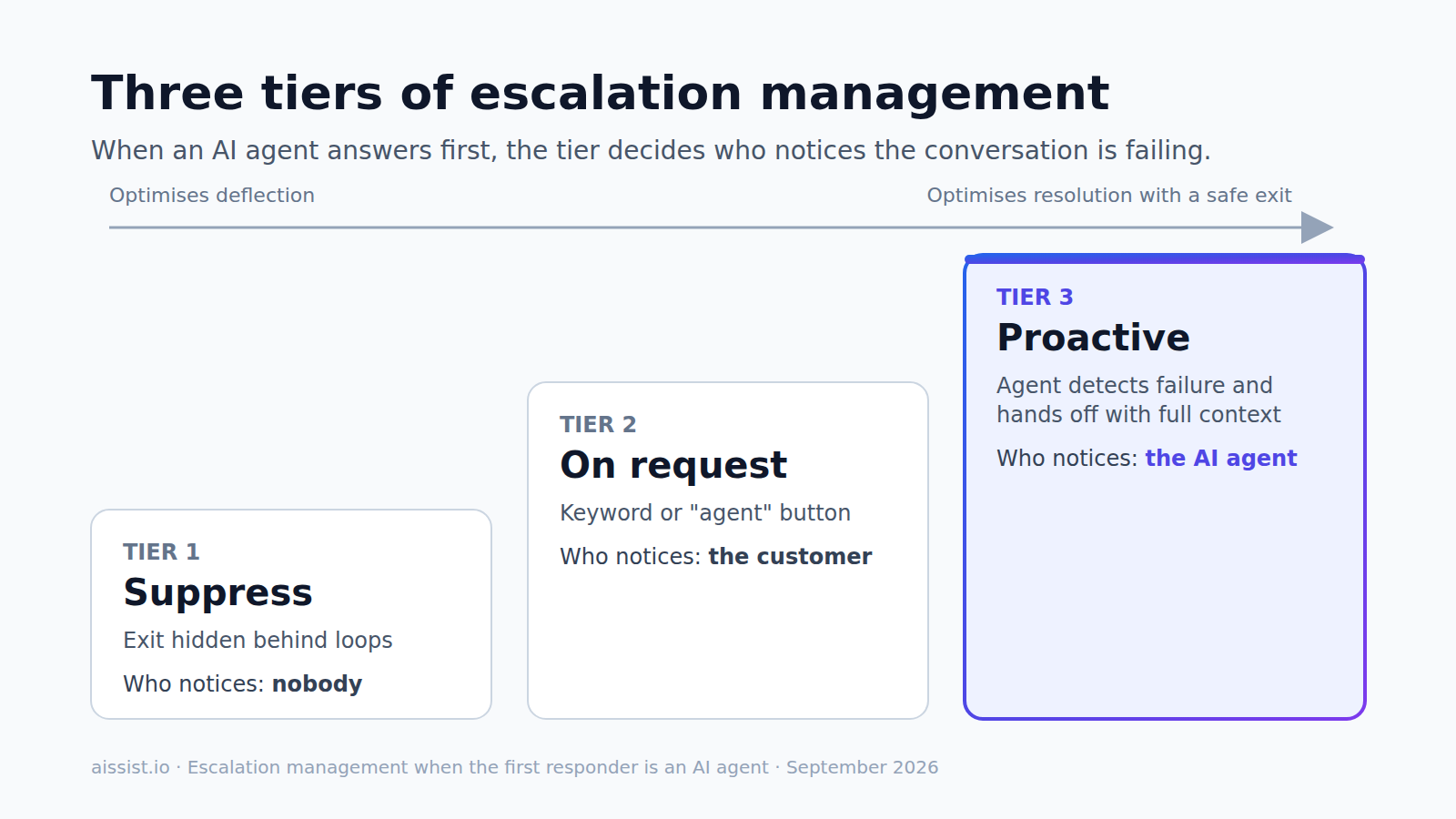
Every AI-first support operation sits in one of three tiers: it hides the exit, it opens the exit when asked, or it opens the exit before anyone asks. The tier decides who does the work of noticing a failed conversation: the customer, a keyword list, or the agent itself.
| Tier | How escalation starts | Who notices the failure | What it optimises |
|---|---|---|---|
| 1. Suppress | The customer has to fight past the bot: buried menus, loops, "I didn't catch that" | Nobody, until a complaint | Deflection rate |
| 2. On request | The customer types "agent" or taps a button | The customer | Compliance with the letter of the rule |
| 3. Proactive | The agent reads the conversation and hands off when it is losing | The AI agent | Resolution, with a safe exit |
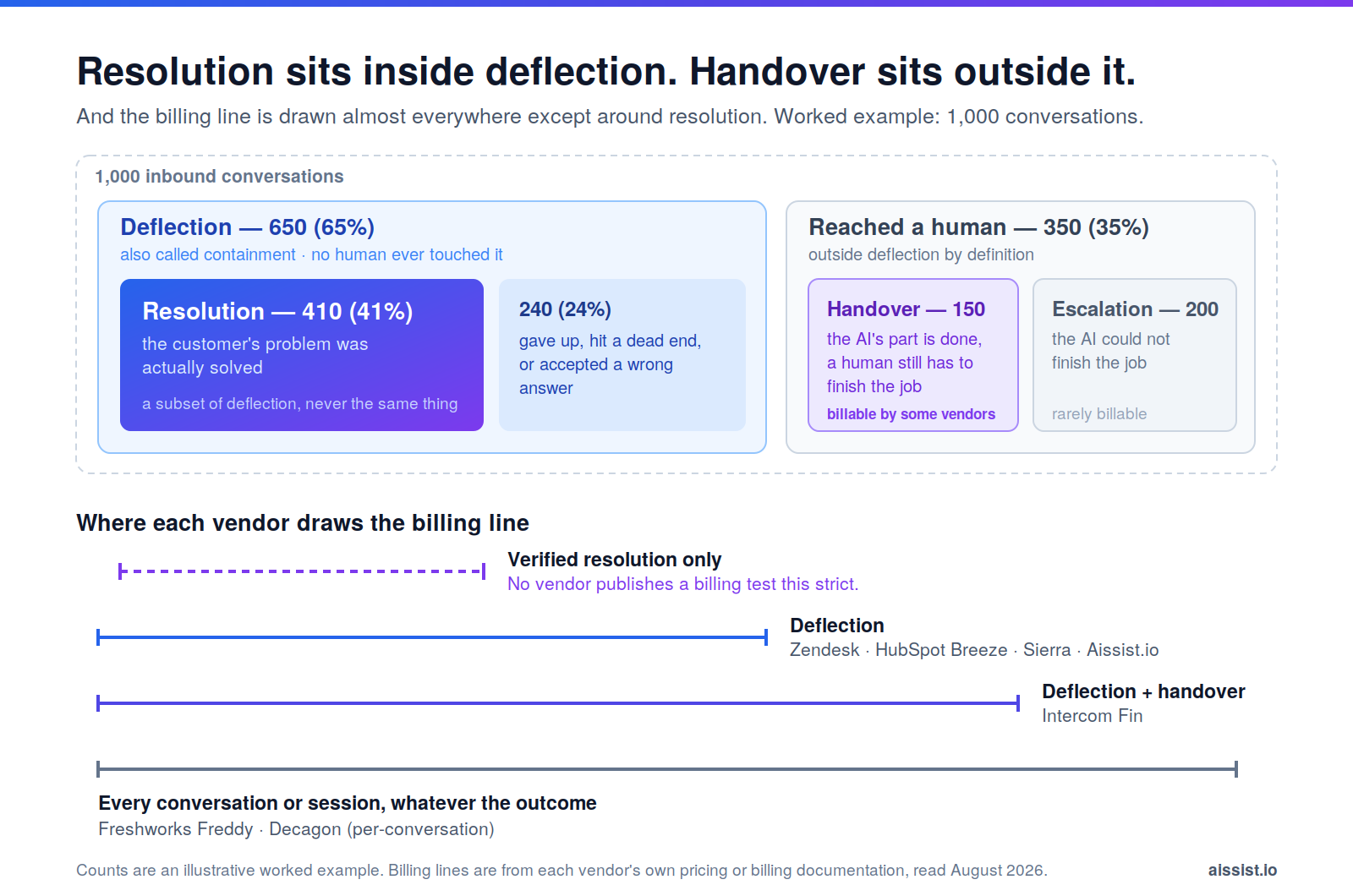
Tier 1 is the oldest trick in the category. Make humans hard to reach and deflection goes up, because an abandoned chat looks the same as a solved one on most dashboards. We covered the gap in deflection vs. resolution rate. Tier 1 doesn't fail on day one. It fails in the complaints data a quarter later.
Tier 2 is where most vendors stop. A keyword or button makes the exit exist, and that matters. But it puts the diagnosis on the customer. By the time someone types "human" twice, they have already had the bad experience. The escalation is on time for the audit and late for the customer.
Tier 3 treats escalation as a detection problem. The agent watches its own performance during the conversation: is the customer repeating themselves, is their tone souring, has a tool call failed? It hands off when those signals cross a threshold, and it passes the case summary along so nobody starts over. Aissist builds for tier 3. We explain the mechanism in what is proactive escalation, and the rest of this article is the working version.
Why is AI escalation suddenly a number regulators track?
Complaints about AI blocking access to humans are now being counted, and the first reported counts are high. For most of the last decade, "the bot wouldn't let me through" was a story. In September 2026 it became a statistic.
| Date | What happened | Figure | Source |
|---|---|---|---|
| 22 Sep 2026 | UK bank complaints about "access barriers to human support" | +34% in one quarter, across five major high-street banks | Customer Experience Magazine, citing FCA Consumer Duty monitoring (primary not located) |
| 22 Sep 2026 | Share of Financial Ombudsman disputes involving callers "trapped in recursive conversational AI loops" | Nearly half | Customer Experience Magazine (primary not located) |
| 21 Sep 2026 | SoundHound launches Human Assisted Resolution: the AI sends one approval question to a human without transferring the call | Product launch | Customer Experience Magazine |
| 10 Jul 2026 (update) | FCA good-practice review cites a firm routing chatbot bereavement queries to a human, and another flagging vulnerability keywords | Qualitative | FCA |
| 6 Jun 2023 | CFPB report cites research that 80% of chatbot users left more frustrated, and 78% needed a human afterwards | 80% / 78% | CFPB |
The UK press calls it "voicebot entrapment." The CFPB used plainer words three years earlier: one consumer complaint in its report reads, "I am being sent in an endless loop with no way out."
"A poorly deployed chatbot can lead to customer frustration, reduced trust, and even violations of the law." — Rohit Chopra, then Director, Consumer Financial Protection Bureau
The FCA's own good-practice examples read like a spec for tier 2 and tier 3. A keyword list for vulnerability is tier 2. Routing a bereavement query to a person before the customer asks is tier 3. The regulator isn't asking firms to switch off automation. It is asking them to notice when automation is the wrong tool.
Which signals should trigger an AI agent handoff?
Six signals cover almost every conversation that should leave the AI: repeated intent, sentiment inversion, an explicit request for a human, a regulated topic, low tool confidence, and a dead-end loop. Each needs a signal, a threshold and a defined action. The thresholds below are the starting points we recommend. Tune them against your own transcripts rather than treating them as industry standards.
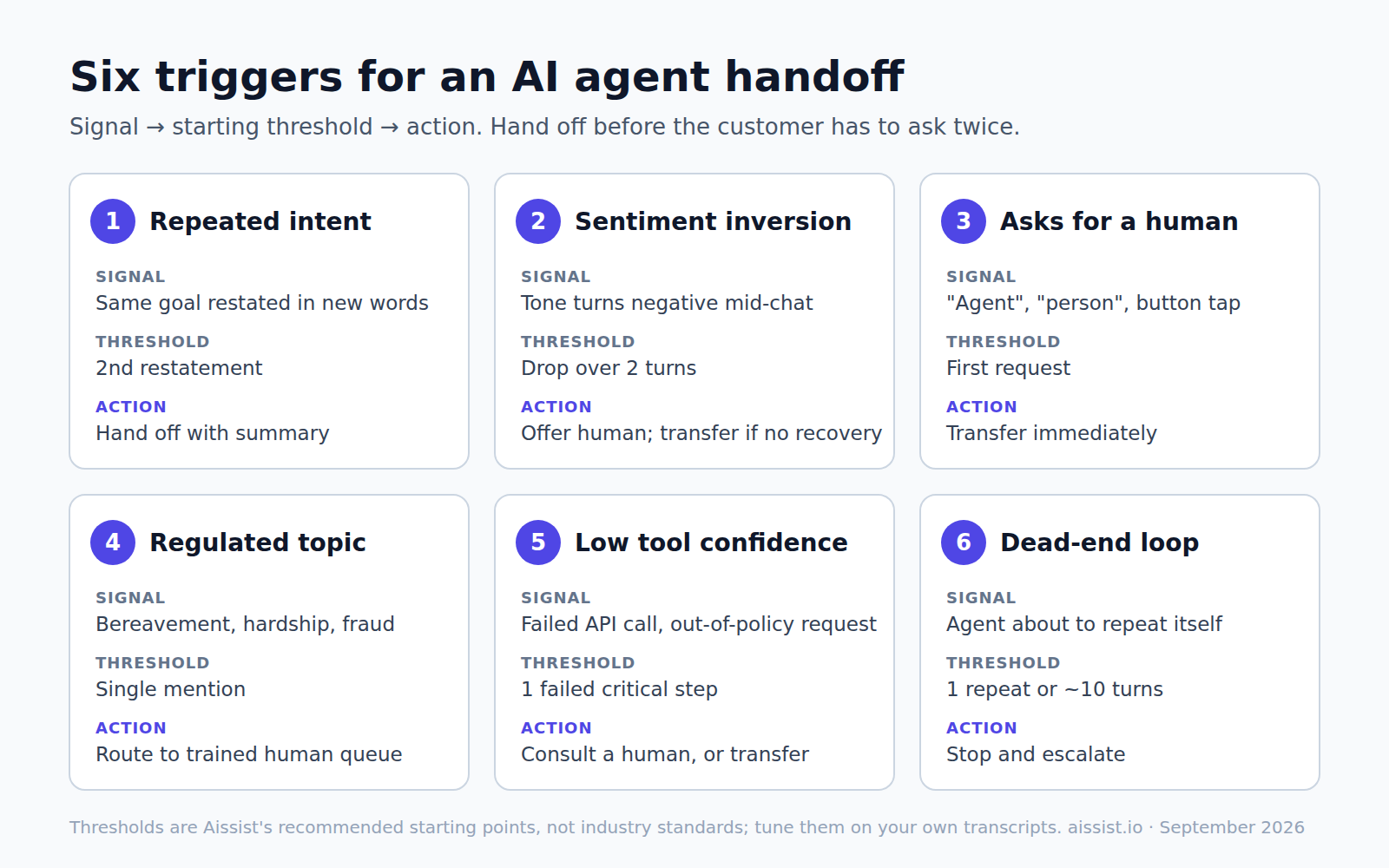
- Repeated intent. Signal: the customer restates the same goal in new words. Threshold: the second restatement, so the third time they say it. Action: hand off with a summary that says "customer asked for X three times; AI offered Y." Being asked twice is information. Being asked three times is a verdict.
- Sentiment inversion. Signal: tone moves from neutral or positive to negative within the conversation, not just a customer who arrived angry. Threshold: a drop across two consecutive turns. Action: acknowledge it once, offer a human, and transfer if the next turn doesn't recover.
- Explicit human request. Signal: "agent," "person," "someone real," or a button tap. Threshold: the first request. Action: transfer immediately, with no retention attempt and no "let me try one more thing." This is the tier-2 floor. Tier 3 builds on it, it doesn't replace it.
- Regulated or vulnerable topic. Signal: bereavement, financial hardship, fraud, a formal complaint, a legal threat, or a stated vulnerability. Threshold: a single mention. Action: route to a trained human queue and tag the case. This is the trigger in the FCA's own examples.
- Low tool confidence. Signal: a failed API call, a missing record, a policy lookup that returns nothing, or a refund above the agent's authority. Threshold: one failed critical action or one out-of-policy request. Action: either consult a human for a single approval and continue (SoundHound's pattern), or transfer with the failed step named.
- Dead-end loop. Signal: the agent is about to repeat an answer it already gave, or the conversation passes a turn budget without progress. Threshold: one repeated answer, or roughly ten turns without a resolved sub-step. Action: stop and escalate. An agent that repeats itself isn't being persistent. It's lost.
The action matters as much as the trigger. An escalation that dumps the customer into a queue with no context just moves the failure somewhere else. Every handoff should carry the intent, what the AI tried, what failed, and the customer's current mood, so the human starts at step four instead of step one.
How does an escalation matrix change when AI answers first?
A traditional escalation matrix ranks cases by severity and routes them up a chain of people. An AI-first matrix ranks conversations by detected risk and routes them out of the machine. Most of the pages ranking for "escalation matrix" describe only the first version. Dialpad, for example, defines escalation management as handling customers "whose issues can't be resolved by the first front-line agent, and who need to speak with a manager or supervisor." That's accurate for a human team, but it misses the case where the front-line agent is software.
| Human-era escalation matrix | AI-first escalation matrix | |
|---|---|---|
| First responder | L1 human agent | AI agent |
| Main question | How severe is this case? | Is the AI still the right handler? |
| Trigger | Agent judgement, severity level, SLA breach | Detected signals: repetition, sentiment, topic, tool failure, loops |
| Who starts it | The agent or the customer | The AI, before the customer has to |
| Direction | Up (L1 → L2 → manager) | Out (AI → human), plus a new mode: consult without transfer |
| Clock | SLA timer on the ticket | Turn budget inside the conversation |
| Context passed | Ticket notes, if written | Automatic summary of intent, attempts and failure point |
| Failure mode | Slow handoffs, ping-pong between teams | Entrapment: no handoff at all |
| What to report | Escalation volume by tier | Resolution rate and escalation rate, on the same denominator |
The new row is "consult without transfer." SoundHound's launch formalises a middle path: the AI stays in the conversation, asks a human one bounded question, such as whether to approve a refund, and carries on.
"Human input stops being a property of the conversation and becomes a property of the individual moment, which lets you place judgment exactly where the risk is and nowhere else." — Jack Gantt, Director of Product Marketing, SoundHound AI, via Customer Experience Magazine
A human-era matrix still has a job. Once a case reaches people, L1-to-L2 routing and SLA clocks apply as before. It just no longer describes the first and riskiest handoff.
What does the "right to a human" require in the UK and EU?
In the UK, regulated financial firms must not put unreasonable barriers between customers and support. In the EU, consumers taking out financial services through online tools now have an explicit right to request human intervention. Both rules are in force today, and neither is satisfied by a bot that technically has an exit nobody can find.
| Rule | Where | What it requires | In force |
|---|---|---|---|
| FCA Consumer Duty, PRIN 2A.6.2R(4) | UK, FCA-regulated firms | Customers must "not face unreasonable barriers" when making enquiries, complaining or cancelling. Guidance at PRIN 2A.6.4G flags "unreasonable delays" | July 2023 |
| Data (Use and Access) Act 2025, Arts. 22A–22D UK GDPR | UK, any organisation making significant automated decisions | Tell people about the automated decision, and offer "a route to meaningful human intervention" plus a way to contest it | 5 Feb 2026 |
| EU Directive 2023/2673, Art. 16d(3) | EU, distance financial services contracts | When traders use online tools such as chatbots, the consumer has "a right to request and to obtain human intervention" | 19 Jun 2026 |
| EU AI Act, Art. 50(1) | EU, AI systems interacting with people | Tell users they are talking to an AI unless that is already obvious. This obligation was not delayed by the Omnibus | 2 Aug 2026 |
Read together, these rules require tier 2 and reward tier 3. An on-request exit covers the "right to request" wording. But "unreasonable delays" and "meaningful human intervention" are judged by outcome, and an exit that opens on the fourth attempt is hard to defend as reasonable. Disclosure adds a second link: once the customer knows it's an AI, the quality of the escalation path is the main thing standing between the disclosure and an abandoned session. We cover that in AI disclosure in customer service.
This is a summary, not legal advice. Sector rules vary, so check your obligations with counsel.
A resolution rate without an escalation rate is half a number
A resolution rate means little unless the escalation rate sits beside it on the same denominator. A vendor that publishes only the first is hiding the number the Ombudsman is now counting.
The pull toward hiding it is real. HubSpot's CEO announced in August 2026 that "Customer Agent now resolves 72% of support tickets without human escalation," as reported by CX Today. That is a legitimate milestone. It also defines success as the absence of escalation, and that framing, pushed hard enough, leads back to tier 1.
We have the same tension. Aissist's marketing cites resolution of up to 98%, with 83% typical (vendor-claimed, resolution–CSAT tradeoff). At 98% resolution, escalation fired on at most 2% of conversations. That is fine if nothing else needed a human. It's a warning if the exit was simply hard to find. The same page argues that CSAT peaks around 60–80% genuine resolution and falls at both extremes. A 98% can only be trusted if it comes with the escalation data behind it.
The first-hand version is less flattering and more useful. Aissist's fintech benchmark reports Weltrade, a forex broker running Aissist, at 72% resolution with 25% structured handoff, where "the AI completes what it can and passes structured context to a human agent for the remainder." Both numbers are published side by side, and CSAT stayed above 90% positive (case-study figures). That is what an honest report looks like: roughly a quarter of customers reached a human, on purpose, with context, and the page says so.
What to do next: report resolution and escalation together, audit your transcripts against the six triggers, and fix any trigger that fires on the third ask instead of the second. For how a regulated vertical balances the two, see the fintech resolution, CSAT and cost benchmark.
See how Aissist's agents detect failure and hand off with context. Book a demo →
Frequently asked questions
What is an escalation matrix in customer service?
An escalation matrix is a table that says which issues go to which people, at what severity, and within what time limit. In an AI-first support team it needs one more layer: the signals that move a conversation from the AI agent to a human, with a threshold and an action for each.
What is voicebot entrapment?
Voicebot entrapment is when a customer can't get out of an automated voice or chat flow to reach a person, usually through loops, misrecognised requests or hidden options. Customer Experience Magazine reported in September 2026 that it drives nearly half of Financial Ombudsman escalations. The FCA source it cites could not be located.
How does an AI-to-human handoff avoid making customers repeat themselves?
The AI passes a structured summary with the handoff: the customer's intent, what the AI tried, which step failed and the customer's current sentiment. The human reads that before replying, so the conversation picks up where the AI stopped instead of starting over.
What is a good escalation rate for an AI agent?
There is no universal target, because it depends on channel, intent mix and regulation. The useful test is whether a vendor publishes its escalation rate next to its resolution rate. Aissist's Weltrade deployment, for example, reports 72% resolution alongside 25% structured handoff.
Does proactive escalation lower an AI agent's resolution rate?
Slightly, on paper, because conversations that might have been counted as "deflected" go to a human instead. Aissist's published analysis finds CSAT falls at very high automation levels. So the conversations proactive escalation removes are often the ones that would have hurt satisfaction or produced a complaint.
Should customers always be able to reach a human?
In EU distance financial services, yes: Directive 2023/2673 gives consumers a right to request and obtain human intervention when chatbots are used, from 19 June 2026. In UK financial services, Consumer Duty prohibits unreasonable barriers to support. Outside those rules it is a design choice, and the complaints data suggests hiding the exit costs more than it saves.
What is the difference between deflection and escalation?
Deflection counts conversations that never reached a human, including ones the customer abandoned. Escalation counts conversations deliberately handed to a human. A system tuned only for deflection has a reason to suppress escalation, which is why the two should be reported side by side.