Proactive Escalation: The AI-to-Human Handoff
Proactive escalation is an AI support agent handing a conversation to a human because the case matched a rule the team wrote before the ticket arrived — not because the AI tried, failed, and ran out of moves. The trigger is a policy threshold, a risk signal, or a ticket class the AI was never allowed to attempt.
TL;DR: The AI-to-human handoff is a design decision, not a fallback. Decide four things before go-live: which triggers fire, whether the transfer is warm or cold, what travels with the customer, and which ticket classes the AI never touches. Then measure five post-handoff numbers — not the escalation rate on its own, which is the one number you can improve by making customers unhappier.

This article covers the handoff itself. For where the escalation rate sits against satisfaction, see the resolution–CSAT tradeoff. For whether a human should stay in the loop permanently, see AI copilot vs autopilot.
What is proactive escalation?
Proactive escalation is the practice of routing a support case to a human at the moment a predefined condition is met, before the AI attempts a resolution it is unlikely to reach. The escalation policy is authored during deployment and evaluated on every turn, so the handoff happens at turn one on a case that never belonged to the AI, and at turn three on a case that has started to go wrong.
Reactive escalation is the opposite ordering. The AI answers, the answer misses, the customer repeats themselves, the AI answers again, and a human is brought in once the conversation has visibly stalled. By then the case has acquired a second problem — the customer's experience of the first one.
The distinction is not a matter of speed. It is a matter of who decided, and when. It is the escalation-specific case of the broader split between proactive AI and reactive AI.
| Reactive escalation | Proactive escalation | |
|---|---|---|
| What starts it | The AI runs out of answers, or the customer demands a human | A rule matches: policy, risk, ticket class, or behavioural signal |
| When the decision was made | Mid-conversation, by the model | Before deployment, by the support team |
| What the customer has done by then | Repeated themselves, usually more than once | Described the problem once |
| What the human receives | A thread and a guess | A transcript, the account record, the actions already taken, and the authentication state |
| What it looks like to the customer | The bot gave up | The right person picked it up |
Cold transfer vs warm transfer: which should the AI do?
A cold transfer drops the conversation into a queue and ends the AI's involvement; the receiving agent starts from whatever happens to be in the thread. A warm transfer packages the context and confirms a human is actually available before the customer is moved. Cresta's handoff guide (published 21 April 2026, updated 9 June 2026) frames the same binary, and it has become the category's shared vocabulary for a reason: it is the single decision that most changes what the customer experiences.
Warm should be the default, and the exception list is short. A cold transfer is defensible when a customer has explicitly asked for a human, a human is available in seconds, and the payload still travels with them. It is not defensible as a way to shorten the handoff. A cold transfer is not a faster warm transfer — it is a warm transfer with the context removed, and the time it saves the AI is spent twice over by the customer and the agent.
| Cold transfer | Warm transfer | |
|---|---|---|
| Context sent | Thread only | Full payload (see the five requirements below) |
| Agent availability | Assumed | Confirmed before the customer is moved |
| Customer repeats themselves | Usually | Rarely |
| Where the cost lands | On the agent and the customer | On the integration, once, at build time |
| Use it when | The customer demanded a human and one is free now | Everything else |

What triggers an AI to escalate a conversation?
Escalation triggers fall into four categories — behavioural, technical, policy-based and context-based — and they are not interchangeable. Policy triggers are hard stops evaluated before the AI composes anything. The other three are risk signals evaluated continuously during the conversation. Writing all four into one confidence threshold is the most common way an escalation policy fails in production.
Behavioural triggers
Signals from how the customer is acting, not what they are asking:
- Repeated questions, or the same question rephrased
- Strong or profane language
- Long pauses after a substantive reply
- Emotional tone escalating across turns
- An explicit request for a human, a manager, or a callback
Technical triggers
Signals from the systems the AI is operating against:
- Multiple failed payment attempts
- Error codes that require manual review
- A sensitive account-setting change
- An integration returning nothing, or returning something the AI cannot reconcile
- Two consecutive actions that did not produce the expected state change
Policy-based triggers
Rules the business has decided in advance, which the AI does not get a vote on:
- Refund or credit requests above a stated threshold
- Legal, regulatory, or data-subject requests
- Named accounts contractually entitled to a human
- Anything the compliance team has designated for mandatory human oversight
Context-based triggers
Signals from outside the current conversation:
- A history of unresolved issues on the same account
- A case that matches the pattern of past escalations
- Evidence the customer has already tried another channel
- A ticket re-opened after a previous resolution
Evaluate policy triggers first and treat them as absolute. Evaluate the other three as a running risk score, and set the threshold where a false escalation costs less than a false attempt — which, for most teams, is lower than instinct suggests.

Which tickets should escalate by design, and never be attempted?
Some ticket classes should be routed to a human on identification, in one turn, with no attempted answer first. This is the part most handoff guidance skips, because it reads as a limitation. It is closer to the opposite: a deny list is what makes the rest of the automation trustworthy.
The classes worth denying outright:
- Legal and regulatory requests — subpoenas, data-deletion demands, regulator correspondence. Being fast here has no value; being wrong has a lot of downside.
- Cases where being wrong costs more than being slow — physical safety, medication, medical devices, anything where an incorrect instruction causes harm.
- Identity and account-recovery disputes — when the authentication path is itself what is in question, an AI that can authenticate is a liability rather than a feature.
- Signals of customer distress or vulnerability — these are a human conversation from the first message.
- Re-opened tickets that were already escalated once — the second attempt should not start over from automation.
- Anything above a contractual or financial threshold the business set, whatever the AI's confidence.
Write this list before go-live, keep it in version control, and review it when the product changes. An AI that attempts a case on this list and then escalates has produced the worst available outcome: the delay of a handoff plus the risk of an answer.
What has to travel with the customer? Five context-payload requirements
Five things must reach the receiving agent for a handoff to be warm in practice rather than in name. Each has a test you can run against a real escalated ticket.
- The full transcript, not a summary. The agent needs the customer's own words, including the ones the AI misread. Test: can the agent see the exact phrasing of the first message?
- The customer and account record, read at handoff time. Plan, tier, order history, open tickets — fetched at the moment of transfer, not cached from the start of the conversation. Test: does the record reflect an action the AI took two minutes ago?
- The AI's intent and sentiment labels, marked as AI-generated. Useful as a starting hypothesis, dangerous as an established fact. Test: can the agent tell which fields are inferred and which are observed?
- Every action the AI already took, and its result. The most frequently missing field and the most expensive one. Test: can the agent tell whether the refund was already issued?
- The authentication state. Which identity checks passed, by what method, and when. Test: does the customer have to verify themselves a second time?
Requirement four is the one to check first. Most teams that believe they have warm transfers have transcript-plus-CRM transfers, which is four-fifths of the payload and none of the protection.
What does an incomplete handoff cost?
An incomplete handoff costs more than no automation would have on that same ticket. That claim sounds like overstatement until you follow one through: the customer re-explains the problem, the agent re-verifies identity, and then the agent has to establish not just what the customer wants but what has already been done to their account by a system that is no longer in the conversation.
The failure modes are concrete. Missing action logs produce duplicate refunds and duplicate password resets. Missing authentication state produces a second verification challenge, which is where customers abandon. A summary instead of a transcript produces an agent confidently solving the problem the AI thought it heard. And every one of these lands on the customer's effort score, not on the AI's.
Automation on that ticket did not save handle time. It added a participant.
How do you measure whether the AI-to-human handoff worked?
Measure five numbers after the handoff, not the escalation rate on its own. The escalation rate is the only one of the five that a team can improve by doing the wrong thing — suppressing handoff to hit a containment target is how automation drives satisfaction down while resolution goes up.
| Metric | What it measures | What good looks like |
|---|---|---|
| AI escalation rate | Share of conversations that reach a human | Stable and explainable; read only alongside the four below |
| Post-handoff CSAT | Satisfaction on escalated cases vs non-escalated | The gap between the two narrowing over time |
| Post-handoff first contact resolution | Whether the agent closed it without the customer coming back | Approaching the FCR of cases that never involved AI |
| Customer effort score | How hard the customer worked, including abandonment mid-transfer | Flat across escalated and non-escalated cases |
| Escalated handle time | Agent minutes on a case that arrived with a full payload | Falling as payload completeness improves |
Read them together. Escalation rate up and post-handoff CSAT up is a healthy policy catching more of the right cases. Escalation rate down and CSAT down is the containment trap, and it is the more common direction of travel.
Where this sits in an AI support deployment
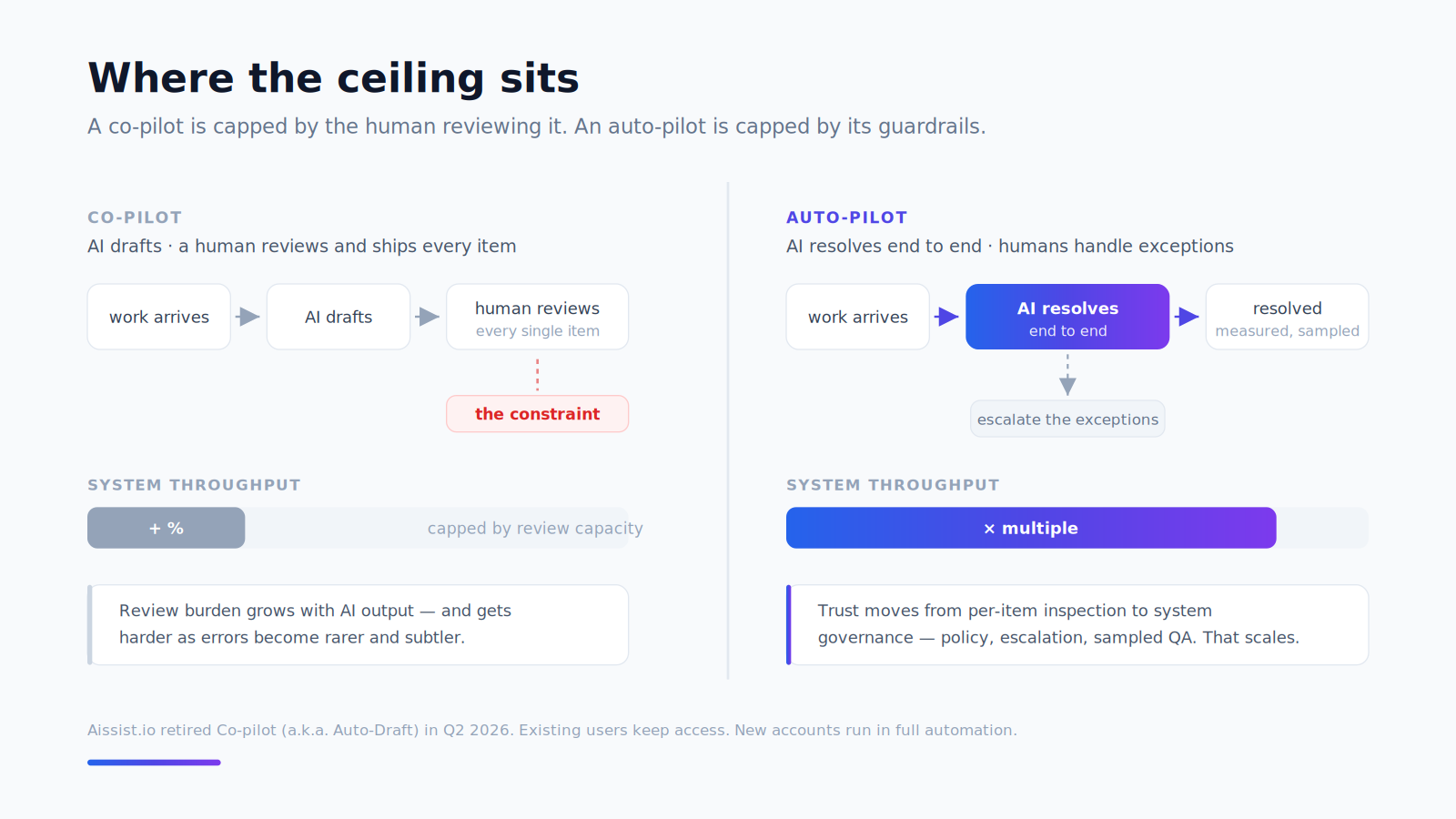
Proactive escalation is not the seam between automation and failure. It is one of the things the automation is for. An AI agent that resolves the routine 80% cleanly and routes the remaining 20% with a complete payload is worth more than one that attempts everything and hands over wreckage on the cases it loses — and the second system usually reports the better resolution rate.
Aissist.io's AgentMesh™ treats the escalation policy as configuration rather than a model behaviour: triggers are declared per workspace, the deny list is explicit, and the payload travels into the helpdesk the team already runs — Zendesk, Intercom, Freshdesk, Salesforce and others — so the receiving agent reads it where they already work. Across deployments that produces an 83% average resolution rate at 4.8/5 CSAT, with the escalated remainder arriving warm rather than cold.
<!-- Sources verified September 2026. Next refresh due March 2027. -->Escalation policy is worth an afternoon and pays for itself on the first hard ticket. Book a consultation →
Frequently asked questions
What is proactive escalation in customer service?
Proactive escalation is an AI support agent routing a case to a human because a predefined rule matched — a policy threshold, a risk signal, or a ticket class the AI is not permitted to attempt. The decision is authored before the ticket arrives, so the handoff happens before the customer has had to repeat themselves.
What is the difference between a cold transfer and a warm transfer?
A cold transfer drops the conversation into a queue and ends the AI's involvement, leaving the receiving agent to work from the thread alone. A warm transfer sends the full context payload and confirms a human is available before the customer is moved. Warm should be the default; cold is defensible only when a customer demanded a human and one is free immediately.
How does an AI agent know when to escalate to a human?
Escalation triggers fall into four categories: behavioural (repeated questions, rising emotional tone, an explicit request for a human), technical (failed payments, error codes, integrations returning nothing), policy-based (refund thresholds, legal requests, mandatory human oversight) and context-based (a history of unresolved issues, a re-opened ticket, another channel already tried). Policy triggers are hard stops evaluated first.
What information should be passed during an AI-to-human handoff?
Five things: the full transcript rather than a summary, the customer and account record read at handoff time, the AI's intent and sentiment labels marked as inferred, every action the AI already took and its result, and the authentication state. The action log is the field most often missing and the most expensive to omit, because without it an agent can issue a second refund.
Which support tickets should never be handled by AI?
Legal and regulatory requests, cases where an incorrect answer causes physical or financial harm, identity and account-recovery disputes where the authentication path is itself in question, signals of customer distress, tickets re-opened after a previous escalation, and anything above a contractual or financial threshold the business has set. These should route to a human on identification, with no attempted answer first.
Does a lower AI escalation rate mean the AI is working?
Not on its own. An escalation rate can be driven down by suppressing handoff to hit a containment target, which raises resolution on paper while collapsing satisfaction. Read the escalation rate only alongside post-handoff CSAT, post-handoff first contact resolution, customer effort score and escalated handle time.
How do you measure whether an AI-to-human handoff worked?
Measure five post-handoff metrics: AI escalation rate, post-handoff CSAT, post-handoff first contact resolution, customer effort score, and escalated conversation handle time. A healthy policy shows escalation rate and post-handoff CSAT moving up together; escalation rate and CSAT falling together is the containment trap.
Is proactive escalation a sign that the AI failed?
No. Proactive escalation is a quality-control mechanism that runs on rules set before deployment, so most escalations are cases the AI was never meant to attempt. The failure mode is the opposite one: an AI that attempts a restricted or high-risk case, gets it wrong, and escalates afterwards has added delay to the risk it was supposed to avoid.