AI Copilot vs Autopilot: Which One Actually Scales?
An AI copilot drafts, suggests and accelerates, but a human reviews and sends every output. An AI autopilot completes the work end to end and brings a person in only when policy or ambiguity requires it. The difference that matters is not capability — it is where the ceiling sits. A copilot can only go as fast as the person checking it, so its throughput is capped by review capacity. An autopilot is capped instead by the quality of its guardrails and escalation rules, which is a limit you can engineer against.
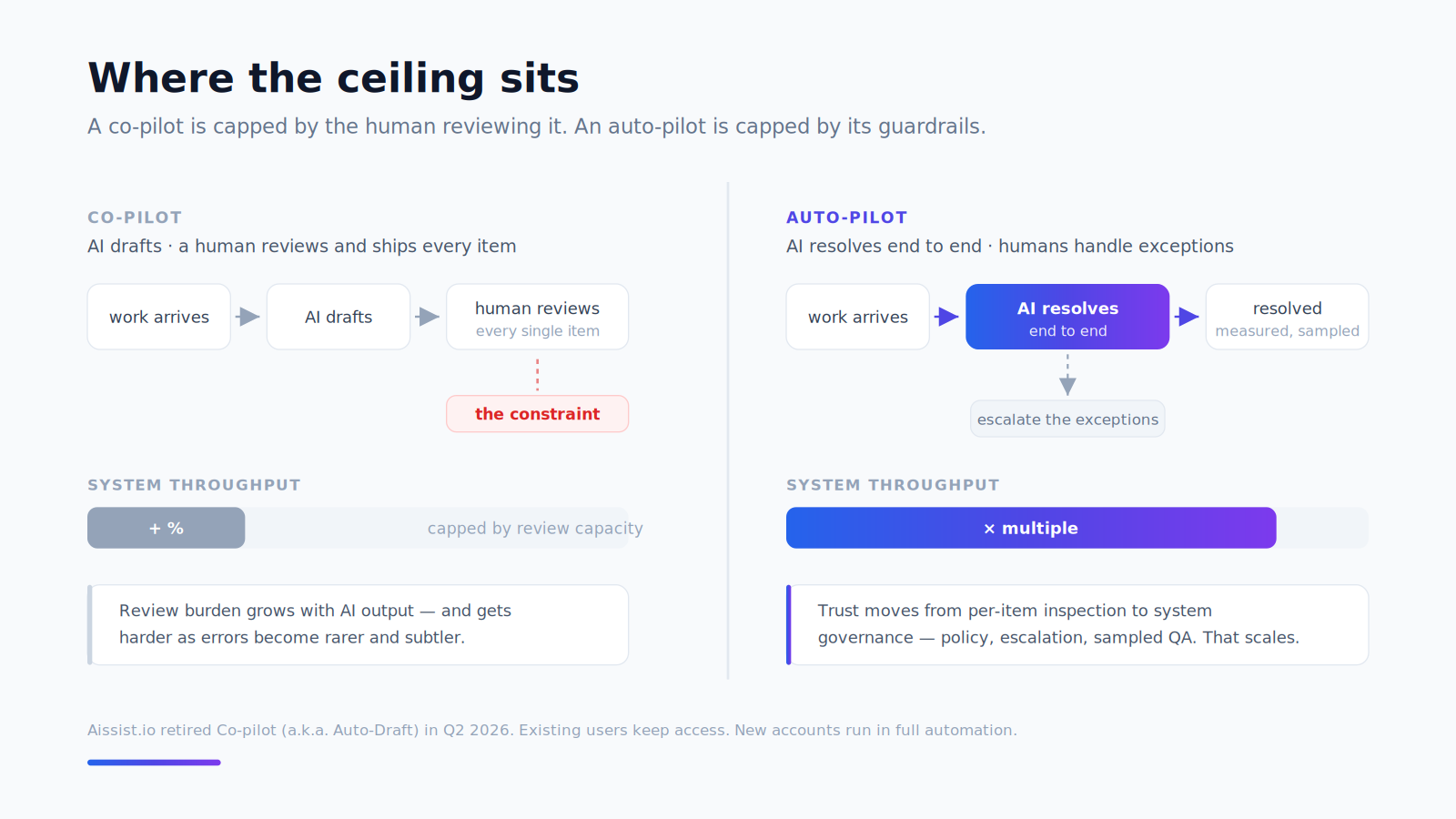
AI copilot vs autopilot at a glance
| AI copilot | AI autopilot | |
|---|---|---|
| Who finishes the work | A person, every time | The AI, with exceptions escalated |
| Human role | Reviews and sends each output | Sets policy, handles escalations, audits samples |
| What caps throughput | Reviewer capacity — scales linearly with headcount | Guardrail and escalation quality |
| Effect of a better model | Diminishing — errors get rarer and subtler, so review gets harder, not easier | Compounding — more traffic clears the bar unassisted |
| Time to first value | Fast; drops into the existing workflow | Slower; exposes gaps in knowledge, policy and escalation up front |
| Failure mode | Quiet ceiling — gains absorbed by process, org design and checking cost | Loud failures early, in front of customers |
| Process change required | Little | Substantial — the flow is rebuilt around the AI |
| Best fit | Regulated advice, irreversible transactions, safety decisions, tightly scoped work on a mature platform | High-volume routine work where resolution can be measured and risk cases can be routed |
| Trust model | Check every item | Govern a system |
The short version. For ordinary high-volume work, copilot mode tends to cap results rather than raise them, because the checking grows with the output. For genuinely high-risk work, a person must stay in the loop — but the right place for that is an escalation rule, not a mode where a human approves every routine message. Below we go through why the copilot ceiling exists, the strongest arguments against our position, and what we did about it at our own company.
Disclosure, up front: we sell an autopilot product, and in Q2 2026 we retired our own copilot product rather than keep selling it. That is a commercial position, not a neutral one — the full account is at the end of this article, and the case against us is taken seriously here. No independent study has compared the two modes head to head; weigh our argument accordingly.
One quick note, because search engines confuse these words. This article is about AI copilot vs autopilot as ways of working — does the AI suggest, or does it finish the job? It is not about Microsoft 365 Copilot or Windows Autopilot.
Our Own AI Journey, and What We Learned
Short answer: Co-pilot mode gave us a percentage. Autonomy plus guardrails gave us a different unit.
The argument here comes from our own experience, not from theory. Nothing in this section is measured or published. Read it as a story, not as data.
We are an AI-native company, and we used AI in engineering from day one. We started where most teams start: in co-pilot mode. We lived in Cursor, mostly using its autocomplete. You type, it finishes your line. You highlight a block and ask for a change.
It was good. It was not a step change. The gains were real but small, because a human still sat in the middle of every loop. I was the bottleneck, and faster autocomplete does not fix that.
(For the record: Cursor has since moved to agents. Its homepage now says "Cursor is your coding agent for building ambitious software." I am describing how we used it back then, not what it is today. The whole industry has moved in the direction this article argues.)
In mid-2025 we brought in Claude Code and Codex. The first few months went badly. In our setup, with our codebase and our prompts, the agents made mistakes we could not review quickly and did not reliably follow instructions. We pulled them back to console work and a few other places where a mistake could not hurt much. To be fair to both tools, that was our experience with the 2025 versions, and both have changed a lot since.
About six months ago it clicked. The models got reliable enough that we opened things up again. But the models were only half the story. The other half was ours: we built guardrails. Style rules the agents have to follow. Automated code review. Required unit tests. Checks that run before anything an agent writes can merge.
That combination is what changed things. Not the model on its own. Not the process on its own. Both.
Here is the honest version of the result, as a management impression rather than a measurement: co-pilot mode felt like a percentage. Autonomy plus guardrails felt like a different unit entirely.
We think most companies will walk the same path. Start in co-pilot mode. Hit the ceiling. Pull back after the first failures. Then open up again as the models improve and as you build the guardrails that make autonomy safe. The order matters. Teams that skip the guardrails and jump straight to autonomy get the failures without the gains, and then decide the technology is not ready.
Why the Spend Often Doesn't Show Up
Short answer: AI spending is climbing fast while most companies report no impact on profit.
There is a pattern worth naming, because it sits behind a lot of AI disappointment right now.
Companies are spending a great deal on AI. Among the heaviest spenders, the median was $7,400 per employee in July 2026, up from $2,590 in January (Ramp AI Index, via Forbes). The results are much harder to find.
McKinsey found that more than 80% of the people it surveyed said their organization saw no real impact on company-level profit from generative AI. Only 21% of respondents at AI-using companies said they had genuinely redesigned any workflow (McKinsey, March 2025). BCG put 60% of companies in a "laggard" group seeing only minimal gains (BCG, September 2025). A 2026 survey of technology leaders found that while 68% believed AI had delivered value, only about a third of AI spending could be tied to a specific business outcome (CloudBees, vendor research).
One thing to be careful about. You may have seen OpenAI's research quoted as proof that AI spending does not produce revenue. It does not say that. That study compares how much money a company made before adopting AI with how heavily its staff used the tool afterwards. It tells you which companies adopt heavily. It says nothing about whether the spending paid off.
So the honest summary is narrower than the headlines: the spending is real, the returns are hard to find, and nobody has proven cause and effect in either direction. Most people read that as "AI is overhyped." We think that is the wrong conclusion.
The Bottleneck Is Not the Model — It Is How We Use It
Short answer: The same technology made one group of developers slower and another faster. What differed was everything around it.
Two careful studies ran on similar technology and got opposite answers.
METR watched 16 experienced open-source developers work through 246 real tasks in code they had known for years. Before starting, the developers expected AI to make them 24% faster. Afterwards they believed it had made them 20% faster. The stopwatch said something else: AI made them 19% slower (METR, July 2025).
Google ran a similar experiment with 96 of its own engineers. It found AI "significantly shortened the time developers spent on task," by about 21%, though with a wide margin of error (Google, October 2024). That is Google studying Google's own tools, so weigh it the way you would any vendor's research.
These two are not a fair head-to-head. Different years, different tools, different kinds of task. But the contrast is still the most useful thing in this article. The same broad technology helped one group and hurt another. What differed was everything around it. Google's engineers worked inside a mature internal platform on a well-defined task. METR's developers worked in sprawling codebases they knew intimately, held to a high review bar.
We should also flag something that cuts against us. METR has since revisited its study design, partly because developers now refuse to work without AI at all. Its newer and weaker evidence points to AI getting faster since early 2025. We would rather say that than quietly leave it out.
The broader surveys point the same way. DORA asked nearly 5,000 technology professionals and concluded that "AI's primary role is as an amplifier, magnifying an organization's existing strengths and weaknesses." It went further: "The greatest returns on AI investment come not from the tools themselves, but from a strategic focus on the underlying organizational system" (DORA / Google Cloud, September 2025). BCG said it in one line this July: "The core problem is not technology. It is execution" (BCG, 22 July 2026).
You can make one part of a system much faster and barely move the whole thing. That, we think, is the real story of AI in 2026.
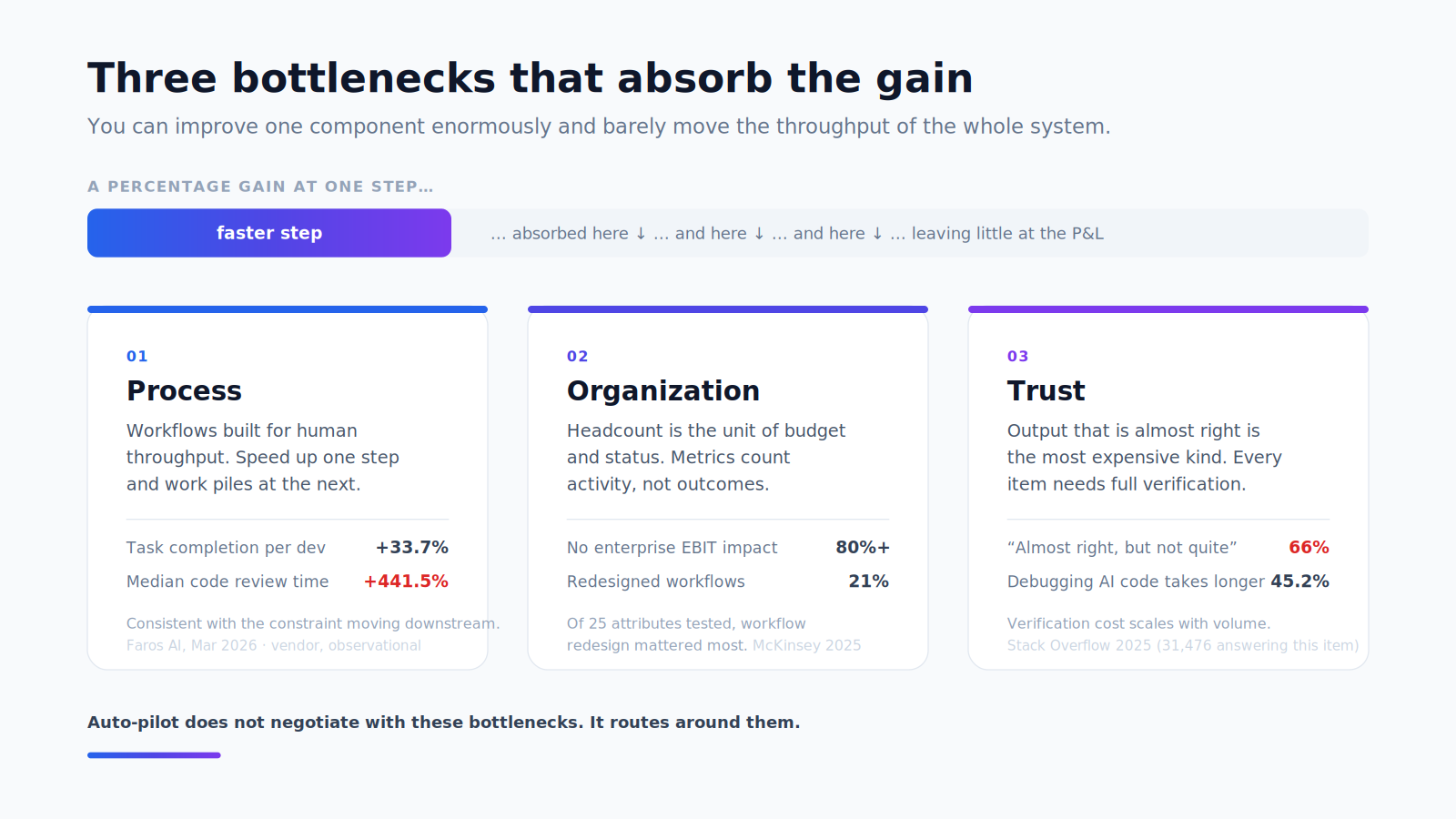
The Three Things That Absorb the Gain
Short answer: Process, organization and trust — where a percentage gain quietly disappears.
If the limit is how we use AI rather than what it can do, the useful question is where the work actually gets stuck. From our own deployments, it is three places.
Process
Most business processes were built around how fast people work. That assumption is baked into queues, shift schedules, approval steps and handoffs. Speed up one step and the work simply piles up at the next one.
You can see this in engineering data. One study of 22,000 developers found that on teams where most people used AI daily, tasks completed per developer rose 34% — while the time a piece of code waited for review rose by several times that (Faros AI, March 2026, vendor research and observational, so read it as a pattern rather than proof). The bottleneck did not go away. It moved to the people doing review.
Support works the same way. If AI writes replies twice as fast but every reply still waits for an agent to read it, your limit is how fast agents can read. You have bought a faster tap for a sink that still drains at the same rate. This is the plain reason co-pilot gains disappear: you sped up a step, not the flow. McKinsey tested 25 different organizational factors and found workflow redesign mattered more than any of them. More than which model you pick. More than how much you spend.
Organization
Even when a process could be redesigned, the org chart often will not allow it. Headcount is how budgets, status and promotions work, so asking a manager to automate a function is asking them to shrink their own team. Teams are built around the handoffs the old process needed. And most success metrics count activity — tickets handled, calls taken — rather than problems solved. So a system that resolves issues without anyone touching them can look, on the dashboard, like productivity going down.
None of this is foolish. It is what happens when a technology that changes the shape of work meets a company built around the old shape. BCG found only 26% of CEOs had built AI into a wider business change (BCG, July 2026).
Trust
The third one is the one people underestimate. It is also the one that kills co-pilot specifically.
Stack Overflow asked developers what frustrated them most about AI. Among the 31,476 who answered that question, the top complaint, from 66%, was "AI solutions that are almost right, but not quite." Close behind, 45% said "debugging AI-generated code is more time-consuming" (Stack Overflow, 2025). DORA found about 30% of people had little or no trust in AI-written code.
Put those together and you get a trap. Almost-right output is the most expensive kind there is. Obviously wrong output is cheap, because you throw it away. Correct output is cheap, because you ship it. Output that looks right but occasionally is not forces you to check every single item, and checking can cost as much as doing.
That is exactly the situation a co-pilot creates. The whole premise is that a person checks the AI's work. So the checking grows with the output. And it gets worse as the AI improves, because the mistakes get rarer and subtler and harder to spot in a page of confident text. A co-pilot does not just leave the human bottleneck in place. It puts the person in the hardest possible position: responsible for catching errors that are, by design, hard to catch.
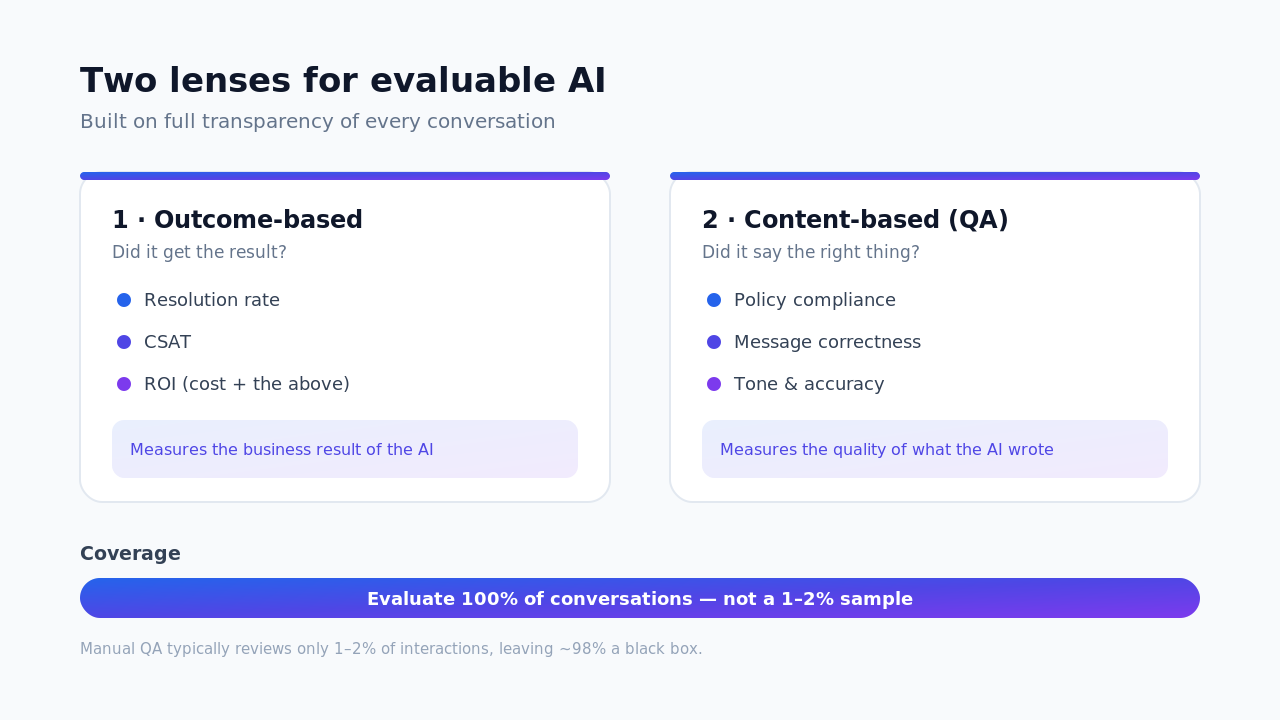
Auto-pilot changes the shape of the problem. You stop checking every output and start governing the system that produces them — policy rules, escalation rules, sampled quality reviews, measured resolution and CSAT. You move from inspecting items to managing a process. That is a cheaper relationship with trust, and it is the only one that scales. It is also why evaluable AI comes first: you cannot govern what you cannot measure.
Two Departments, One Company, Two Answers
Short answer: Same company, same product. The one that went end to end pulled ahead. The one that kept people at the finish line did not.
The clearest example we have is not a study. It is one customer, told from our side, with no independent measurement and no numbers we can publish. Treat it as illustration.
Two departments at the same company deployed us for different purposes but similar kinds of work. One went aggressive: let the AI handle most of the traffic end to end, with escalation for real exceptions. The other kept AI in a supporting role, with people doing the last mile on everything.
The end-to-end department had a harder start. Going fully automated exposes every gap in your knowledge base, your policies and your escalation rules at once, and it does so in front of live customers. There were some rough weeks. We worked through them together and tightened the guardrails.
That work now runs automatically, and our internal quality reviews score it above where it was before automation.
The other department is fine. But its ceiling was set on day one by the fact that a person still had to touch everything. That is a property of the mode, not a judgment of the team.
Same company. Same product. Same vendor. The difference came down to how much autonomy each was willing to hand over.
The Case for Co-pilot, Taken Seriously
Short answer: Autonomy fails often, some work needs a person, and nobody has proven this comparatively.
We would not trust this argument if it ignored the other side, and the other side has real points.
Autonomy fails often. Gartner expects more than 40% of agentic AI projects to be cancelled by the end of 2027, blaming rising costs, unclear value and weak risk controls (Gartner, June 2025). That is not a fringe view, and our own rough weeks fit the pattern.
Some work genuinely needs a person. Regulated advice, irreversible money movements, safety decisions, anything with real legal exposure. Our answer is that those cases belong in escalation rules, not in a mode where a human approves every routine message. If your business truly needs sign-off on every outbound reply, we would rather say plainly that we are not the right fit for you today.
Nobody has proven this comparatively. We looked for solid research comparing full autonomy against keeping humans in the loop. There isn't any we would cite. Companies are making this call on judgment and vendor claims, ours included. Weigh our argument accordingly.
Co-pilot really does help some teams. Google's engineers got about 21% faster on a well-defined task. If your organization looks like that, with a mature platform and clearly scoped work, co-pilot may be the right level for you right now.
The honest version of our position is not that co-pilot never works. It is that a co-pilot's ceiling is set by the person it helps, and that ceiling is low enough that we would rather help customers climb past it than sell them a comfortable place to stop.
AI Copilot vs Autopilot: Why We Think the Future Is Auto-pilot
Short answer: Auto-pilot goes around the bottlenecks instead of arguing with them.
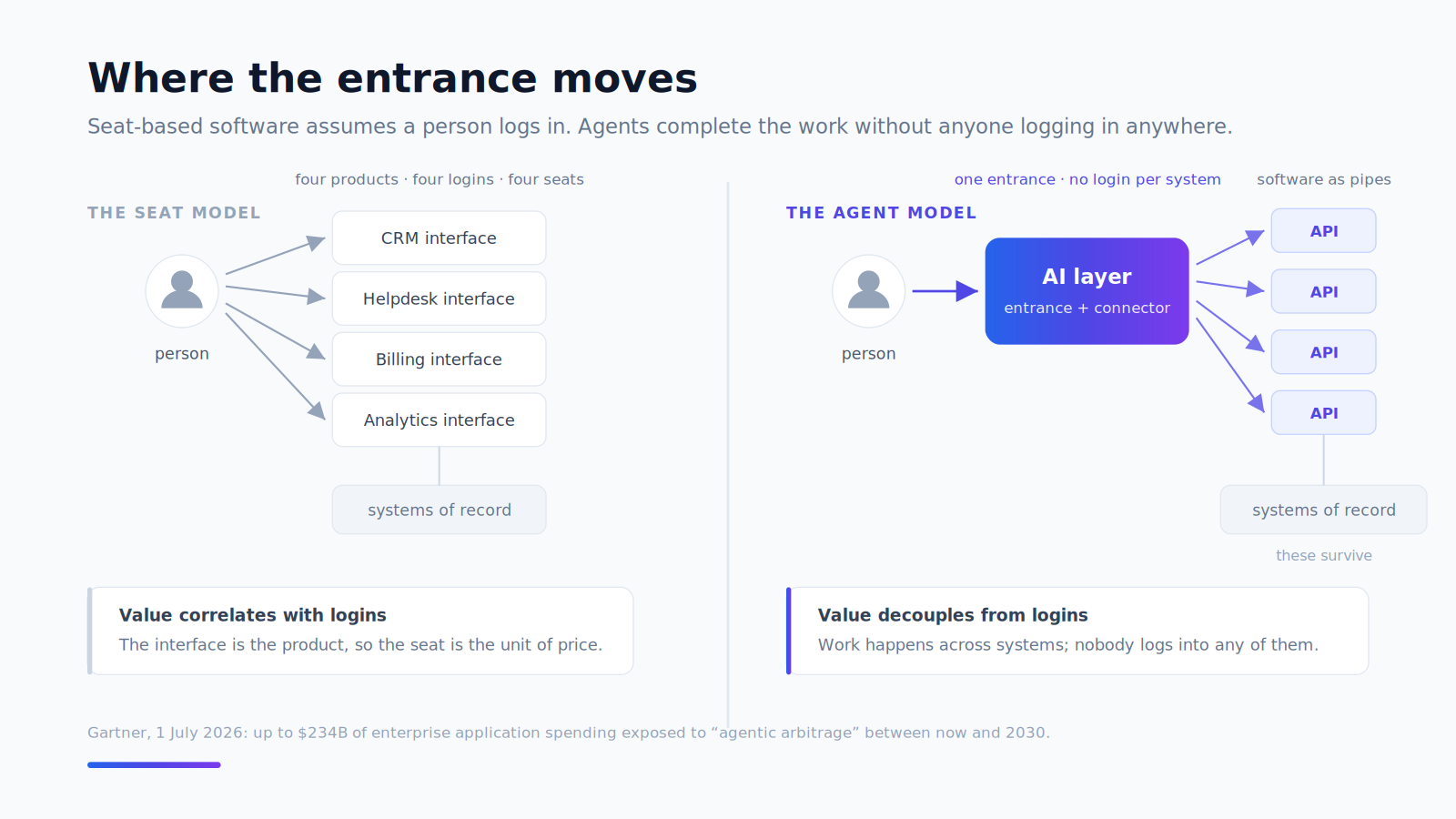
Auto-pilot does not argue with those three bottlenecks. It goes around them. When AI handles a flow end to end, you are no longer speeding up one station inside a human process. You are replacing that process with one built for the thing actually doing the work. The queue design stops mattering. The handoffs disappear. And trust moves from checking items to governing a system, which is the only version of trust that scales.
Gartner expects agentic AI to resolve 80% of common customer service issues on its own by 2029 (Gartner, March 2025). The same firm expects most agentic projects to be cancelled before then. Both are probably right, and the space between them is exactly the organizational readiness this article is about.
What we did about it: we retired our own copilot
Short answer: We used to sell two product lines. We retired Co-pilot, also called Auto-Draft, and now sell one that runs end to end.
We are not a neutral party to this argument, so here is our position in full.
We used to sell two things. Co-pilot, which we also called Auto-Draft, had the AI write the reply; a person read it, edited it if needed, and sent it. Every message passed through a human. Auto-Pilot had the AI handle the whole conversation and bring in a person only when it hit something it should not decide alone.
In Q2 2026 we stopped selling Co-pilot. Customers who already have it keep it; it can no longer be turned on for new accounts or new gateways. There is now one product line, and it runs end to end.
Three things led to that call, all internal and none published. Our customer survey showed Co-pilot accounts were less happy with their results than Auto-Pilot accounts, even when they liked the feature itself. Traffic told a matching story: Co-pilot volume stayed flat while Auto-Pilot volume kept compounding, and accounts that moved up almost never moved back. Some of that is our own doing, since we promoted Auto-Pilot harder, so we would not call it a clean signal. And when we projected the next two years, the gap got wider, not narrower.
Keeping a product because some customers like it is a fair decision. Keeping it when it puts a ceiling on what those customers can achieve is a different thing.
About our name. Aissist started as AI + assist. The original idea was AI that helps a person do their job better. Two years ago we moved away from that and rebuilt the company around agentic AI — systems that do the job. The name is a fossil of where we started. We kept it because it is ours, not because it still describes us.
Summary
AI copilot vs autopilot is not really a question about how capable AI is. It is a question about where the work gets stuck. A co-pilot speeds up one step inside a process built around people, so the gain gets swallowed by queue design, by org structure, and by the cost of checking output that is almost right. That is why AI spending keeps climbing while most companies report no impact on profit, and why one careful study found AI made developers 19% slower while another found 21% faster. The system around the AI decides the outcome. Auto-pilot goes around those limits, at the cost of a harder start and a real failure rate. We learned this on our own team and saw it again at a customer. Our conclusion is that the future is auto-pilot, so in Q2 2026 we retired our Co-pilot product rather than keep selling a mode we believe caps our customers' results.
Still running AI at the finish line? See how AgentMesh™ resolves service and sales end to end on the stack you already run, and how reliable AI makes that autonomy governable. Related reading: why agents are re-architecting enterprise software.
Frequently Asked Questions
What is the difference between an AI copilot and an AI autopilot?
A copilot helps a person: it drafts, suggests and speeds things up, but a human reviews and sends every output. An autopilot does the work end to end and brings in a person only when policy or ambiguity calls for it. The practical difference is the ceiling. A copilot can only go as fast as the person checking it. An autopilot is limited by the quality of its guardrails and escalation rules.
Why do AI copilots fail to scale?
Because the checking grows with the output. A copilot's whole premise is that a person reviews the AI's work, so twice the output means twice the reviewing. It gets harder as the AI improves, because mistakes become rarer and subtler. In Stack Overflow's 2025 survey, 66% of the developers who answered the question named "almost right, but not quite" output as their top frustration, and 45% said debugging AI-generated code takes longer.
When should you use an AI copilot instead of an AI agent?
When a person genuinely must see every outbound action — regulated advice, irreversible financial transactions, safety decisions, or anything with significant legal exposure. Copilot mode can also suit teams with mature internal platforms and tightly scoped work. Google's trial with 96 engineers found about a 21% speedup in that kind of environment. Outside those cases, copilot mode tends to cap results rather than raise them.
Is human-in-the-loop or full automation better for AI customer service?
It depends on the risk of the specific flow, not on a blanket rule. High-risk and regulated interactions need a person involved, and the right place for that is escalation rules rather than approving every routine reply. For ordinary, high-volume support traffic, keeping a person at the finish line usually caps quality and throughput near where they started. No rigorous study has compared the two head to head, which is worth knowing before anyone — vendors included — claims certainty.
Why do so many companies spend heavily on AI without seeing results?
Because they speed up a step instead of redesigning the flow. McKinsey found more than 80% of respondents said their organization saw no real company-level profit impact from generative AI, and that of 25 organizational factors tested, workflow redesign mattered most. DORA's conclusion was that "AI's primary role is as an amplifier, magnifying an organization's existing strengths and weaknesses."
What are the main bottlenecks in AI adoption?
Three. Process: workflows built around human speed just move the jam downstream when one step gets faster. Organization: headcount drives budgets and status, and most metrics count activity rather than problems solved. Trust: checking output that is usually but not always right can cost as much as doing the work, and that cost grows with volume.
Did Aissist.io keep any human-in-the-loop option after retiring Co-pilot?
Not as a product line. Co-pilot, which we also called Auto-Draft, was retired in Q2 2026, and existing customers keep their access. New accounts run in full automation. Human judgment now enters through escalation — the AI hands off cases that policy or ambiguity says it should not decide — rather than through a mode where a person approves every routine message.
Isn't autonomous AI risky, given how many agentic projects fail?
Yes, and the risk is documented. Gartner expects more than 40% of agentic AI projects to be cancelled by the end of 2027 because of rising costs, unclear value and weak risk controls. The answer is not to avoid autonomy but to earn it: strong escalation rules, clear policy limits, measured resolution and CSAT, and sampled quality reviews. Autonomy without guardrails gives you the failures without the gains.
How long does it take to move from copilot to autopilot?
In our own deployments, usually weeks rather than months, but the hard part comes early. Going end to end exposes every gap in your knowledge base, policies and escalation rules at once. In our experience, teams that push through end up above the quality they had before automation, while teams that retreat after the first bad week stay roughly where they started.