Anthropic's Valuation: Is a $2 Trillion IPO Justified?
Personal opinion. This piece reflects my own view and does not represent the position of Aissist.io. It is analysis of a public market question, not investment advice, and I have no non-public information about any company named here. Every number is sourced and dated; the conclusions are mine.
TL;DR — The Anthropic valuation question is not a thought experiment: $2 trillion is the figure the press expects for its IPO, and Anthropic is one front-runner in a shift every frontier lab can ride. Today's software framework prices that as absurd, because that framework assumes software is a product a human logs into. Three things break the assumption: AI is becoming the primary entrance to software, AI is becoming the connector that demotes much of today's software to plumbing, and physical AI is an unpriced option on top. The bear case is real and I engage it below. My view: you cannot judge this number with the framework we inherited, and on the framework I think is coming, it is defensible.
Ask how to evaluate an agentic AI company and most people reach for a revenue multiple. That instinct is why the Anthropic valuation debate keeps producing bad answers. This is not really about one vendor or one model — it is about a shift every serious lab can ride, and about whether the framework we use to value software still describes what software is becoming. Anthropic is a clear front-runner, which is why its number is the one on the table.
The Anthropic Valuation Slope, and Why the Number Is Real
Short answer: $2 trillion is not invented. It is the valuation the press expects for an October listing, against a private mark of $965 billion four months ago.
Anthropic raised $65 billion in Series H at a $965 billion post-money valuation on 28 May 2026, disclosing that run-rate revenue "crossed $47 billion" that month (Anthropic). It confidentially submitted a draft Form S-1 to the SEC on 1 June 2026 (Anthropic). Bloomberg later reported run-rate revenue reaching $65 billion by the end of July 2026 (via Axios). The Financial Times has reported an expected $2 trillion valuation for an October listing (via Fortune) — an expectation held by investors and reporters, not a figure the company has named.
The valuation slope, from the company's own announcements: $61.5B (March 2025) → $183B (September 2025) → $380B (February 2026) → $965B (May 2026).
For scale, on figures read 27 August 2026: $2 trillion is a little under TSMC's own $2.2 trillion (CompaniesMarketCap) — the foundry that manufactures most frontier AI silicon — and roughly 72% of Amazon's $2.76 trillion (CompaniesMarketCap). Treat both as a snapshot rather than a fixed ratio: Amazon alone traded between about $2.76 trillion and above $3 trillion during August 2026 (CNBC, 3 August 2026). Either way it is not the top of the market — NVIDIA sits above $5 trillion (read 26 August 2026, StockAnalysis).
So the question is not "how could software be worth that." It is whether what is being built is still software in the sense the multiple assumes.
Shift One: AI Becomes the Super Entrance
Short answer: Seat pricing worked because value and login were the same event. Agents break that, and the interface layer is what gets repriced.
I believe the next super entrance is already here.
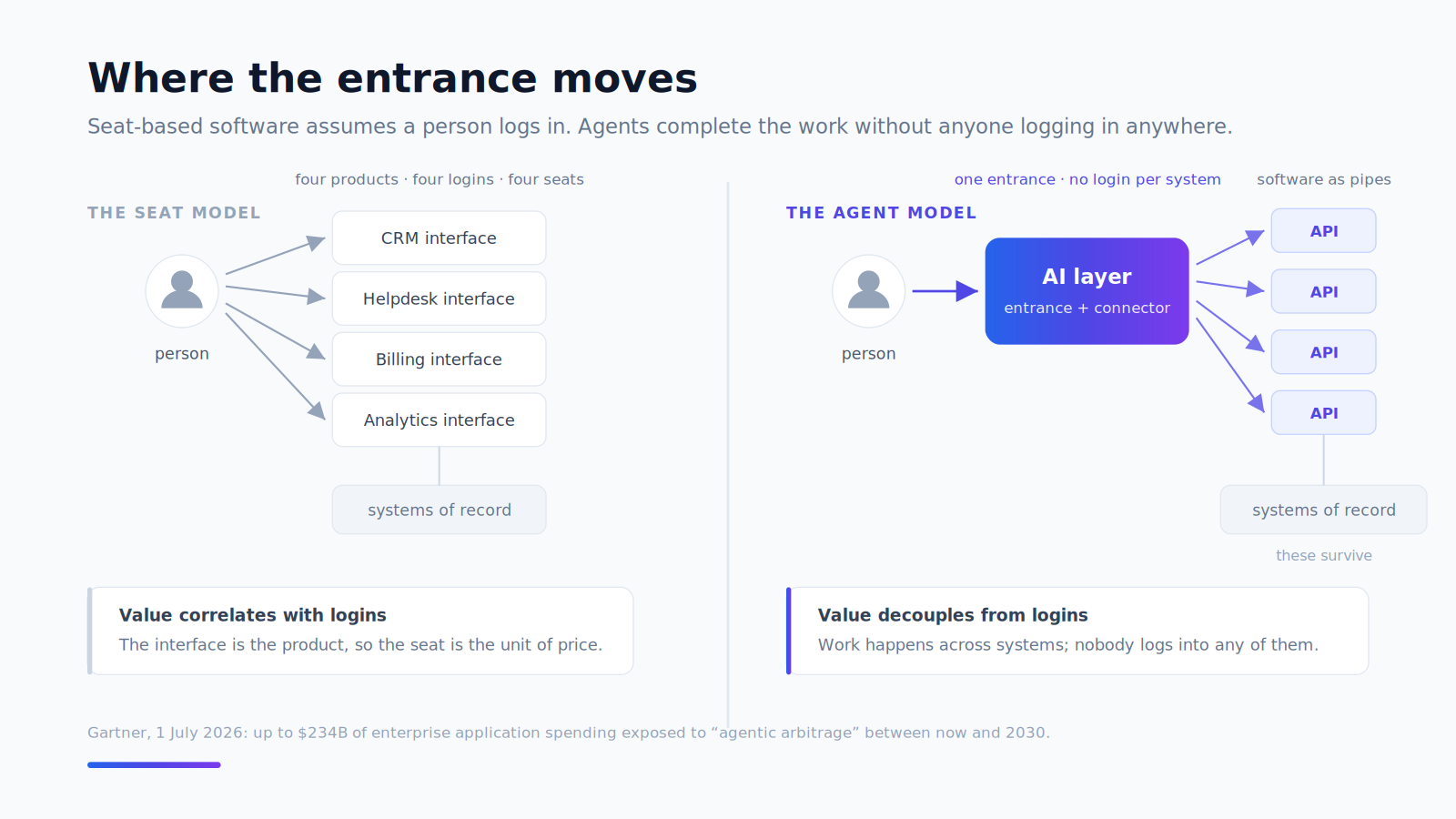
For thirty years, the entrance to enterprise capability was a screen. You bought seats, users logged in, and the interface was where the product lived — which is exactly why seat-based pricing worked. Value and login were the same event.
Agents break that coupling. When an agent completes a task across four systems, nobody logged into any of them. Gartner named the pattern: "agentic arbitrage," which "happens when AI agents complete tasks across multiple systems, reducing the need for users to interact with multiple traditional software interfaces." Its estimate is that up to $234 billion of enterprise application spending is exposed to agentic arbitrage between now and 2030 (Gartner, 1 July 2026). Managing VP George Brocklehurst: "Agentic systems deliver outcomes directly, bypassing traditional user experience-heavy applications."
Satya Nadella said the sharper version in December 2024: "SaaS applications or biz apps — the notion that business applications exist, that will probably collapse in the agent era."
The market briefly priced a version of this. In early February 2026, after Anthropic shipped a legal plugin for Claude Cowork, Thomson Reuters fell as much as 18% and RELX 14% — RELX's steepest single-day decline since 1988 (eWeek, 4 February 2026). I would not lean on that episode as proof; most analysts covering it called the selloff an overreaction and the shares partially recovered. What it shows is not that the thesis is right, but that the market now treats interface disintermediation as a live risk to price.
This is why almost every piece of software we have today is worth rethinking. Not deleting — rethinking. The logic, the UI and the experience were all designed around an assumption that a person would operate them. When that stops being true, the product is not upgraded. It is re-architected. That is the same reasoning behind building service automation as an operational layer over the stack you already run rather than as one more console to log into.
Shift Two: AI Becomes the Super Connector
Short answer: Much of today's software becomes a pipe. The system of record survives; the system of engagement moves to the AI layer.
The second shift is the one I find most convincing, because the evidence is not a forecast — it is already in production.
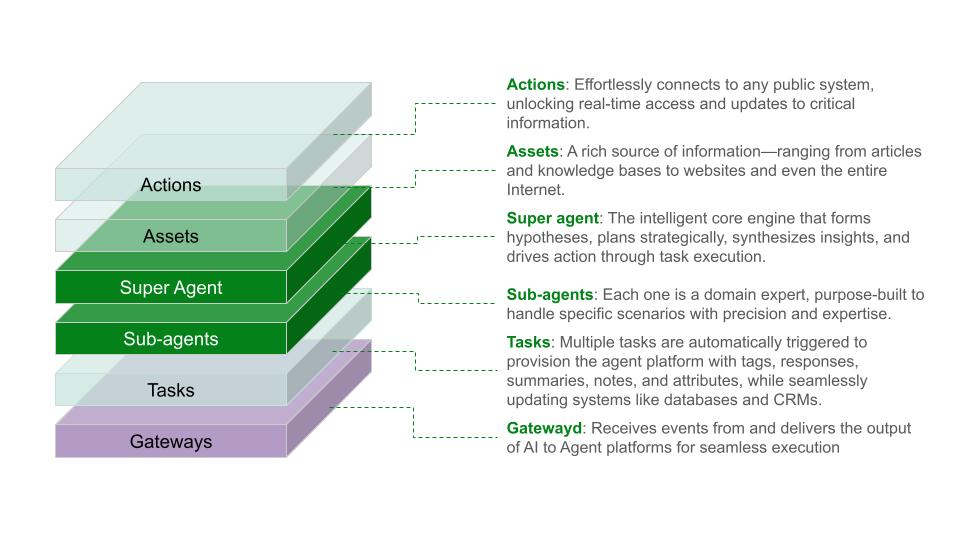
AI can now connect to nearly anything with an API. That means a large amount of today's software becomes a pipe: it supplies information and executes actions, while the AI sits at the center connecting things and making them run. This is the practical argument for building on a multi-agent platform rather than a single-model integration.
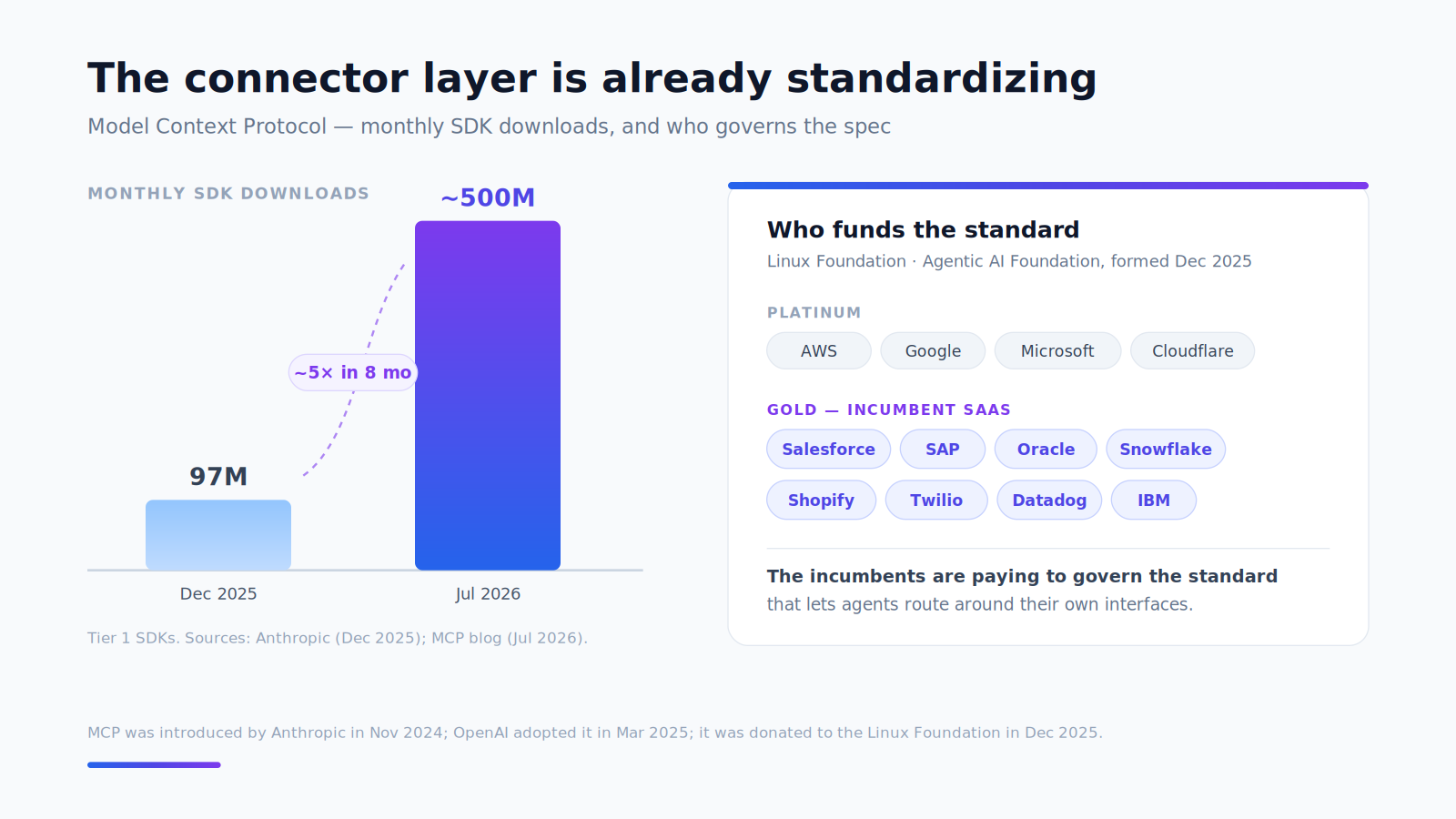
Watch what happened to the protocol. Anthropic introduced the Model Context Protocol as an open standard on 25 November 2024 (Anthropic). Four months later OpenAI adopted it — Sam Altman: "People love MCP and we are excited to add support across our products" (TechCrunch, 26 March 2025). A direct competitor standardized on a rival's connector spec inside a year.
Then it was donated. In December 2025 the Linux Foundation formed the Agentic AI Foundation, anchored by three projects: Anthropic's MCP, Block's goose, and OpenAI's AGENTS.md (Linux Foundation). The Platinum tier is AWS, Anthropic, Block, Bloomberg, Cloudflare, Google, Microsoft and OpenAI — the labs are in there too, so read that tier as the contributors, not as independent endorsement.
The Gold tier is the interesting one. It includes Salesforce, SAP, Oracle, Snowflake and Shopify: the largest incumbents in enterprise software, funding and participating in the standard that lets agents reach past their own interfaces. Whatever their reasoning, the revealed preference is clear — being the one system an agent cannot reach is worse than being reachable.
The usage curve points the same way. MCP downloads went from 97M+ per month across the Python and TypeScript SDKs in December 2025 (Anthropic) to close to half a billion a month across all Tier 1 SDKs by July 2026 (MCP blog, 28 July 2026) — a broader basket, so not a like-for-like multiple, but a steep curve either way. The July spec also moved the protocol to a stateless core with header-based routing and cacheable results: the kind of change you make for gateway-scale enterprise traffic, not for developer experiments.
Adoption is real but uneven. In McKinsey's 2026 survey, 40% of respondents from organizations above $1B in revenue reported scaling AI agents, up from 27% a year earlier — while respondents at smaller organizations stayed flat at 22% (McKinsey, 25 August 2026). That gap matters, and I will come back to it.
Shift Three: Physical AI Is the Option You Are Not Paying For
Short answer: Real, unpriced, and not in my base case. Treat it as optionality, not a pillar.
The third leg still needs a breakthrough, and I want to be honest that it is a leg I would not underwrite.
If embodied AI arrives, the addressable value is several times anything above — you stop automating knowledge work and start automating physical labor. Morgan Stanley models a $5 trillion humanoid robot market by 2050, while cautioning that adoption "should be relatively slow until the mid-2030s" (Morgan Stanley, May 2025). Goldman Sachs sized the category at $38 billion by 2035 (Goldman Sachs, February 2024). Different target years on a curve both describe as steepening late — so not a clean disagreement, but nobody publishes a confident number for the same horizon, which tells you where the uncertainty sits.
Rodney Brooks, who co-founded iRobot and Rethink Robotics, argues practical humanoids are 15+ years out and names the missing piece: tactile sensing. "If you're not even collecting the data about touch, you can't learn about touch" (Boston Globe, 24 February 2026). He is an outlier — he also puts superintelligence roughly 300 years away — but an outlier who has shipped robots.
So: real, unpriced, and not in my base case. Optionality, not a pillar.
The Case Against, Taken Seriously
Short answer: The capital math is brutal, the financing is getting exotic, and the system of record may be stickier than the orchestration layer.
A piece that skipped this would be advocacy, not analysis.
The capital math is brutal. Bain estimates the industry needs $2 trillion in new annual revenue by 2030 to fund AI compute, projecting an $800 billion annual shortfall even crediting AI-driven savings (Bain, September 2025). The number one company might be worth is the number the whole industry has to find.
The financing is getting exotic. Hyperscaler capex is expected to exceed $690 billion in FY26, with incremental annual debt rising from 9% of capex in FY24 to 32% on a trailing-twelve-month basis by mid-2026 (FactSet, 23 July 2026). Bloomberg reported Broadcom seeking more than $60 billion in debt through a special-purpose vehicle to fund AI chips for Anthropic and others, with the hardware leased rather than bought (via TNW, 21 August 2026). Off-balance-sheet compute is not a detail.
The strongest argument is structural, not financial. The orchestration layer and the system of record are different businesses, and the second is stickier. Fortune's Jeremy Kahn argued in February 2026 that incumbents hold data access, security posture and hybrid workflows an agent layer does not automatically inherit. Wedbush's Dan Ives was blunter: "You can't just snap your fingers and go to an AI model on an enterprise scale" (ABC News, 5 February 2026). Deloitte's read is that agents largely stay headless, with new management layers emerging rather than UIs vanishing (Deloitte TMT Predictions 2026). Gartner itself calls this a "metamorphosis" of the SaaS market, not a destruction.
I think that is mostly right, and it is why the McKinsey size gap matters: this transition is running fast at the top of the market and has barely started below it.
AI Agents vs SaaS: So Is Anthropic Worth $2 Trillion?
Short answer: Not on today's framework, which prices seats. On the framework I think is coming, yes.
You cannot answer that with today's framework, because today's framework prices seats, and the thing being built is not sold by the seat.
On the framework I think is coming — where AI is the entrance to most software, the connector between all of it, and eventually the operator of physical work — a company that owns the layer everything else routes through is not priced against Salesforce. It is priced against the aggregate value of what it intermediates. On that basis, in my personal view, $2 trillion is defensible.
I could be wrong in a specific, checkable way, so here is what would change my mind: if MCP-style adoption plateaus and enterprises keep humans at the UI rather than at the exception layer; if gross margins on frontier inference stay structurally below software norms; or if the agent layer proves to be a thin, commoditized shim while systems of record capture the value. Any of those, and the multiple is a story rather than a thesis.
What this means if you buy customer service software
This is an investor-shaped argument, so it is worth stating plainly what follows from it for the people who actually run support and sales operations — because the answer is not "buy more AI".
Model capability is not where your risk sits. If frontier labs are worth these numbers, it is because capability keeps improving and keeps getting cheaper per unit of work. That is the part you do not have to bet on. The bet you are actually making when you buy an AI agent is on the layer above the model: whether the vendor's system resolves your cases end to end, escalates the ones it should not touch, and can be measured honestly. None of that improves automatically when the underlying model does.
Falling model costs do not become falling invoices on their own. Token prices have not moved in a straight line — flagship pricing turned back upward in early 2026, as our token efficiency analysis shows. And most AI support vendors bill per resolution or per conversation, not per token, so a cheaper model widens the vendor's margin before it touches your bill. If you want cost to track capability, that has to be in the pricing model you sign, not in the industry's trend line.
Concentration is a procurement question. A handful of labs at these valuations means the agent you buy is probably reselling one of a very small number of models. Ask any vendor which models it runs, whether it can switch, and what happens to your deployment if a provider changes terms or deprecates a version. Multi-model flexibility is a resilience feature, not a spec-sheet detail.
The 2027 number to hold in mind is not a valuation. Gartner expects more than 40% of agentic AI projects to be cancelled by the end of 2027 on cost, unclear value and weak risk controls. Both things are true at once: the labs are worth a fortune and most deployments built on them will be switched off. The gap between those two facts is organisational, not technological, and it is where your decision actually gets made — see AI copilot vs autopilot for how that plays out in practice.
Summary
The Anthropic valuation debate keeps producing bad answers because people reach for a software multiple, and the thing being priced is not software in the sense that multiple assumes. Three shifts explain the gap: AI is becoming the primary entrance to enterprise capability, which decouples value from logins and puts up to $234 billion of application spending in play; AI is becoming the connector, with the largest SaaS incumbents themselves funding the standard that lets agents reach past their interfaces; and physical AI sits on top as real but unpriced optionality. The bear case — the capital math, the off-balance-sheet financing, and the durability of systems of record — is serious and unresolved. My personal view is that $2 trillion is defensible on the framework that is arriving, not the one we inherited. Watch the connector adoption curve; that is the leading indicator for all of it.
Evaluating agentic AI for your own operation rather than the market? The same question applies at your scale: what does the layer actually intermediate. See how AgentMesh™ resolves service and sales end-to-end, and why evaluable AI is the part most deployments get wrong.
Frequently Asked Questions
Will AI agents completely replace SaaS?
No — but the interface layer is genuinely at risk. Gartner estimates up to $234 billion of enterprise application spending is exposed to "agentic arbitrage" between now and 2030, and describes the shift as a metamorphosis rather than a destruction. Systems of record largely survive; systems of engagement move to the agent layer, and seat-based pricing is the first casualty.
What does "AI agents vs SaaS" actually mean?
It is shorthand for a change in where work happens. Traditional SaaS assumes a person logs into a screen, which is why it is sold per seat. An agent completes tasks across several systems without anyone logging in, so value stops correlating with logins. Gartner's term for it is "agentic arbitrage" — agents completing tasks across multiple systems, reducing the need for users to touch traditional interfaces at all.
Which SaaS categories are most at risk from AI agents?
Point solutions that own a workflow step but not the workflow itself are most exposed, along with any product whose value is mostly a convenient interface over data someone else holds. Platforms that own systems of record, proprietary data, security posture and compliance obligations are considerably more defensible — the agent still has to read from and write to something.
What is the Model Context Protocol, and why does it matter?
MCP is an open standard, introduced by Anthropic in November 2024, for connecting AI systems to the tools and data where work lives. It matters because it standardizes the connector layer: OpenAI adopted it in March 2025, and it is now governed under the Linux Foundation's Agentic AI Foundation, whose members include AWS, Google, Microsoft, Salesforce, SAP, Oracle, Snowflake and Shopify.
How fast is MCP actually being adopted?
Downloads went from 97M+ per month across the Python and TypeScript SDKs in December 2025 to close to half a billion a month across all Tier 1 SDKs by July 2026 — a broader basket, so not a like-for-like comparison. The July 2026 specification also moved the protocol to a stateless core designed for gateway-scale enterprise traffic, which suggests production deployment rather than experimentation.
Why is Anthropic expected to be worth $2 trillion?
That figure is an expectation, not a settled fact. Anthropic's last disclosed private mark was $965 billion post-money in May 2026, it confidentially filed a draft S-1 in June 2026, and the Financial Times has reported an expected $2 trillion valuation for an October listing. The company itself has named no valuation. The case for the number rests on run-rate revenue growing from roughly $1 billion in January 2025 to a reported $65 billion by July 2026, and on the argument that a frontier lab is priced as an intermediation layer rather than as a software vendor.
How do you evaluate an agentic AI company?
Not on seats, and not on a conventional software revenue multiple, because neither describes what is being sold. The more useful questions are: how much economic activity does the layer intermediate rather than merely serve; how durable is its position in the connector standard other systems adopt; what are the real gross margins on inference at scale; and how much of the growth is genuine demand rather than vendor-financed compute. Those four determine whether a high multiple is a thesis or a story.
How much is agentic AI worth?
Nobody can price it precisely yet, and the credible estimates measure different things. Gartner puts up to $234 billion of enterprise application spending in play from agentic arbitrage by 2030 and projects agentic AI at roughly 30% of enterprise application software revenue by 2035. Bain estimates the industry needs $2 trillion in new annual revenue by 2030 simply to fund the compute. The spread between those framings is the honest state of the question.
What is the strongest argument against these valuations?
The capital math. Bain estimates the industry needs $2 trillion in new annual revenue by 2030 to fund AI compute, with an $800 billion annual shortfall even after crediting AI-driven savings. Hyperscaler capex is expected to exceed $690 billion in FY26, incremental debt financing has risen sharply, and some AI compute is now financed off-balance-sheet through special-purpose vehicles.
What is physical AI, and should it factor into valuations today?
Physical AI is AI that perceives and acts in the physical world — robotics, embodied systems. In my view it belongs in the option value, not the base case. Published forecasts are far apart and cover different horizons ($38 billion by 2035 from Goldman Sachs in 2024; $5 trillion by 2050 from Morgan Stanley in 2025), and roboticist Rodney Brooks argues the core tactile-sensing problem is 15+ years from solved.
Are large and small companies adopting AI agents at the same rate?
No, and the gap is widening. In McKinsey's 2026 survey, 40% of respondents from organizations above $1 billion in revenue reported scaling AI agents, up from 27% a year earlier, while respondents at smaller organizations stayed flat at 22%. The transition is running fast at the top of the market and has barely started below it.