Customer Service Automation in 2026: What Actually Gets Automated, and What Does Not
Compiled by M.W. Published September 28, 2026 · Last updated September 29, 2026.
Customer service automation now resolves a median of about 41% of tier-1 tickets end to end, with the top quartile near 59%, according to Aissist's 2026 benchmark. Gartner forecasts 80% of common issues by 2029. The distance between the two numbers is mostly about which tickets are safe to automate, not about model quality.
TL;DR: Every ticket class is either automated or human. Automate it when the AI can verify the answer against a system of record and a wrong action is cheap to undo, and give it an escalation strategy for the cases it cannot finish; everything else goes to a human, which is why tier-1 medians sit near 41% (Aissist 2026 benchmark).
Methodology & sources
- Automation and resolution bands: Aissist's AI Customer Service Benchmark 2026, a compilation of 40+ public sources, updated July 2026; figures read from sources 24 August 2026. No single sample; ranges, not a survey.
- Customer attitudes: two Gartner surveys — 5,728 customers (December 2023) and 3,566 B2B and B2C customers (February–March 2026).
- Aissist deployment figures (Payphone, Weltrade, Coros) are published case studies on Aissist's own benchmark pages. Treat them as vendor-published.
- The ticket-class verdicts in the table are editorial judgement based on these sources, not a measured dataset.
- All figures verified September 2026. Disclosure: this is Aissist's blog, and Aissist sells AI agents for customer service.
What is customer service automation?
Customer service automation is the use of software, now mostly AI agents, to complete support work without a human agent — answering questions, taking actions in business systems, and sorting and routing the tickets that still need a person. It covers three jobs: resolving tickets end to end, escalating the ones it cannot finish to a person with the case prepared, and running the queue itself through ticket triage and intelligent routing.
The definitions on page one of Google agree on the first job and skip the other two. IBM calls it "the use of technology to perform routine customer support tasks with limited or no human agent involvement." G2's category page requires products to use conversational AI, provide "intelligent case routing to human agents," and integrate with the helpdesk and CRM. G2 tracks 250 products in the category as of September 2026, which tells you the software is not the scarce part.
The scarce part is knowing where to draw the line. "Routine" is doing a lot of work in IBM's definition. A refund is routine until the order was split across two warehouses and one parcel is lost.
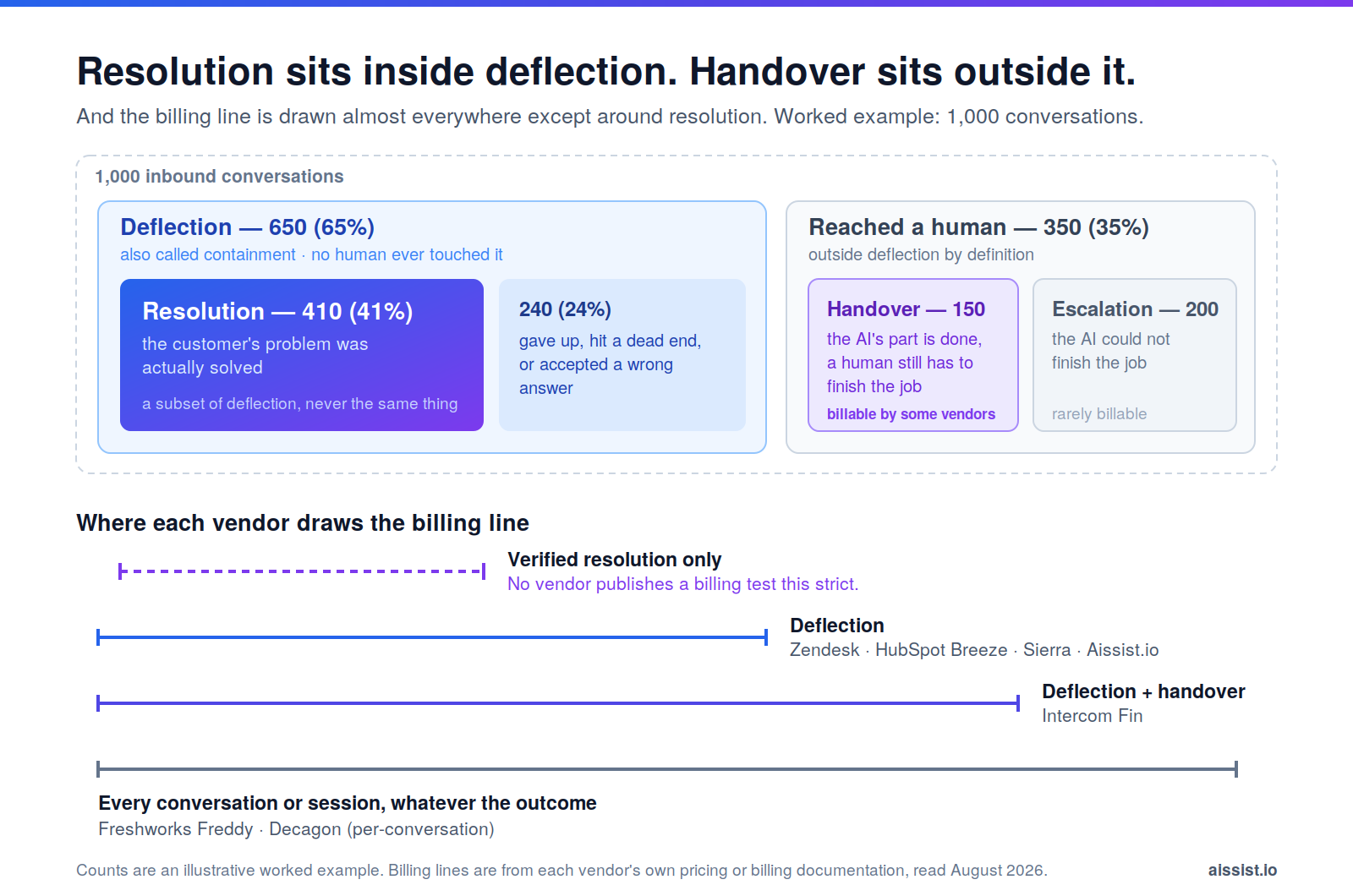
The one distinction that matters before any other is deflection versus resolution. Deflection counts conversations that never reached a human, including customers who gave up. Resolution counts conversations where the problem was actually solved. Aissist's deflection vs resolution analysis finds the gap runs 20–40 points on the same deployment. It also cites one customer's manual audit of 40 Intercom Fin tickets: 16 were marked resolved, and the reviewer judged 3 genuinely resolved.
Every automation rate in this article is a resolution rate. Vendor pages that quote a "containment" number are measuring something else.
Which tickets can be fully automated, and which cannot?
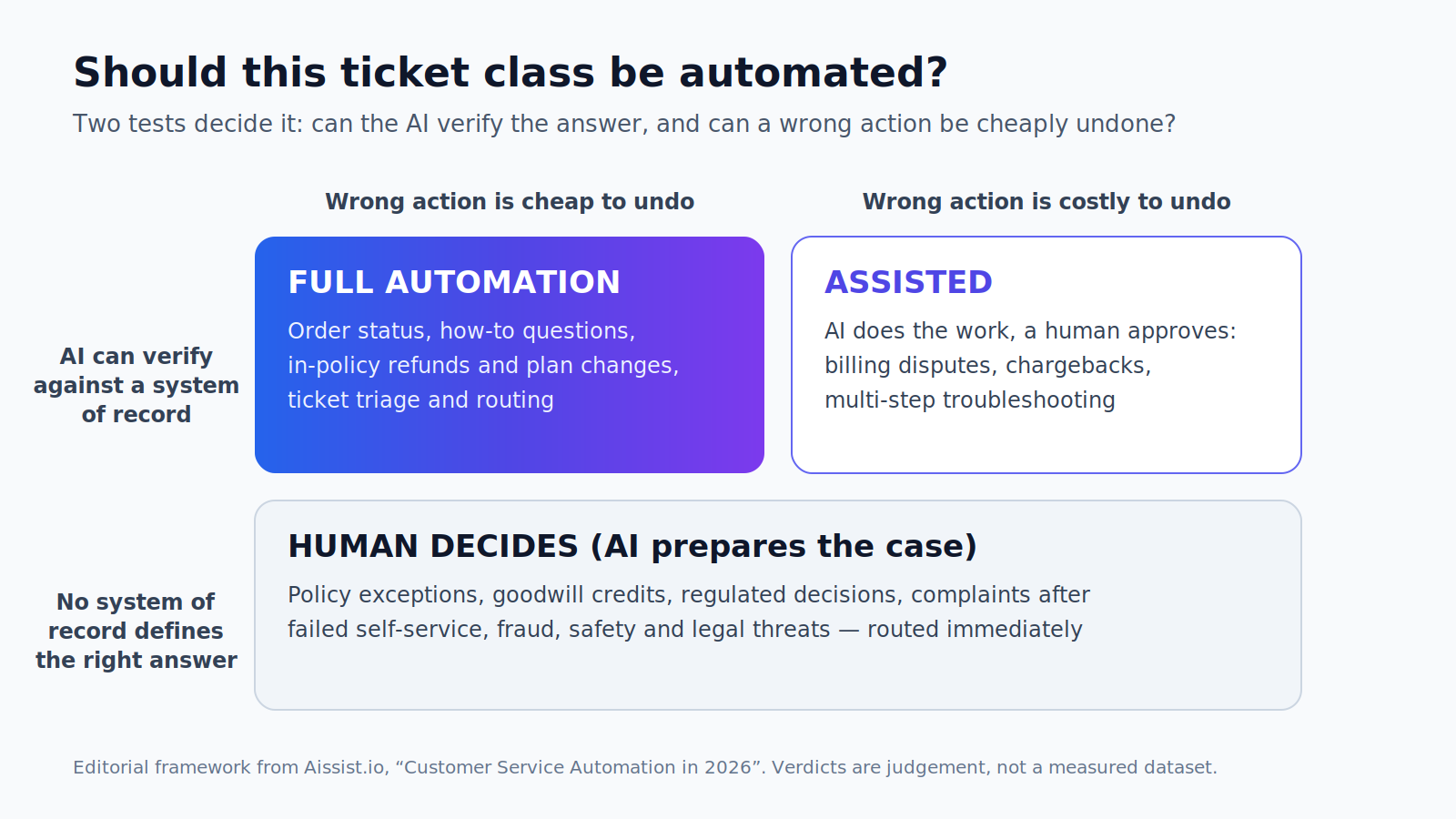
A ticket class can be fully automated when two things are true: the AI can verify the answer against a system of record, and a wrong action is cheap to reverse. When either is false, a human decides, and the AI prepares the case. There is no third category: a ticket is automated or it is human. What makes automation safe on harder work is not a halfway state but an escalation strategy, a defined way for the AI to hand over the cases it cannot finish.
That test explains results the "automate the repetitive stuff" advice cannot. Order status is repetitive and verifiable, and Aissist's benchmark shows order-status and billing questions resolving at 70–84%. A goodwill credit is also repetitive, but no system of record says whether this customer deserves one. Frequency tells you where the volume is. Verifiability and reversibility tell you where the automation is.
| Ticket class | Verdict | Why |
|---|---|---|
| Order status, tracking, delivery ETA | Automated | Read-only lookup against the order system; nothing to reverse |
| How-to and product questions | Automated | Verifiable against the knowledge base; a wrong answer is corrected in the next reply |
| Password reset, login help | Automated | Runs through the existing identity flow; the AI never holds the key |
| Refunds and returns inside policy | Automated, with a write action | Resolves only if the AI can issue the refund or label in the order and billing system |
| Plan changes, cancellations, address edits | Automated, with a write action | Same rule; without API access this becomes a form link, which is deflection |
| Ticket triage and intelligent routing | Automated | Tags, priority and queue are verifiable and trivially reversible |
| Multi-step technical troubleshooting | Automated, with an escalation strategy | Each step is verifiable against logs, device and account state, and a wrong suggestion is cheap to undo; the AI escalates on defined triggers with the steps tried and the evidence attached |
| Billing disputes and chargebacks | Human | Facts are checkable, but the decision moves money and creates a record; the AI assembles the evidence |
| Policy exceptions, goodwill credits | Human | No system of record defines the right answer |
| Complaints from customers who already tried self-service | Human | The customer's request is, in part, a human |
| Regulated decisions: credit, claims, KYC exceptions | Human | Wrong answers carry legal cost; the AI prepares the file |
| Fraud reports, safety issues, legal threats | Human, routed immediately | Cheap to route, very expensive to get wrong |
Troubleshooting is automated only with a proper escalation strategy. That means four things:
- Defined triggers. The AI escalates when a fix fails twice, when a needed log or screenshot is missing, when the error signature matches nothing known, when its confidence drops below a set threshold, or when the customer asks for a person.
- A complete handoff. The person receives the diagnosis so far, the steps tried and their results, the evidence collected and the suspected cause.
- No repeated questions. The customer is never asked again for anything the AI already collected.
- A clear promise. The customer is told a person is taking over and when to expect them, and the escalation lands in the right queue with an SLA.
Without those four, troubleshooting should be treated as human.
The two "with a write action" rows are where most deployments lose their numbers. An AI that explains the refund policy and links a form has deflected the ticket. An AI that issues the refund has resolved it. The difference is API access, not intelligence, which is why agentic AI for complex customer support is mostly an integration project wearing a model's name badge.
"Service leaders should not use GenAI as a mandatory first step for every issue." — Eric Keller, Sr Director Analyst, Customer Service & Support Practice, Gartner
What does not automate well?
Seven kinds of work resist customer service automation, and none of them are rare edge cases: they share either an answer the AI cannot verify or a mistake it cannot cheaply undo. Every competing guide lists what can be automated. This is the other half of the list.
- Customers who already failed at self-service. They arrive annoyed and already sure the bot cannot help. Gartner's 2024 survey of 5,728 customers found 64% would prefer companies not use AI for service, and the top concern was difficulty reaching a person.
- Decisions that cannot be taken back. Approving a large refund, waiving a contract term, agreeing to a price. These are cheap to automate and expensive to get wrong, which is the worst combination in the table.
- Policy exceptions. Policy is written down. Exceptions are judgement. An AI that grants them consistently is an AI that has rewritten your policy.
- Regulated judgements. Credit decisions, insurance claims, identity exceptions. Aissist's benchmark puts healthcare and insurance at 40–60% resolution, among the lowest bands, and much of that volume ends in a decision a person must sign.
- Problems with no ground truth yet. A new outage or an undocumented bug has no knowledge-base article. The AI's job is to detect the pattern and route it, not to improvise a fix.
- Ambiguous identity. If the system cannot confirm who the customer is, nothing that touches the account should be automated.
- Anything behind a system with no API. If the AI cannot write to the system of record, it can only describe the next step. That is deflection with better grammar.
Items 1 and 2 are the ones buyers underestimate. Klarna is the public example: after its AI assistant took on work it said equalled 700 agents, it began recruiting human agents again.
"As cost unfortunately seems to have been a too predominant evaluation factor when organizing this, what you end up having is lower quality." — Sebastian Siemiatkowski, CEO, Klarna, speaking to Bloomberg, as reported by CX Dive
Customers are not asking for no AI. Gartner's 2026 survey of 3,566 customers found 50% say GenAI makes interactions easier, and 87% say access to a human agent is essential. Both answers are the same answer: automate the verifiable work and keep the door to a person open.
What automation rate is realistic for your vertical?
Realistic customer service automation in 2026 ranges from 40–60% resolution in telecom, healthcare and insurance to 70–84% in ecommerce, according to Aissist's 2026 benchmark, with a cross-industry tier-1 median near 41%. The bands track the verdict table almost exactly: verticals heavy on lookups and in-policy actions automate more; verticals heavy on judgement automate less.
| Vertical | Realistic resolution band (2026) |
|---|---|
| Ecommerce and retail | 70–84% (best-in-class 93%) |
| Consumer fintech | 60–75% |
| SaaS and software | 50–70% |
| Marketplaces and platforms | 50–65% |
| Travel and hospitality | 45–70% |
| Telecom and utilities | 40–60% |
| Healthcare and insurance | 40–60% |
Source: Aissist AI Customer Service Benchmark 2026, compiled from 40+ public sources.
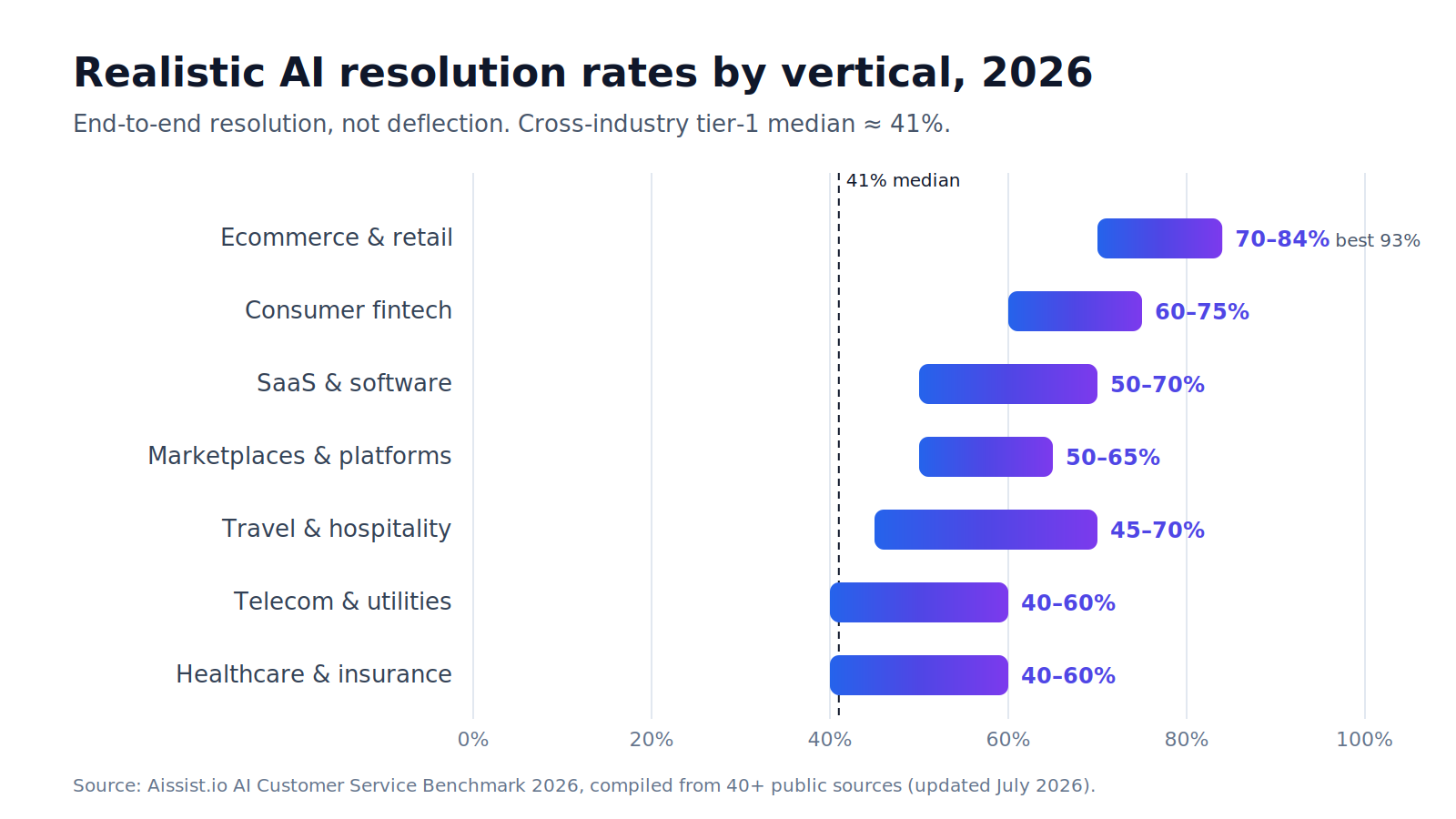
Time matters as much as vertical. The same benchmark finds new deployments launch at 40–50% and improve by roughly a point a month, reaching 60–67% when mature. A vendor quoting 80% in week one is quoting either a narrow scope or a deflection rate. Ask which.
Aissist's own published deployments sit inside these bands, which is the point. In fintech, Payphone reports 75% resolution at about $0.50 per resolution, and Weltrade 72%, both on Aissist's fintech benchmark page. In connected devices, Coros reports 82% across chat and email.
"The AI agents handle complex customer inquiries with human-like understanding, dramatically improving our support quality." — Mike Box, AI Lead, Coros, on Aissist's smart-device benchmark
Weltrade shows what a proper escalation strategy looks like in production. Its deployment reports 90% tier-1 automation with 25% structured handoff: the AI completes the steps it can, then escalates the case to a person with a summary and suggested next steps. That handoff is not a failure of automation. It is the escalation strategy doing its job, and it is how 90% tier-1 automation and 72% resolution can both be true of the same deployment. They measure different things.
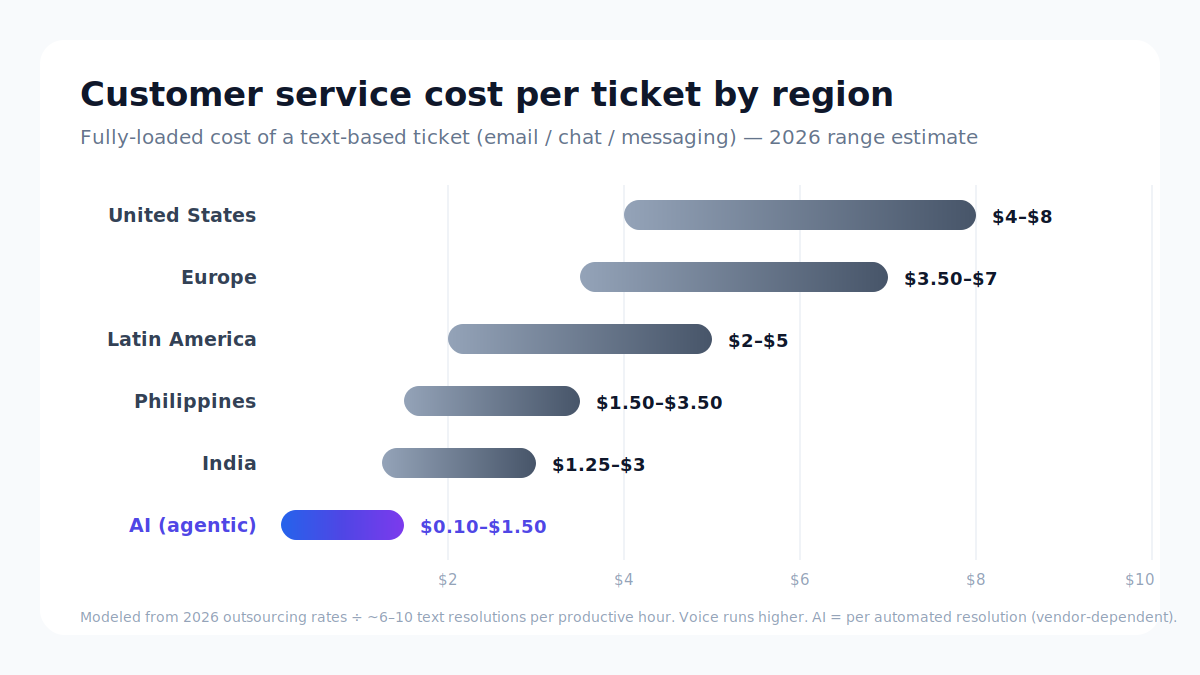
Cost follows the same split. Gartner's February 2024 cost benchmark, as cited in Aissist's cost-per-ticket guide, puts the median contact handled by a live agent at $13.50 against $1.84 for self-service. That gap is why automating the verifiable 60% matters more than chasing the last 20%.
What kinds of customer service automation tools are there?
Customer service automation tools fall into five categories, and the right one depends on where your tickets live and how many systems the AI must write to. A ranked roster of 15 products answers a different question. This is the map.
| Category | Examples | Best fit | Watch for |
|---|---|---|---|
| Helpdesk-native AI agents | Intercom Fin, Zendesk AI agents, Freshdesk Freddy AI, Gorgias AI Agent | Teams whose work lives inside one helpdesk | Write actions outside that helpdesk are often limited or metered |
| Standalone AI agent platforms | Aissist.io, Decagon, Sierra, Ada | Teams that need AI agents to resolve tickets across the helpdesk, order, billing and CRM systems | Pricing is usually quote only; judge them on resolution data, not containment |
| CRM-native agents | Salesforce Agentforce, ServiceNow CSM | Organisations already standardised on that CRM | Value depends on how clean the CRM data is |
| Contact-centre platforms (CCaaS) | Genesys Cloud CX, Five9, Talkdesk | Voice-heavy operations; routing at scale | Strongest at routing and IVR, less at end-to-end resolution |
| Build-your-own agent builders | Voiceflow | Teams that want to design every flow themselves | You own the maintenance |
Categories and examples from G2's customer service automation category and vendor sites, September 2026. Aissist appears in the standalone AI agent platforms row; this is our blog.
If you run one helpdesk and most tickets are questions, start with the helpdesk-native agent, because setup is shortest. If most of your volume is in the "with a write action" rows, choose a tool that can write to your order, billing and CRM systems, because that is where resolution comes from. If voice is the main channel, start with a CCaaS platform, because routing and telephony are the hard part.
Whichever category you pick, the playbook in help desk automation applies: baseline your current resolution rate, trial on your own tickets, and decide on results. Aissist is a standalone AI agent platform: its AI Operational Layer is built on AgentMesh™ for multi-agent resolution across the stack you already run.
Automation rate is a property of your ticket mix, not your vendor
The automation rate you will reach is set mostly by your ticket mix and your API access, not by which model or vendor you choose. Sort a month of tickets into the verdict table before you talk to anyone selling software. The share that lands in the "Automated" rows, including "with a write action" and "with an escalation strategy", is your realistic ceiling. The share in "Human" is the part to protect.
Plan for the curve, too: a deployment that starts in the low 40s and gains a point a month is on track, not failing.
Then ask each vendor two questions: can it write to the systems behind your top five intents, and does it report resolution or deflection? A vendor that answers both clearly is worth a trial. One that answers with a single percentage and a customer logo is worth a second call, at most.
Want to know your own ceiling before you buy anything? Aissist.io sorts a month of your tickets into automated and human, and designs the escalation strategy between them, on the helpdesk you already run. Book a consultation →
Frequently asked questions
What percentage of customer service can be automated?
Realistic end-to-end resolution in 2026 runs from about 40% to 84%, depending on vertical and maturity. Aissist's 2026 benchmark puts the cross-industry tier-1 median near 41%, the top quartile near 59%, and ecommerce at 70–84%.
What is automated ticket resolution?
Automated ticket resolution means an AI agent solves the customer's problem end to end, with no human handoff and no abandoned conversation. It usually requires the AI to take an action — a refund, a plan change, an address update — in the system of record, not just reply.
What is the difference between ticket triage and intelligent routing?
Ticket triage classifies an incoming ticket: intent, priority, language, sentiment. Intelligent routing uses that classification to send the ticket to the right queue, agent or AI workflow. Both are safe to fully automate because a wrong tag is visible and cheap to fix.
Will AI replace customer service agents?
AI is replacing tier-1 work, not the whole function. Gartner's 2026 survey found 87% of customers say human access is essential when companies use GenAI, and Klarna began rehiring human agents in 2025 after leaning heavily on AI.
How do I measure whether customer service automation is working?
Measure resolution rate, CSAT on AI-handled conversations, and repeat contacts within seven days. Aissist's benchmark finds AI-handled CSAT typically runs 5–10 points below human-handled, so a gap much wider than that points to over-automation.
Is customer service automation worth it for a small team?
Usually yes, if order lookups, how-to questions and in-policy changes make up most of the volume. Gartner's 2024 benchmark puts the median live-agent contact at $13.50 against $1.84 for self-service, so even a modest resolution rate pays back quickly.
Should angry customers ever be routed to AI first?
Generally no, when they have already tried self-service. Use AI to detect frustration, summarise the history and route to a person fast; Gartner's research found difficulty reaching a person is customers' top concern about AI in service.