Claude for Commerce: What It Is, and the Four Things That Will Decide Whether It Works
Claude for Commerce is a free, open-source starter kit from Anthropic, released on 2 September 2026. It gives engineering teams two ready-made agents — one for shoppers, one for store staff — plus the plumbing and safety rails to get them running in days instead of months. Eleven companies are named as launch partners, including Shopify, Visa, Mastercard and Accenture, per Anthropic's announcement (read September 2026). The code is on GitHub under Apache 2.0.
It is a skeleton to build on. It is not a finished product.
TL;DR:
- What it is: two reference agents (shopping + merchant), four worked examples, three ways to run them, free.
- Who joined: 11 named partners — payments, platforms, marketing data, one consultancy, three consumer brands. No end-to-end vendors.
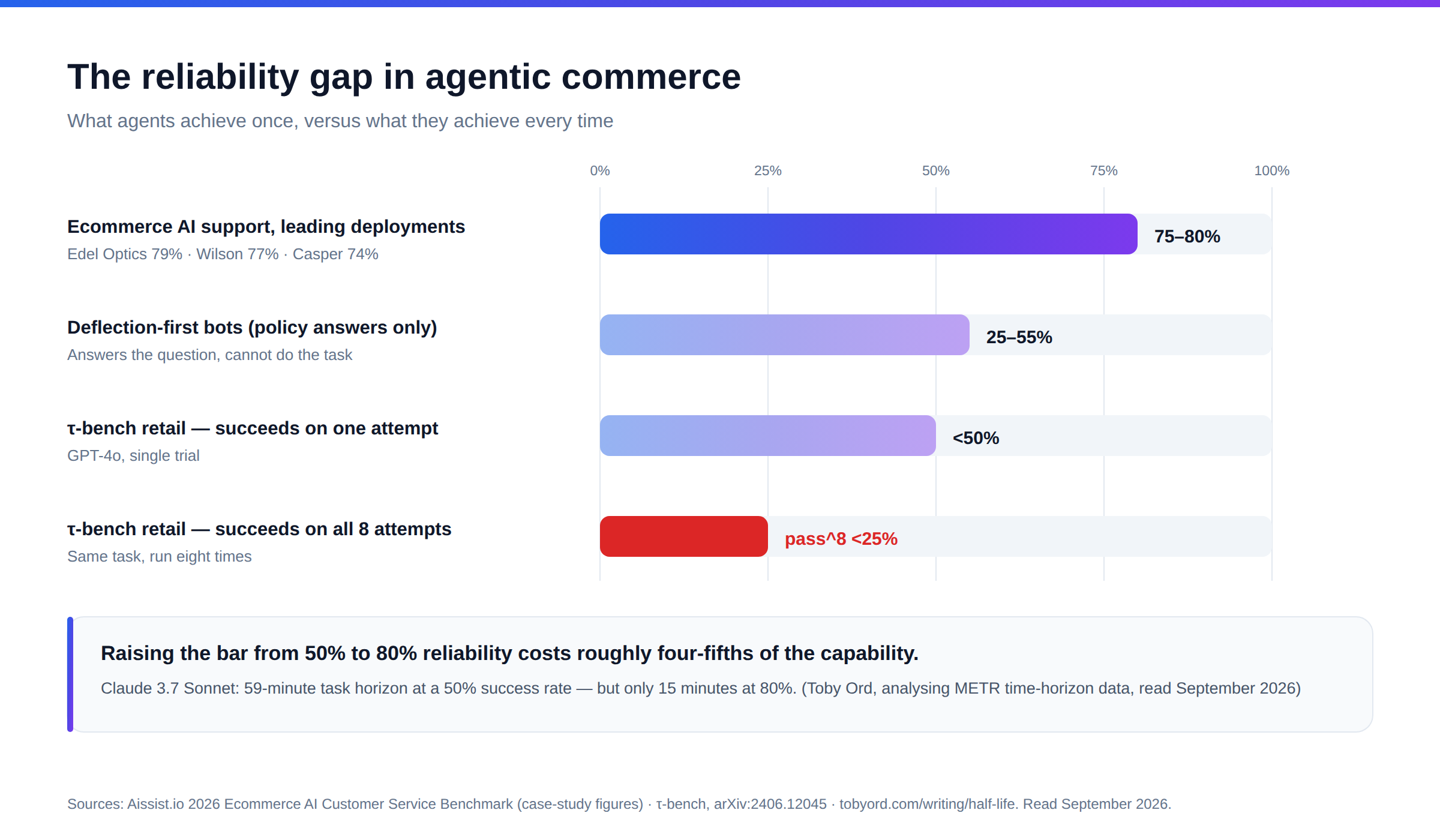
- Why ecommerce first: the tasks are narrow and the data is standard. Ecommerce AI support already hits 75–80% resolution in the best deployments (case-study figures, Aissist.io's 2026 Ecommerce AI Customer Service Benchmark, read September 2026).
- Four open problems: doing the same task right every time, speed on the shopper side, measurement on both sides, and an ecosystem made entirely of parts.
What is Claude for Commerce?
Claude for Commerce is a set of free reference implementations that show engineering teams how to build two kinds of commerce agent on Claude: one that talks to shoppers, and one that helps store staff run the shop. Anthropic published it on 2 September 2026 under an Apache 2.0 license. The README says plainly that it "is not maintained and does not accept contributions."
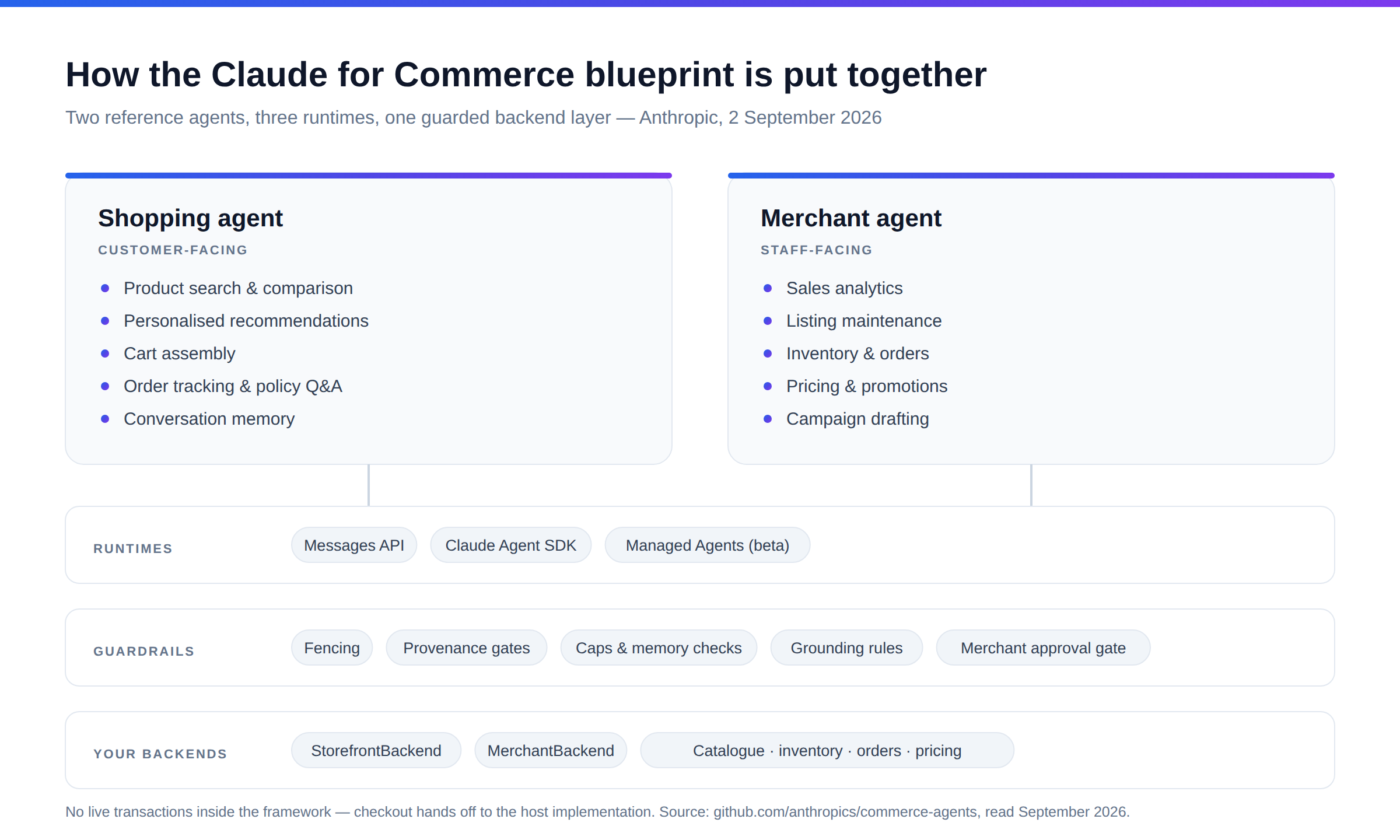
The shopping agent searches products, compares them, makes recommendations, builds a cart, tracks orders and answers policy questions. The merchant agent reads sales data, fixes listings, watches inventory, suggests prices and promotions, and drafts campaigns. Every change it wants to make is held for a human to approve first.
Four full examples ship with it: retail, travel, telecom and ticketing. Each one has both a shopper-facing store and a staff-facing back office, per the commerce-agents repository (read September 2026).
One thing it does not do is take money. No card is charged inside the framework — checkout is handed back to your own systems. That puts it in a different category from OpenAI and Stripe's Agentic Commerce Protocol, which is about standardizing the payment step itself.
How does Claude for Commerce actually work?
You get three ways to run the same agent — the Messages API, the Claude Agent SDK, or Managed Agents (in beta) — and one set of skills, connectors and safety rails that work across all three. You plug in your own catalog, inventory and order systems behind two interfaces named StorefrontBackend and MerchantBackend.
Each agent comes with five skills: catalog search, personalization, analytics, inventory, and campaign work. Managed Agents also get two MCP servers for the storefront and the back office. There are no ready-made connectors to Shopify or NetSuite. You wire up your own systems, and that is where most of the real work sits.
The safety layer is the more interesting half. The repo's docs/safety.md lists five controls: access fencing, provenance gates that track where data came from, caps and memory checks, grounding rules, and an approval gate on every merchant change. That last one is worth reading twice. Anthropic does not let the merchant agent write to a live system without a human clicking approve.
"Our engineers had a working commerce agent taking prompts within fifteen minutes."
— Dror Zalika, Head of Commerce at Wix, quoted on Anthropic's commerce solutions page (read September 2026)
Fifteen minutes to a working demo is real and impressive. Fifteen minutes to something you would point at live revenue is a very different number.
How many vendors have joined Claude for Commerce?
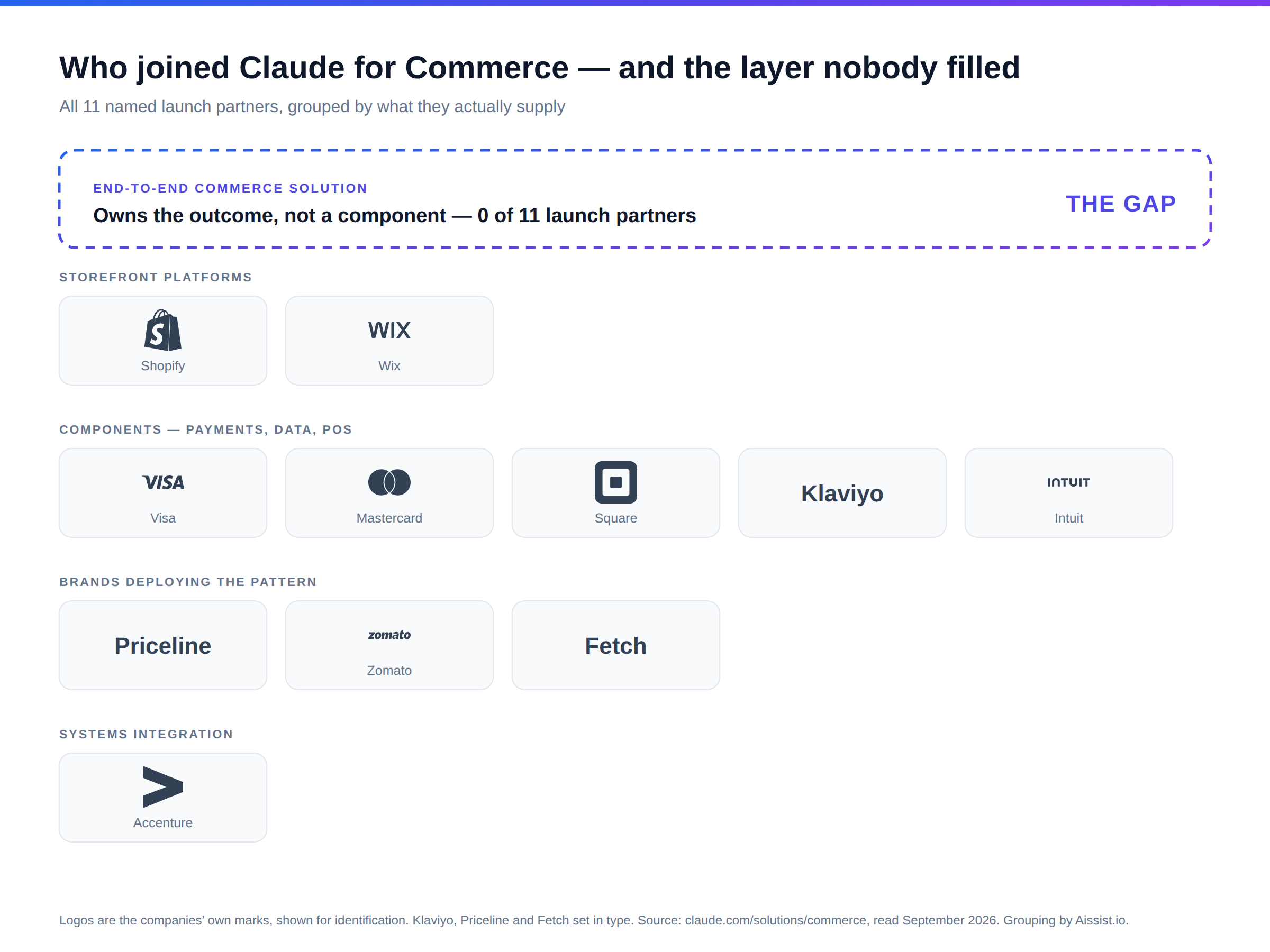
Eleven companies are named in Anthropic's launch: Shopify, Wix, Square, Visa, Mastercard, Klaviyo, Intuit, Priceline, Zomato, Fetch and Accenture. A twelfth, Vambe, appears on the solutions page but not in the announcement. There is no sign-up program and no growing vendor count. This is a launch partner list, not a network.
Press coverage has been inconsistent on the number, which tells you something. Some outlets named only Shopify. Others named only Accenture, Mastercard and Visa. Go to the primary source.
| Company | What they bring | Part or whole? |
|---|---|---|
| Shopify | Storefront platform | Platform |
| Wix | Storefront platform for small business | Platform |
| Square | Payments and point of sale | Part |
| Visa | Payment network and trust layer | Part |
| Mastercard | Payment network | Part |
| Klaviyo | Marketing and customer data | Part |
| Intuit | Financial data | Part |
| Priceline | Travel brand using the pattern | End brand |
| Zomato | Food delivery brand using it | End brand |
| Fetch | Loyalty brand using it | End brand |
| Accenture | Systems integration | Delivery |
Source: Anthropic's commerce solutions page, read September 2026. Grouping is Aissist.io's.
Read the right-hand column. The rest of this article turns on it.
Why is ecommerce the low-hanging fruit for agentic AI?
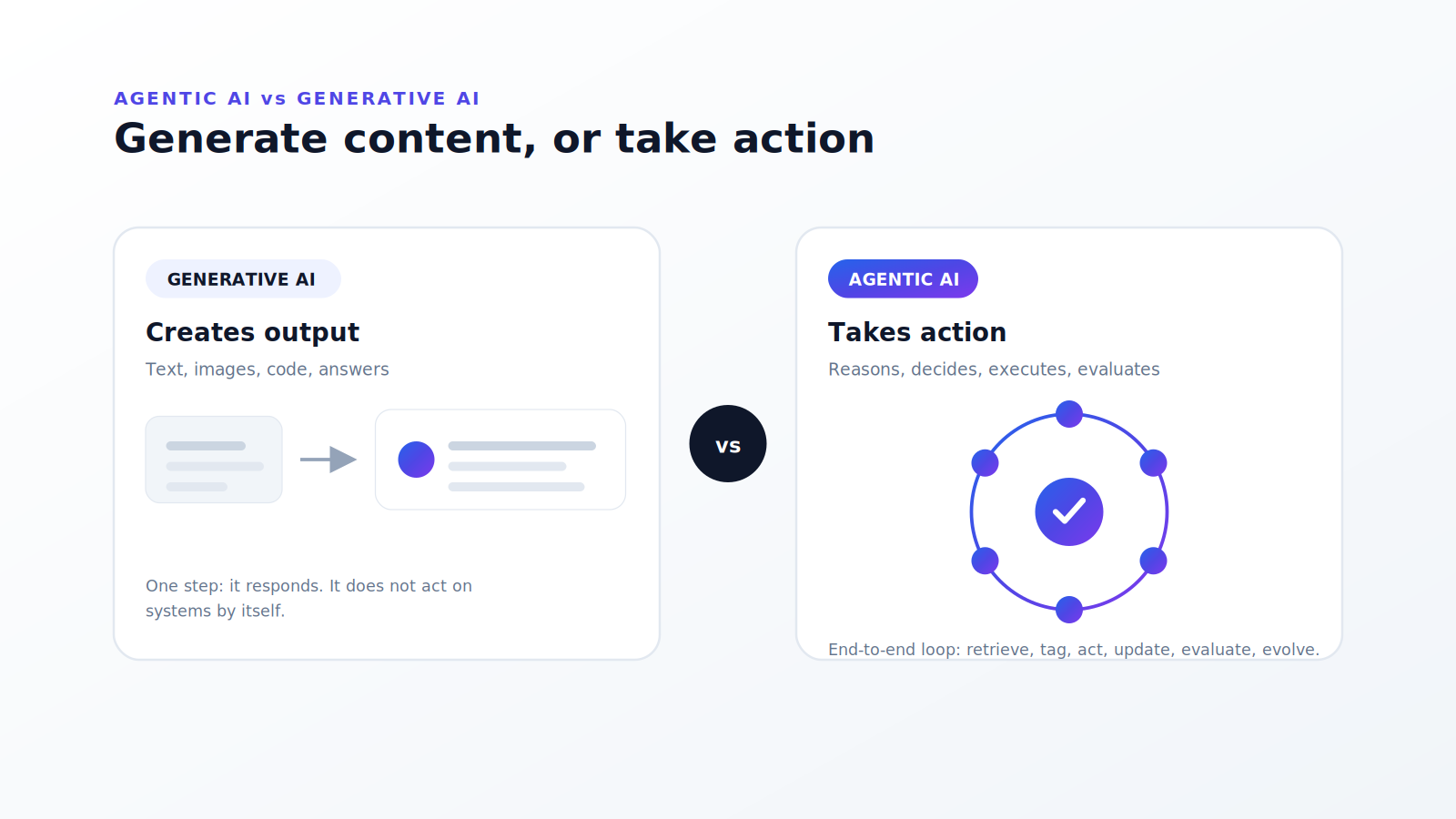
Ecommerce is the easiest place to start with agentic AI because its busiest tasks are narrow, repetitive, and sit on data that already looks the same everywhere. An order has a status. A return has a window. A refund has an amount. There is very little to interpret.
The automation numbers show it. The best ecommerce deployments reach 75–80% resolution — Edel Optics at 79%, up from 25%, Wilson at 77%, Casper at 74% — while bots built only to deflect stall at 25–55%. Those are case-study figures compiled in Aissist.io's 2026 Ecommerce AI Customer Service Benchmark (read September 2026). The same benchmark puts AI resolution at $0.60–$0.90 against $6–$13 for a ticket a person handles.
The benchmark is blunt about why the gap exists: "A bot that can only quote the returns policy stalls at the deflection band." Knowing the policy is not the job. Issuing the refund is.
So the low-hanging fruit is real, and Claude for Commerce reaches straight for it. The catch is that narrow and repetitive is exactly the kind of work today's agents are least consistent at. Which brings us to the awkward part.
Can commerce agents do the same routine task right every time?
Not yet — and the failure pattern runs backwards from what you would expect. Agentic AI is strongest on hard, unusual, many-step problems and weakest at doing one simple thing the same way a hundred times. In the tau-bench retail test, agents that can solve a task once succeed on all eight repeat attempts less than 25% of the time, per the τ-bench paper.
We see the same shape in production. An agent will reason its way through a genuinely tricky case nobody wrote a rule for, then fumble the address change it has done four hundred times. It is the swings, not the ceiling, that break an operation.
The independent evidence agrees. Looking at METR's time-horizon data, researcher Toby Ord found that Claude 3.7 Sonnet "could achieve a 50% success rate on tasks up to 59 minutes vs only 15 minutes if an 80% success rate was required" (independently reported, read September 2026). Ask for 80% reliability instead of 50% and you give up about four-fifths of the capability. In Vending-Bench, every model tested had runs that spiraled into "meltdown loops" — and it had nothing to do with running out of context.
One of Anthropic's own partner quotes says the quiet part out loud:
"We ran the Claude Code workflow twice and got two different architectures back, each designed to what we'd asked for."
— Ashley Nader, Staff Product Manager at Fetch, quoted on Anthropic's commerce solutions page (read September 2026)
Two good answers is a lovely feature in a design tool. It is a hazard in a refund workflow.
This is an old machine learning trade-off in new clothes
You are looking at the trade-off between how widely a system can generalize and how predictable it is — the agentic version of the bias–variance trade-off every ML practitioner already knows. A model flexible enough to handle the case nobody planned for is, by design, a model that can take a different route through the case you planned for perfectly.
Prompting harder does not fix this. Narrowing the choices does. Use fixed tools instead of open reasoning for routine work. Ground answers in retrieved data instead of model memory. Hold writes behind approval. Add a checking layer that reads the output against policy before it goes out.
That is the four-layer approach Aissist.io describes in reliable AI: prompt guardrails, repeat runs to compare, self-inspection, and a policy layer sitting on top. It is what turns a capable model into something an operations team will sign off on, and it is why evaluable AI matters more than a headline benchmark score. Anthropic's merchant approval gate is the same instinct, built at the simplest possible level.
How fast does a shopping agent have to be?
Shopper-facing agents have a speed budget that most agent designs blow straight through. Back-office agents barely have one at all. Google's data puts mobile abandonment at 53% when a page takes more than three seconds. An agent that plans, calls four tools and rereads its own work measures a turn in tens of seconds.
The infrastructure news is not encouraging either. Writing for The New Stack, Jon Alexander, Senior Vice President of Product for the Cloud Technology Group at Akamai, reports that 82% of organizations need end-to-end responses in 500ms or less, 64% need under 250ms for critical uses, and half of deployments miss those targets at peak load (read September 2026). His point: more GPU does not help, because the delay comes from network hops and orchestration, not from generating tokens.
The useful insight is the gap between the two sides:
| Surface | Realistic wait tolerance | Verdict |
|---|---|---|
| Merchant agent (back office) | Seconds to minutes — a staff member running a pricing report will wait | Ship it |
| Shopping agent (browse and compare) | 2–5 seconds, with visible progress | Worth experimenting |
| Shopping agent (checkout step) | Under a second | Keep the agent out of the path |
If you are testing on the shopper side, measure time to first word separately from time to final answer, and stream something readable while the tools run. A shopper will forgive an agent that is thinking. They will not forgive a blank box.
How do you measure a commerce agent's performance?
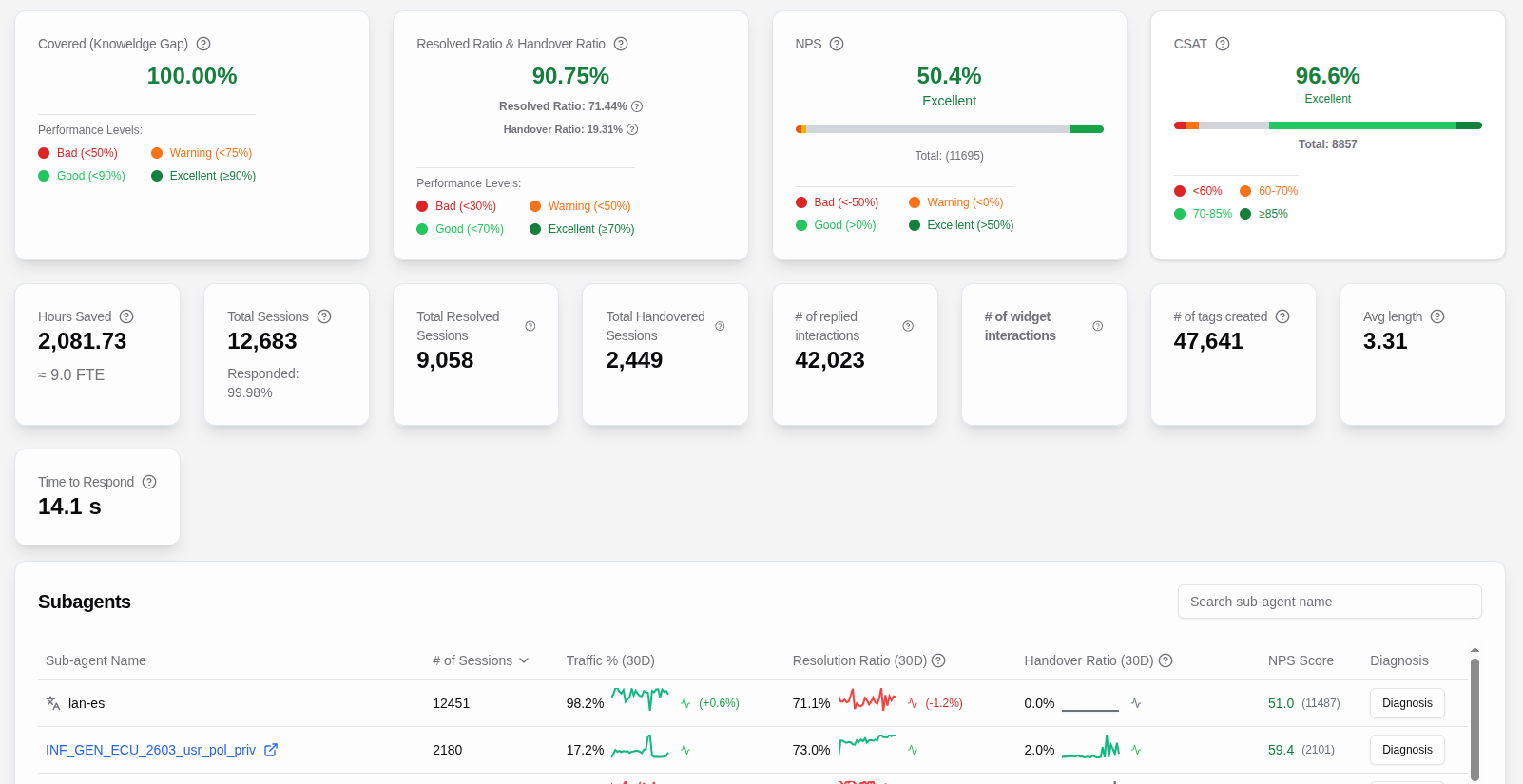
Measurement is the second unsolved problem, because the shopper side and the merchant side need completely different metrics, and almost nobody publishes either. Anthropic says retailers using Claude-powered agents see carts up to 35% larger and shoppers 60% more likely to finish a purchase (vendor-claimed, Anthropic, read September 2026), and that Vambe reports 40% higher conversion for small businesses selling through sales agents (vendor-claimed, same source).
Those are sales numbers. They say nothing about whether the agent was right.
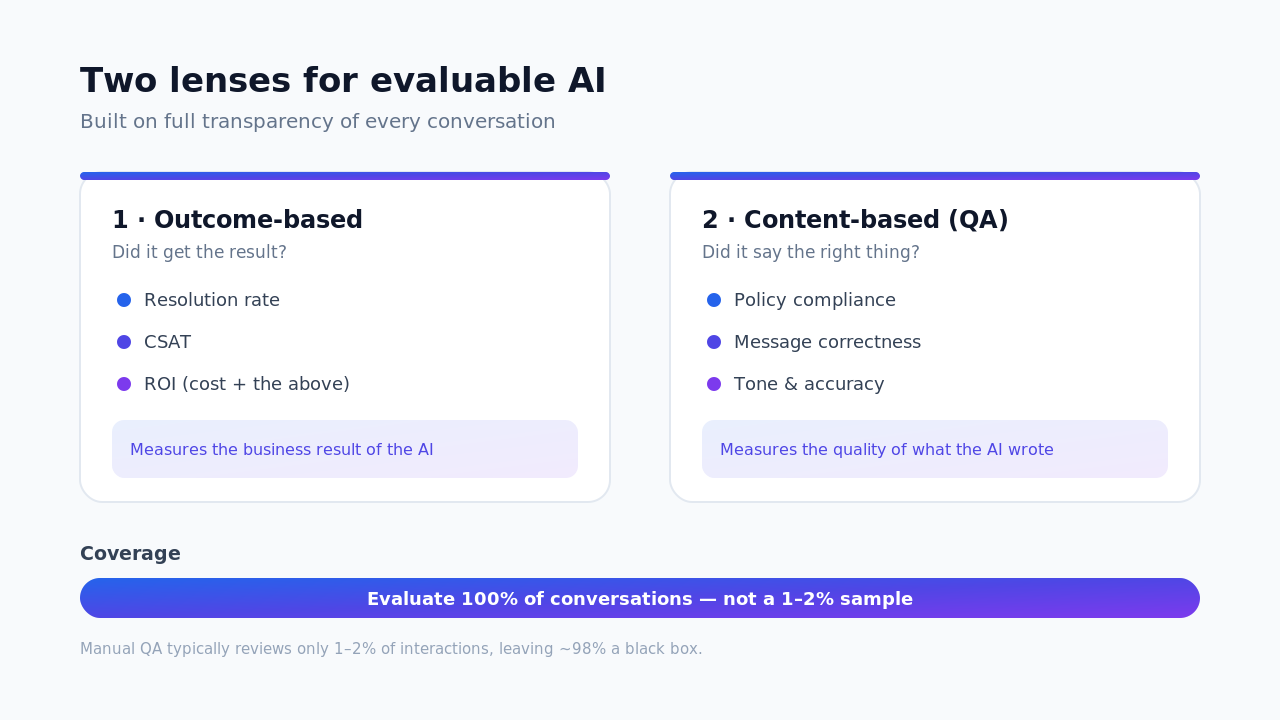
| Side | What to measure | Why the obvious metric fails |
|---|---|---|
| Shopper | Task completion, first-contact resolution, CSAT, escalation rate, time to first word | Sales can go up while accuracy goes down — a persuasive agent is not a correct one |
| Shopper | Pass rate across eight runs of your top 20 routine journeys | One good demo run tells you nothing about the hundredth |
| Merchant | Suggestion acceptance rate, corrections after approval, time saved per task | Approval gates hide errors — a rejected suggestion still cost someone the review |
| Both | Cost per resolved task, not cost per call | Multi-step agents make per-call pricing meaningless |
The number almost nobody publishes is the one that matters most: how often the agent gets the same task right every single time. Run your twenty busiest journeys eight times each and count how many pass all eight. That is your real automation rate, and it usually sits well below the demo. For the money side of the same question, see how to measure the true ROI of agentic AI.
Is the Claude for Commerce ecosystem missing end-to-end vendors?
Yes, and it is the most interesting gap in the whole launch. Of the eleven named partners, eight supply a component or are a brand using the pattern, one is a consultancy, two are storefront platforms — and none sells assembled, end-to-end commerce automation. Payments, marketing data, financial data and point of sale are all covered. The layer that turns those parts into a working operation is not.
That leaves the assembly job with the retailer, or with Accenture. For a mid-market merchant with four engineers, "here is an unmaintained reference implementation and eleven components" is not a solution. It is a project plan.
This is a competitive risk for Anthropic as much as an opening for everyone else. A blueprint with no solution layer turns into live deployments slowly. Slow is dangerous in a market where OpenAI and Stripe are shipping a payment protocol and Google is pushing AP2. That is how a strong technical position becomes a footnote.
Retail commentator Scot Wingo, writing at Retailgentic (read September 2026), calls the merchant agent "toy"-like for now, while noting that roughly 200 companies building shopping agents for retailers now face a free reference implementation.
So the thing to watch over the next two quarters is not model quality. It is whether a solution layer forms on top of this blueprint — vendors who own the outcome rather than a part — and whether Anthropic helps that happen or leaves it to the market.
Key takeaways
Claude for Commerce is a credible starting point aimed at the right target: the narrow, structured, high-volume tasks that make ecommerce the easiest place to put agentic AI to work. Eleven named partners give it real weight, and the safety design — staged writes, provenance gates, approval on every merchant change — is more honest than most vendor demos.
Four questions are still open: doing the same task right every time, speed on the shopper path, measurement on both sides, and an ecosystem made entirely of parts. None of these are model problems. All of them are systems problems, which means they can be solved — by whoever decides to own the end-to-end layer this launch so clearly lacks.
We will declare the bias up front: end-to-end resolution is the layer Aissist.io builds. It is also why the gap was the first thing we noticed.
Curious what the end-to-end layer looks like on your stack? See agents resolve real ecommerce tickets — orders, returns, refunds — not just answer questions about them. Book a free demo →
Frequently asked questions
What is Claude for Commerce?
Claude for Commerce is a free, open-source blueprint Anthropic released on 2 September 2026. It contains two reference agents — one for shoppers, one for store staff — plus skills, runtimes and safety rails. It ships with four worked examples and is explicitly not maintained by Anthropic.
How many vendors have joined Claude for Commerce?
Eleven companies are named in Anthropic's announcement: Shopify, Wix, Square, Visa, Mastercard, Klaviyo, Intuit, Priceline, Zomato, Fetch and Accenture. A twelfth, Vambe, appears on the solutions page. There is no sign-up program or growing vendor count — it is a launch partner list.
Is Claude for Commerce free?
Yes. The commerce-agents repository is published on GitHub under Apache 2.0 at no cost. You still pay for Claude usage through the Claude API, Amazon Bedrock, Microsoft Foundry or Google Cloud Vertex AI, plus the integration work to connect your own catalog and order systems.
Does Claude for Commerce handle payments or checkout?
No. The blueprint runs no live transactions — checkout hands back to your own systems and no card is charged inside it. That makes it different from OpenAI and Stripe's Agentic Commerce Protocol, which standardizes the payment step itself.
Why does agentic AI fail on simple repetitive tasks?
Because flexibility and consistency pull against each other. A model that can reason through a new case can also take a different route through an identical one. In the tau-bench retail test, agents get all eight repeat attempts right less than 25% of the time, even when they succeed on one try.
How do you make a commerce agent reliable enough to deploy?
Narrow its choices. Use fixed tools for routine tasks, ground answers in retrieved data rather than model memory, hold every write behind approval, and add a layer that checks output against policy before release. Then measure repeat-run success on your own journeys, not a demo.
Is latency a problem for AI shopping agents?
On the shopper side, yes. Google reports 53% of mobile visitors leave after three seconds, while multi-step agents often take tens of seconds. Back-office merchant agents face almost no time pressure. Stream partial output on anything a customer sees.
What should retailers watch next in agentic commerce?
Watch whether a solution layer forms on top of the blueprint. The eleven launch partners cover payments, platforms and data, but none sells assembled commerce automation. That leaves integration to retailers or consultancies, which slows adoption against competing standards.